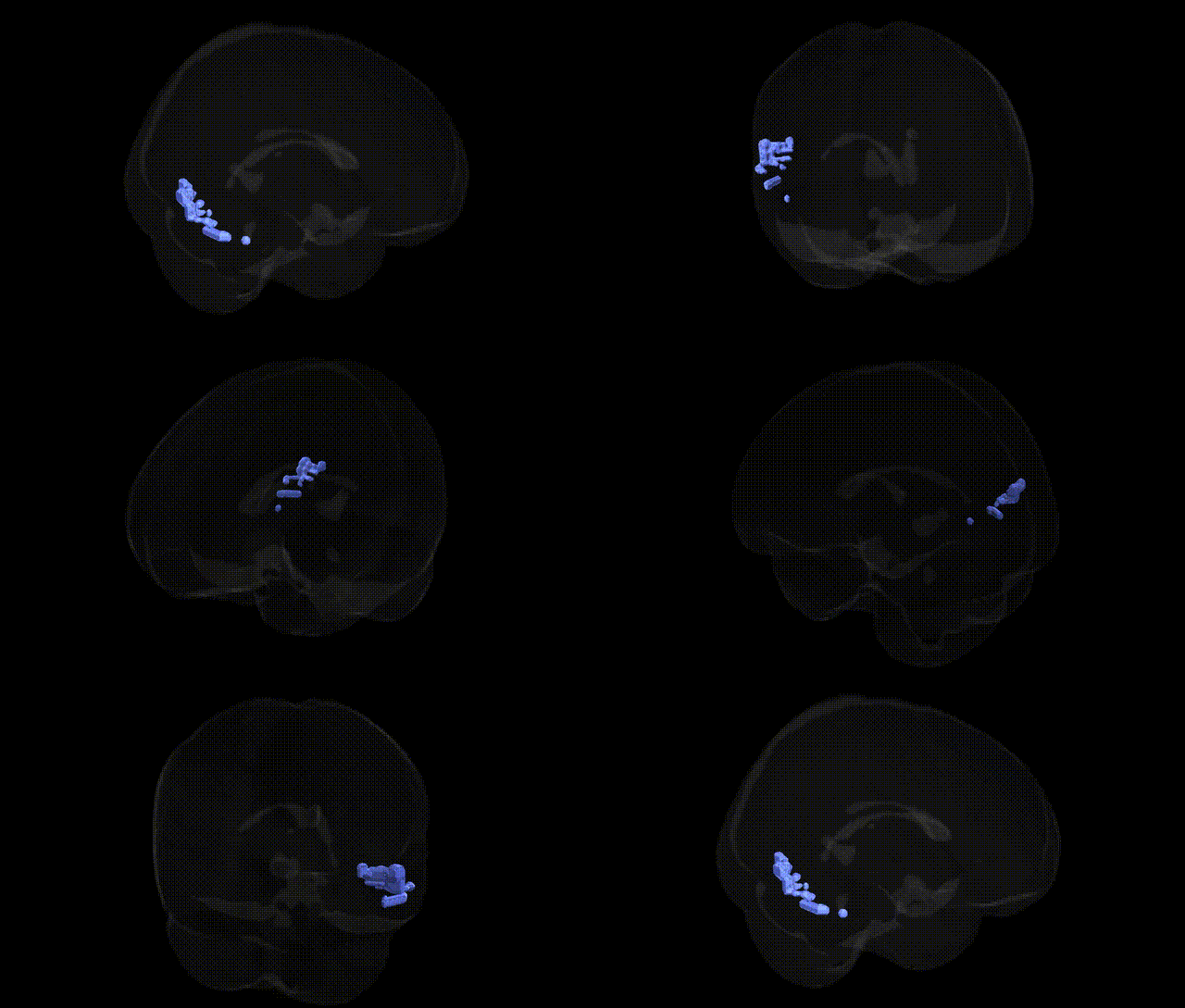
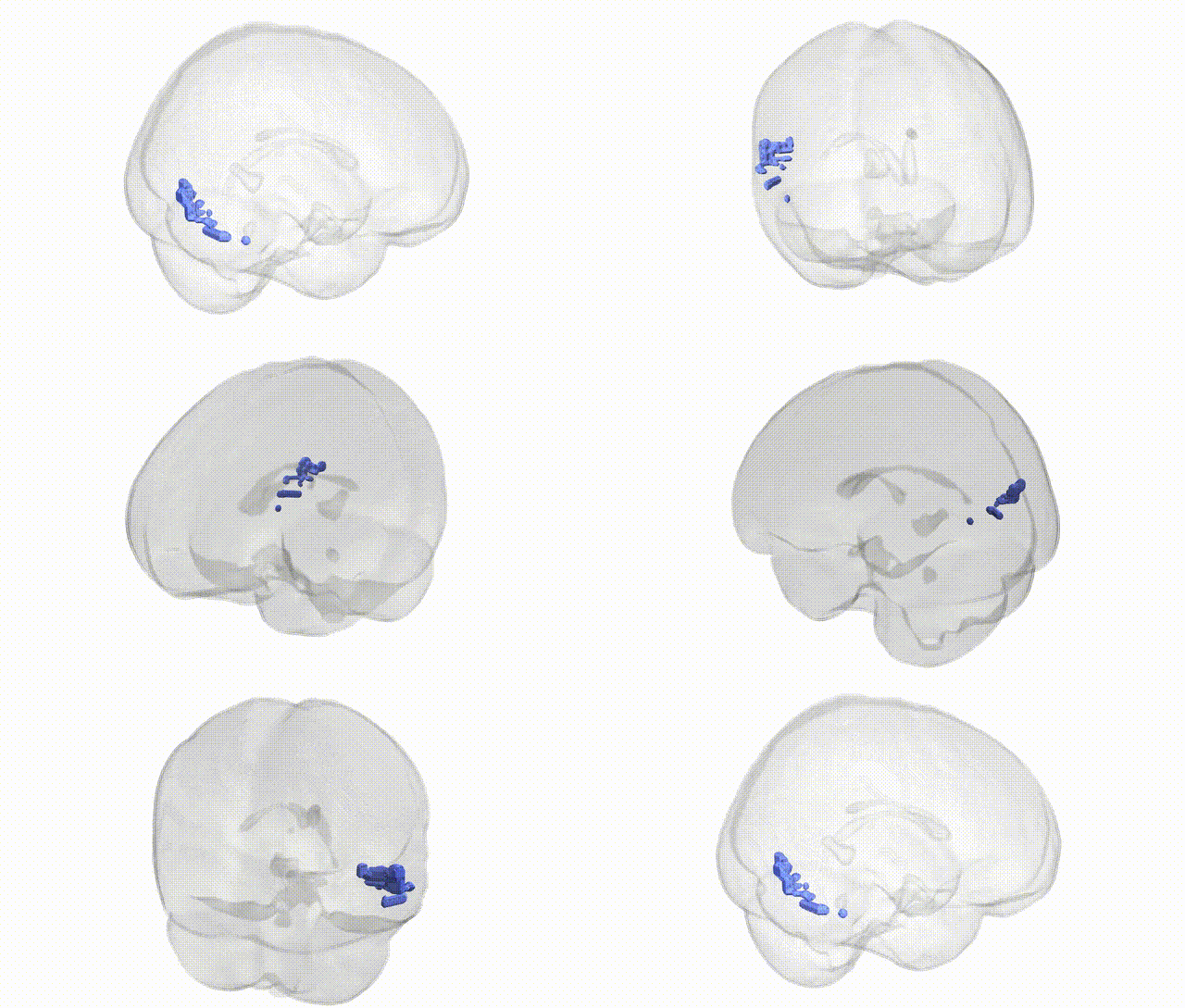
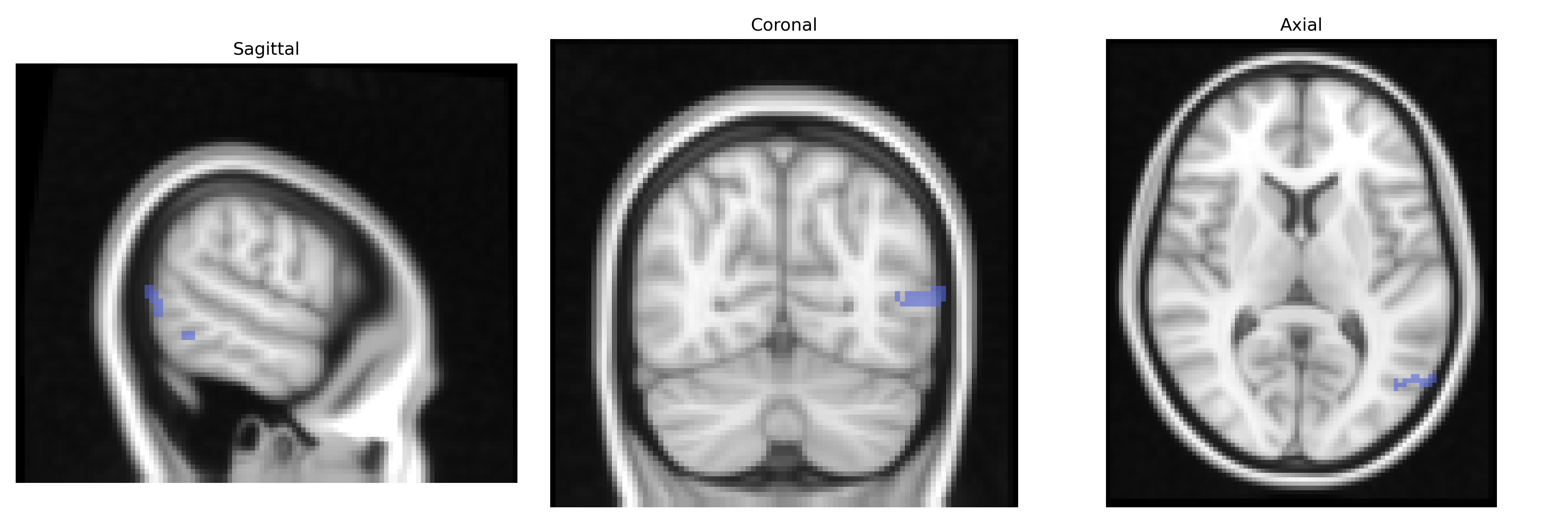
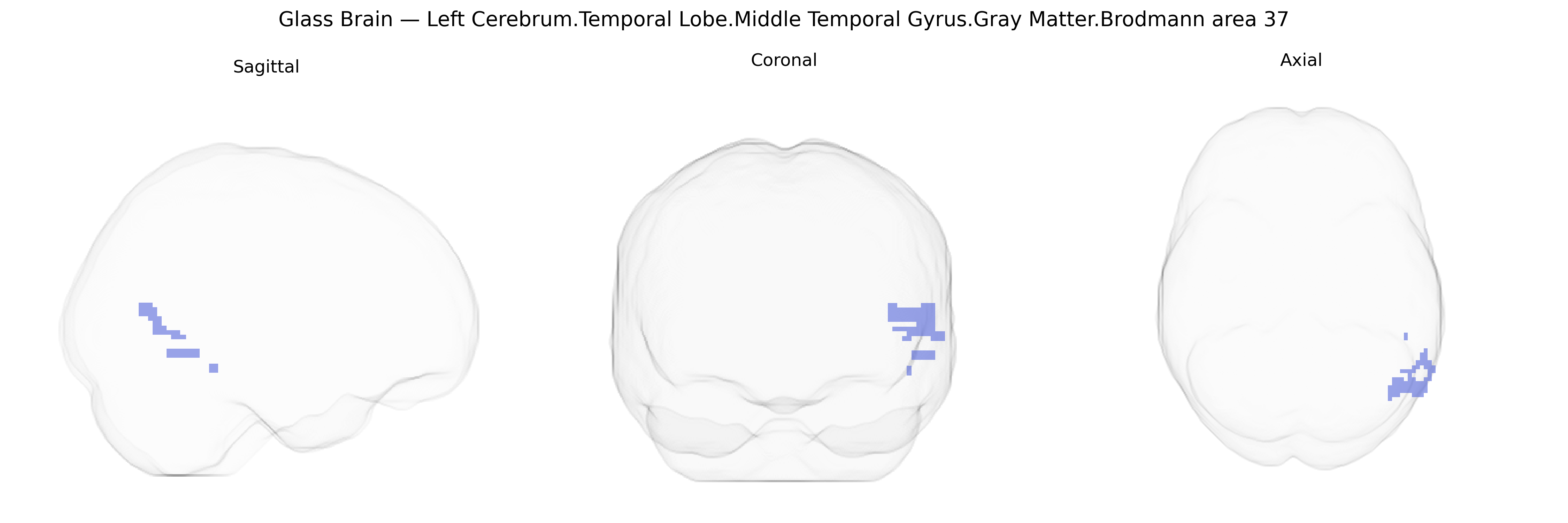
Bilateral Left Cerebrum.Temporal Lobe.Middle Temporal Gyrus.Gray Matter.Brodmann area 37 corresponds primarily to the left fusiform and adjacent inferior temporal regions implicated in high-level visual processing and multimodal integration. This region participates in object and face recognition, visual word form processing, and the mapping of complex visual stimuli onto stored semantic representations, making it crucial for recognizing and categorizing meaningful visual patterns such as words, faces, and familiar objects. BA37 is heavily interconnected with occipital visual cortices, other temporal association areas, and language-related regions, supporting functions that bridge perceptual analysis with memory and language systems. There is no direct link for this exact Talairach label; a closely related structure is the fusiform gyrus: Fusiform gyrus.
The bilateral left Middle Temporal Gyrus gray matter in Brodmann area 37, a key component of the ventral visual and language pathways, has been implicated in multiple genetic and GWAS-based associations, particularly for reading, language, and neurodevelopmental traits. Polygenic influences on cortical surface area and thickness in temporal regions, including BA37, have been mapped in large imaging-genetics studies (e.g., ENIGMA and UK Biobank), with common variants near genes such as MAPT, KIAA0586, and DPP4 among others contributing to temporal lobe morphology. BA37 has shown structural and functional alterations in dyslexia and language impairment, with genetic risk loci in FOXP2, DCDC2, KIAA0319, and CNTNAP2 associated with reading and phonological processing abnormalities that often involve this region’s activation patterns. In autism spectrum disorder and schizophrenia, GWAS-implicated risk genes involved in synaptic function and neuronal development (e.g., GRIN2A, NRXN1, SHANK3) map to distributed cortical networks that include BA37, where atypical activation and gray-matter volume changes are frequently observed in social cognition and semantic processing tasks. Alzheimer’s disease risk variants (notably APOE ε4 and loci such as BIN1 and CLU) and polygenic risk scores for neurodegeneration have also been associated with accelerated atrophy and connectivity disruption in temporal cortices, including BA37, consistent with its role in higher-order visual recognition and semantic memory. Overall, genetic influences on language, reading, social cognition, and neurodegenerative risk converge on networks in which left BA37 is a critical node, and imaging-genetics work supports a polygenic architecture underlying its structure and function rather than single-gene specificity.
Overview generated by GPT-4o (2026).
Region ID: 269
Hemisphere: bilateral
Atlas: Talairach labels 2mm
Full Quality Version: Download MP4
Full Quality Version: Download MP4
Wali Sidiqyar*, Gaurav Rudravaram*, Elyssa M. McMaster, Trent M. Schwartz, Adam M. Saunders, Kurt G. Schilling, Bennett A. Landman "Introducing SPINS: A Shared Public Visualization Library of Neuroanatomical Structures." Medical Imaging with Deep Learning- short paper
This resource is licensed under CC0 1.0 Universal (Public Domain).