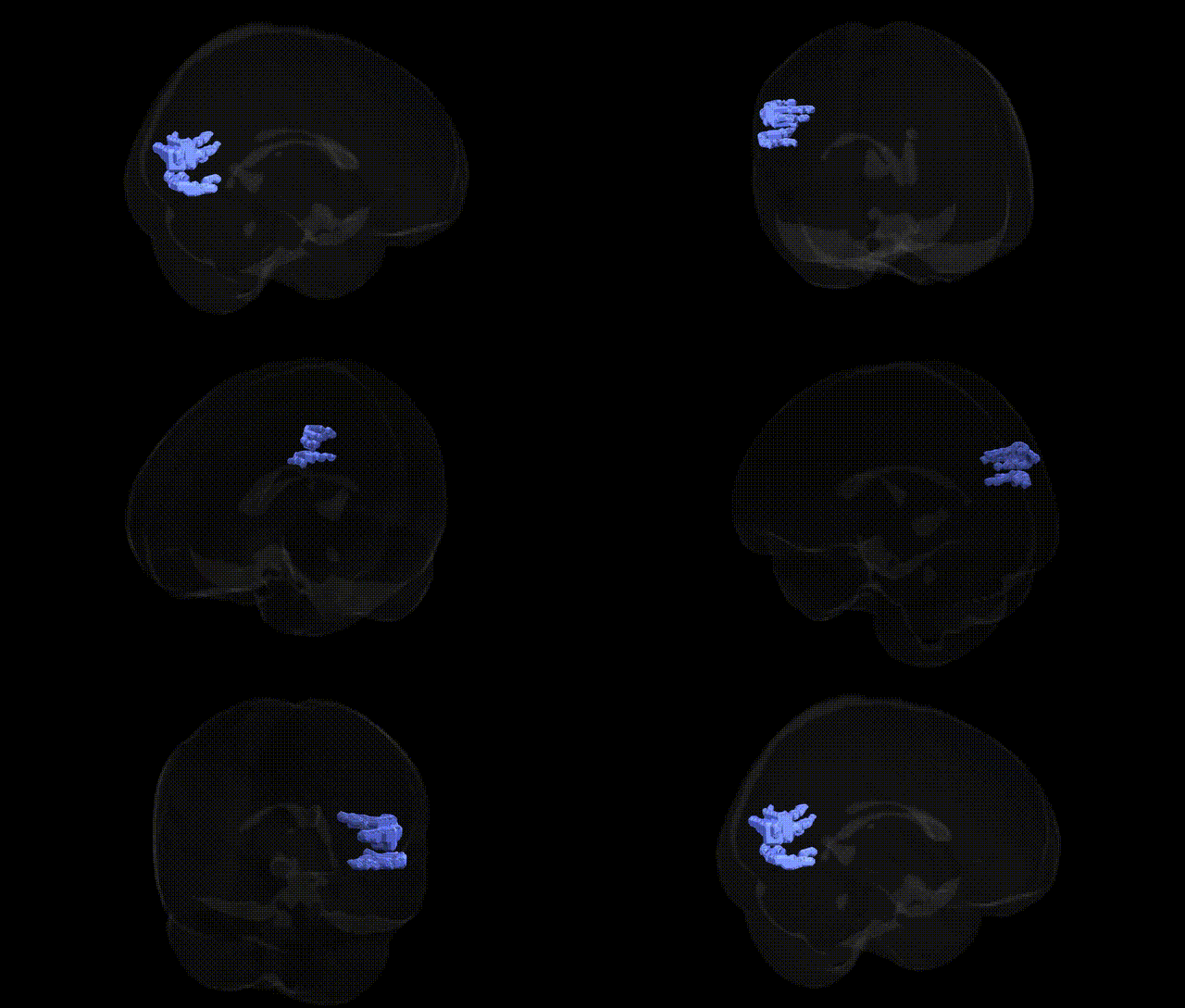
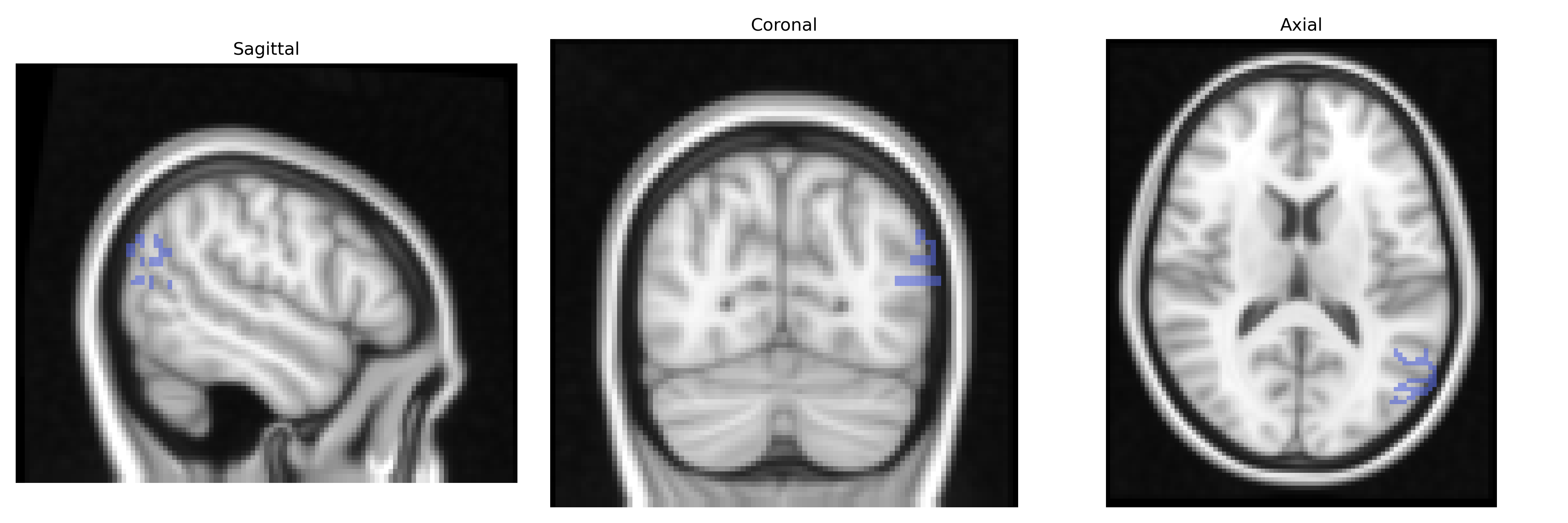
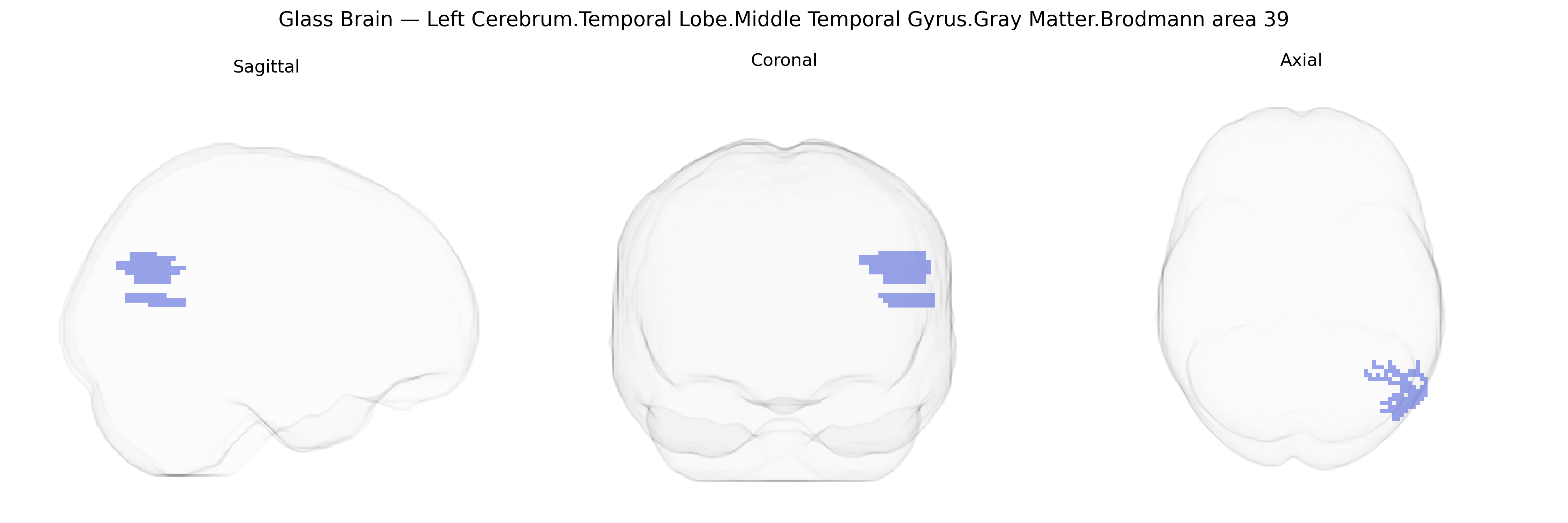
The bilateral Left Cerebrum.Temporal Lobe.Middle Temporal Gyrus.Gray Matter.Brodmann area 39 corresponds to the left angular gyrus region, located at the posterior part of the middle temporal gyrus extending into the inferior parietal lobule near the temporo‑parietal junction. Cytoarchitectonically defined as Brodmann area 39, this cortical field is involved in complex multimodal integration, including language-related functions (reading, semantic processing), spatial cognition, number processing, and aspects of episodic memory retrieval. It receives convergent inputs from visual, auditory, and somatosensory association areas and participates in high-order conceptual and symbolic processing, making it a critical node in the brain’s default mode and language networks. Angular gyrus
The bilateral left middle temporal gyrus gray matter in Brodmann area 39 (angular/supramarginal region within the temporal–parietal junction) has been implicated in several genetic and GWAS findings through its roles in language, semantic processing, and social cognition. Imaging genetics and GWAS of cortical thickness and surface area have associated common variants in genes involved in neurodevelopment and synaptic function (e.g., HMGA2, microtubule and cell-adhesion pathways, and multiple intergenic loci) with structural variation in temporal and temporoparietal regions encompassing BA39. Language- and dyslexia-related GWAS and candidate-gene studies link variants in FOXP2, DCDC2, KIAA0319, and CNTNAP2 to altered structure or activation in left temporoparietal language areas, including the middle temporal gyrus. Large consortia, such as ENIGMA, have reported heritable differences in temporal lobe morphology associated with psychiatric risk loci (e.g., CACNA1C, ZNF804A, DRD2) that also relate to schizophrenia, bipolar disorder, and major depression, where BA39 participates in language, auditory-verbal processing, and social-cognitive networks. Autism spectrum disorder risk genes affecting synapse formation and axon guidance (such as SHANK3, NRXN1, and CHD8) have been connected to atypical development and functional connectivity in temporoparietal junction and BA39, particularly in theory-of-mind and social communication tasks. Additionally, GWAS of educational attainment and general cognitive ability identify polygenic influences on left temporal and temporoparietal gray matter, linking distributed variants in neurodevelopmental and transcriptional regulation pathways to BA39 structural and functional differences that contribute to language, reading, and higher-order cognitive performance.
Overview generated by GPT-4o (2026).
Region ID: 703
Hemisphere: bilateral
Atlas: Talairach labels 2mm
Full Quality Version: Download MP4
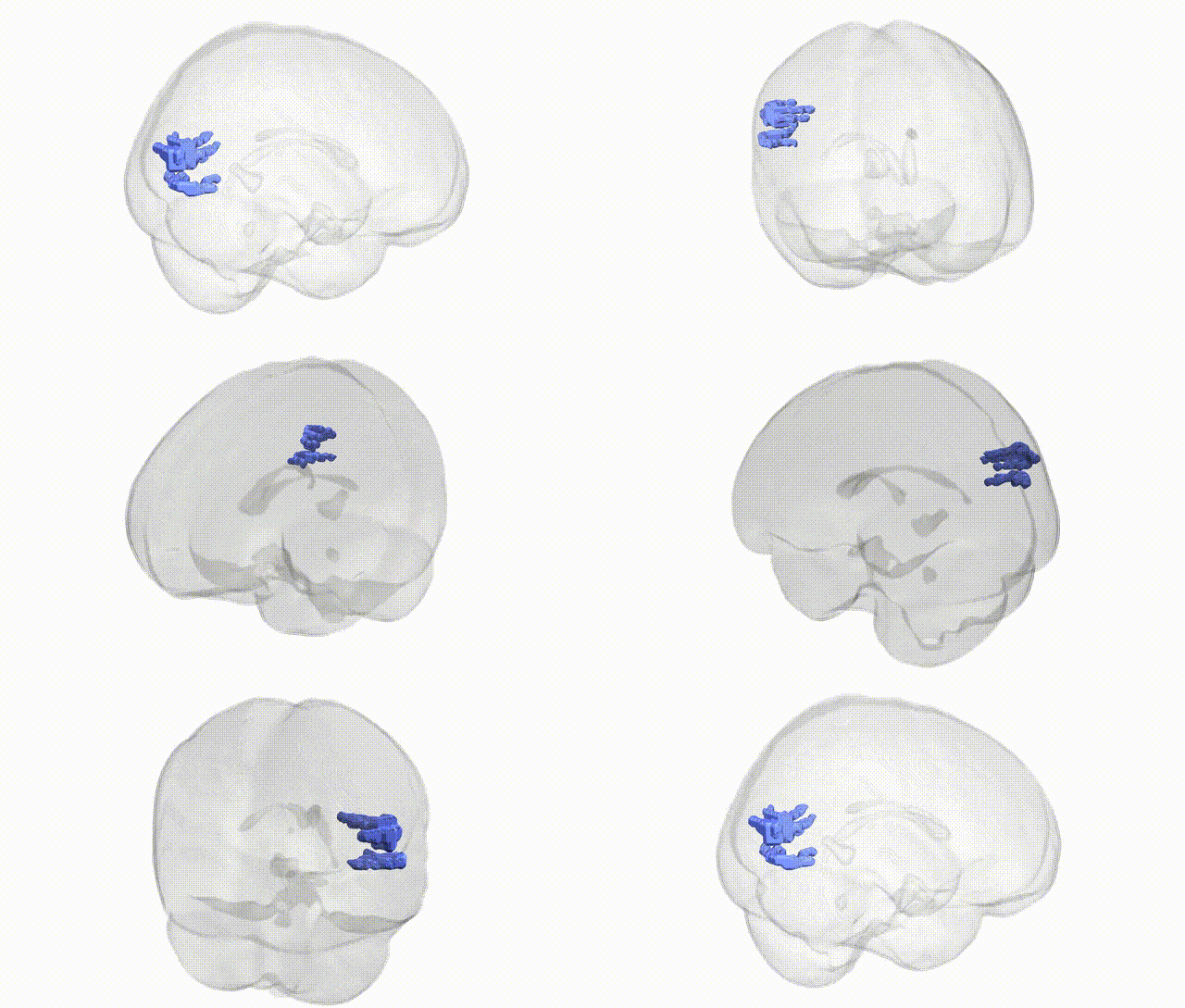
Full Quality Version: Download MP4
Wali Sidiqyar*, Gaurav Rudravaram*, Elyssa M. McMaster, Trent M. Schwartz, Adam M. Saunders, Kurt G. Schilling, Bennett A. Landman "Introducing SPINS: A Shared Public Visualization Library of Neuroanatomical Structures." Medical Imaging with Deep Learning- short paper
This resource is licensed under CC0 1.0 Universal (Public Domain).