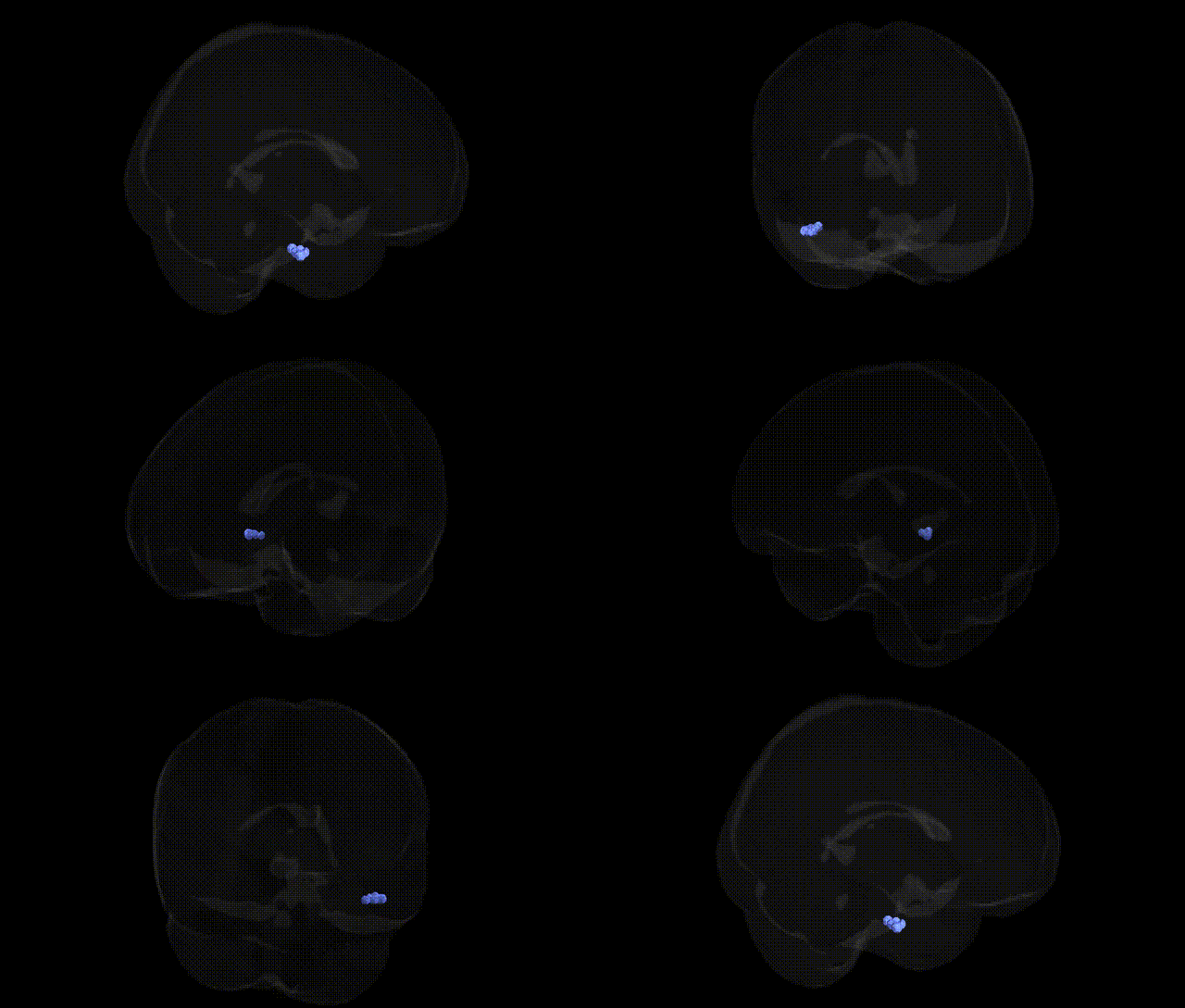
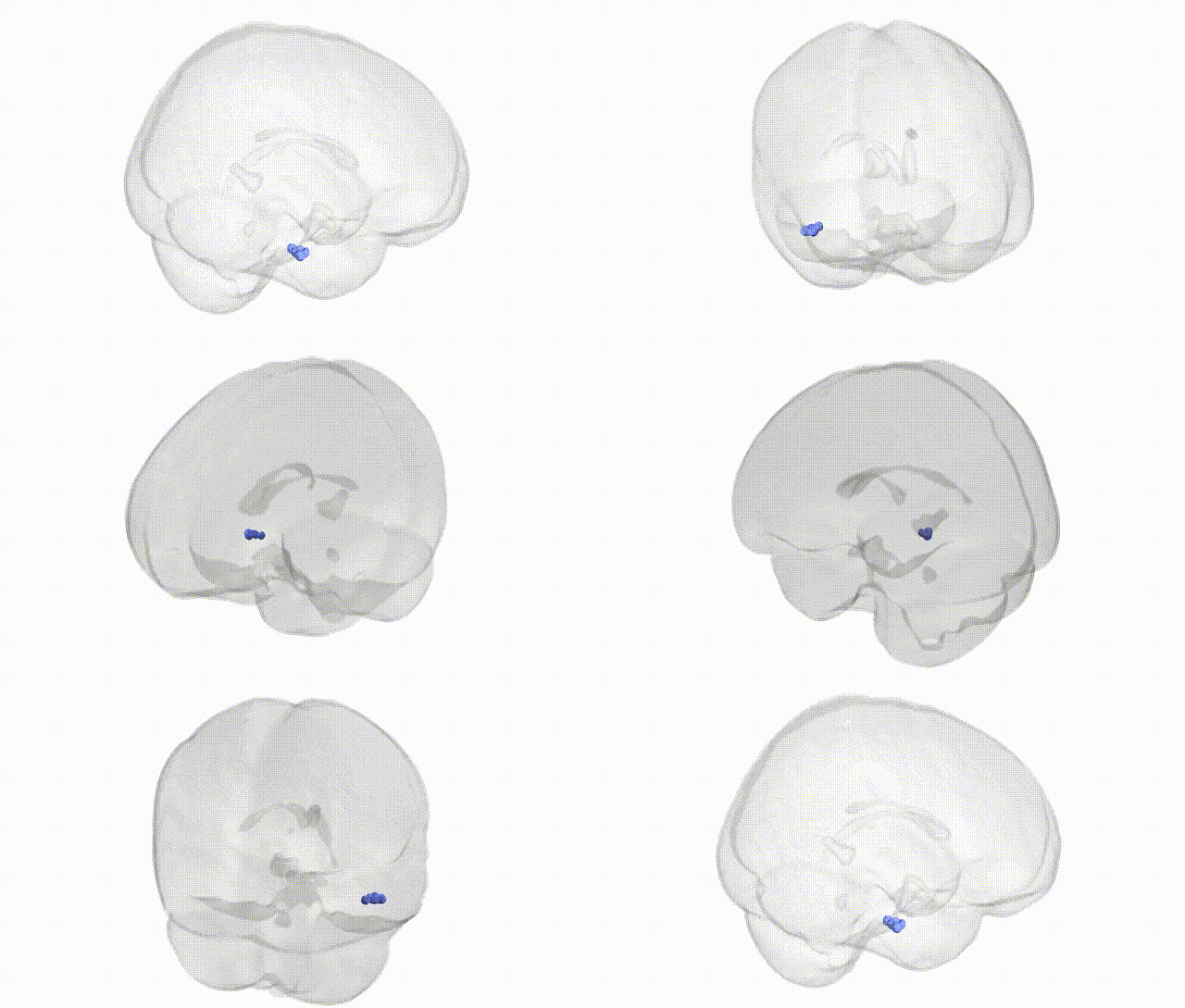
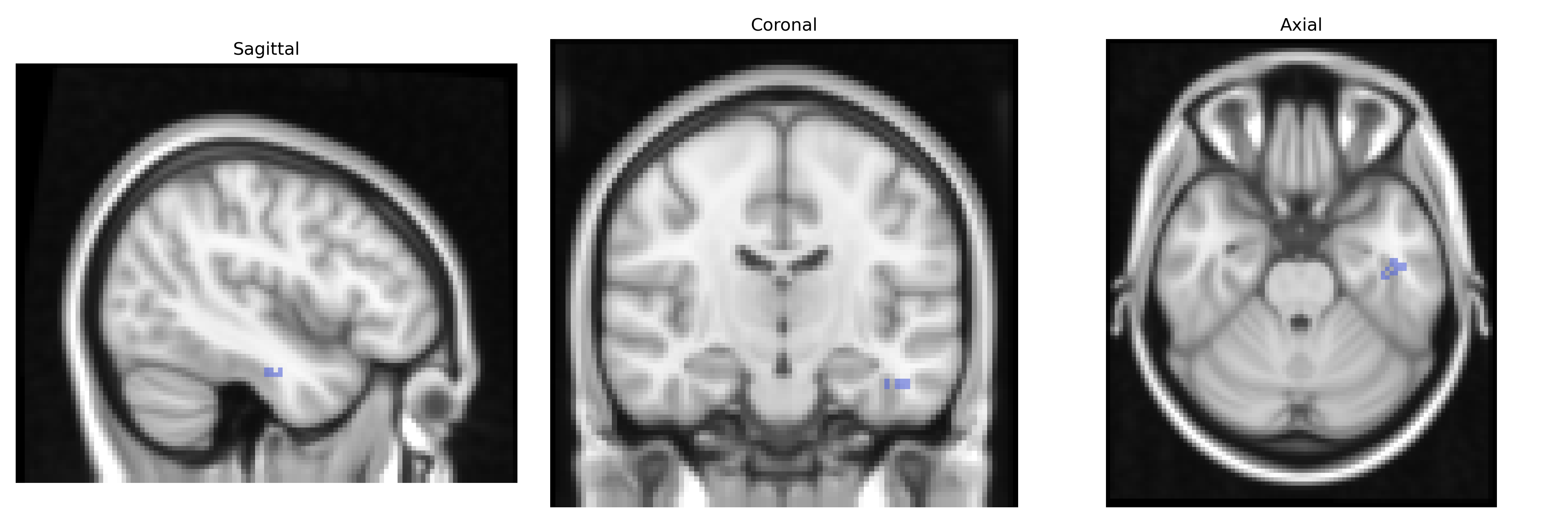
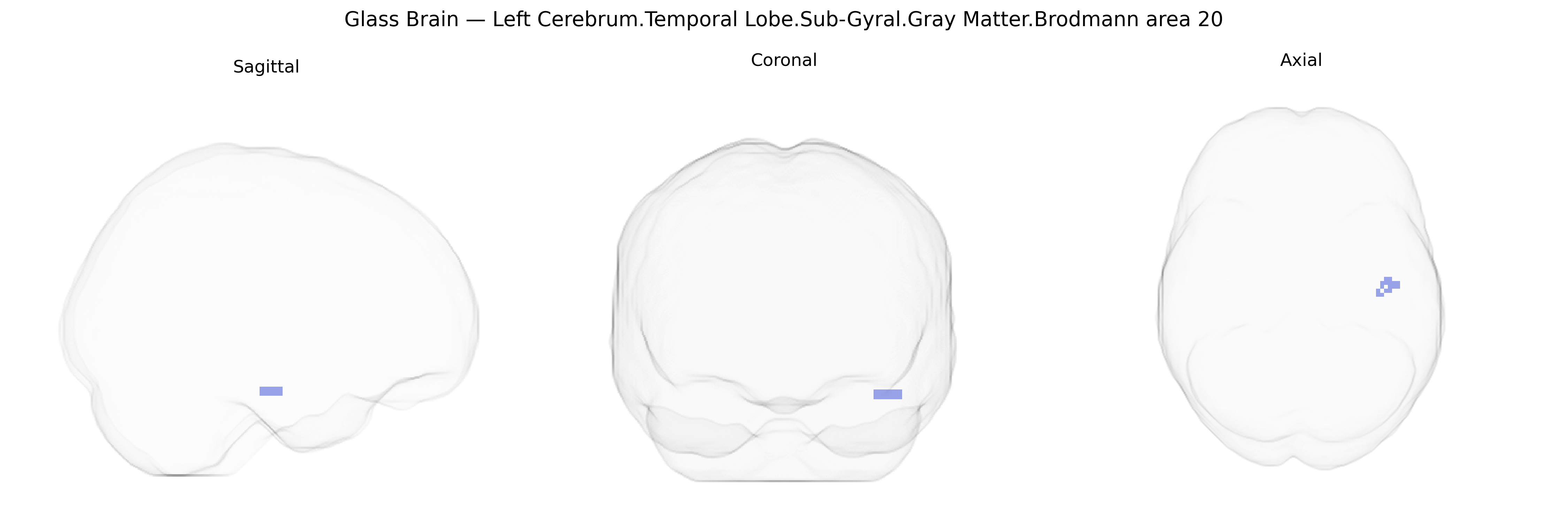
Bilateral Left Cerebrum.Temporal Lobe.Sub-Gyral.Gray Matter.Brodmann area 20 corresponds to cortex in the inferior temporal gyrus, primarily involved in high-level visual processing and object recognition within the ventral visual stream. Brodmann area 20 is characterized cytoarchitectonically as association cortex with dense reciprocal connections to other temporal, occipital, and limbic regions, integrating complex visual features with memory and semantic information. Neuronal populations in this region contribute to the perception and categorization of objects and faces, and lesions can impair visual agnosia-like functions while sparing primary visual abilities. Functionally, this area participates in multimodal integration, supporting the linkage of visual stimuli with stored representations and contextual meaning. There is no dedicated Wikipedia entry for Brodmann area 20; a closely related and encompassing structure is the Inferior temporal gyrus.
The bilateral left temporal lobe sub-gyral gray matter in Brodmann area 20, a high-level visual and semantic processing region, has been implicated in multiple genetic and GWAS-derived associations largely through imaging-genetics and disorder-focused studies rather than locus-specific analyses of this exact Talairach-defined parcel. Variants in genes affecting cortical thickness, surface area, and volume of temporal regions—including BA20-containing inferior temporal and fusiform areas—have been reported in large neuroimaging GWAS, with polygenic influences spanning synaptic, neurodevelopmental, and cell-adhesion pathways; for example, common variation in loci near genes such as GRIN2B, BDNF, and other neuroplasticity-related genes has been associated with temporal cortex morphology, although not uniquely to BA20. BA20 falls within networks repeatedly implicated in genetic studies of language and reading (e.g., FOXP2 and DCDC2-related pathways), face and object recognition (genes influencing ventral visual stream development), and semantic memory, with structural and functional alterations observed in genetically influenced disorders such as autism spectrum disorder, schizophrenia, and frontotemporal dementia, where risk variants in genes like CNTNAP2, DISC1, C9orf72, and MAPT are linked to temporal lobe abnormalities encompassing BA20 territory. In Alzheimer’s disease and other neurodegenerative conditions, GWAS hits in APOE and additional loci (e.g., CLU, PICALM, BIN1) correlate with atrophy patterns that include inferior and middle temporal regions overlapping BA20, while brain-wide polygenic scores for cognitive ability, educational attainment, and general intelligence show associations with temporal lobe gray-matter measures and functional activation during semantic and memory tasks that recruit BA20. Overall, genetic findings point to a broadly polygenic architecture influencing BA20 structure and function as part of ventral temporal and semantic networks, rather than discrete, region-specific genetic effects uniquely mapped to this Talairach atlas label.
Overview generated by GPT-4o (2026).
Region ID: 171
Hemisphere: bilateral
Atlas: Talairach labels 2mm
Full Quality Version: Download MP4
Full Quality Version: Download MP4
Wali Sidiqyar*, Gaurav Rudravaram*, Elyssa M. McMaster, Trent M. Schwartz, Adam M. Saunders, Kurt G. Schilling, Bennett A. Landman "Introducing SPINS: A Shared Public Visualization Library of Neuroanatomical Structures." Medical Imaging with Deep Learning- short paper
This resource is licensed under CC0 1.0 Universal (Public Domain).