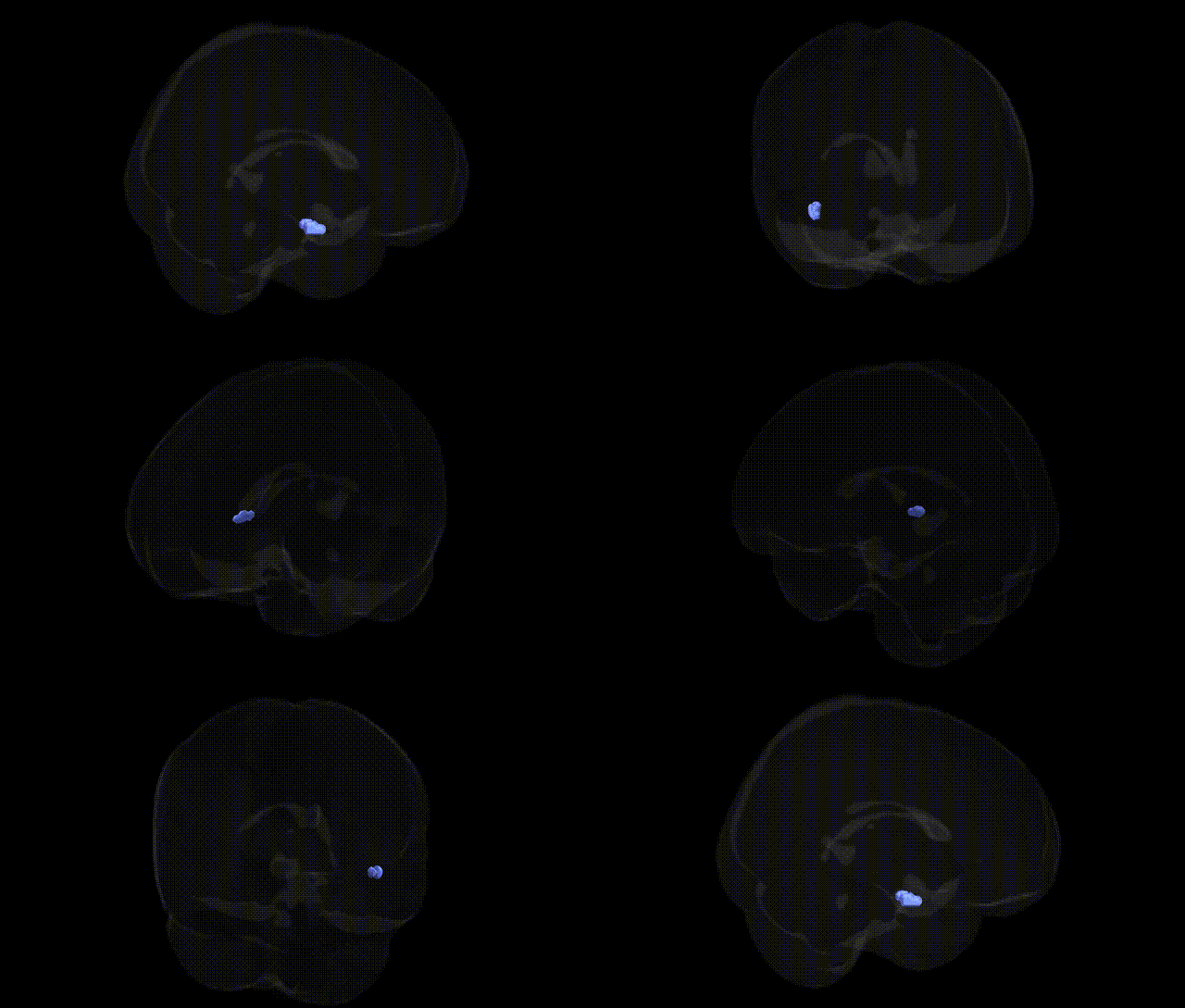
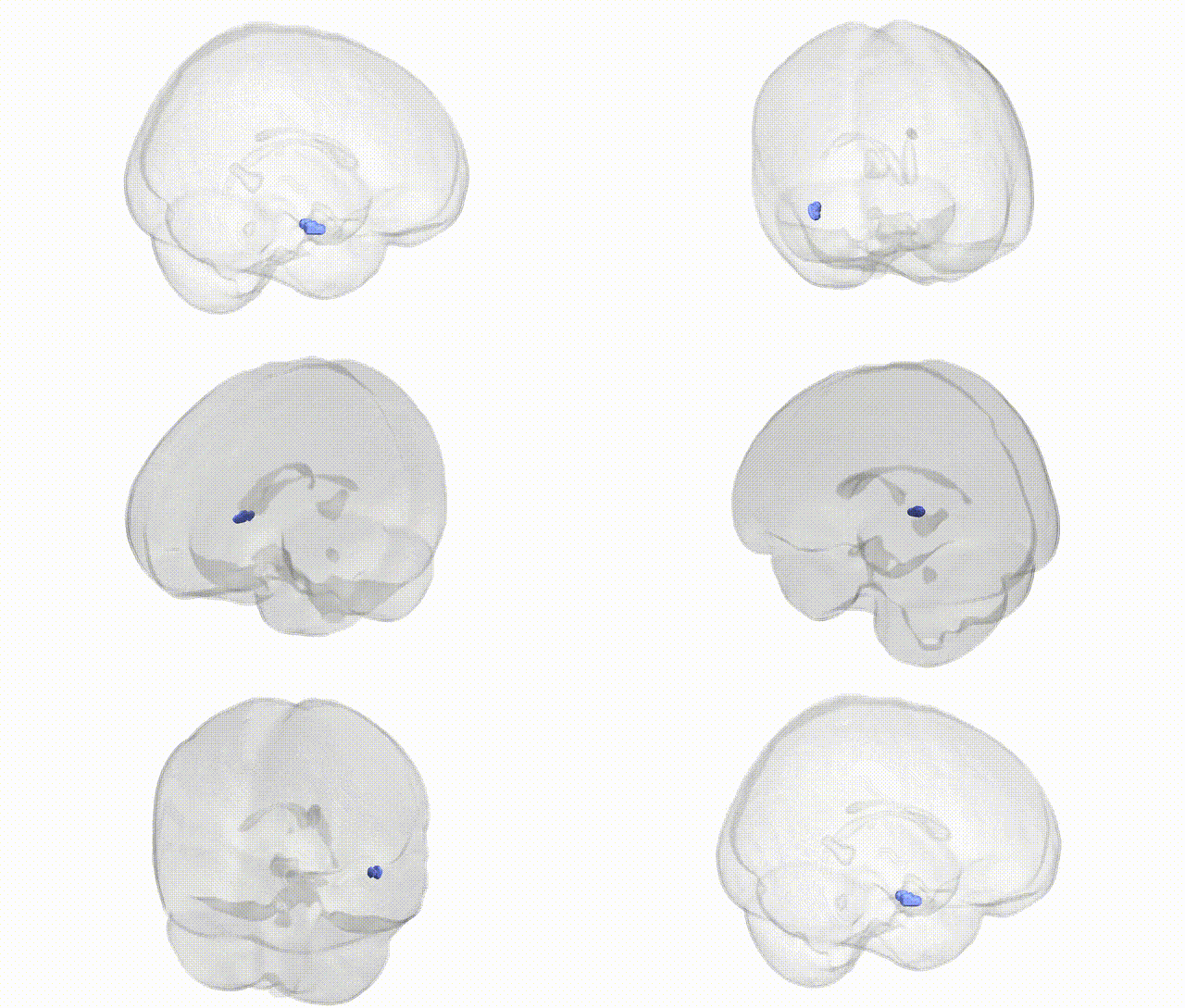
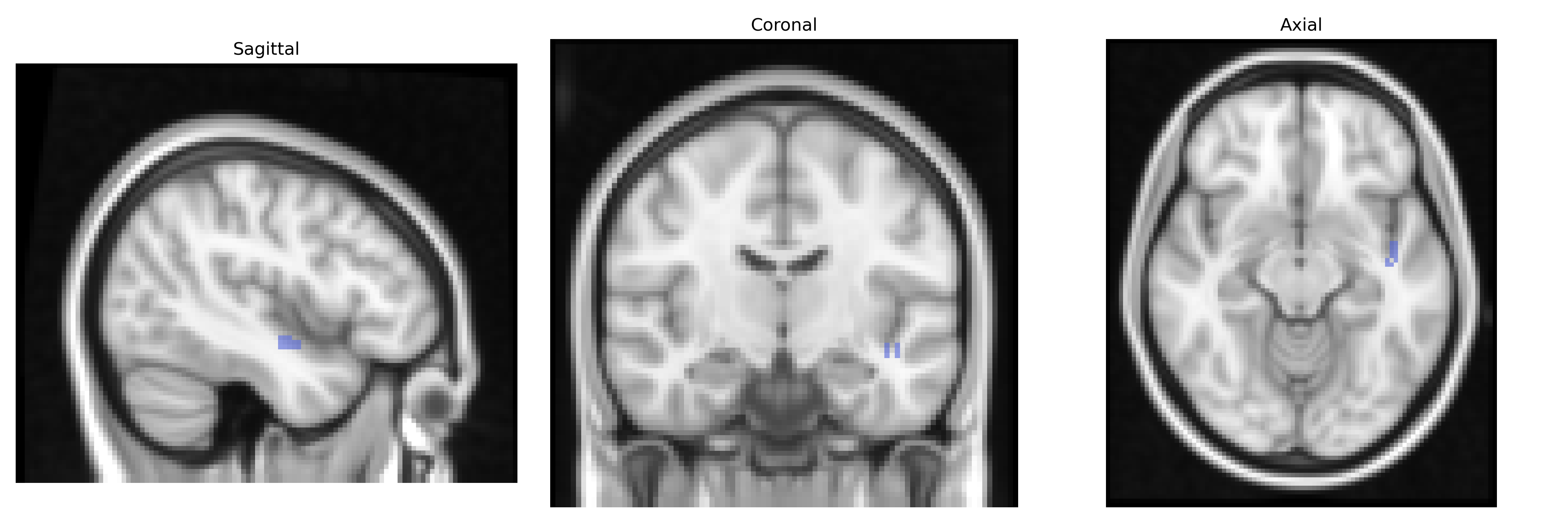
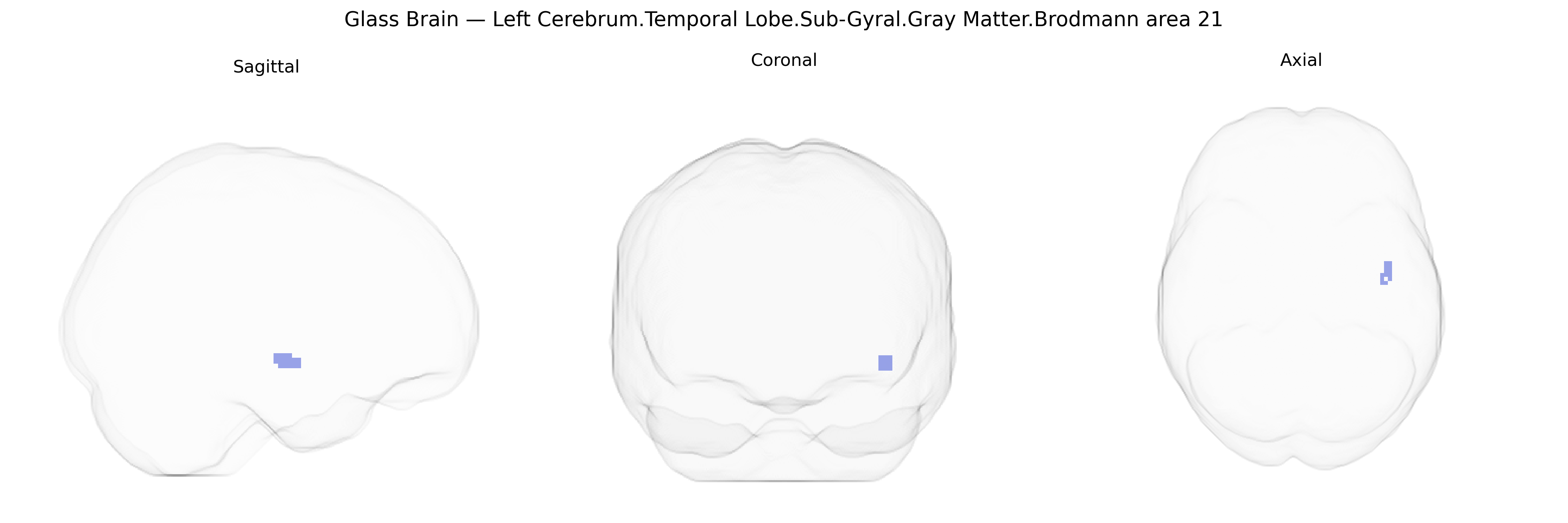
The bilateral Left Cerebrum.Temporal Lobe.Sub-Gyral.Gray Matter.Brodmann area 21 corresponds to association cortex within the middle temporal gyrus, located lateral and inferior to the Sylvian fissure and anterior to primary auditory regions. Brodmann area 21 is composed predominantly of neocortical gray matter with a typical six-layered laminar structure and is strongly connected with adjacent temporal, frontal, and parietal association areas, as well as limbic structures. Functionally, it is implicated in higher-order auditory and language processing, semantic memory, and multimodal integration of visual and auditory information, contributing to object recognition and aspects of social cognition. Lesions or dysfunction in this region can be associated with language comprehension deficits, semantic aphasia, and certain forms of temporal lobe epilepsy. There is no direct link for this specific Talairach-labeled region; a closely related area is Brodmann area 21.
The bilateral Left Cerebrum.Temporal Lobe.Sub-Gyral.Gray Matter.Brodmann area 21 region, a key component of the lateral temporal cortex involved in language, semantic processing, and social cognition, has been implicated in multiple genetic and GWAS-based associations through imaging-genetics and neuropsychiatric studies. Variants in genes influencing cortical structure and connectivity—such as those in the MAPT locus, CNTNAP2, FOXP2, and common polygenic architectures captured by large consortia like ENIGMA and UK Biobank—have been linked to temporal lobe cortical thickness, surface area, and volume, which often encompass BA21. GWAS of brain imaging phenotypes show that temporal cortical metrics (including middle temporal and superior temporal regions overlapping BA21) are heritable and associated with loci enriched for neurodevelopmental and synaptic genes, many of which also contribute risk to language-related traits, educational attainment, and general cognitive ability. Neuropsychiatric genetic studies implicating temporal cortex regions overlapping BA21 include schizophrenia (e.g., common risk loci such as those in the MHC region and synaptic genes that modulate temporal lobe structure and functional activation), autism spectrum disorder (with genetic variants in synaptic and cell-adhesion genes associated with temporal social-cognitive networks), and major depressive disorder and bipolar disorder, where polygenic risk has been linked to altered temporal lobe volumes and connectivity. Additional genetic associations involve temporal lobe epilepsy, with variants in genes such as LGI1 and others influencing susceptibility to seizures arising from medial and lateral temporal structures, and neurodegenerative diseases like frontotemporal dementia and Alzheimer’s disease, where risk loci in genes such as GRN, C9orf72, APOE, and others are associated with atrophy patterns that include lateral temporal regions and BA21, especially in semantic variant primary progressive aphasia. Overall, BA21 emerges in genetic studies largely through its role in broader temporal and language networks, with polygenic influences spanning synaptic function, neurodevelopment, and neurodegeneration that shape both its structure and its involvement in psychiatric and cognitive phenotypes.
Overview generated by GPT-4o (2026).
Region ID: 352
Hemisphere: bilateral
Atlas: Talairach labels 2mm
Full Quality Version: Download MP4
Full Quality Version: Download MP4
Wali Sidiqyar*, Gaurav Rudravaram*, Elyssa M. McMaster, Trent M. Schwartz, Adam M. Saunders, Kurt G. Schilling, Bennett A. Landman "Introducing SPINS: A Shared Public Visualization Library of Neuroanatomical Structures." Medical Imaging with Deep Learning- short paper
This resource is licensed under CC0 1.0 Universal (Public Domain).