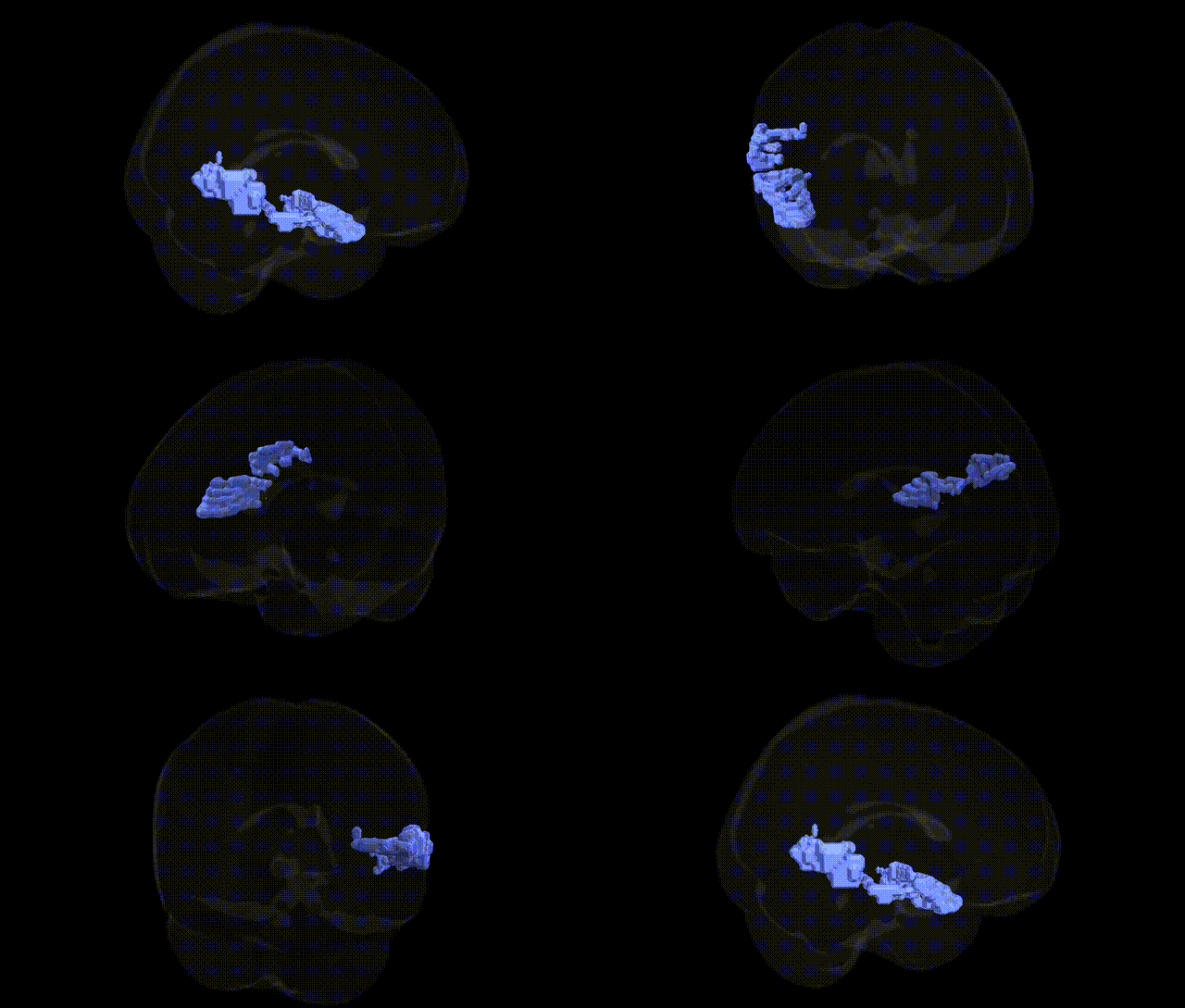
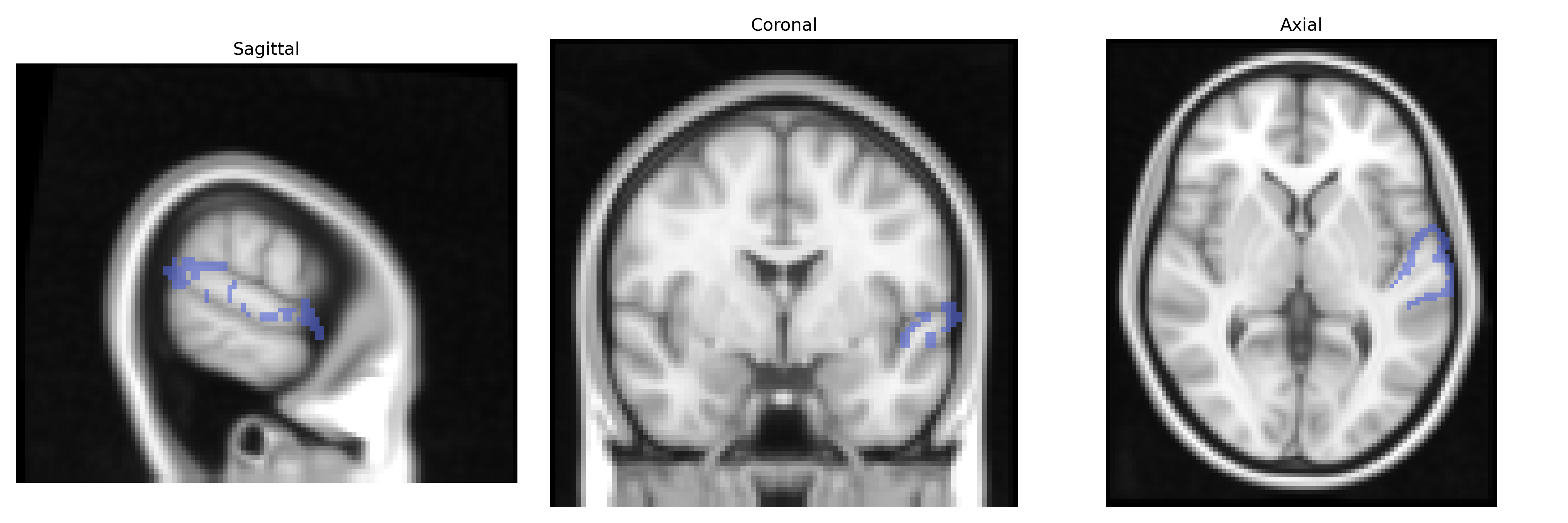
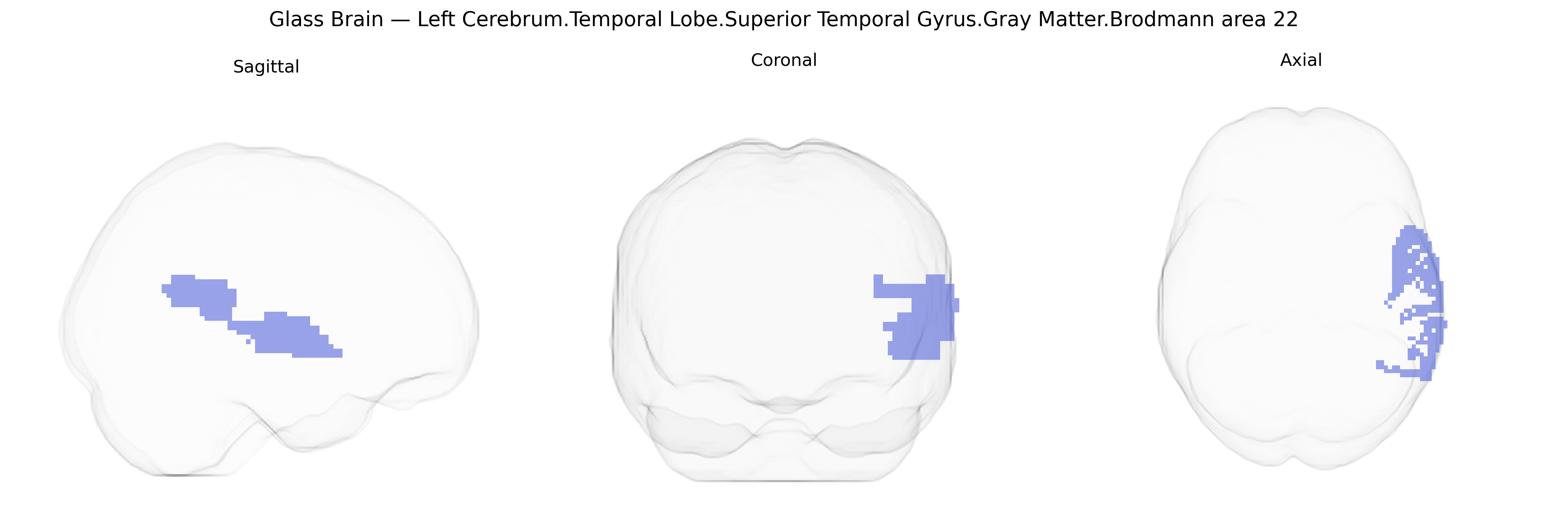
Bilateral Left Cerebrum.Temporal Lobe.Superior Temporal Gyrus.Gray Matter.Brodmann area 22 corresponds primarily to the left superior temporal gyrus cortex associated with auditory language processing, including phonological analysis and aspects of semantic integration. Cytoarchitectonically defined by Brodmann as area 22, this region encompasses key components of the classic Wernicke area, receiving auditory input from primary and secondary auditory cortices and contributing to speech perception, comprehension, and the mapping of acoustic signals onto linguistic representations. It is heavily connected with inferior parietal and frontal language regions via association fiber tracts (e.g., arcuate fasciculus), and functional imaging implicates it in sentence-level processing, lexical access, and the integration of auditory and multimodal language cues. There is no direct Wikipedia article for this exact compound label; a closely related structure is Wernicke’s area.
The bilateral Left Cerebrum.Temporal Lobe.Superior Temporal Gyrus.Gray Matter.Brodmann area 22, corresponding largely to primary language and auditory association cortex (including Wernicke’s area on the left), has been repeatedly implicated in genetic studies of language, psychosis, and neurodevelopmental variation. Twin and family studies show high heritability for superior temporal gyrus (STG) and BA22 gray matter volume and cortical thickness, and GWAS of brain morphology (e.g., ENIGMA consortium) have identified common variants in genes involved in neurodevelopment and synaptic function (such as variants near PACRG, TESC, and other loci) associated with temporal lobe surface area and thickness, including the superior temporal regions. Genetic risk for schizophrenia, particularly polygenic risk scores and specific loci like complement component 4 (C4) and other synaptic pruning and glutamatergic signaling genes, has been associated with structural and functional alterations in BA22/STG, including gray matter reduction and abnormal auditory processing that map to hallucinations and thought disorder. In autism spectrum disorder, variants affecting synaptic adhesion and neuronal migration (e.g., in genes such as CNTNAP2, NRXN1, and other ASD-related loci) have been linked to atypical development and connectivity of temporal language regions, including BA22, with corresponding differences in social communication. GWAS of language-related traits and reading ability, including dyslexia, have suggested associations between genetic variation in genes involved in cortical development (e.g., KIAA0319, DCDC2, and others) and structural or functional measures in left temporal language areas that encompass BA22. Additionally, polygenic risk for major depressive disorder, bipolar disorder, and auditory processing traits has been correlated with altered STG/BA22 connectivity and gray matter, supporting a broader role for this genetically influenced region in language, auditory perception, and higher-order social-cognitive functions across multiple psychiatric and neurodevelopmental conditions.
Overview generated by GPT-4o (2026).
Region ID: 442
Hemisphere: bilateral
Atlas: Talairach labels 2mm
Full Quality Version: Download MP4
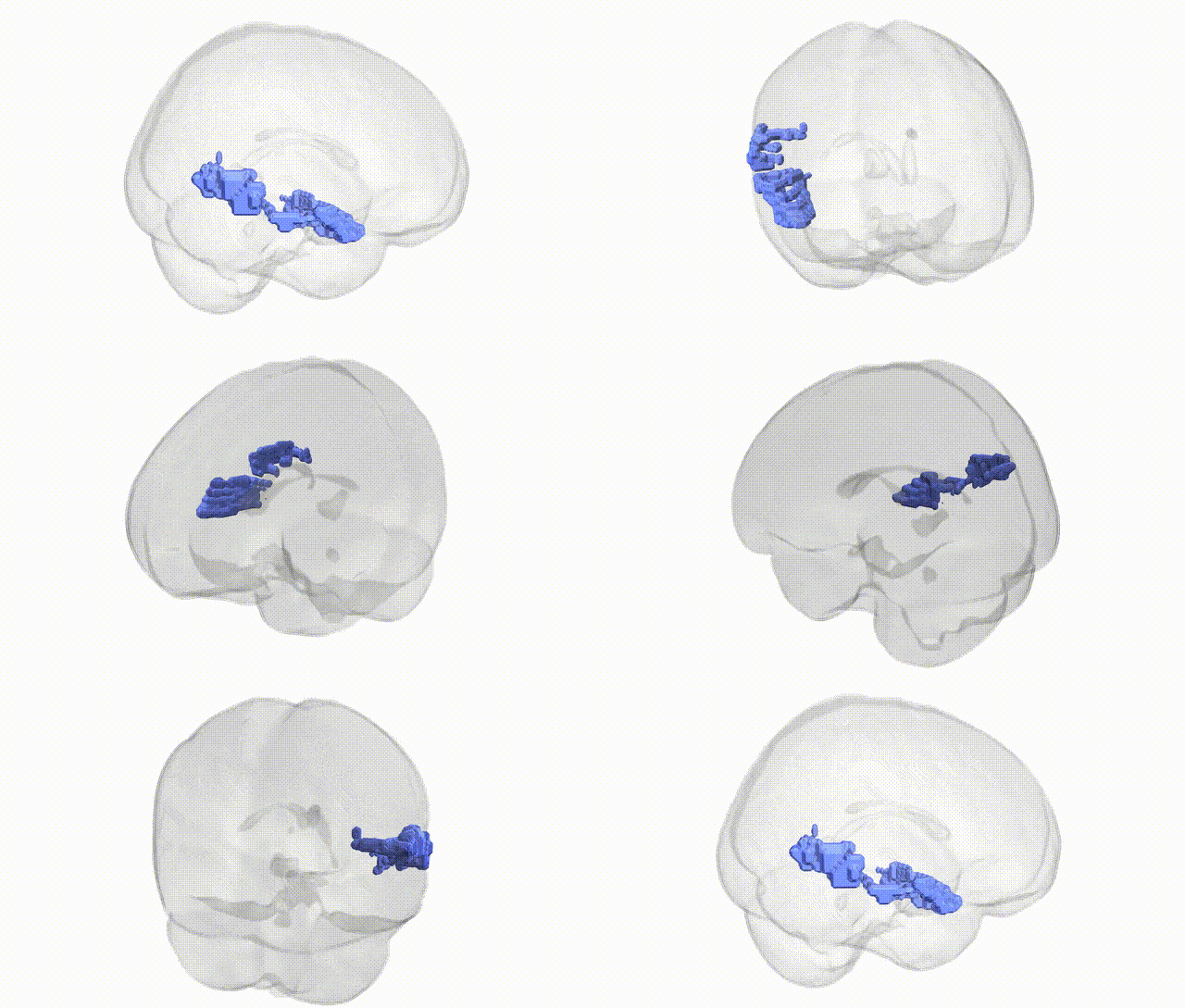
Full Quality Version: Download MP4
Wali Sidiqyar*, Gaurav Rudravaram*, Elyssa M. McMaster, Trent M. Schwartz, Adam M. Saunders, Kurt G. Schilling, Bennett A. Landman "Introducing SPINS: A Shared Public Visualization Library of Neuroanatomical Structures." Medical Imaging with Deep Learning- short paper
This resource is licensed under CC0 1.0 Universal (Public Domain).