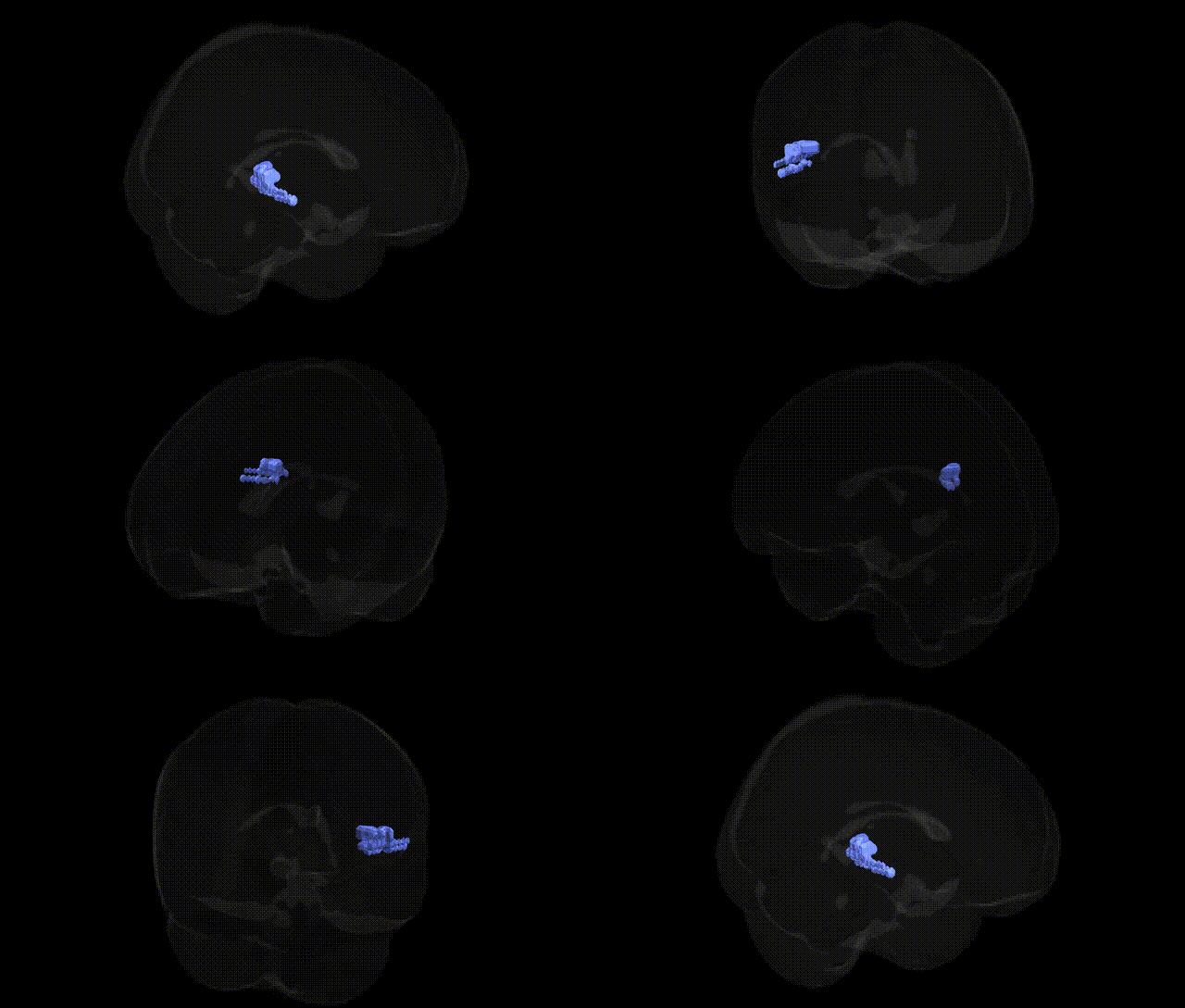
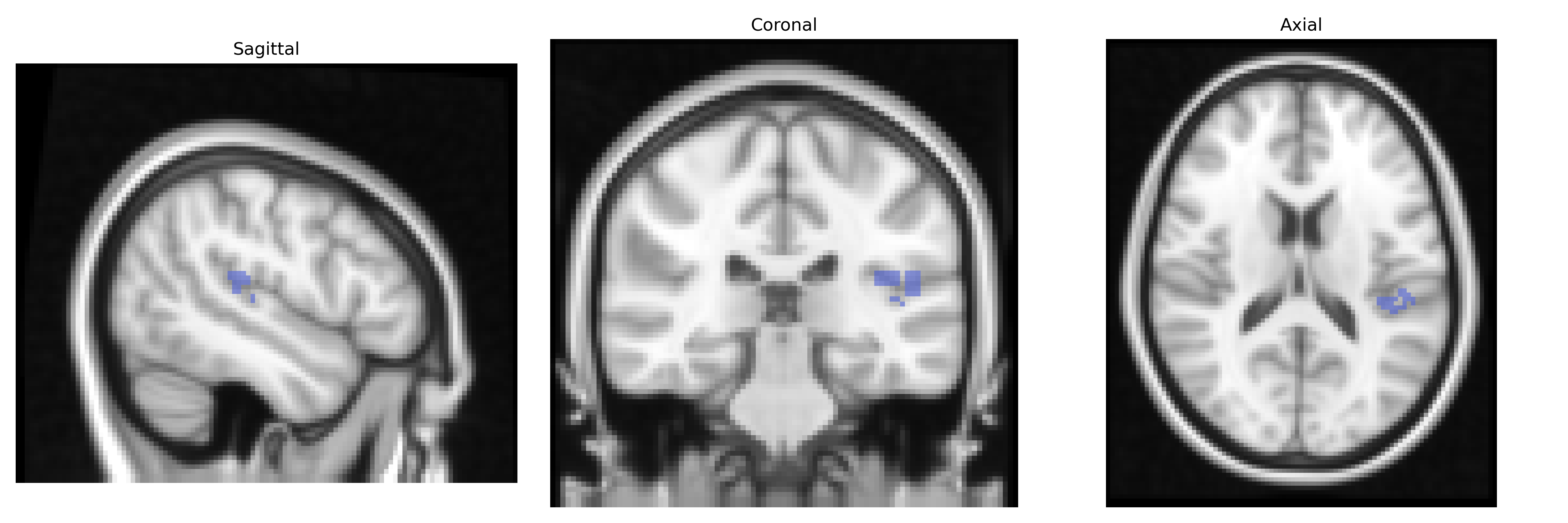
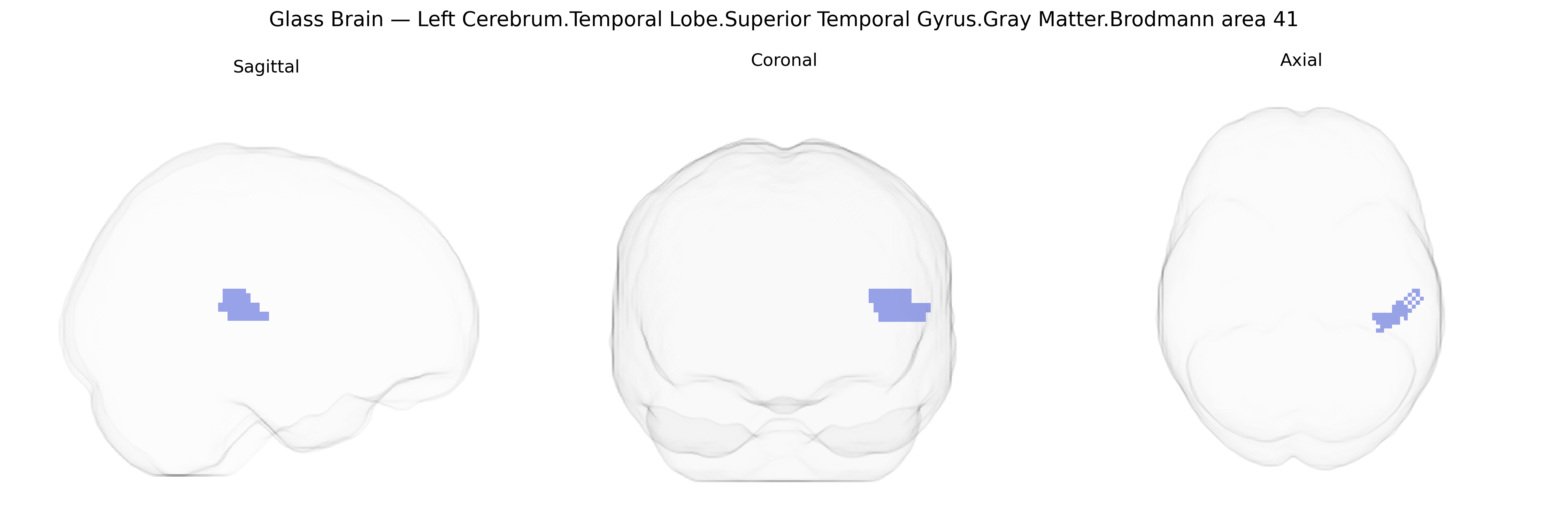
The bilateral Left Cerebrum.Temporal Lobe.Superior Temporal Gyrus.Gray Matter.Brodmann area 41 corresponds to primary auditory cortex located on the transverse temporal (Heschl’s) gyri within the superior temporal gyrus, receiving highly organized input from the medial geniculate nucleus of the thalamus. This cytoarchitectonic region is specialized for early-stage processing of acoustic information, including sound intensity, frequency, and temporal patterns, and forms the core of the auditory processing hierarchy that supports more complex perceptual functions such as speech and environmental sound recognition. Brodmann area 41 is characterized by granular cortex typical of primary sensory areas, with a tonotopic organization that maps sound frequencies across its surface, and it is critically involved in normal auditory perception; lesions in this region can lead to deficits in basic sound detection and discrimination. There is no direct link; a closely related structure is Primary auditory cortex.
The bilateral left superior temporal gyrus (STG) gray matter in Brodmann area 41, a primary auditory cortex region, shows consistent genetic associations with language, speech, and auditory processing traits, as well as several neuropsychiatric disorders. Twin and imaging-genetics studies indicate substantial heritability of STG volume and cortical thickness, with common variants in genes such as FOXP2, CNTNAP2, DCDC2, KIAA0319, and ROBO1 linked to phonological processing, speech and language impairments, dyslexia, and developmental language disorder, often involving reduced gray matter or altered activation in superior temporal auditory areas. GWAS and large-scale neuroimaging consortia (e.g., ENIGMA, UK Biobank) have identified loci influencing temporal lobe structure and auditory cortex morphology, including variants near microtubule and synaptic genes, though Brodmann area–specific signals are typically not resolved. Variants in GRM8, NRG1, and CACNA1C, among others, have been associated with schizophrenia and bipolar disorder, where structural and functional abnormalities in left STG, particularly BA41/42, are frequently observed, including altered gray matter and auditory hallucination–related changes. Autism spectrum disorder and social communication traits show links to genes involved in synaptic function and neuronal migration (e.g., SHANK3, NRXN1), with convergent evidence for atypical auditory and language-related processing in superior temporal regions. Tinnitus, musical aptitude, and auditory perception traits have also been tied to genetic variation in ion channel, synaptic, and plasticity-related genes, with imaging work implicating primary auditory cortex regions including BA41. Collectively, genetic studies point to a polygenic architecture in which variants affecting synaptic development, cortical microstructure, and language/auditory circuitry contribute to variation and pathology in this left superior temporal Brodmann area 41 region.
Overview generated by GPT-4o (2026).
Region ID: 672
Hemisphere: bilateral
Atlas: Talairach labels 2mm
Full Quality Version: Download MP4
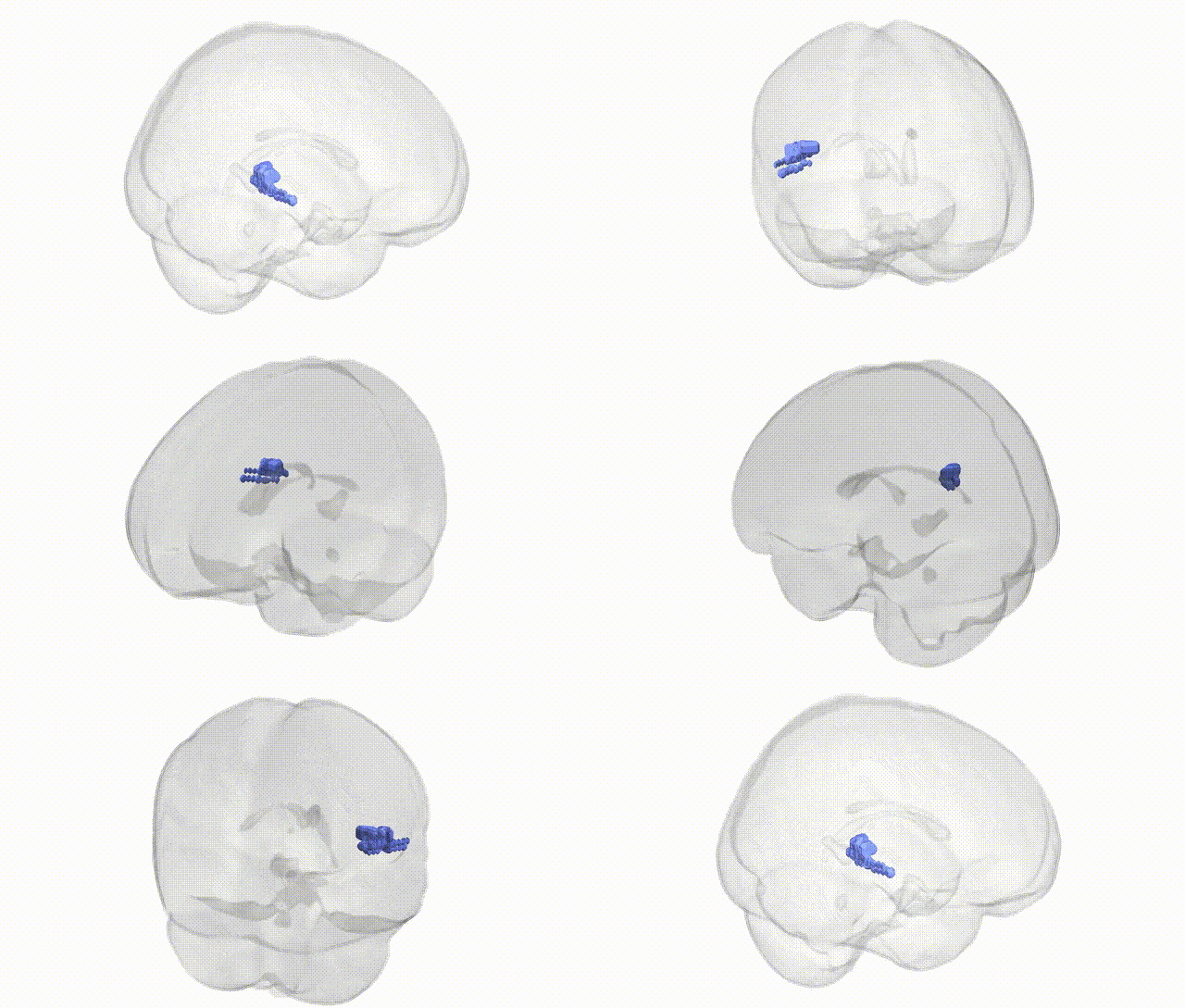
Full Quality Version: Download MP4
Wali Sidiqyar*, Gaurav Rudravaram*, Elyssa M. McMaster, Trent M. Schwartz, Adam M. Saunders, Kurt G. Schilling, Bennett A. Landman "Introducing SPINS: A Shared Public Visualization Library of Neuroanatomical Structures." Medical Imaging with Deep Learning- short paper
This resource is licensed under CC0 1.0 Universal (Public Domain).