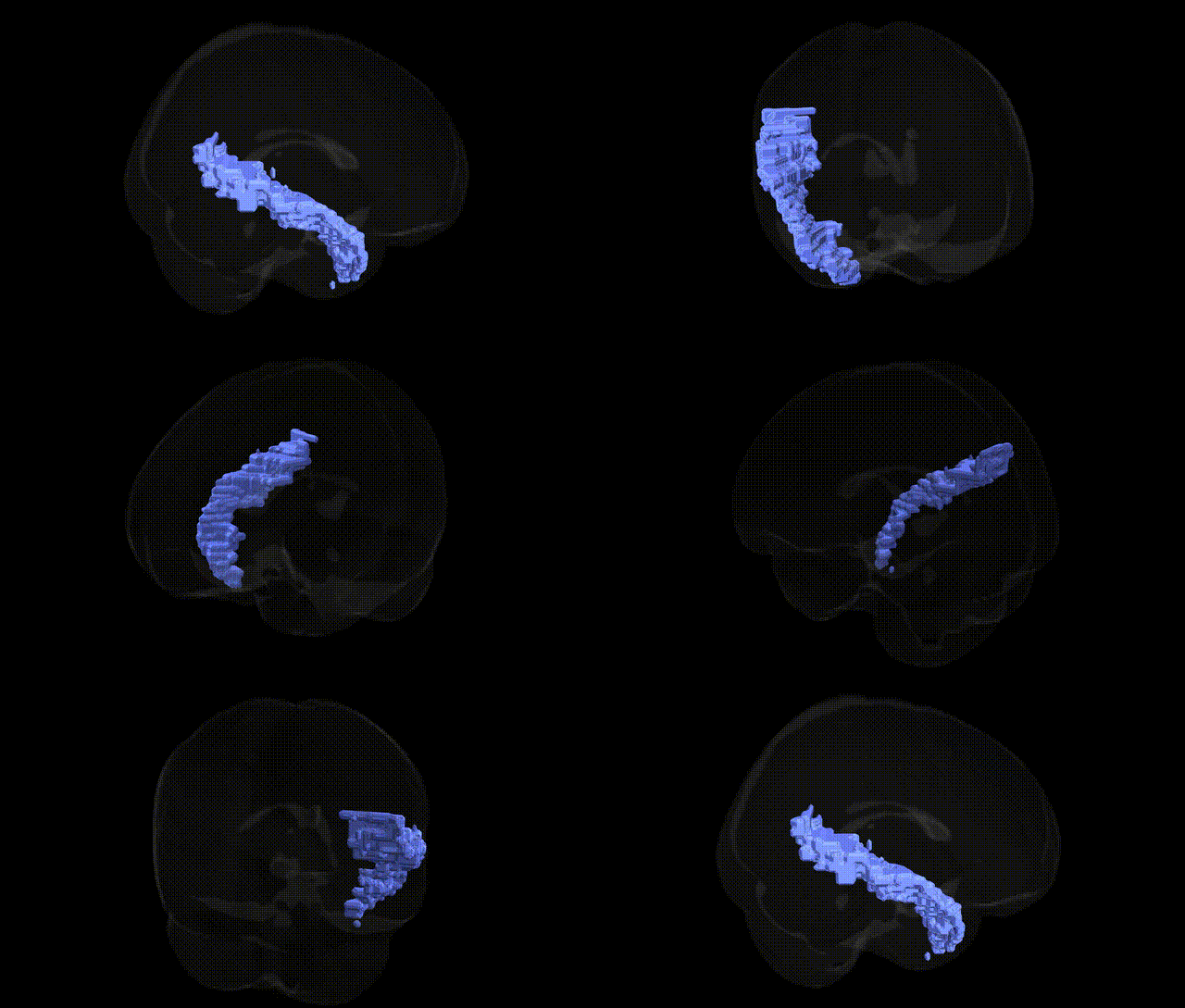
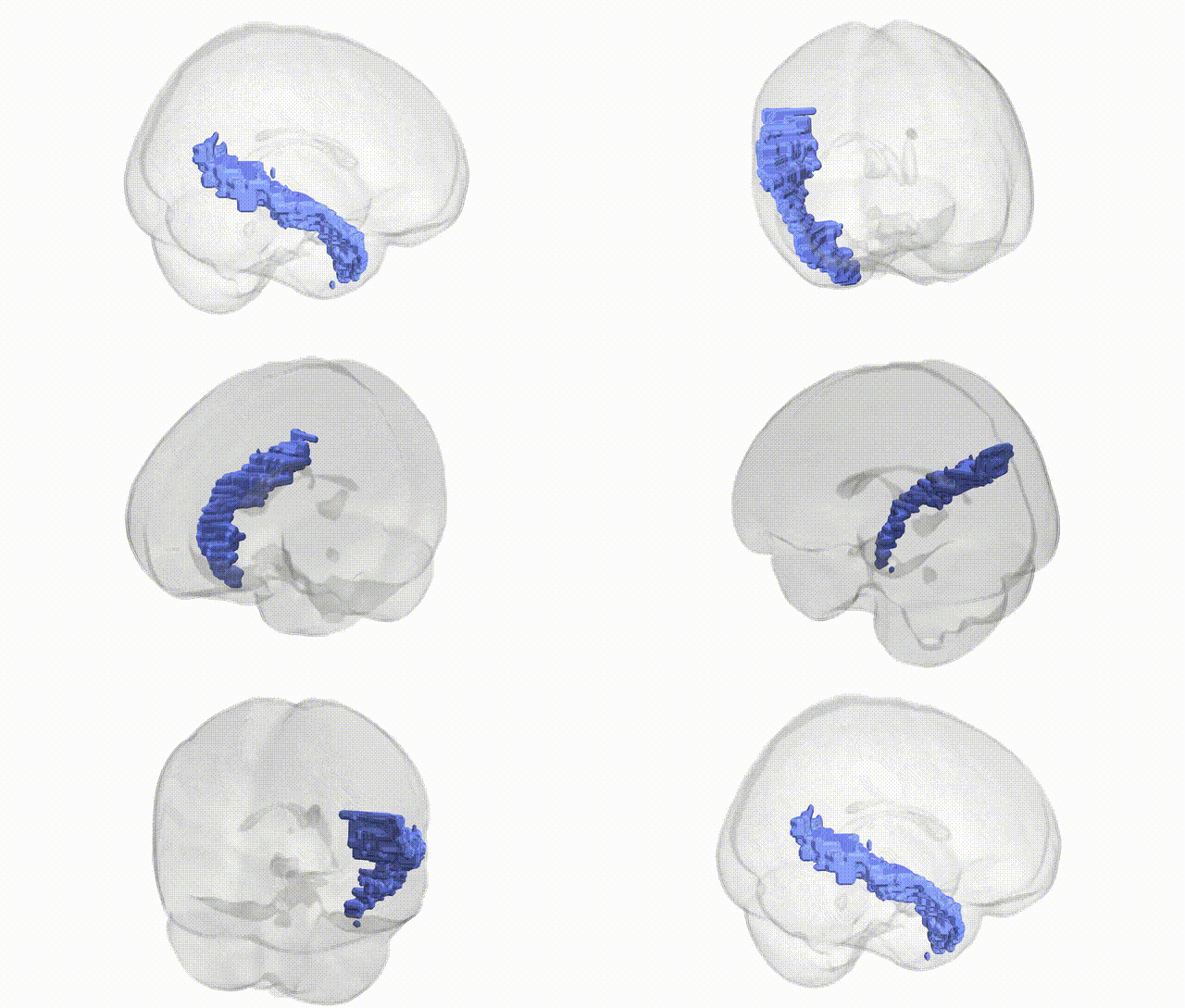
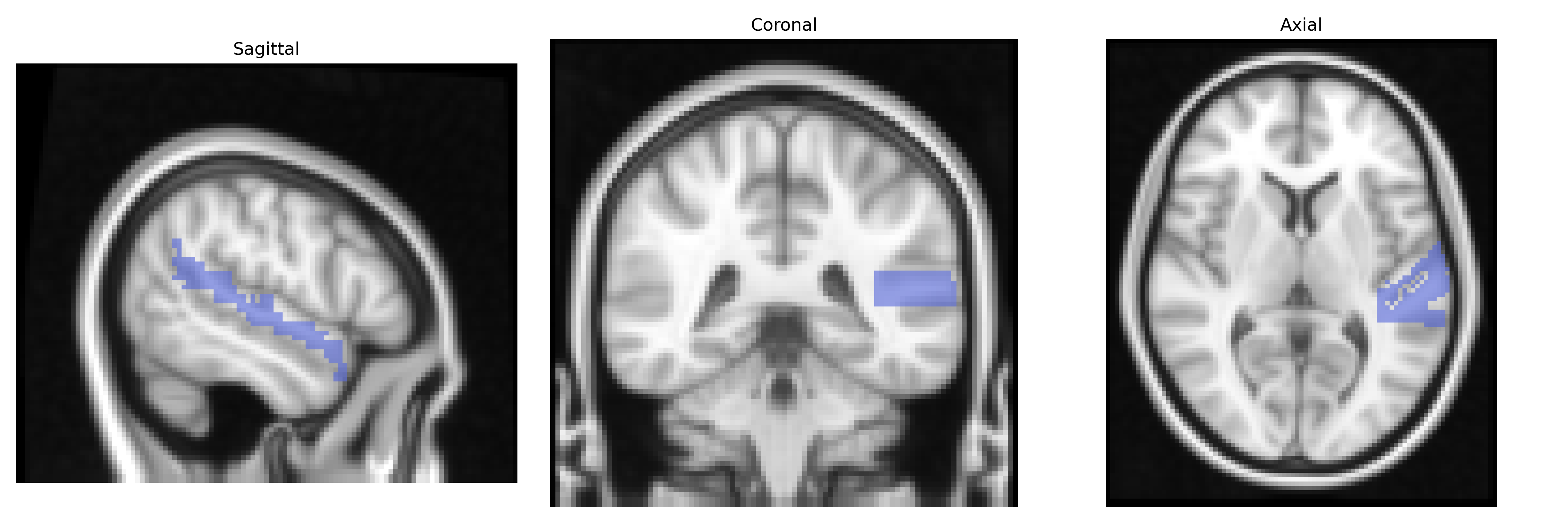
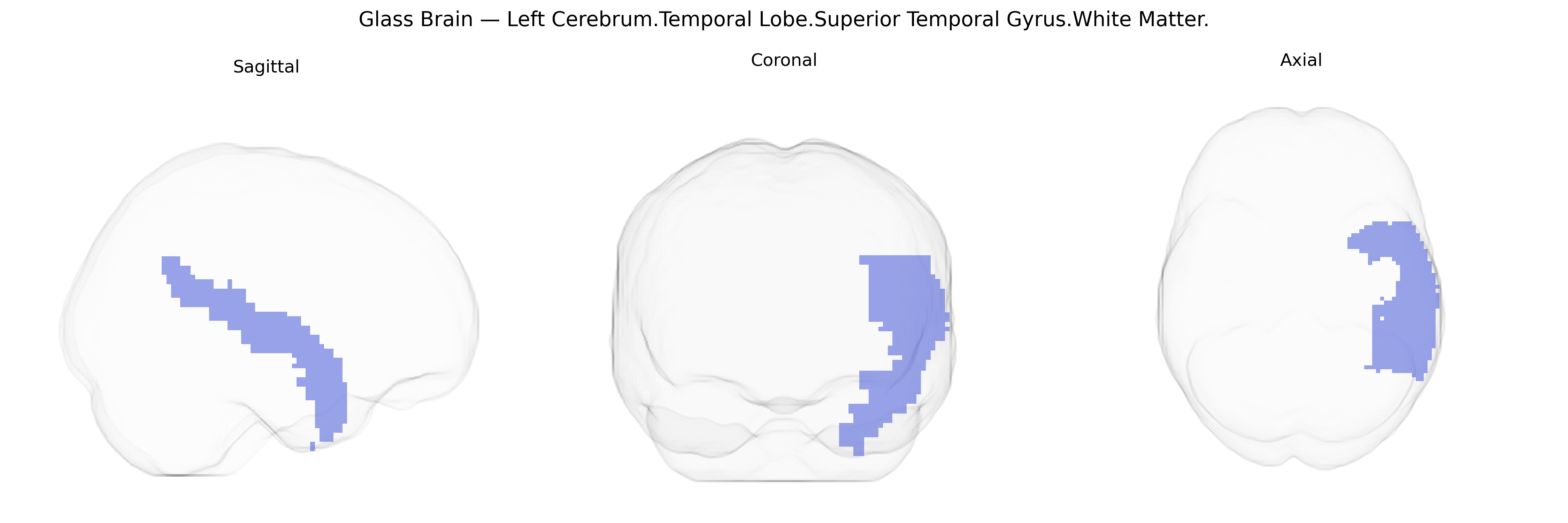
The bilateral Left Cerebrum.Temporal Lobe.Superior Temporal Gyrus.White Matter corresponds to the subcortical fiber systems underlying the superior temporal gyrus in the left hemisphere, forming part of the temporal lobe’s association and projection pathways. These white matter tracts include fibers connecting the superior temporal cortex—critical for auditory processing, language comprehension, and aspects of social cognition—to other temporal, parietal, and frontal regions, such as via portions of the arcuate fasciculus and other longitudinal fasciculi. Functionally, this white matter supports rapid integration and transfer of auditory and linguistic information, contributing to phonological processing, semantic access, and higher-order speech perception. There is no direct Wikipedia article for the white matter of the left superior temporal gyrus; see the related cortical structure: Superior temporal gyrus.
The bilateral left superior temporal gyrus (STG) white matter, as defined in the Talairach 2 mm atlas, lies within a language, auditory, and social-cognition hub whose structure and connectivity show robust genetic influences and multiple GWAS-based associations. Twin and imaging-genetics studies indicate high heritability of STG cortical thickness, surface area, and white matter microstructure (e.g., fractional anisotropy), with common variants in genes affecting neurodevelopment and axon guidance (such as NRGN, DCDC2, CNTNAP2, FOXP2, and KIAA0319) repeatedly linked to language-related regions and temporal lobe connectivity. Large neuroimaging GWAS consortia (e.g., ENIGMA and UK Biobank) have identified loci associated with temporal lobe volumes and diffusion metrics, including variants near genes like HMGA2, SLC39A8, and others implicated in general brain size and white matter integrity, some of which show pleiotropic effects on cognitive performance and educational attainment. Genetic risk for schizophrenia, bipolar disorder, and major depression has been associated with altered STG volume and white matter organization, with polygenic risk scores correlating with temporal lobe structural changes, particularly in left-lateralized language areas. Similarly, autism spectrum disorder and social communication traits have been linked to variants in synaptic and neurodevelopmental genes (e.g., SHANK3, NRXN1, GRIN2A) that show convergent effects on temporal lobe circuitry, while dyslexia and specific language impairment GWAS and candidate gene studies implicate temporal white matter tracts connecting STG to other perisylvian language areas. Overall, genetic studies support a highly polygenic architecture in which common and rare variants affecting neuronal migration, synaptic plasticity, and myelination contribute to individual differences and disorder-related alterations in the structure and connectivity of the left superior temporal gyrus white matter.
Overview generated by GPT-4o (2026).
Region ID: 39
Hemisphere: bilateral
Atlas: Talairach labels 2mm
Full Quality Version: Download MP4
Full Quality Version: Download MP4
Wali Sidiqyar*, Gaurav Rudravaram*, Elyssa M. McMaster, Trent M. Schwartz, Adam M. Saunders, Kurt G. Schilling, Bennett A. Landman "Introducing SPINS: A Shared Public Visualization Library of Neuroanatomical Structures." Medical Imaging with Deep Learning- short paper
This resource is licensed under CC0 1.0 Universal (Public Domain).