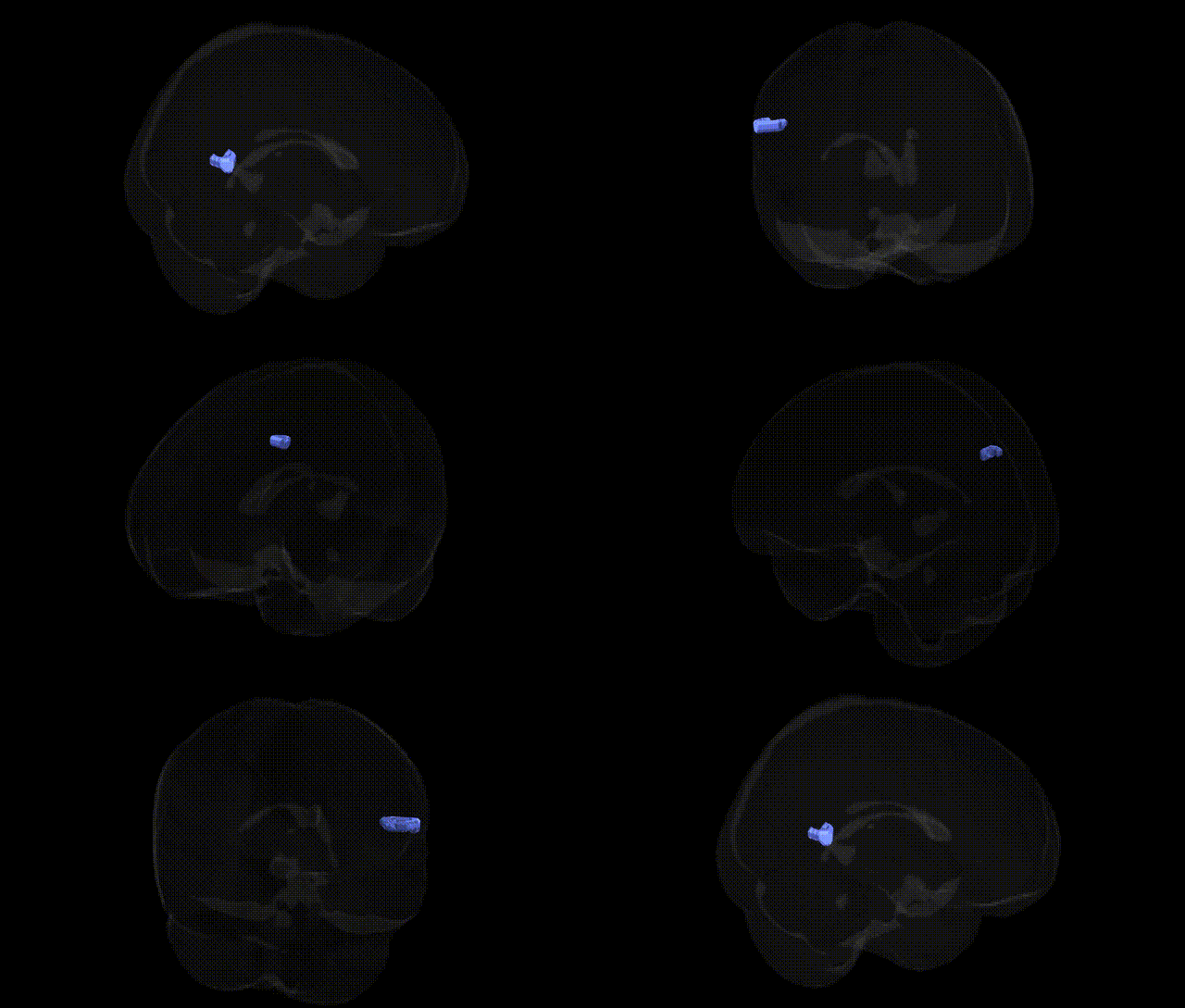
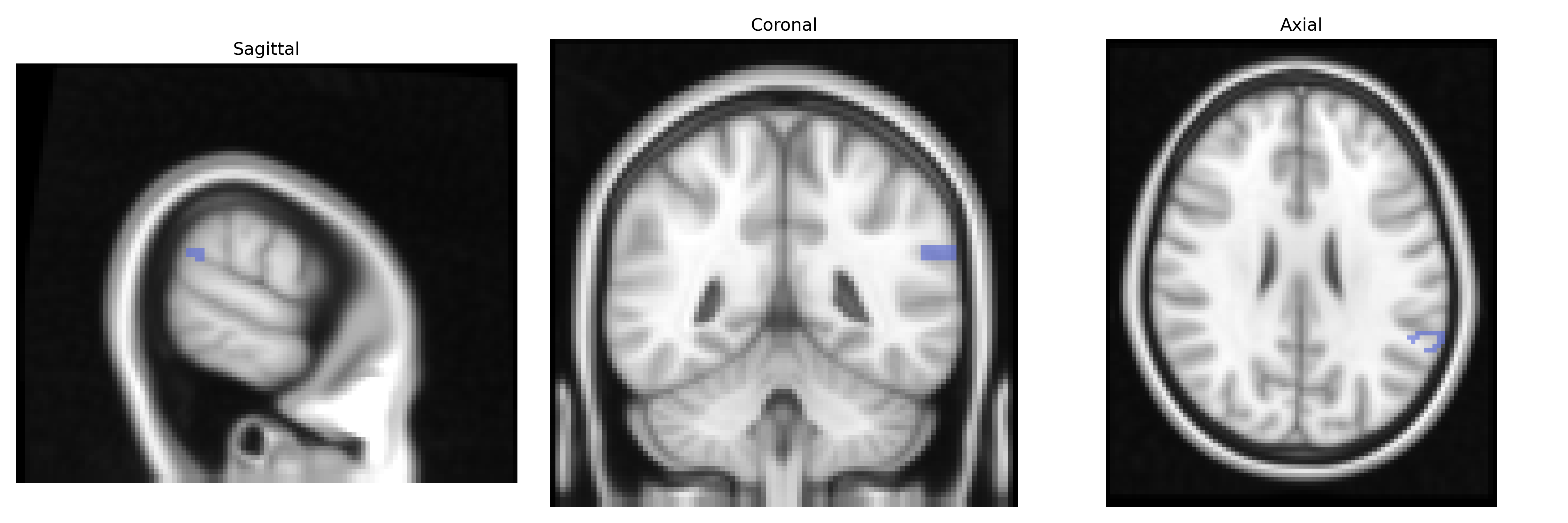
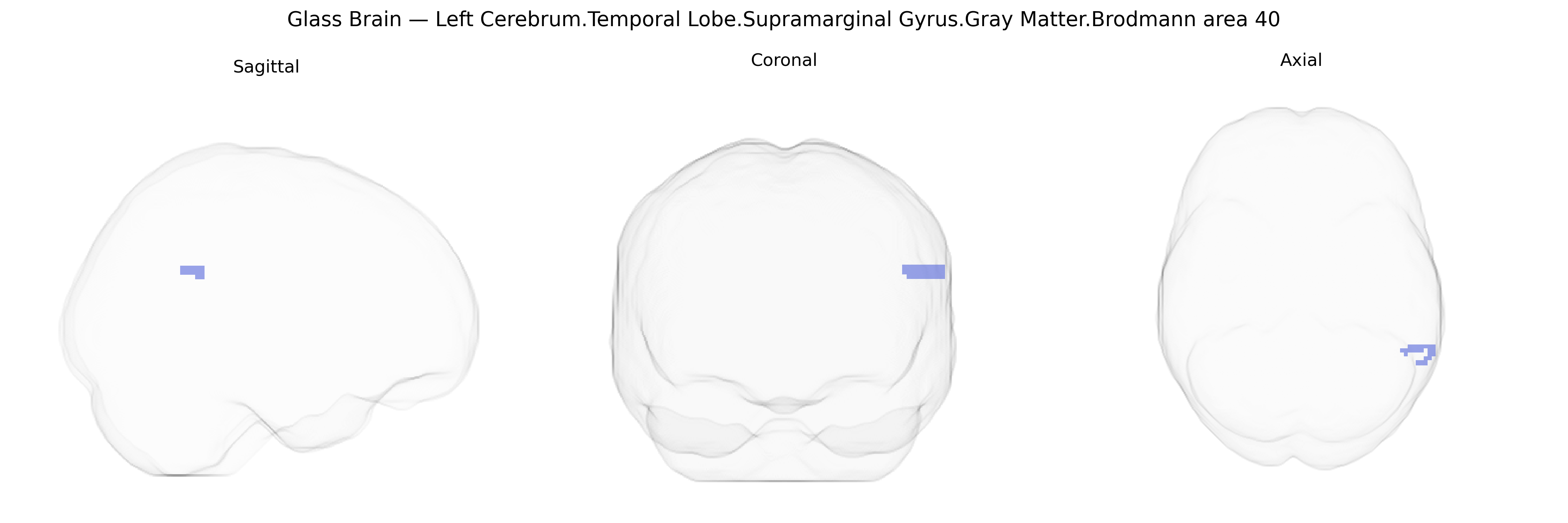
The bilateral Left Cerebrum.Temporal Lobe.Supramarginal Gyrus.Gray Matter.Brodmann area 40 corresponds to cortical tissue in the supramarginal gyrus, a key subdivision of the inferior parietal lobule bordering the posterior temporal lobe and overlying the posterior end of the lateral (Sylvian) fissure. Brodmann area 40 is involved in multisensory integration, phonological processing, language comprehension, and aspects of spatial attention and praxis, receiving convergent input from auditory, visual, and somatosensory cortical regions. Functionally, this region participates in mapping sounds to articulatory representations, supporting reading and repetition, and contributes to higher-order body schema and tool-use representations. Lesions in this area can result in components of conduction aphasia, ideomotor apraxia, and disorders of spatial perception or tactile recognition, reflecting its role as an association cortex hub within the temporo-parietal junction. Supramarginal gyrus
The supramarginal gyrus (SMG; Brodmann area 40) in the left temporal/parietal region has been implicated in multiple genetically informed studies, especially for language, reading, and social cognition. GWAS and imaging genetics work within large cohorts (e.g., UK Biobank) have linked common variants in genes involved in cortical development and synaptic function (such as FOXP2, DCDC2, KIAA0319, CNTNAP2, and GRIN2B) to structural and functional measures in temporoparietal language regions that include the SMG, particularly in relation to phonological processing and developmental dyslexia. Polygenic risk for schizophrenia, bipolar disorder, and major depression has been associated with altered gray matter volume and connectivity in the left SMG, consistent with its role in language, attentional, and social processing networks; similarly, autism spectrum disorder risk loci (including those affecting synaptic adhesion and neuronal migration) have been linked to atypical activation and morphology in temporoparietal junction and adjacent SMG regions during social and language tasks. Variants influencing handedness and language lateralization (e.g., in PCSK6 and other lateralization-related genes) show associations with structural asymmetries in perisylvian cortex, including BA40, while GWAS of educational attainment and general cognitive ability have reported enrichment of genetic effects in networks encompassing the left supramarginal gyrus. Although most findings are indirect—linking genetic variants to traits and then to SMG structure or function rather than to this precise Talairach-defined parcel—the converging evidence indicates that genetically mediated variation in neurodevelopmental and synaptic pathways contributes to individual differences and disorder-related alterations in left BA40 gray matter.
Overview generated by GPT-4o (2026).
Region ID: 869
Hemisphere: bilateral
Atlas: Talairach labels 2mm
Full Quality Version: Download MP4
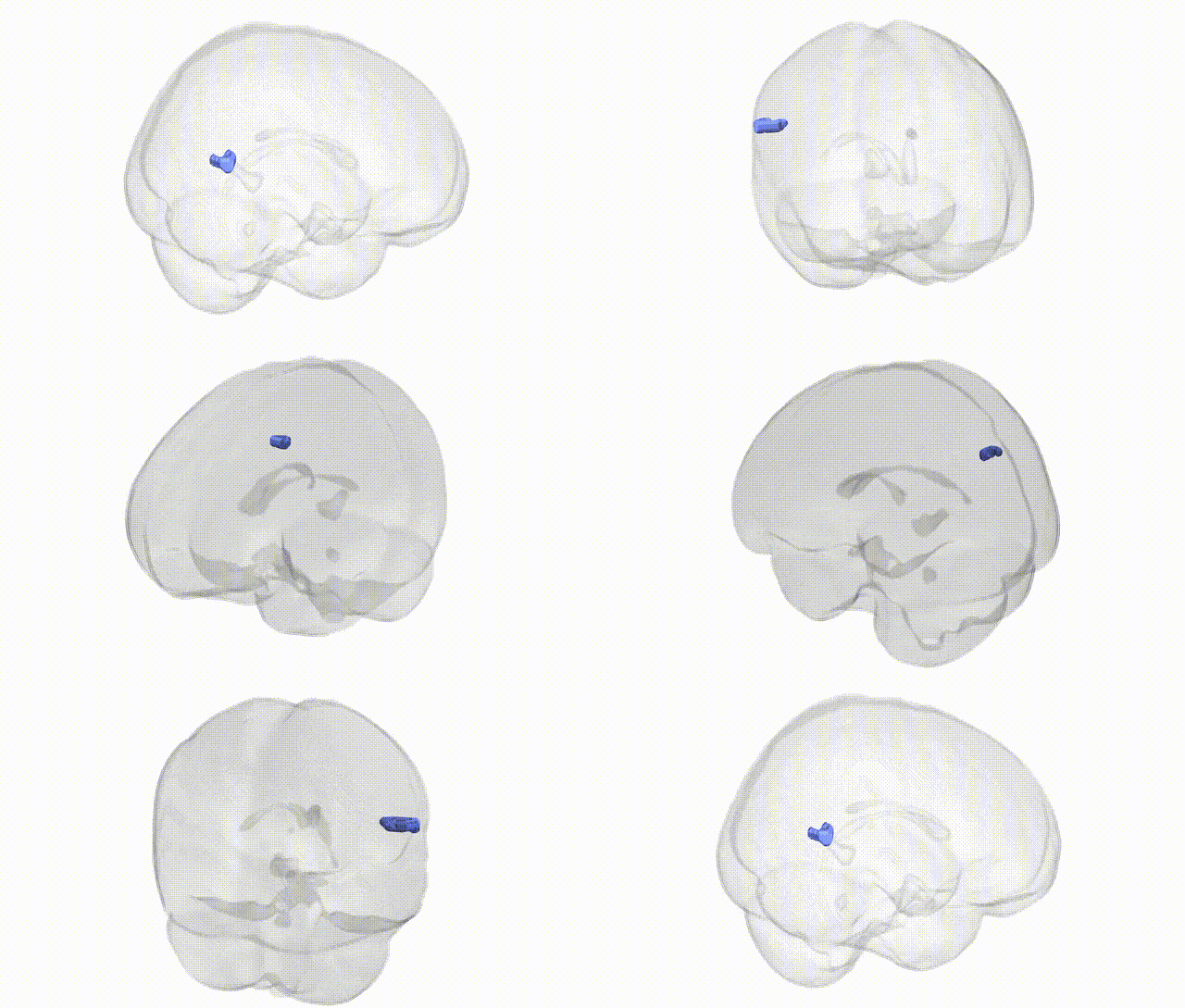
Full Quality Version: Download MP4
Wali Sidiqyar*, Gaurav Rudravaram*, Elyssa M. McMaster, Trent M. Schwartz, Adam M. Saunders, Kurt G. Schilling, Bennett A. Landman "Introducing SPINS: A Shared Public Visualization Library of Neuroanatomical Structures." Medical Imaging with Deep Learning- short paper
This resource is licensed under CC0 1.0 Universal (Public Domain).