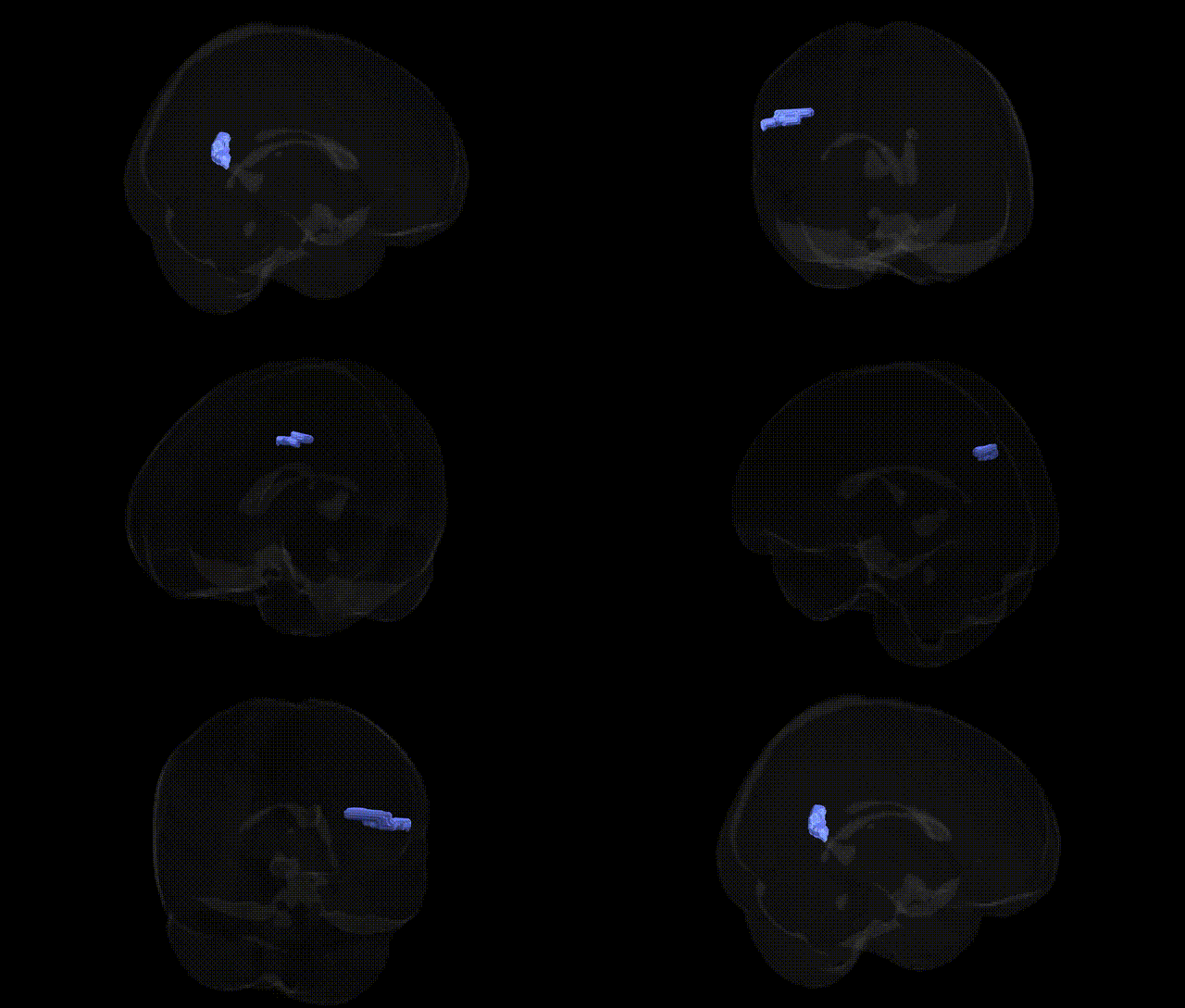
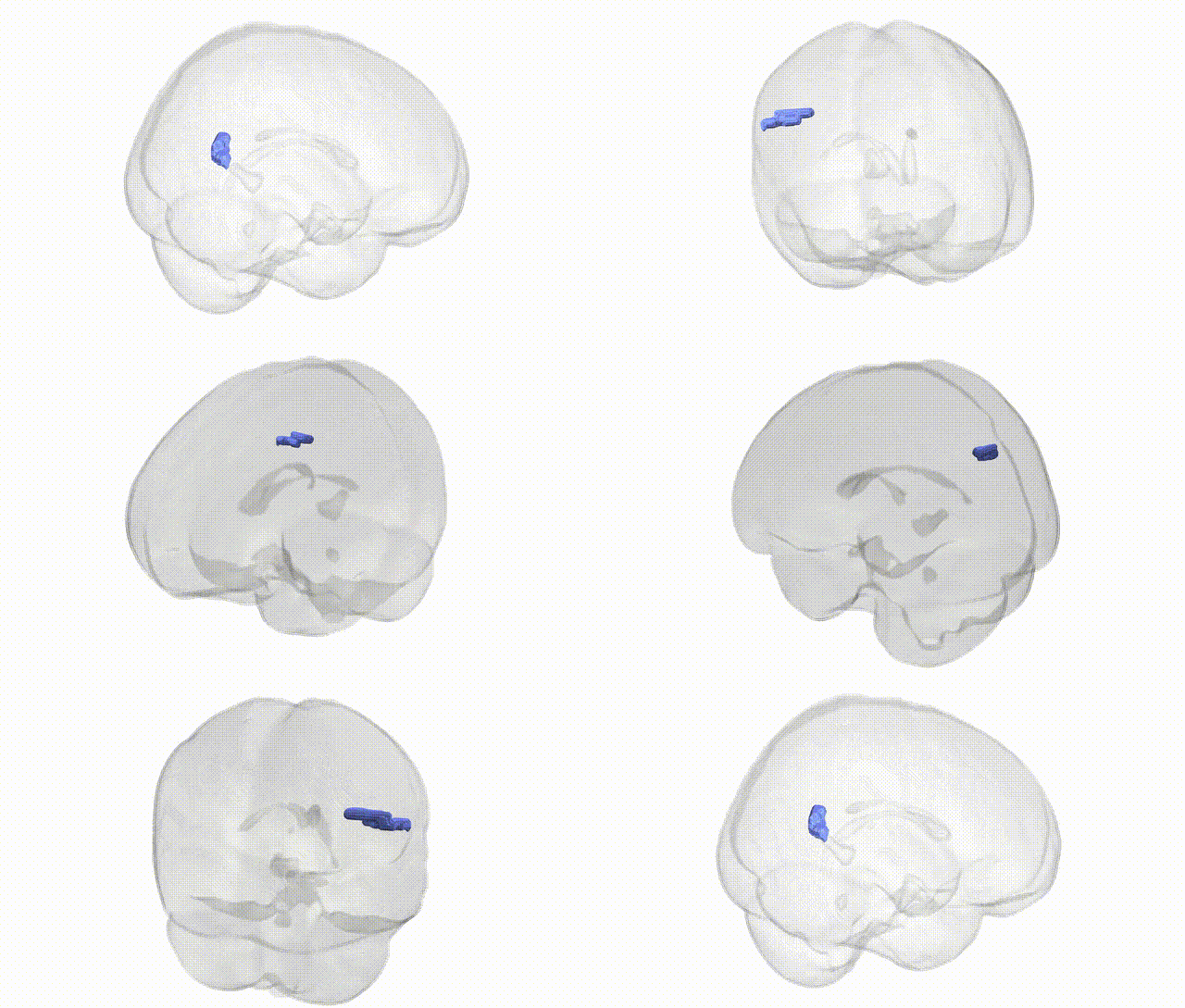
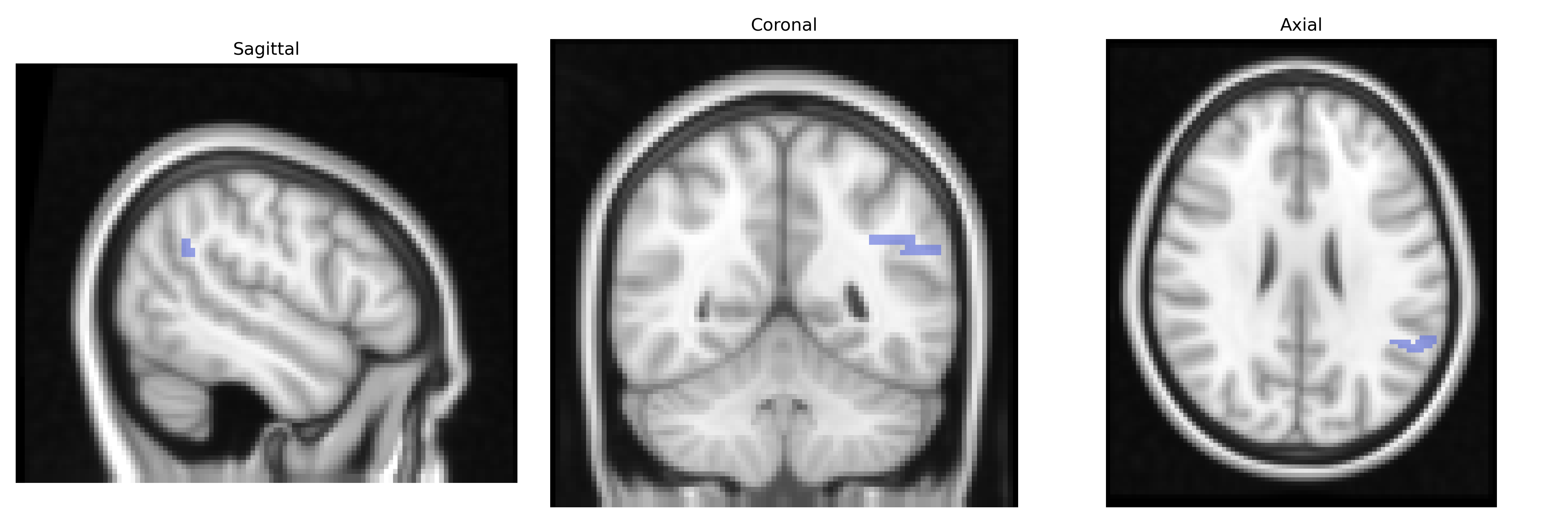
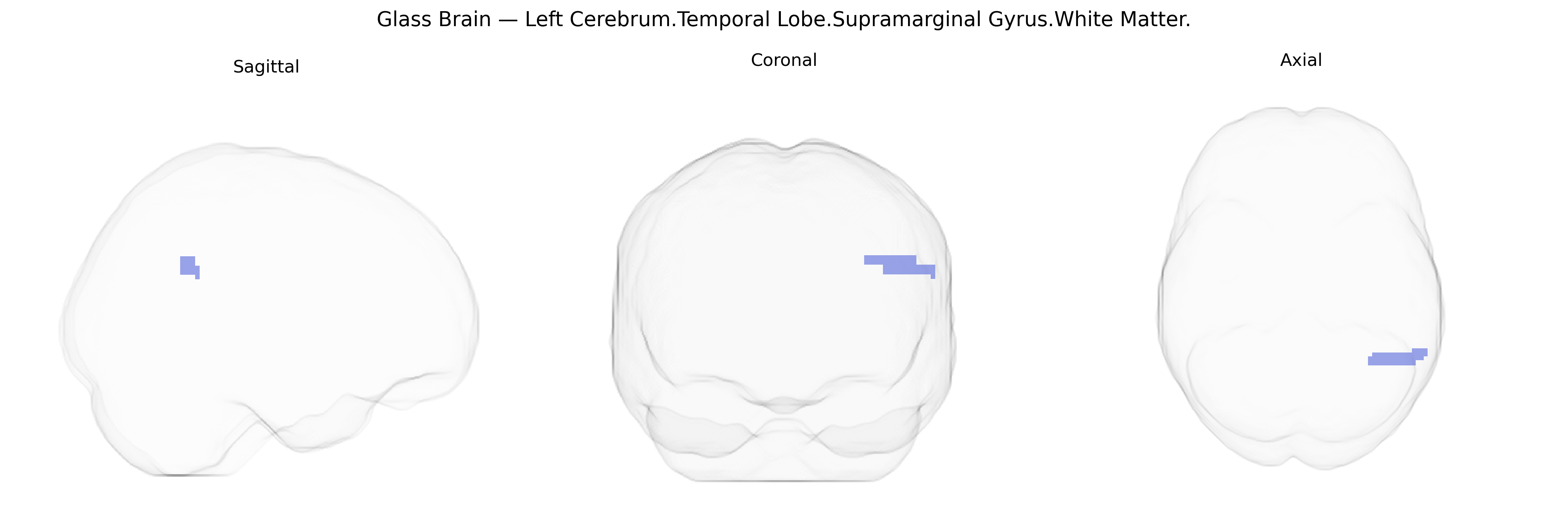
The bilateral Left Cerebrum.Temporal Lobe.Supramarginal Gyrus.White Matter corresponds to subcortical fiber pathways underlying the supramarginal gyrus, a multimodal associative region typically located in the inferior parietal lobule at the parietotemporal junction. This white matter contains association fibers that interconnect supramarginal gyrus cortex with adjacent temporal, parietal, and frontal regions, supporting integrative functions such as phonological processing, language comprehension, sensorimotor integration, and aspects of spatial attention. As part of the broader temporoparietal white matter network, these fibers contribute to dorsal language and attention pathways and interface with long-range tracts such as the arcuate fasciculus and superior longitudinal fasciculus. There is no direct Wikipedia article for this specific white matter region; a related cortical structure is the Supramarginal gyrus.
The bilateral Left Cerebrum.Temporal Lobe.Supramarginal Gyrus.White Matter region, as localized in the Talairach 2mm atlas, has been implicated indirectly through genetic studies of language, reading, and higher-order cognitive traits, although few GWAS isolate this white-matter parcel specifically. Variants in genes related to axon guidance and myelination (e.g., CNTNAP2, FOXP2, DCDC2, KIAA0319) have been associated with structural and functional alterations in perisylvian language networks that include the supramarginal gyrus and its underlying white matter, particularly in developmental dyslexia, specific language impairment, and speech sound disorders. Large-scale imaging genetics consortia (e.g., ENIGMA, UK Biobank) have identified polygenic influences on temporal-parietal white-matter microstructure (fractional anisotropy, mean diffusivity) that overlap this region, with common variants in genes involved in neurodevelopment, synaptic function, and oligodendrocyte biology contributing to interindividual differences in connectivity supporting phonological processing, verbal working memory, and reading ability. In neuropsychiatric GWAS, risk loci for schizophrenia, bipolar disorder, and autism spectrum disorder converge on pathways affecting fronto-temporo-parietal white-matter tracts (including superior longitudinal fasciculus segments coursing near the supramarginal gyrus), consistent with observed heritable reductions in integrity of these fibers and associated deficits in language, social cognition, and executive function. Additionally, polygenic scores for educational attainment and general cognitive ability show associations with white-matter properties in temporal and parietal regions that encompass this atlas-defined area, suggesting that distributed genetic influences on neurodevelopment and myelination partly shape the structural substrate of language and higher cognition within its supramarginal white matter.
Overview generated by GPT-4o (2026).
Region ID: 870
Hemisphere: bilateral
Atlas: Talairach labels 2mm
Full Quality Version: Download MP4
Full Quality Version: Download MP4
Wali Sidiqyar*, Gaurav Rudravaram*, Elyssa M. McMaster, Trent M. Schwartz, Adam M. Saunders, Kurt G. Schilling, Bennett A. Landman "Introducing SPINS: A Shared Public Visualization Library of Neuroanatomical Structures." Medical Imaging with Deep Learning- short paper
This resource is licensed under CC0 1.0 Universal (Public Domain).