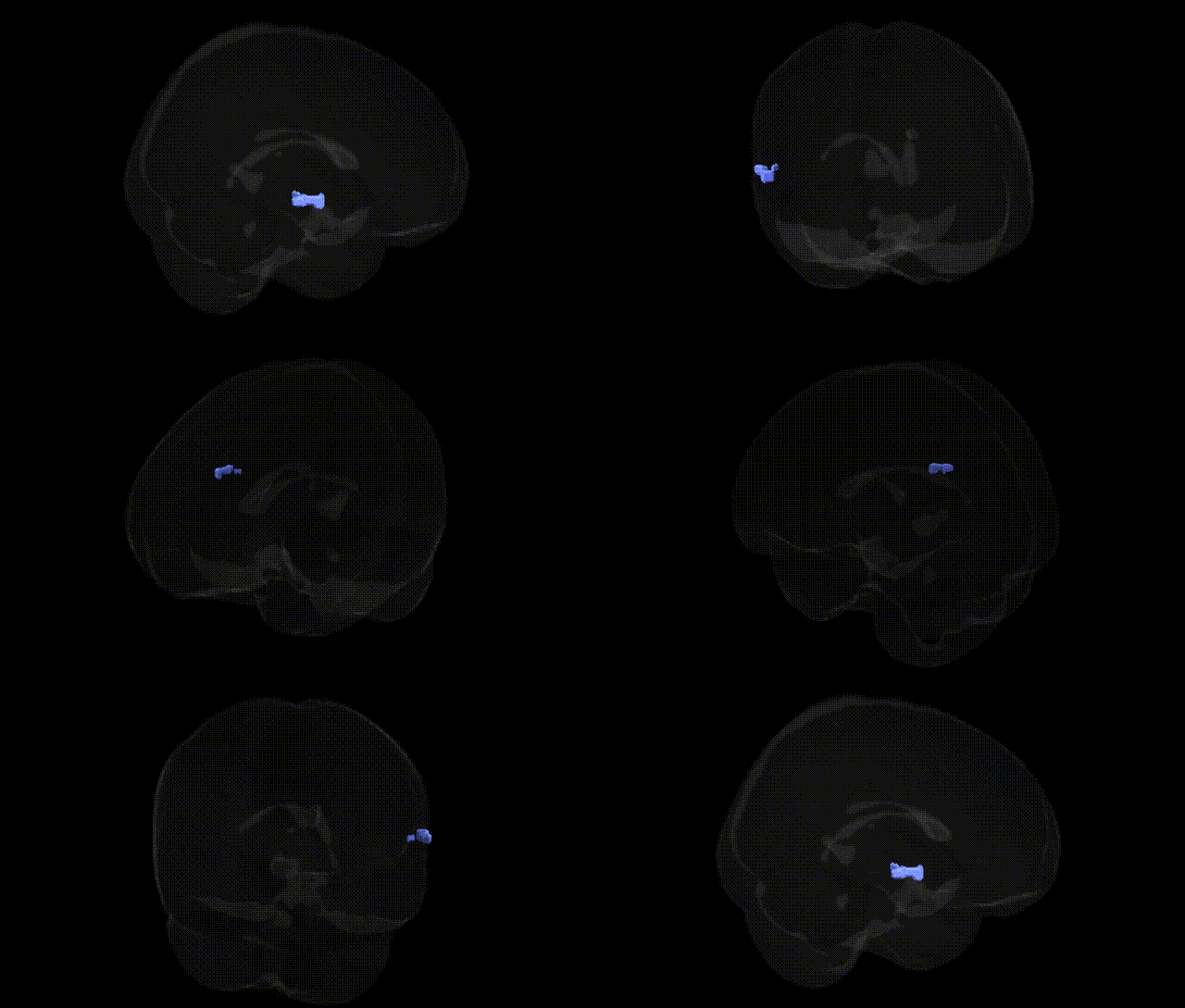
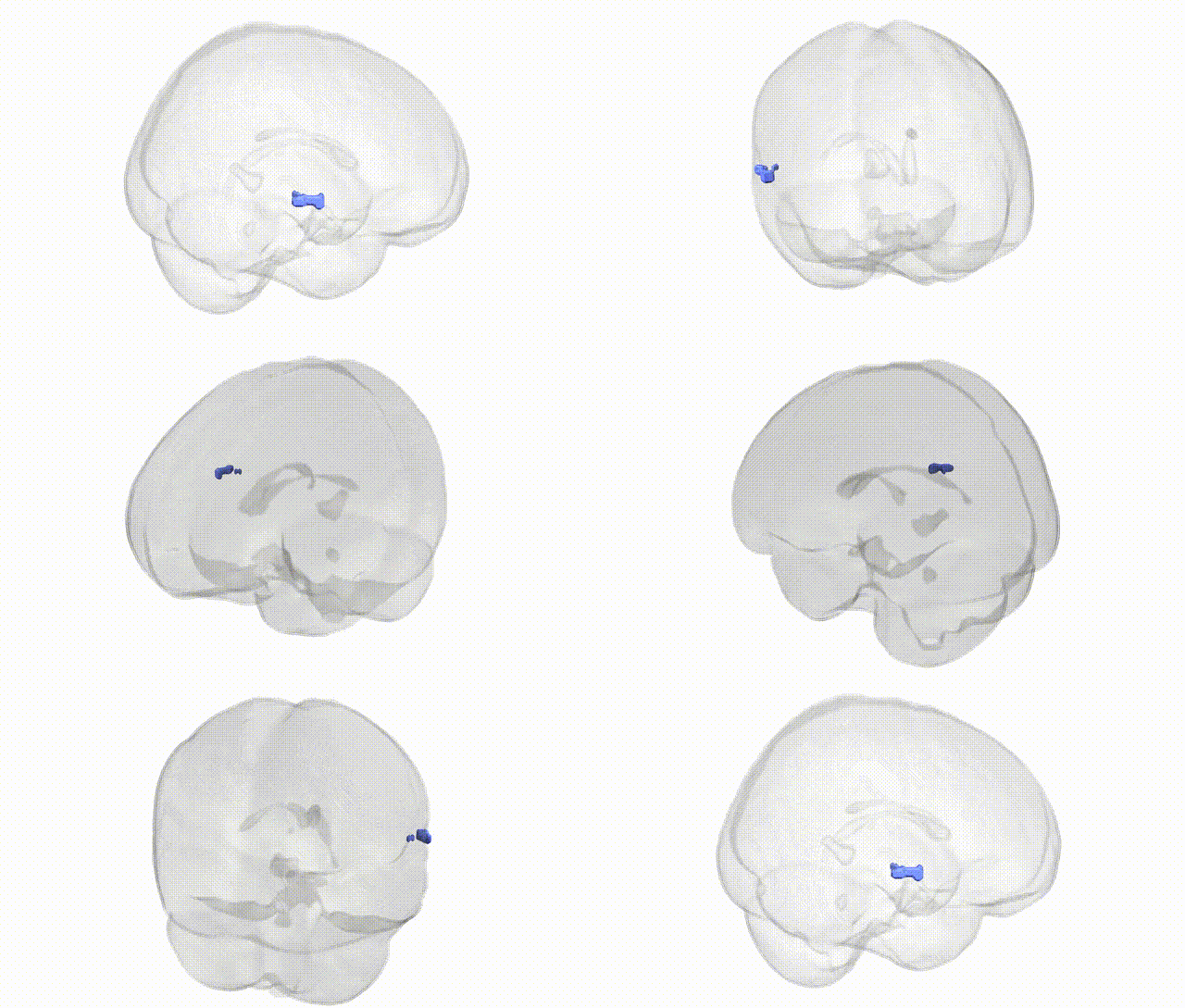
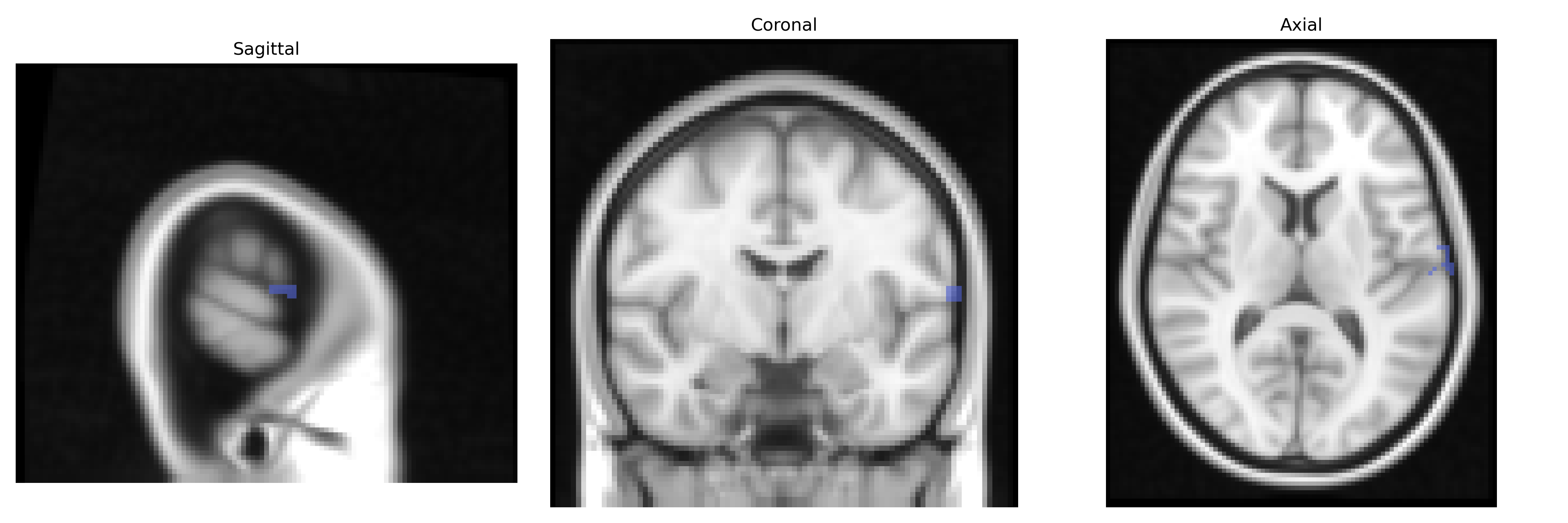
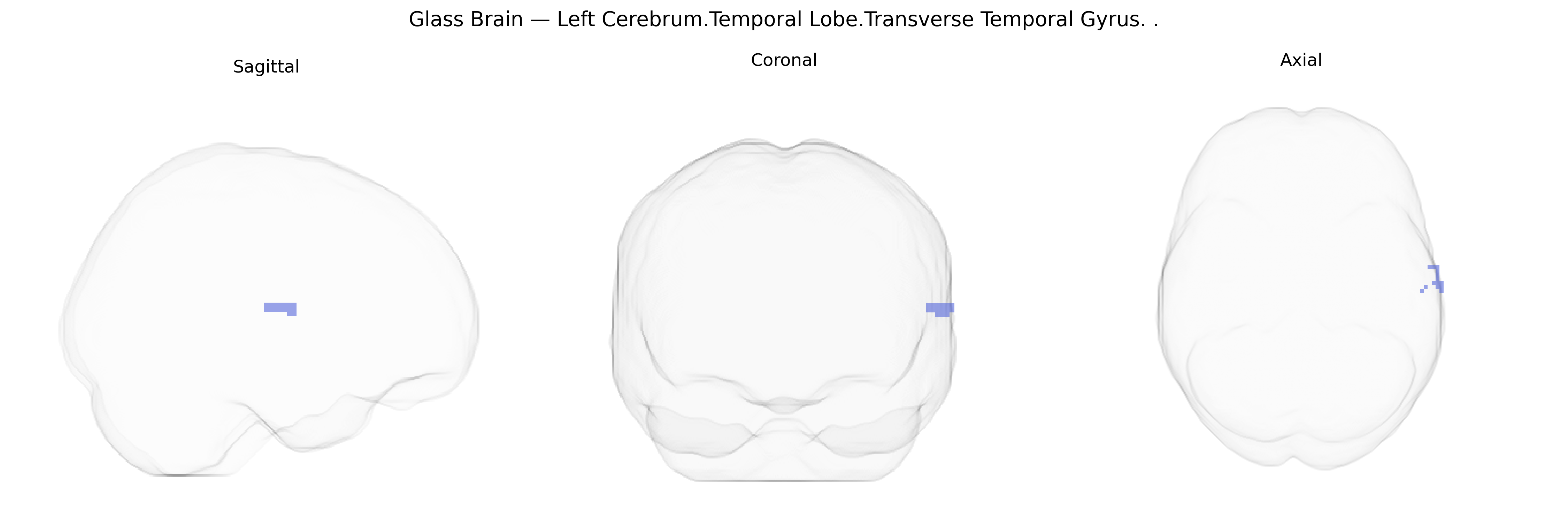
The bilateral left cerebrum temporal lobe transverse temporal gyrus corresponds primarily to Heschl’s gyrus, a short, obliquely oriented cortical fold buried within the lateral (Sylvian) fissure on the superior surface of the temporal lobe. It forms the core of the primary auditory cortex (Brodmann areas 41 and partially 42), receiving tonotopically organized input from the medial geniculate nucleus of the thalamus and playing a critical role in early-stage processing of acoustic features such as frequency, intensity, and temporal patterns. Neuronal populations here are specialized for sound detection and discrimination, including speech and complex environmental sounds, and provide essential feedforward outputs to surrounding auditory association cortices involved in higher-order perceptual and linguistic processing. Transverse temporal gyrus
The bilateral Left Cerebrum Temporal Lobe Transverse Temporal Gyrus (primary auditory cortex, including Heschl’s gyrus) has been implicated in several genetic and GWAS-based findings, largely through studies of cortical thickness/surface area, auditory processing, and neuropsychiatric traits. Large imaging-genetics consortia such as ENIGMA and UK Biobank have identified heritable variation in temporal lobe auditory cortex morphology, with common variants near genes involved in neurodevelopment and synaptic function (for example, loci near DACT1, TBR1, and other cortex-patterning genes) contributing to Heschl’s gyrus surface area and gyrification. GWAS of musical aptitude and pitch perception have reported associations in or near genes regulating cortical auditory circuitry, consistent with inter-individual variability in transverse temporal gyrus function, although specific loci remain under active investigation. Structural and functional abnormalities in this region are frequently reported in schizophrenia, bipolar disorder, and major depressive disorder, and several psychiatric GWAS highlight temporal cortex–expressed genes (such as GRIN2A and CACNA1C) whose risk variants may influence auditory cortex physiology and hallucination susceptibility. Additionally, autism spectrum disorder and developmental language disorder studies have shown that risk genes involved in cortical layering and synaptogenesis (including CNTNAP2, FOXP2-related networks, and other neuronal adhesion and transcriptional regulators) are expressed in early-developing temporal auditory areas, linking genetic variation to atypical development of the transverse temporal gyrus and altered speech and sound processing. Overall, current evidence points to polygenic influences on the structure and function of this auditory cortical region, with overlapping genetic architectures across cognitive, language, musical, and psychiatric phenotypes, although few associations are uniquely specific to the transverse temporal gyrus in Talairach-defined space.
Overview generated by GPT-4o (2026).
Region ID: 728
Hemisphere: bilateral
Atlas: Talairach labels 2mm
Full Quality Version: Download MP4
Full Quality Version: Download MP4
Wali Sidiqyar*, Gaurav Rudravaram*, Elyssa M. McMaster, Trent M. Schwartz, Adam M. Saunders, Kurt G. Schilling, Bennett A. Landman "Introducing SPINS: A Shared Public Visualization Library of Neuroanatomical Structures." Medical Imaging with Deep Learning- short paper
This resource is licensed under CC0 1.0 Universal (Public Domain).