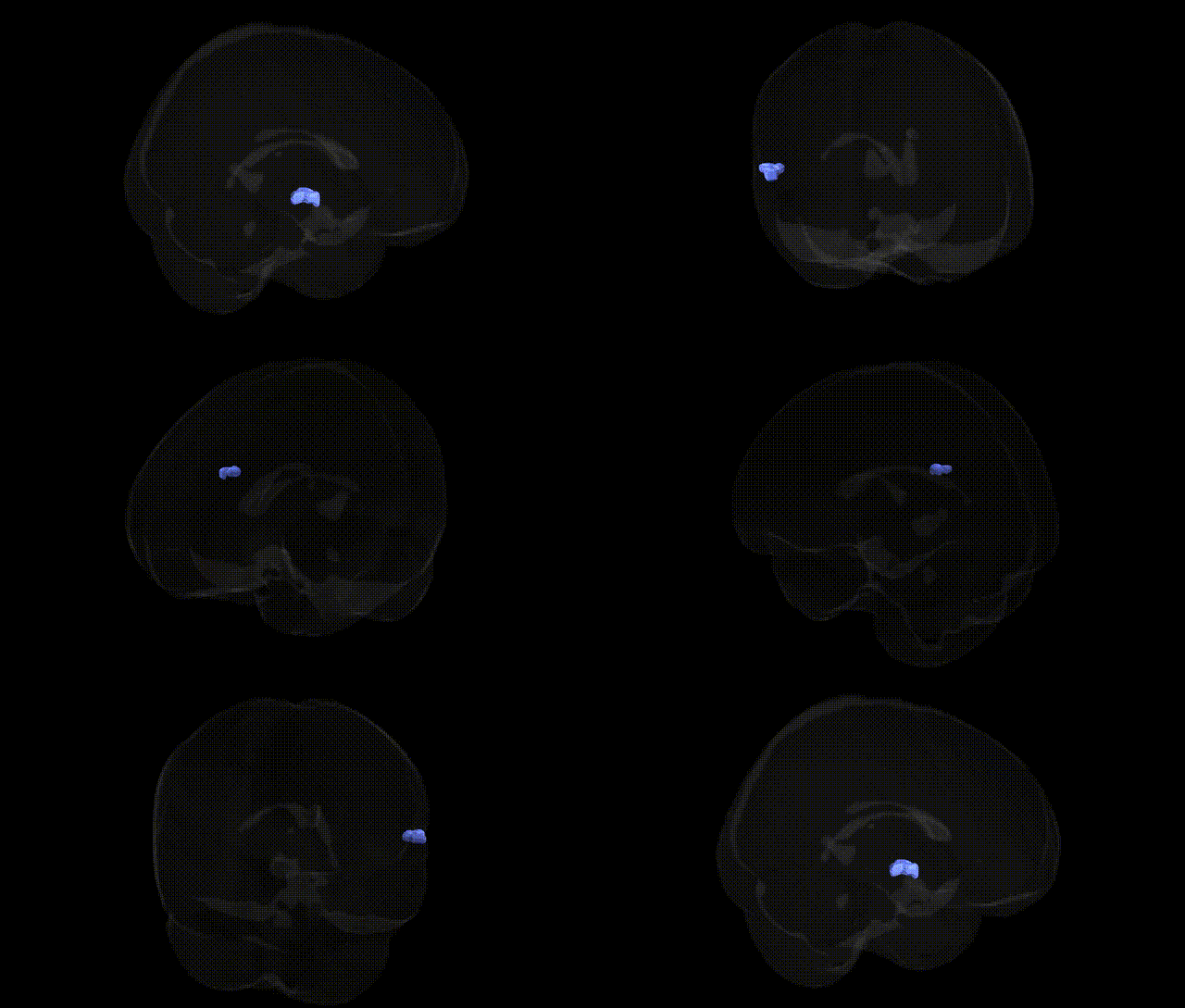
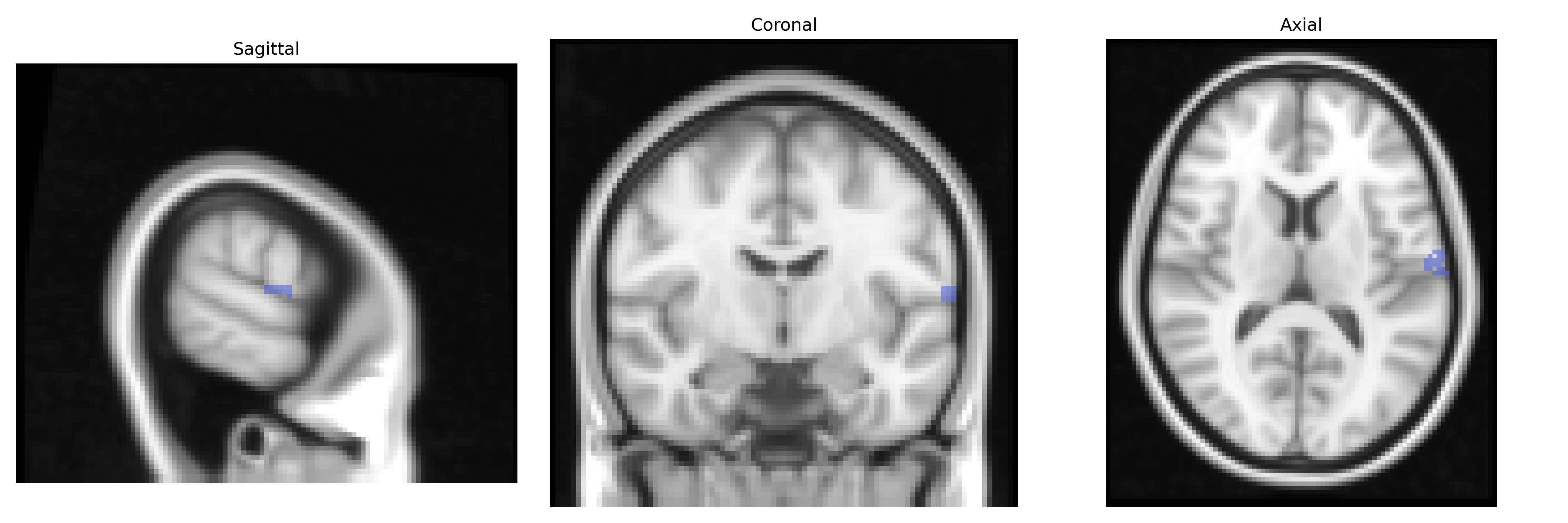
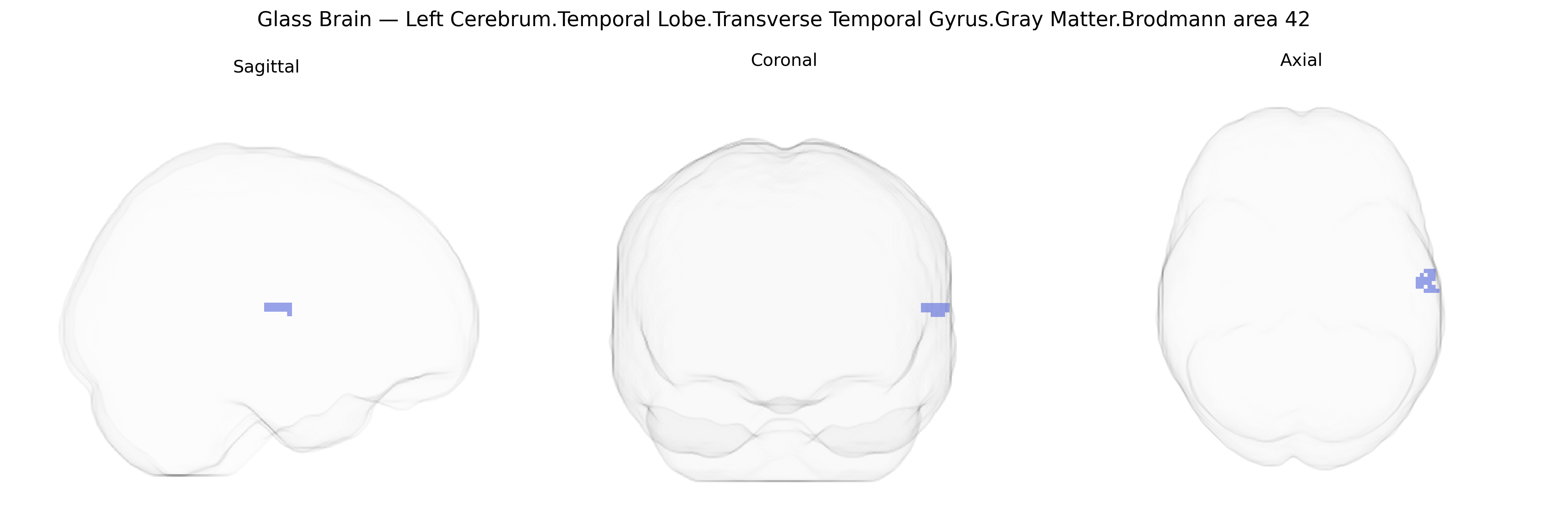
The bilateral Left Cerebrum.Temporal Lobe.Transverse Temporal Gyrus.Gray Matter.Brodmann area 42 corresponds to the secondary auditory cortex located in the transverse temporal gyrus (Heschl’s gyrus) of the temporal lobe. Brodmann area 42 lies adjacent to primary auditory cortex (BA41) and participates in higher-order processing of acoustic information, including complex sound patterns and aspects of speech perception. Neuronal populations in this region receive thalamocortical input from the medial geniculate nucleus and are organized tonotopically, contributing to the integration and interpretation of auditory stimuli rather than basic sound detection. Functionally, BA42 is implicated in auditory discrimination, phonological processing, and the early cortical stages of language-related sound analysis, with hemispheric differences reflecting specialization for speech (left) and more general acoustic features (right). There is no direct Wikipedia article for Brodmann area 42; a closely related structure is the Auditory cortex.
The bilateral left Transverse Temporal Gyrus (Brodmann area 42), a core Heschl’s gyrus/auditory association region, has been implicated in genetic studies of cortical morphology, language, and neuropsychiatric risk. Large neuroimaging GWAS (e.g., ENIGMA, UK Biobank) have identified common variants near genes involved in neuronal development and synaptic signaling—such as KIAA0586, DACT1, and several glutamatergic and GABAergic pathway genes—associated with cortical thickness and surface area in superior and transverse temporal regions that encompass BA42, with heritability estimates for auditory cortex morphology often in the 40–70% range. Variants linked to developmental language disorder, dyslexia, and specific language impairment (including loci near CNTNAP2, DCDC2, KIAA0319 and FOXP2-regulated networks) show convergent evidence of altered structure or activation in superior/transverse temporal gyri, highlighting genetic influences on phonological and speech-processing circuits. Schizophrenia and bipolar disorder GWAS, particularly those implicating complement and synaptic genes (e.g., C4A, GRIN2A, CACNA1C), have been associated with gray-matter reductions and functional abnormalities in left Heschl’s/superior temporal regions, consistent with auditory hallucinations and language disturbances. Autism spectrum disorder risk genes affecting cortical microcircuitry (e.g., NRXN1, SHANK3) have also been linked to atypical auditory and language-related activity in adjacent temporal auditory cortex. Although few GWAS target BA42 specifically, converging genetic, imaging, and clinical data support a model in which polygenic variation in neurodevelopmental, synaptic, and language-related genes contributes to individual differences and disorder-related alterations in the gray matter of the left Transverse Temporal Gyrus.
Overview generated by GPT-4o (2026).
Region ID: 729
Hemisphere: bilateral
Atlas: Talairach labels 2mm
Full Quality Version: Download MP4
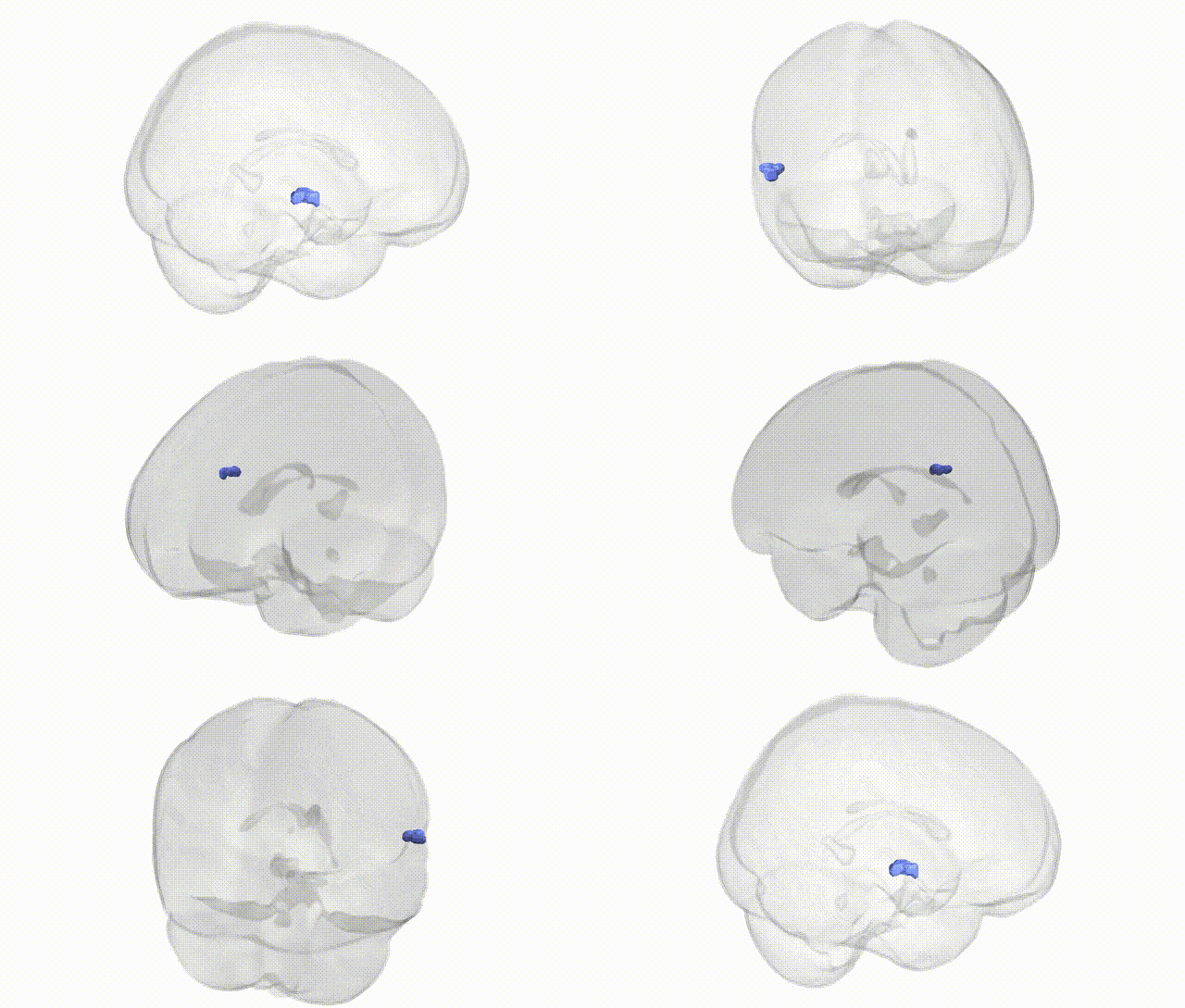
Full Quality Version: Download MP4
Wali Sidiqyar*, Gaurav Rudravaram*, Elyssa M. McMaster, Trent M. Schwartz, Adam M. Saunders, Kurt G. Schilling, Bennett A. Landman "Introducing SPINS: A Shared Public Visualization Library of Neuroanatomical Structures." Medical Imaging with Deep Learning- short paper
This resource is licensed under CC0 1.0 Universal (Public Domain).