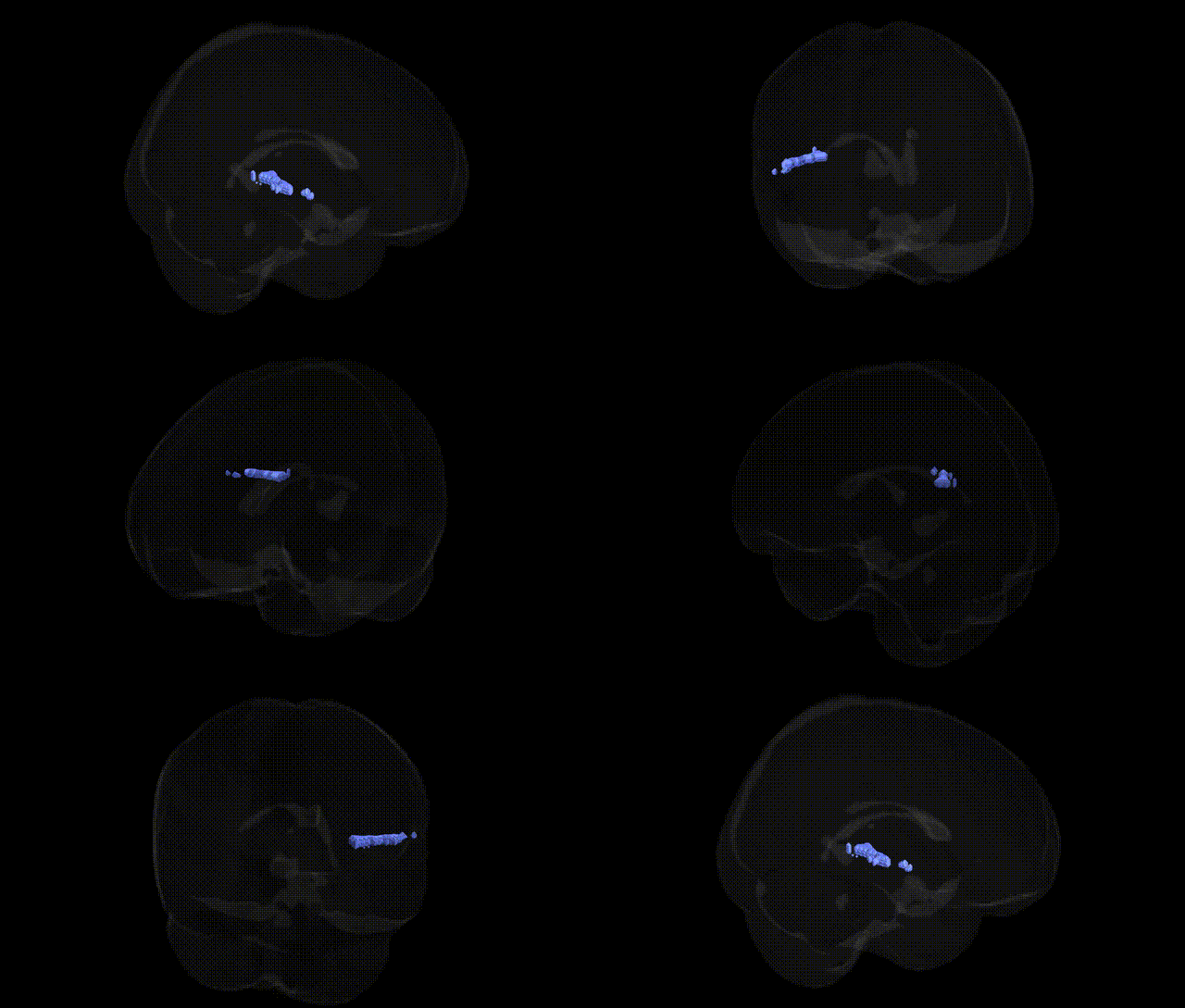
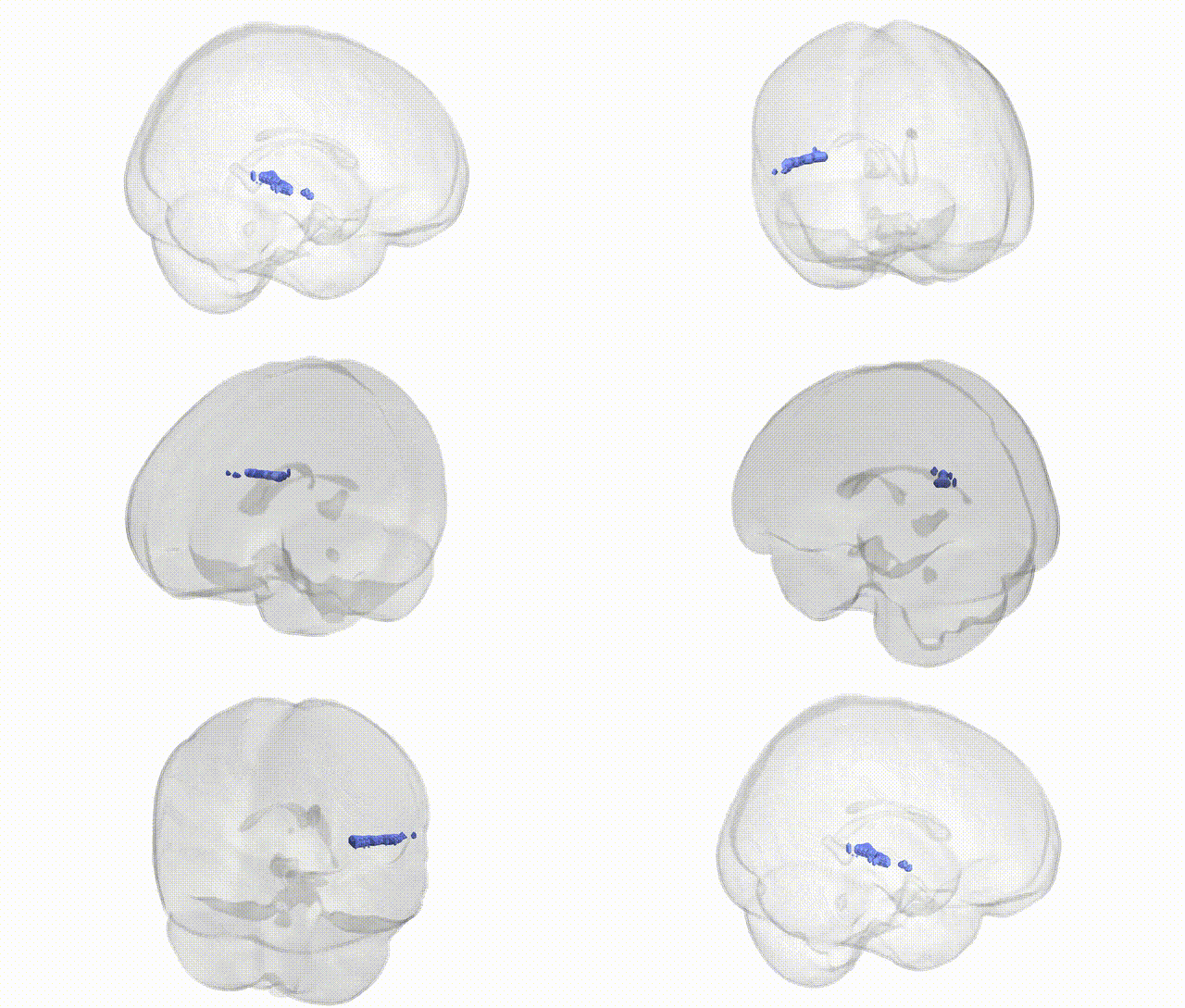
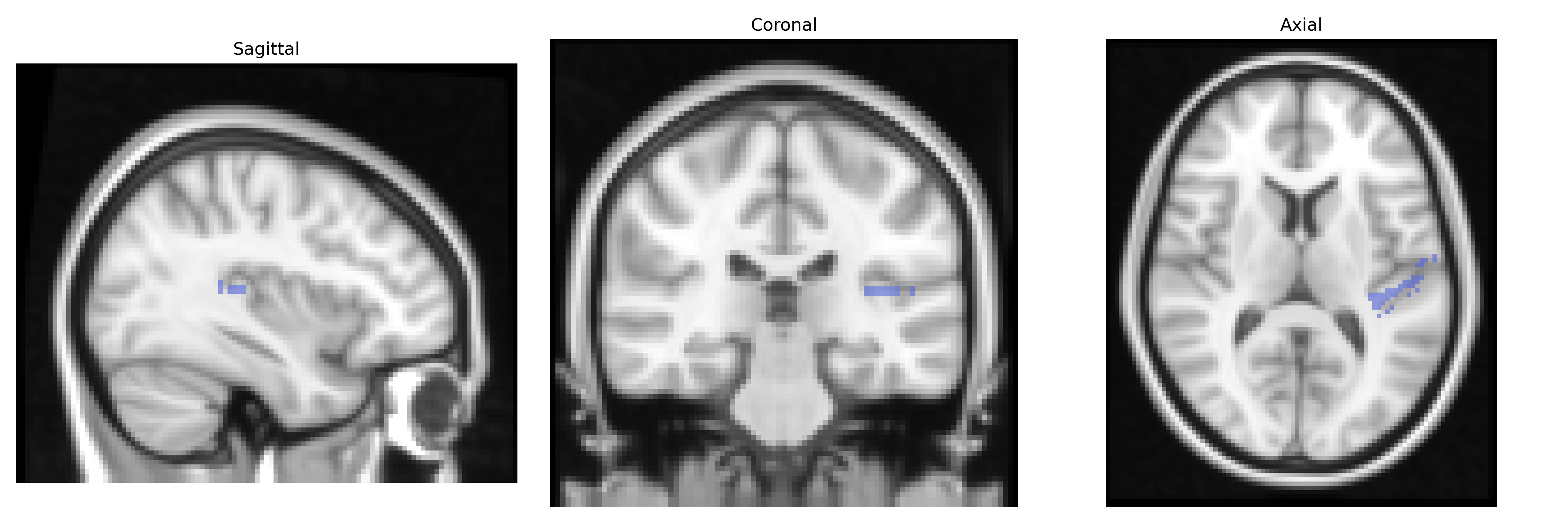
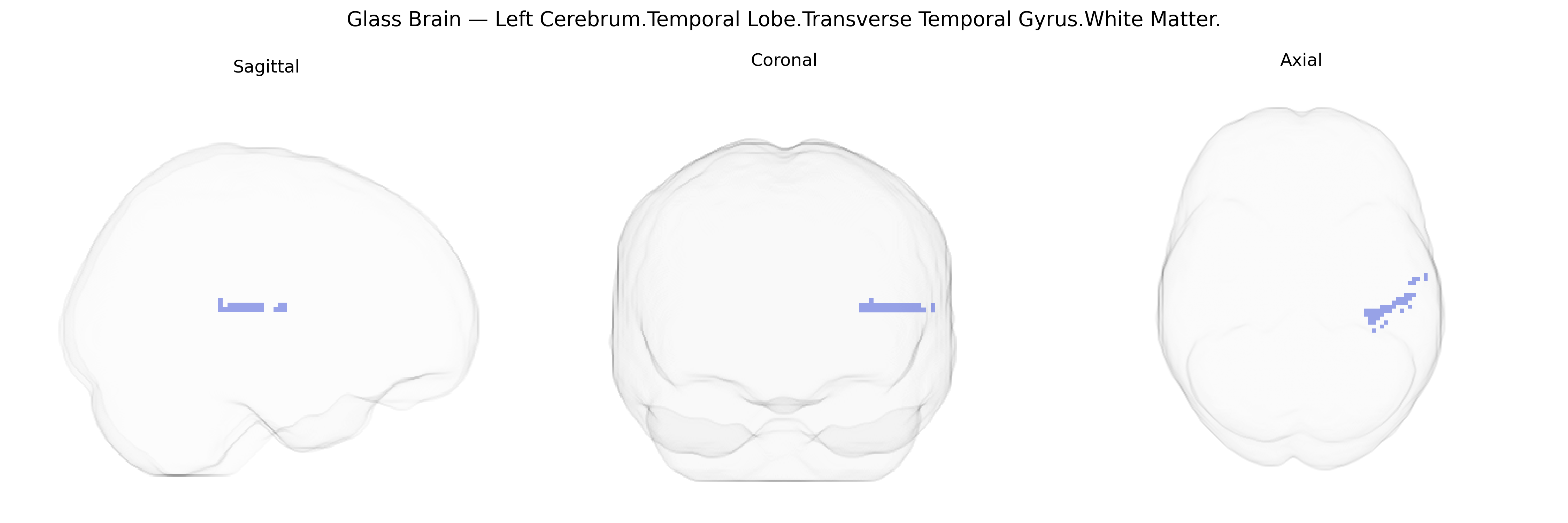
The bilateral Left Cerebrum.Temporal Lobe.Transverse Temporal Gyrus.White Matter corresponds to the subcortical fiber pathways underlying the transverse temporal gyri (Heschl’s gyri) in the left temporal lobe, a key region for early stages of auditory processing. These white matter tracts contain myelinated axons that connect primary auditory cortex with adjacent auditory association areas, higher-order temporal regions, and thalamic nuclei (notably the medial geniculate body), supporting sound perception, spectral and temporal analysis, and integration of auditory information with language-related networks. In the Talairach 2 mm atlas, this label marks the deep portion of the transverse temporal gyrus, emphasizing its role as a conduit for auditory information flow rather than a primary site of neuronal cell bodies. There is no direct Wikipedia article for the specific white matter of the transverse temporal gyrus; a related cortical structure is Heschl’s gyrus.
The bilateral Left Cerebrum Temporal Lobe Transverse Temporal Gyrus White Matter corresponds largely to the white-matter pathways serving primary auditory cortex (Heschl’s gyrus) and adjacent temporal regions, and genetic associations involving this area generally arise from imaging genetics studies of auditory cortex structure, connectivity, and related phenotypes. GWAS of regional brain volumes and cortical characteristics (e.g., ENIGMA and UK Biobank studies) have identified multiple loci influencing temporal lobe and auditory cortex morphology—often in or near genes involved in neurodevelopment, synaptic function, and axon guidance (such as DLG2, GRIN2B, NRXN1, and genes in the cadherin/protocadherin families)—with some effects mapping to white-matter microstructure (e.g., fractional anisotropy and mean diffusivity) in temporal lobe tracts. Although the Talairach 2 mm transverse temporal gyrus white matter label is not typically analyzed as a standalone region in GWAS, broader temporal lobe and auditory pathway measures overlapping this area have been genetically linked to language and reading abilities, speech and music perception, and susceptibility to neurodevelopmental conditions such as autism spectrum disorder and developmental language disorder, as well as to psychiatric traits like schizophrenia and hallucination-related phenotypes that show structural and functional alterations in Heschl’s gyrus. Moreover, large-scale GWAS of white-matter integrity have implicated variants affecting myelination and oligodendrocyte biology (e.g., in genes such as MAG, MBP, and CNTN4) in temporal lobe tracts that traverse or border this region, supporting a partly shared genetic architecture between this specific white-matter label and more global measures of auditory-temporal connectivity, cognitive performance, and risk for common neuropsychiatric disorders.
Overview generated by GPT-4o (2026).
Region ID: 717
Hemisphere: bilateral
Atlas: Talairach labels 2mm
Full Quality Version: Download MP4
Full Quality Version: Download MP4
Wali Sidiqyar*, Gaurav Rudravaram*, Elyssa M. McMaster, Trent M. Schwartz, Adam M. Saunders, Kurt G. Schilling, Bennett A. Landman "Introducing SPINS: A Shared Public Visualization Library of Neuroanatomical Structures." Medical Imaging with Deep Learning- short paper
This resource is licensed under CC0 1.0 Universal (Public Domain).