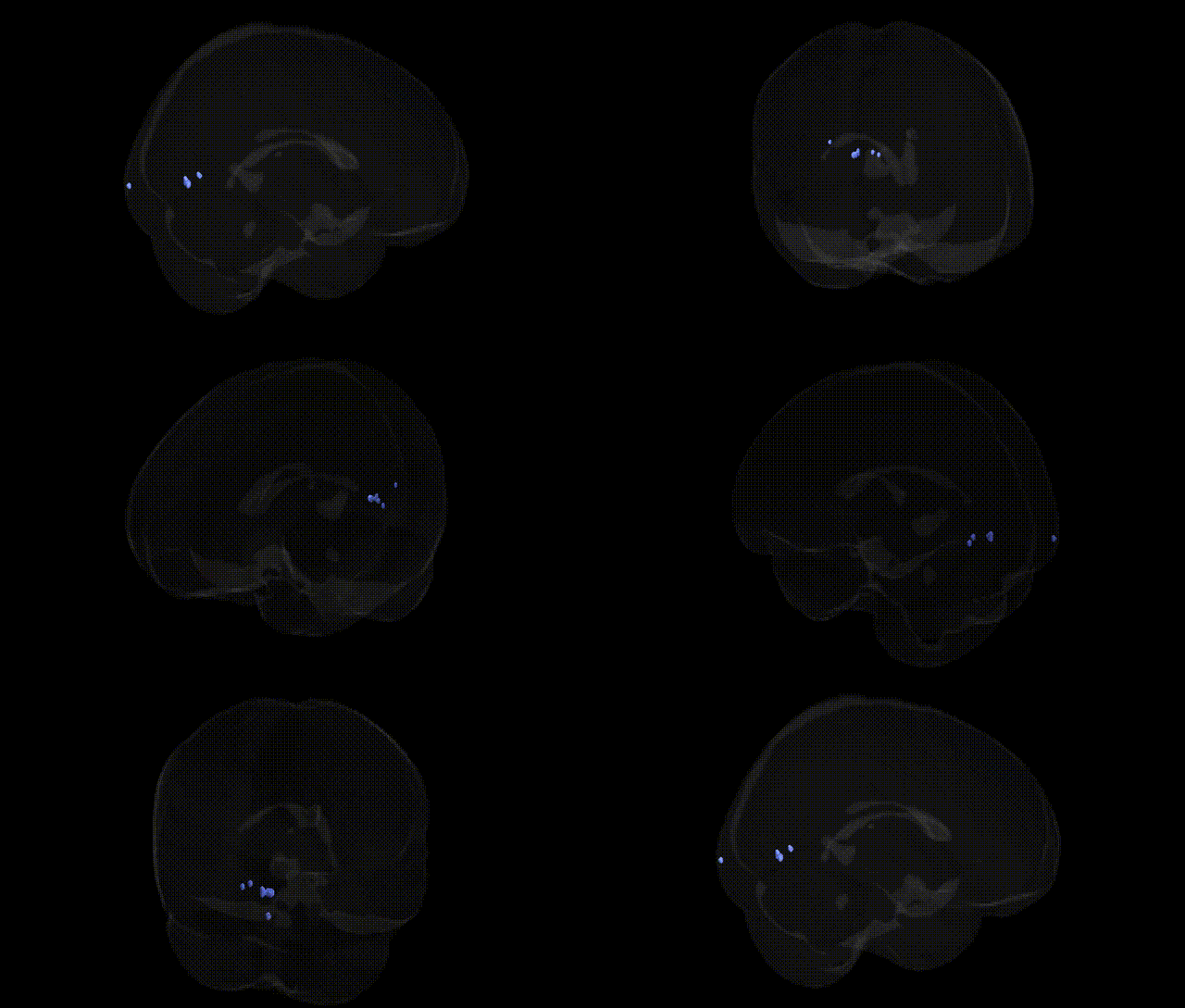
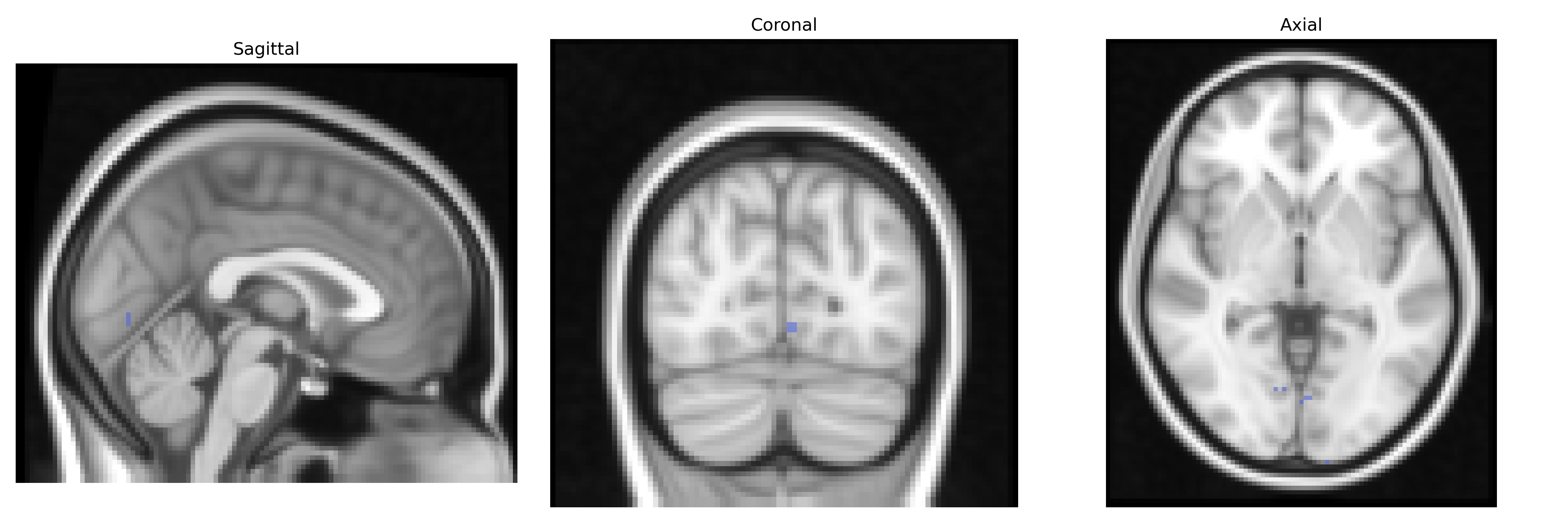
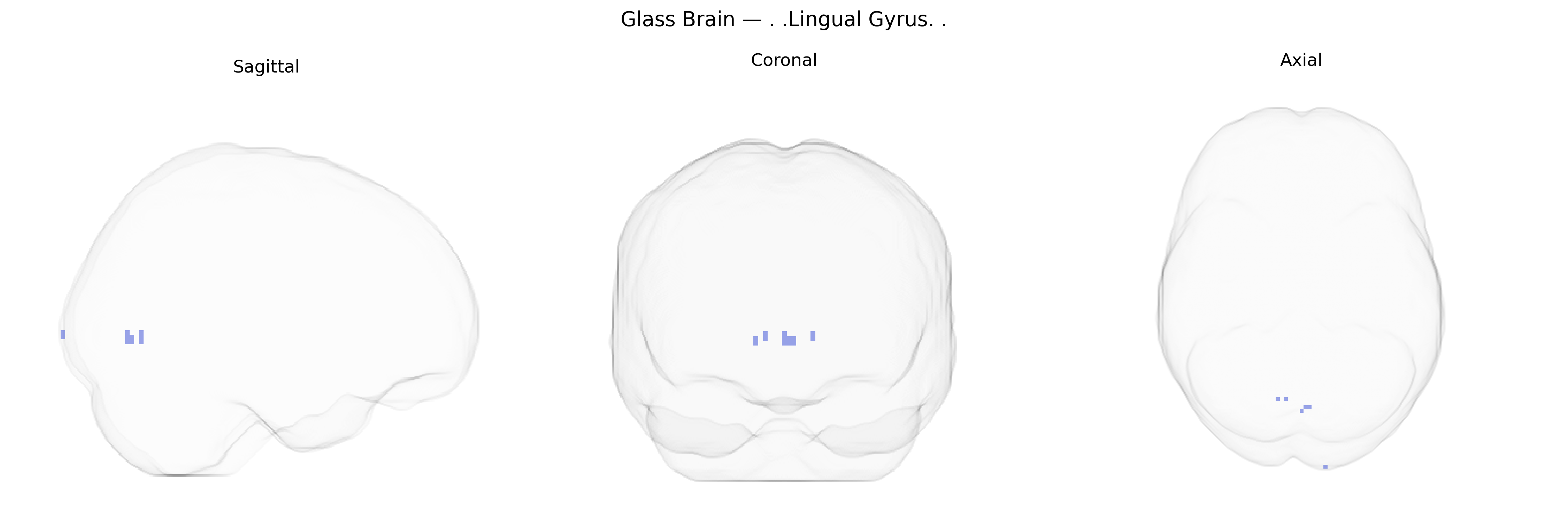
The bilateral lingual gyrus is a paired cortical region of the occipital lobe located on the ventral (inferior) surface of the brain, extending from the posterior calcarine sulcus toward the temporal lobe. It is primarily involved in visual processing, particularly in the analysis of complex visual stimuli, letter and word recognition, and aspects of visual memory, and also contributes to processing of scenes and visual imagery. Functionally, it is part of the ventral visual stream (“what” pathway), integrating visual input with higher-order perceptual and cognitive processes, and shows activation in tasks involving reading, face and object perception, and certain forms of visual attention. The lingual gyrus receives input from primary and secondary visual cortices and is interconnected with temporal and parietal association areas, supporting multimodal integration of visual information. Lingual gyrus
The bilateral lingual gyrus, a ventral occipital region implicated in visual processing, memory, and emotion, has been repeatedly highlighted in imaging genetics and GWAS of brain structure and cognition. Large-scale neuroimaging GWAS (e.g., ENIGMA, UK Biobank) have identified multiple common variants associated with occipital and lingual cortical thickness, surface area, and volume, including loci near genes involved in neurodevelopment (such as MAPT, HMGA2, and variants in or near glutamatergic and synaptic genes), though findings are typically reported at lobar or occipital-complex level rather than Talairach-defined lingual gyrus alone. Polygenic scores for general cognitive ability and educational attainment correlate with structural and functional measures in the lingual gyrus, consistent with its role in visual learning and reading-related processes. Genetic studies of reading and dyslexia (e.g., variants in KIAA0319, DCDC2) frequently report altered activation or structure in posterior occipitotemporal regions that encompass or border the lingual gyrus. GWAS and imaging-genetic studies in major depressive disorder, schizophrenia, and bipolar disorder have associated risk variants and polygenic burden with functional and structural alterations in the lingual gyrus, including visual and emotional processing deficits, although these links tend to be part of broader occipital and limbic-cortical circuits rather than region-specific effects. Additionally, variants linked to migraine, PTSD, and anxiety traits have been connected to altered lingual gyrus activation in response to visual or emotional stimuli, suggesting that genetic influences on sensory integration and affective processing partially converge on this region. Overall, genetic associations involving the lingual gyrus are robust at the level of occipital and visual cortices, but fine-grained, region-specific GWAS constrained to the Talairach 2 mm lingual label remain limited, with most evidence emerging from multimodal imaging-genetics analyses of broader visual and cognitive networks.
Overview generated by GPT-4o (2026).
Region ID: 239
Hemisphere: bilateral
Atlas: Talairach labels 2mm
Full Quality Version: Download MP4
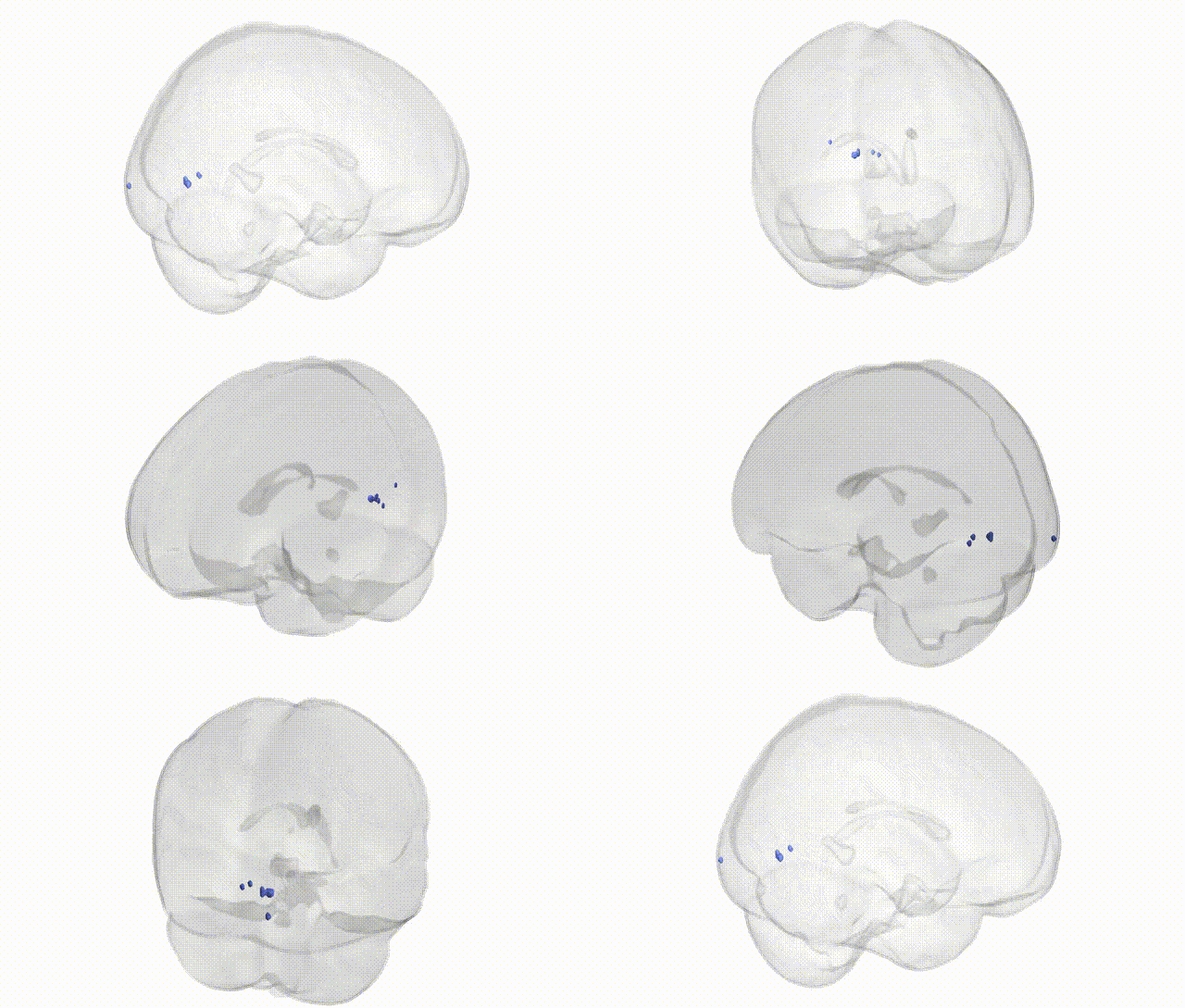
Full Quality Version: Download MP4
Wali Sidiqyar*, Gaurav Rudravaram*, Elyssa M. McMaster, Trent M. Schwartz, Adam M. Saunders, Kurt G. Schilling, Bennett A. Landman "Introducing SPINS: A Shared Public Visualization Library of Neuroanatomical Structures." Medical Imaging with Deep Learning- short paper
This resource is licensed under CC0 1.0 Universal (Public Domain).