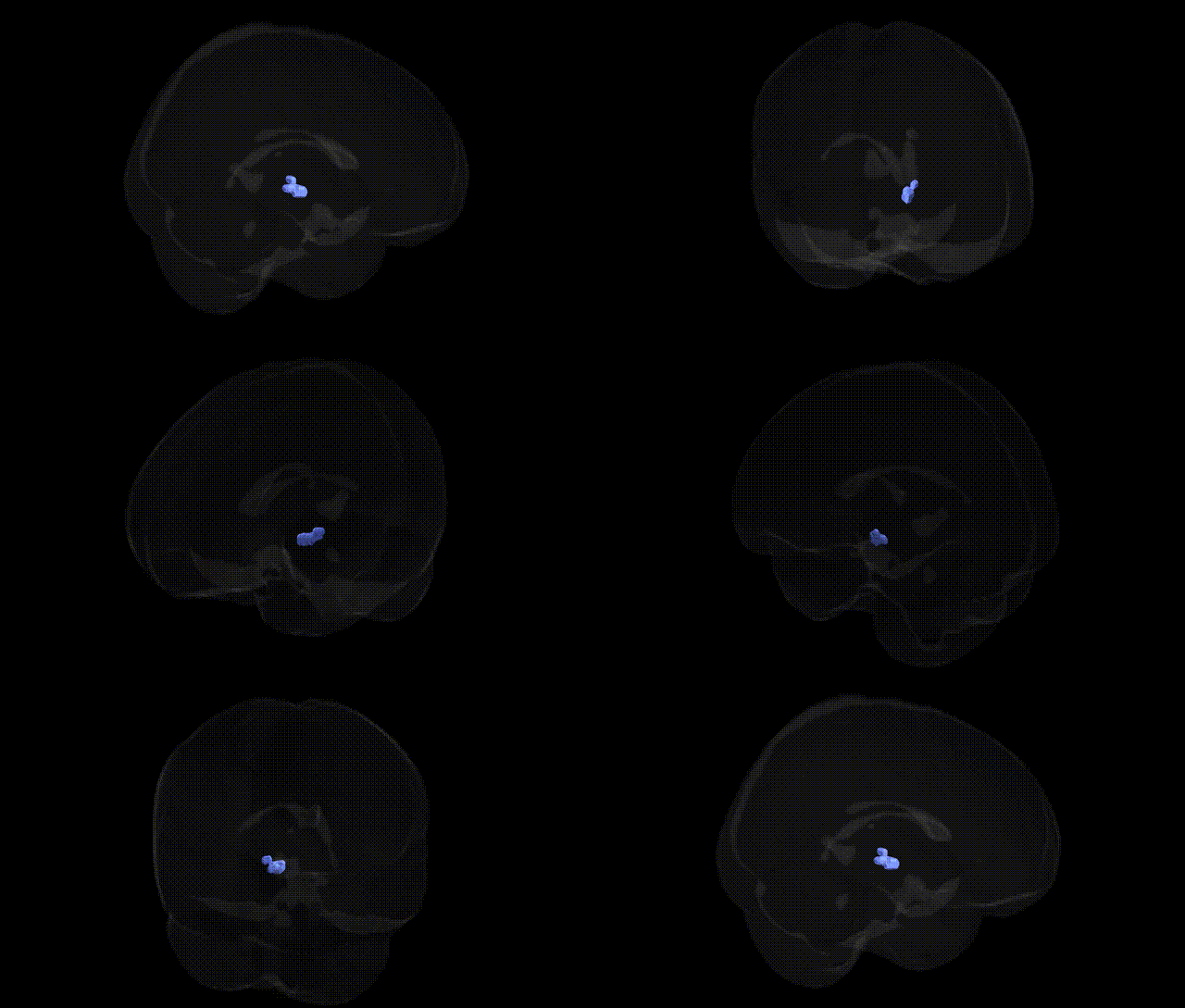
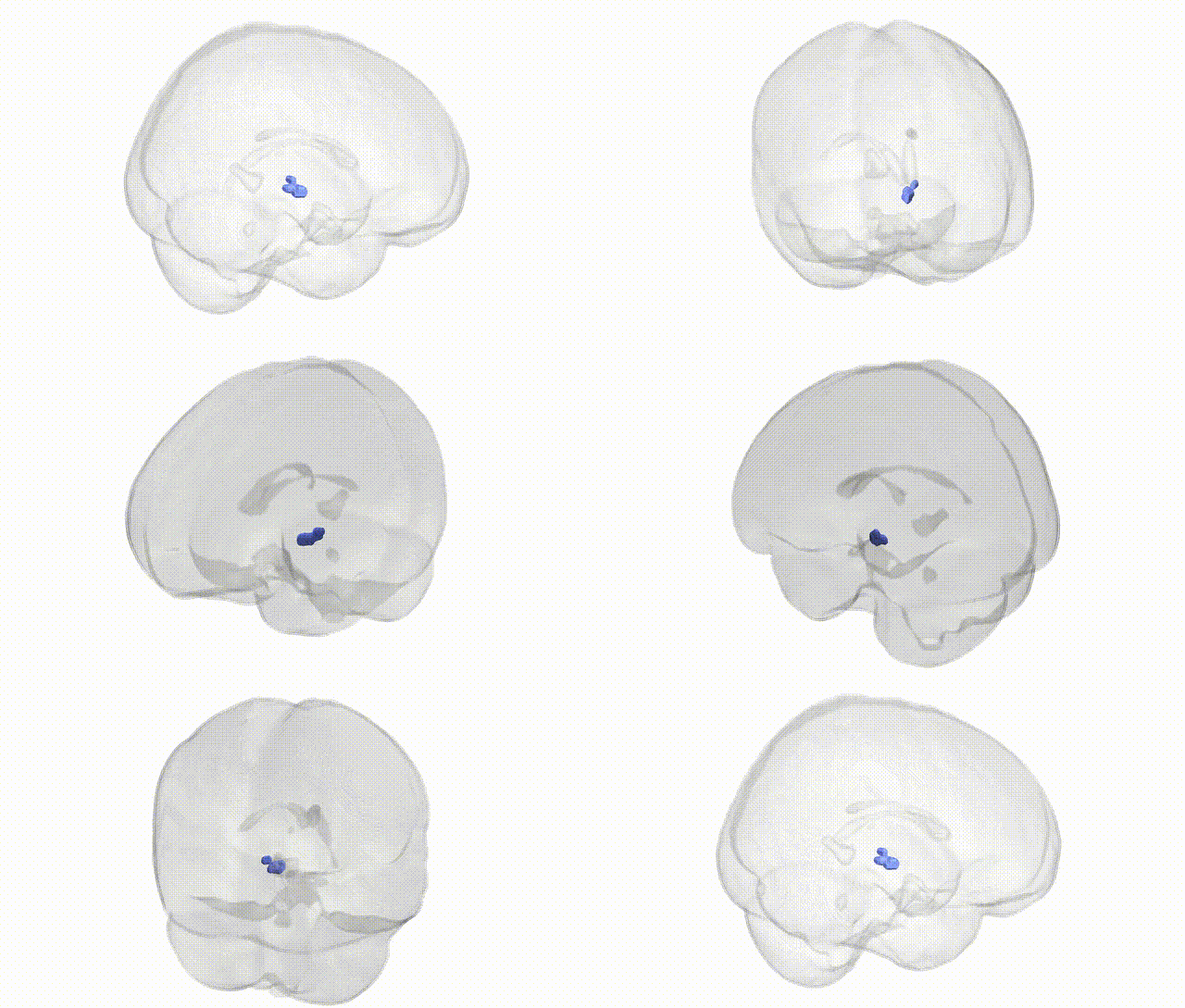
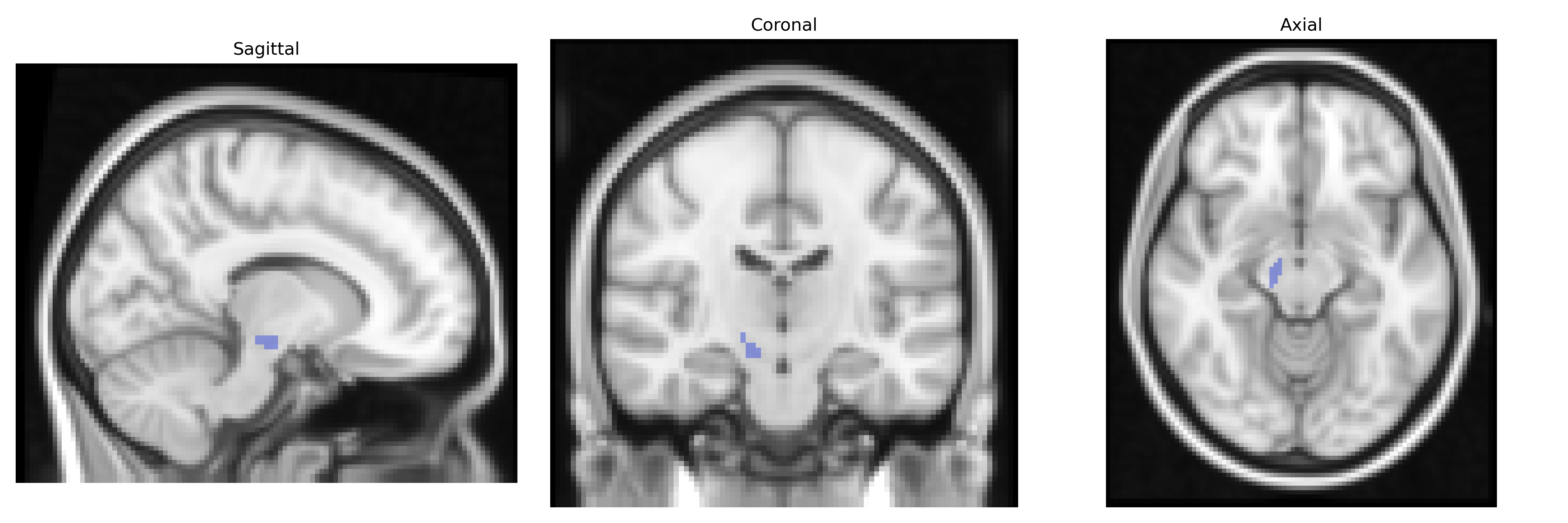
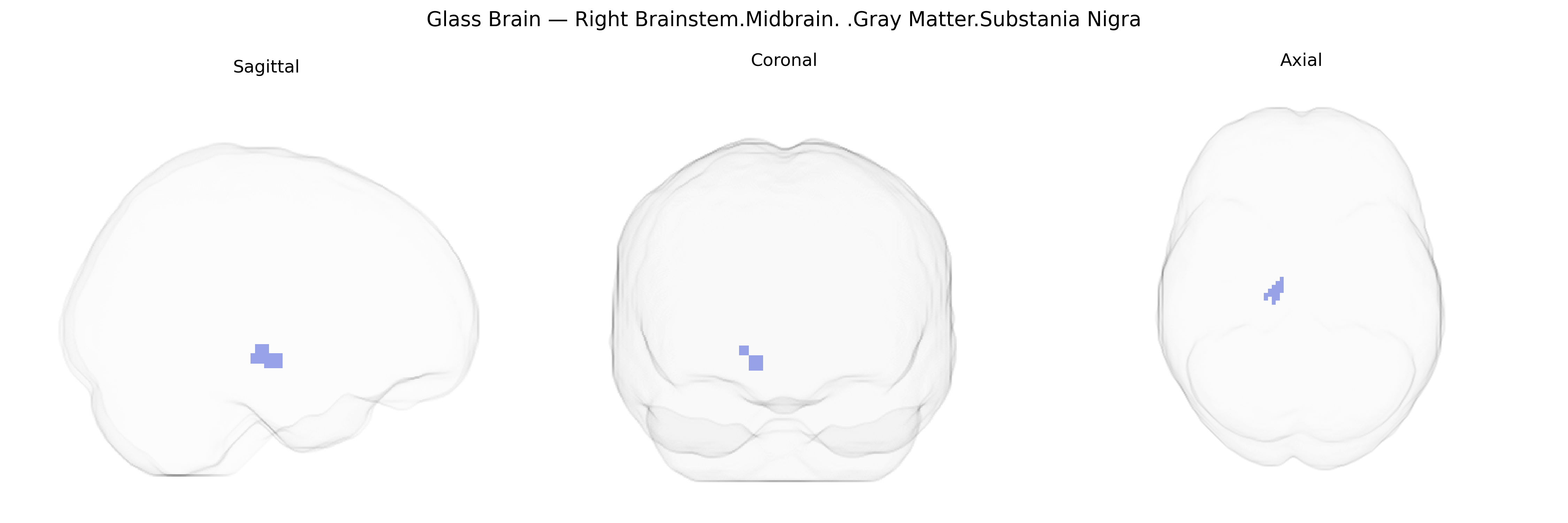
The bilateral Right Brainstem.Midbrain.Gray Matter.Substantia Nigra corresponds to the substantia nigra, a dopaminergic nucleus in the ventral midbrain that plays a critical role in motor control, reward, and learning. It is classically divided into two main parts: the pars compacta (SNc), containing pigmented dopamine-producing neurons that project primarily to the striatum as part of the nigrostriatal pathway, and the pars reticulata (SNr), which functions similarly to the internal segment of the globus pallidus as an output station of the basal ganglia. Degeneration of neurons in the substantia nigra pars compacta is a hallmark of Parkinson’s disease, leading to bradykinesia, rigidity, and tremor due to disrupted basal ganglia circuitry. The region is also implicated in addiction, habit formation, and certain neuropsychiatric conditions through its influence on dopaminergic signaling. Substantia nigra
The bilateral right midbrain substantia nigra, a dopaminergic nucleus critical for motor control and reward processing, is strongly implicated in genetic studies of Parkinson’s disease, where variants in SNCA, LRRK2, GBA, PARK2 (PRKN), PINK1, and VPS35, among others, are associated with neuronal vulnerability and selective degeneration in this region; GWAS have additionally identified risk loci in genes such as MAPT, HLA-DQB1, and BIN3 that modulate susceptibility to nigral neurodegeneration or age-related nigral volume loss. Imaging–genetics studies link polygenic risk scores for Parkinson’s disease and schizophrenia to altered substantia nigra structure and connectivity, with dopaminergic pathway genes (COMT, DRD2, DRD3, DAT1/SLC6A3) influencing nigrostriatal signaling, reward sensitivity, and impulse control. Variants in iron-regulation genes (e.g., HFE, TF) and mitochondrial or oxidative stress–related genes (e.g., NFE2L2, SOD2) have been associated with nigral iron deposition and vulnerability to neurodegeneration in GWAS and candidate-gene studies. Substantia nigra morphology and function are also implicated genetically in attention-deficit/hyperactivity disorder, substance use disorders, and cognitive traits via dopaminergic and synaptic plasticity genes identified in large-scale GWAS, reflecting the region’s central role in genetically influenced motor, cognitive, and motivational phenotypes.
Overview generated by GPT-4o (2026).
Region ID: 342
Hemisphere: bilateral
Atlas: Talairach labels 2mm
Full Quality Version: Download MP4
Full Quality Version: Download MP4
Wali Sidiqyar*, Gaurav Rudravaram*, Elyssa M. McMaster, Trent M. Schwartz, Adam M. Saunders, Kurt G. Schilling, Bennett A. Landman "Introducing SPINS: A Shared Public Visualization Library of Neuroanatomical Structures." Medical Imaging with Deep Learning- short paper
This resource is licensed under CC0 1.0 Universal (Public Domain).