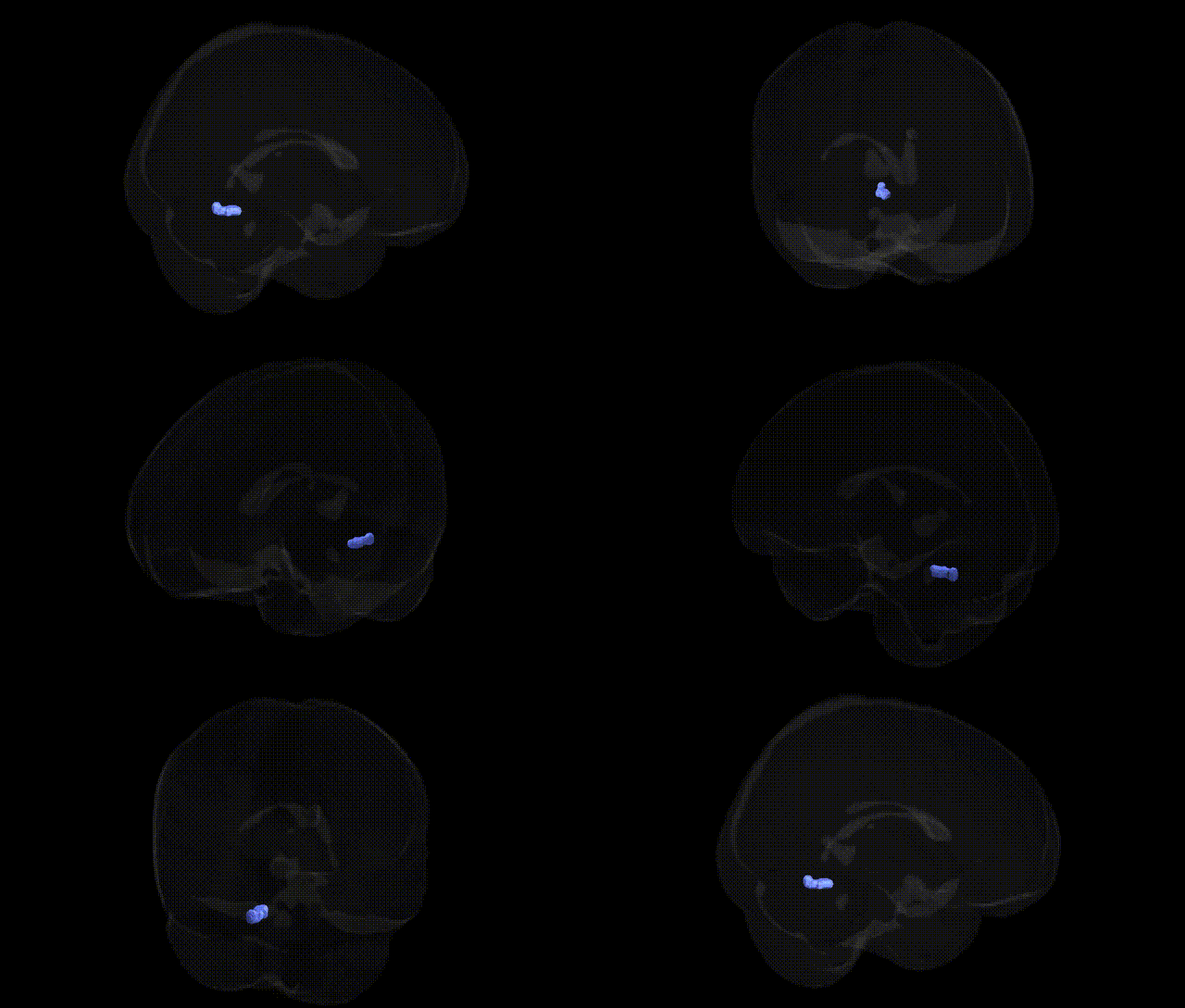
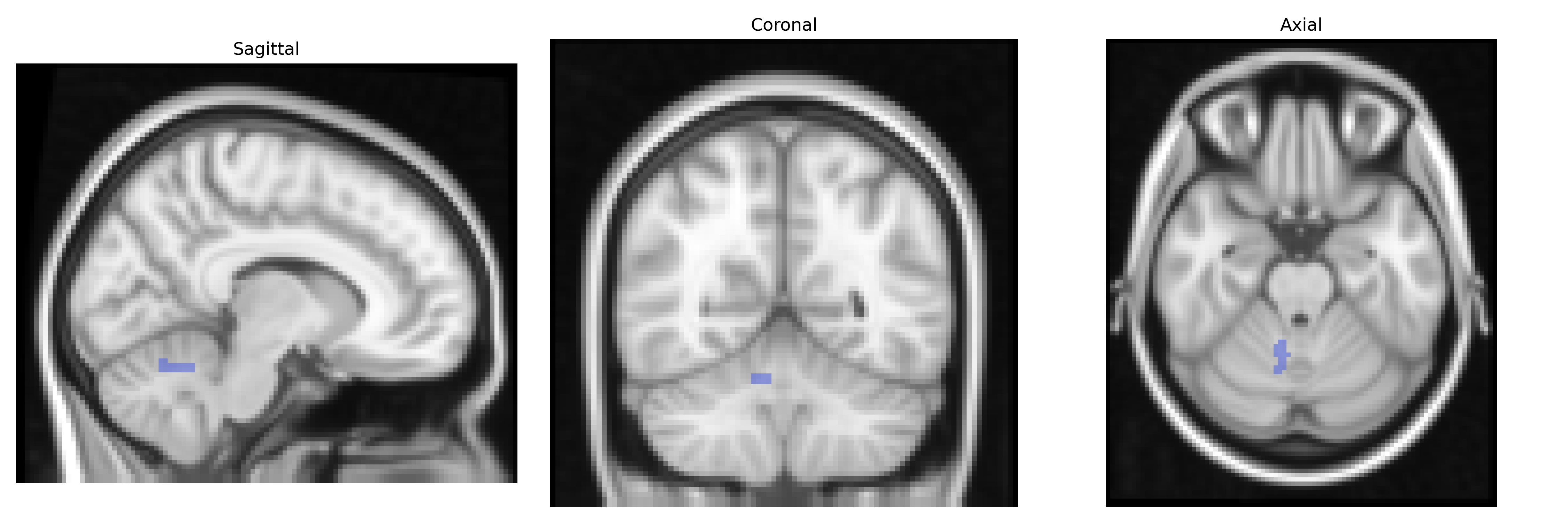
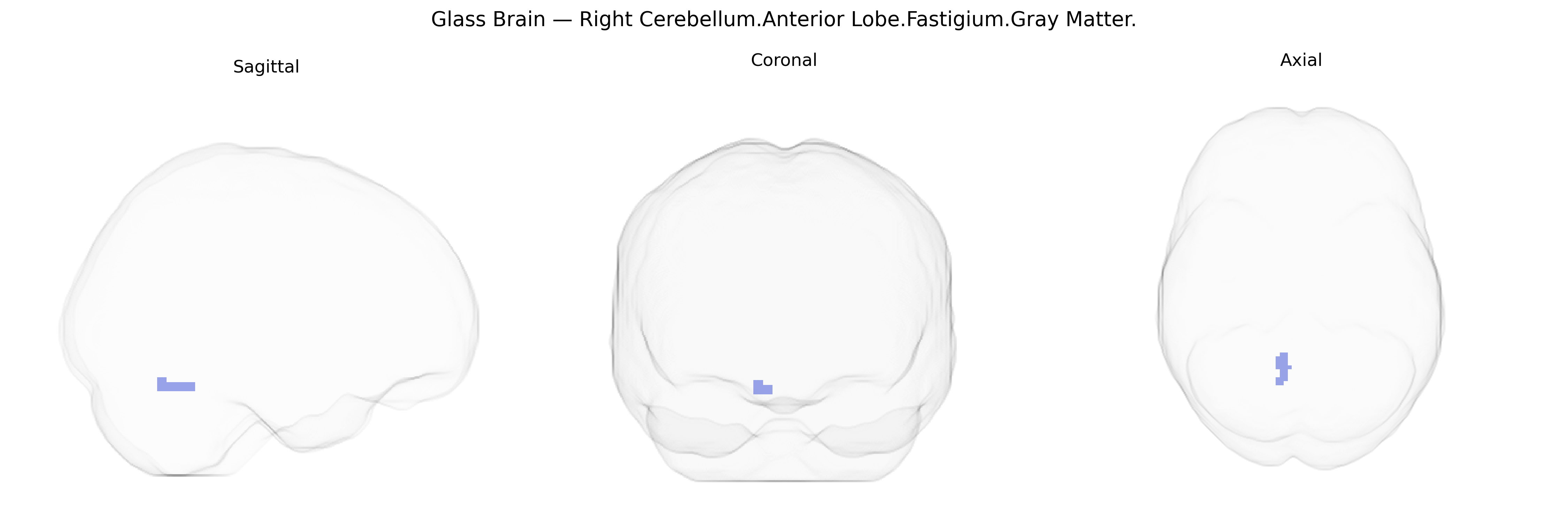
The bilateral Right Cerebellum.Anterior Lobe.Fastigium.Gray Matter refers to gray matter located in the anterior lobe of the right cerebellar hemisphere in the vicinity of the fastigium, a midline region associated with the roof of the fourth ventricle and closely related to the fastigial nucleus. Functionally, this area participates in the regulation of posture, balance, and coordination of axial and proximal limb movements, integrating proprioceptive and vestibular input to fine‑tune motor control. Through connections with the vestibular nuclei, reticular formation, and spinal cord, activity in this region contributes to the timing and precision of gait and stance adjustments and is implicated in cerebellar modulation of autonomic and ocular motor functions. There is no direct link for this composite Talairach label; a related structure is the Cerebellum.
The bilateral Right Cerebellum.Anterior Lobe.Fastigium.Gray Matter region, as defined in the Talairach 2 mm atlas, resides in the vermal fastigial area of the anterior cerebellar lobe and participates in motor coordination, posture, and aspects of affect regulation, and has been implicated in several genetic and neuropsychiatric contexts, although few GWAS report findings at this exact micro-anatomical label. Large brain-imaging GWAS (e.g., ENIGMA, UK Biobank) have shown that cerebellar gray matter volumes are heritable and influenced by common variants in genes involved in neurodevelopment and synaptic function, including loci near KIAA0319, DCC, and FOXP1, among others, with some cerebellar volume measures associating with polygenic risk for schizophrenia, major depressive disorder, and autism spectrum disorder. Cerebellar vermis and fastigial nucleus abnormalities have been linked, via imaging–genetic and candidate-gene studies, to bipolar disorder and mood dysregulation, with suggestive associations to genes affecting serotonin and glutamate signaling (such as HTR2A and GRM family genes), and to neurodevelopmental genes such as CACNA1C and DISC1. Cerebellar structural variation is also observed in genetically influenced conditions including ADHD, essential tremor, and ataxias, where monogenic mutations (e.g., in CACNA1A, ATXN1/2/3, and other spinocerebellar ataxia genes) produce prominent degeneration in anterior cerebellar lobules encompassing the fastigial region. More recent multivariate GWAS that combine cerebellar morphology and cognitive or psychiatric phenotypes suggest shared genetic architecture between anterior cerebellar gray matter and traits such as general cognitive ability, neuroticism, and risk for psychosis, underscoring the fastigial/anterior lobe subregion as part of a genetically modulated network for motor-affective integration, even though direct, label-specific GWAS hits for the “Right Cerebellum.Anterior Lobe.Fastigium.Gray Matter” parcel have not yet been systematically reported.
Overview generated by GPT-4o (2026).
Region ID: 163
Hemisphere: bilateral
Atlas: Talairach labels 2mm
Full Quality Version: Download MP4
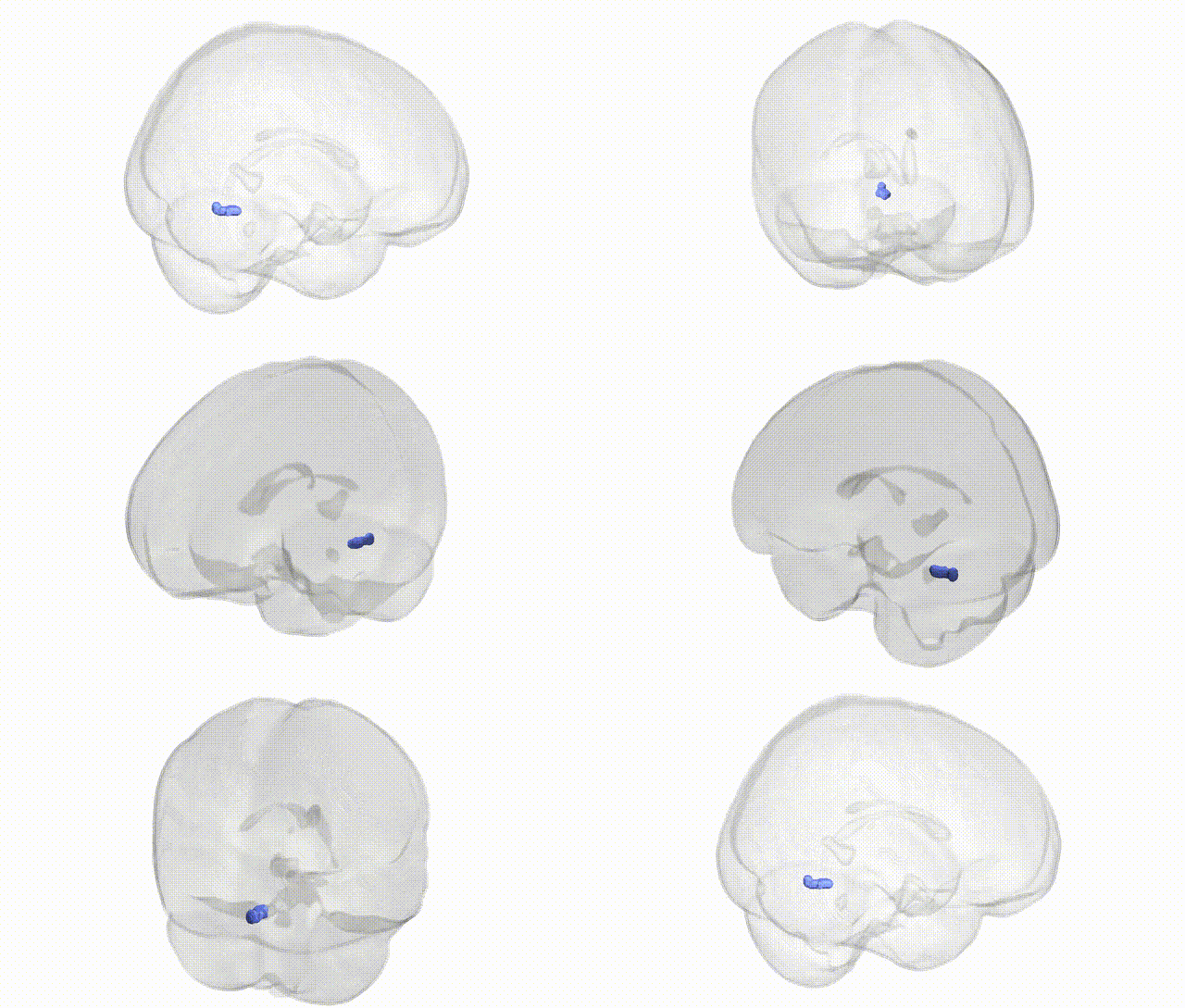
Full Quality Version: Download MP4
Wali Sidiqyar*, Gaurav Rudravaram*, Elyssa M. McMaster, Trent M. Schwartz, Adam M. Saunders, Kurt G. Schilling, Bennett A. Landman "Introducing SPINS: A Shared Public Visualization Library of Neuroanatomical Structures." Medical Imaging with Deep Learning- short paper
This resource is licensed under CC0 1.0 Universal (Public Domain).