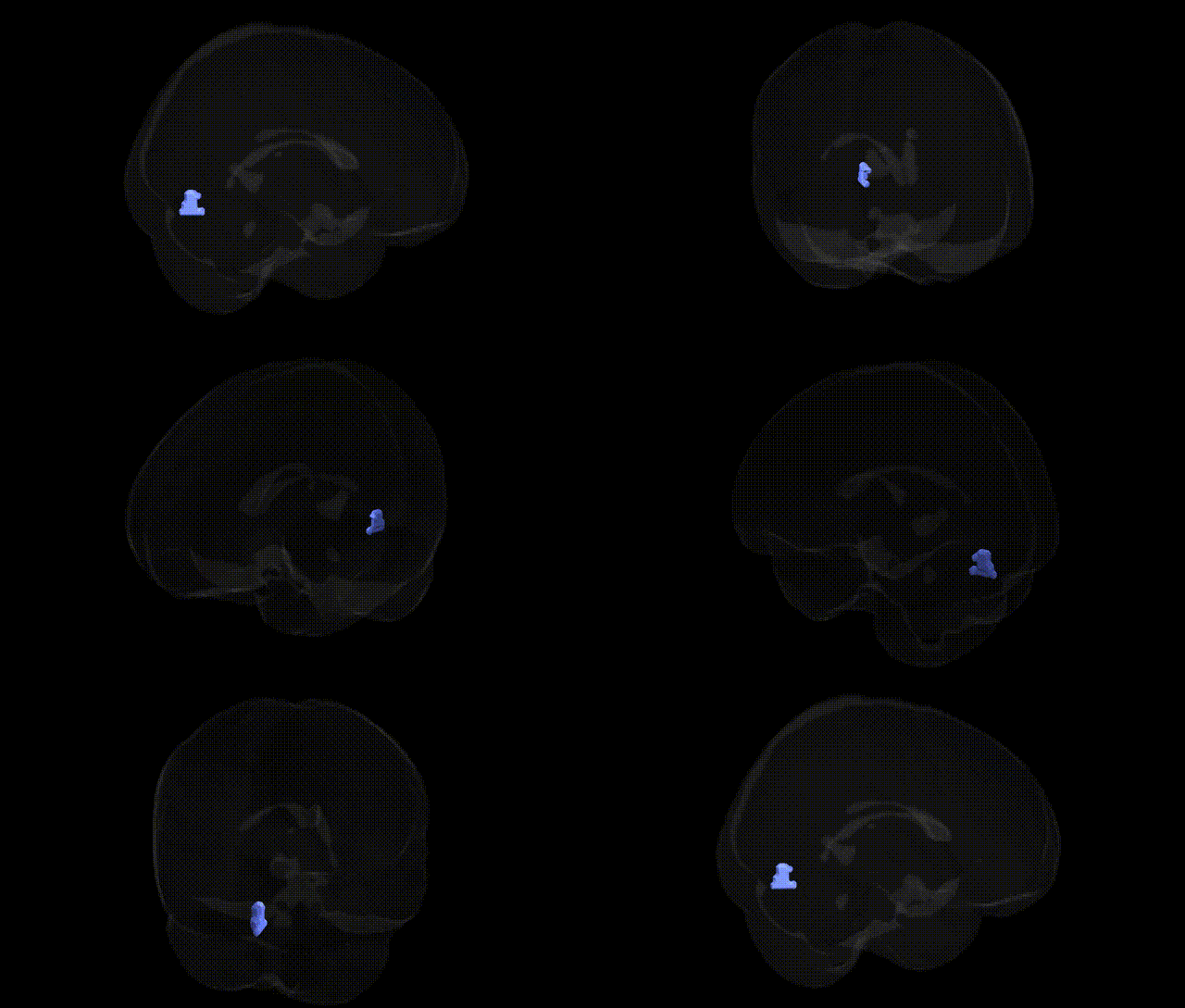
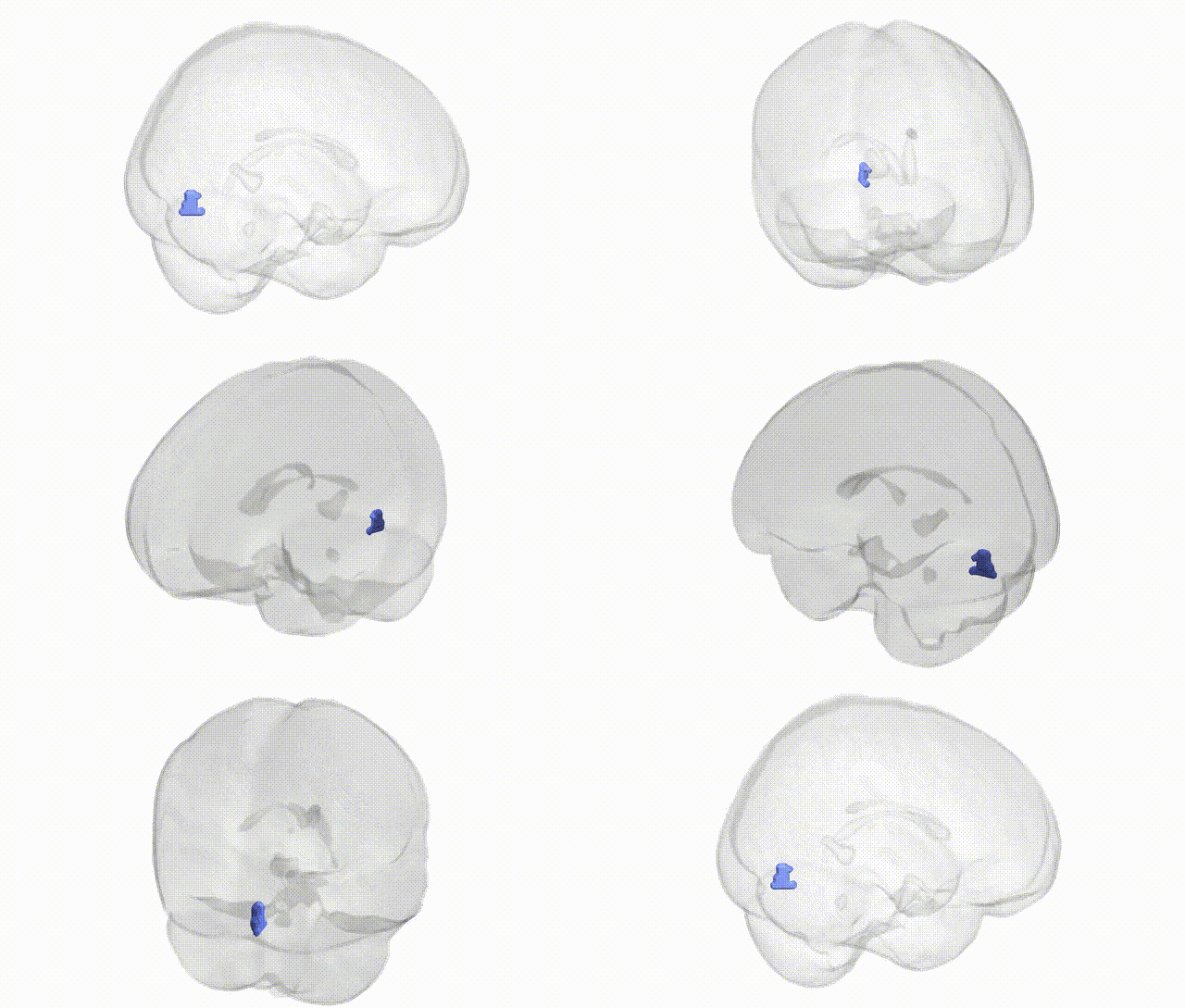
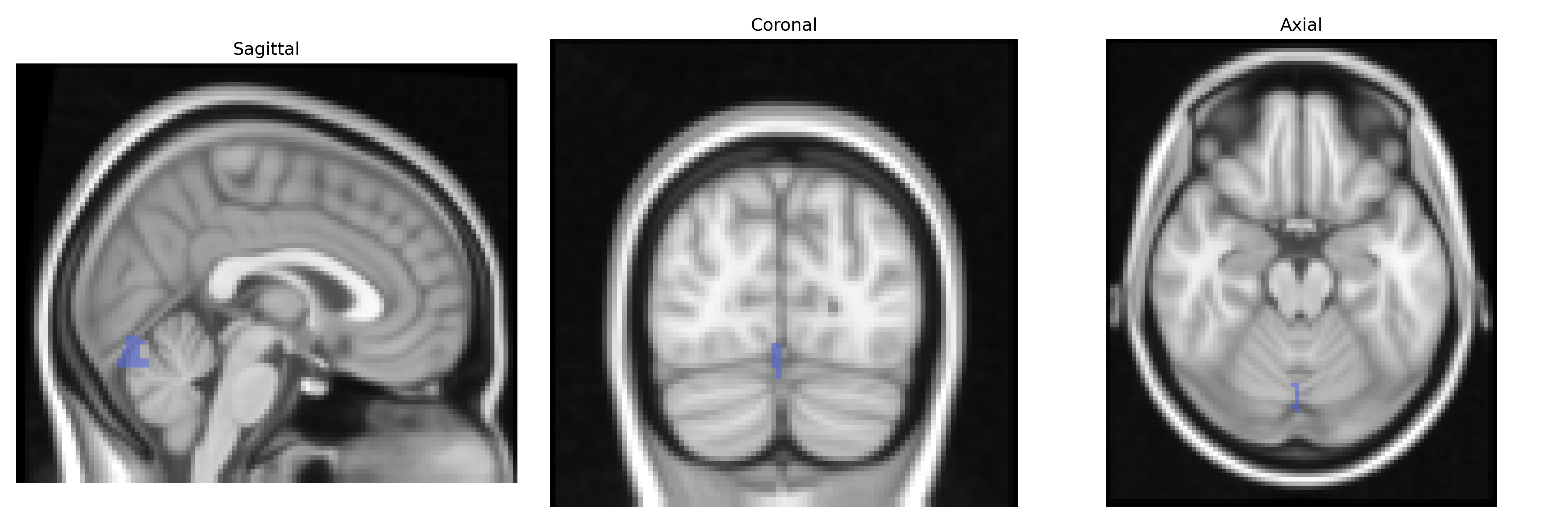
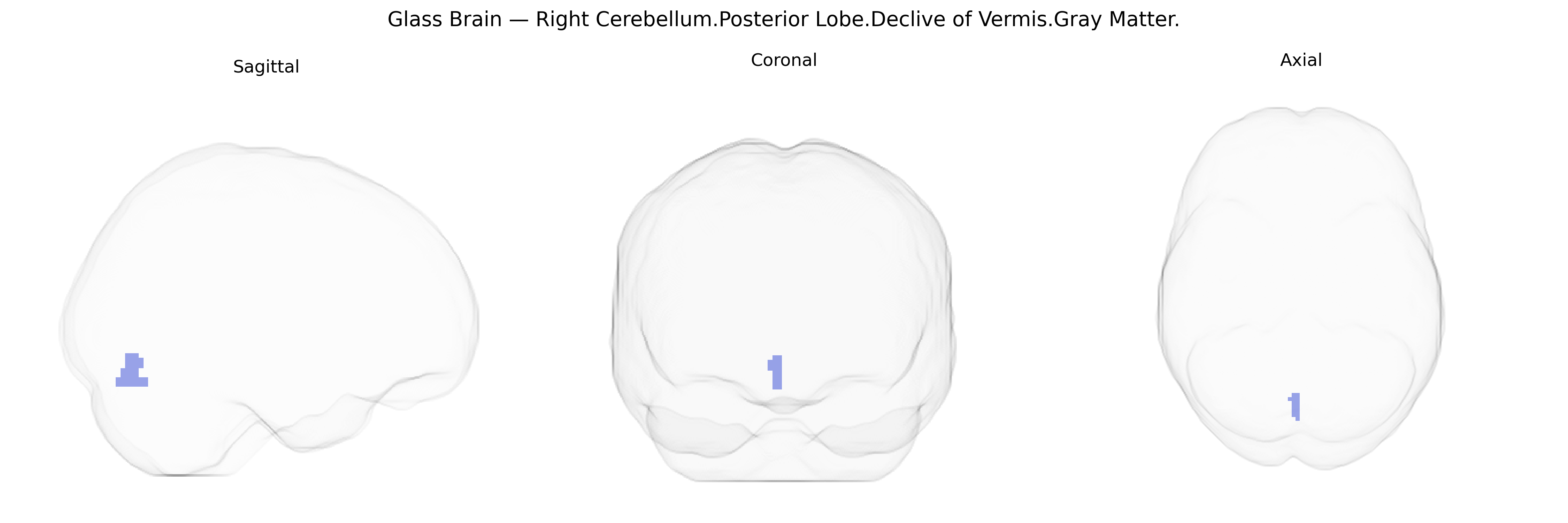
The bilateral Right Cerebellum Posterior Lobe, Declive of Vermis, Gray Matter corresponds to a portion of the cerebellar vermis within the posterior lobe, specifically the declive (lobule VI), composed predominantly of cerebellar cortical gray matter. This region is involved in the integration of sensory and motor information necessary for the coordination, timing, and fine-tuning of voluntary movements, as well as contributing to postural control and balance. It receives input from multiple sensory modalities via cerebellar afferent pathways and projects through deep cerebellar nuclei to motor and premotor cortical areas and brainstem centers, forming part of cerebellar circuits that modulate motor execution and potentially participate in cognitive and affective processing. There is no direct Wikipedia article for this exact subregion; a closely related structure is the Cerebellar vermis.
The bilateral Right Cerebellum, Posterior Lobe, Declive of Vermis (gray matter) is part of the midline cerebellar structure implicated in motor coordination, timing, and affective regulation, and although few GWAS explicitly target this precise Talairach 2 mm atlas parcel, genetic imaging studies consistently implicate vermal and posterior cerebellar volumes and connectivity in association with common variants in neurodevelopmental and synaptic genes. Large-scale GWAS of brain structure (e.g., ENIGMA and UK Biobank) have identified heritable variation in cerebellar gray matter volume linked to loci near genes such as KATNAL2, DCC, and MAPT, with downstream effects on cognition, motor function, and psychiatric risk, and polygenic scores for schizophrenia, major depressive disorder, ADHD, and autism spectrum disorder show associations with altered cerebellar and vermal morphology or functional activation, suggesting that distributed psychiatric risk variants converge on this region’s development and function. Additional GWAS of cognitive traits, educational attainment, and general intelligence have associated polygenic load with increased cerebellar volume and altered activation in posterior lobes, while variants in FOXP2 and related language and motor-control networks have been related to cerebellar involvement in speech and sequence learning. Vermal and posterior cerebellar abnormalities, including Declive, are repeatedly reported in autism, bipolar disorder, schizophrenia, and mood dysregulation, with genetic studies highlighting risk alleles in synaptic, neuroplasticity, and neuroimmune pathways (e.g., CACNA1C, GRM3, complement genes) that correlate with perturbations in cerebellar circuitry, though these links generally reference lobular or whole-cerebellum measures rather than this exact micro-anatomical label. Overall, existing genetic evidence supports a heritable basis for structure and function in the Declive of Vermis as part of the posterior cerebellum, with risk and trait-associated variants influencing motor, cognitive, and affective phenotypes through effects on cerebellar development, connectivity, and synaptic regulation, but ultra-fine-grained genetic associations for this specific Talairach-defined parcel remain largely inferential from broader cerebellar and vermal GM GWAS findings.
Overview generated by GPT-4o (2026).
Region ID: 160
Hemisphere: bilateral
Atlas: Talairach labels 2mm
Full Quality Version: Download MP4
Full Quality Version: Download MP4
Wali Sidiqyar*, Gaurav Rudravaram*, Elyssa M. McMaster, Trent M. Schwartz, Adam M. Saunders, Kurt G. Schilling, Bennett A. Landman "Introducing SPINS: A Shared Public Visualization Library of Neuroanatomical Structures." Medical Imaging with Deep Learning- short paper
This resource is licensed under CC0 1.0 Universal (Public Domain).