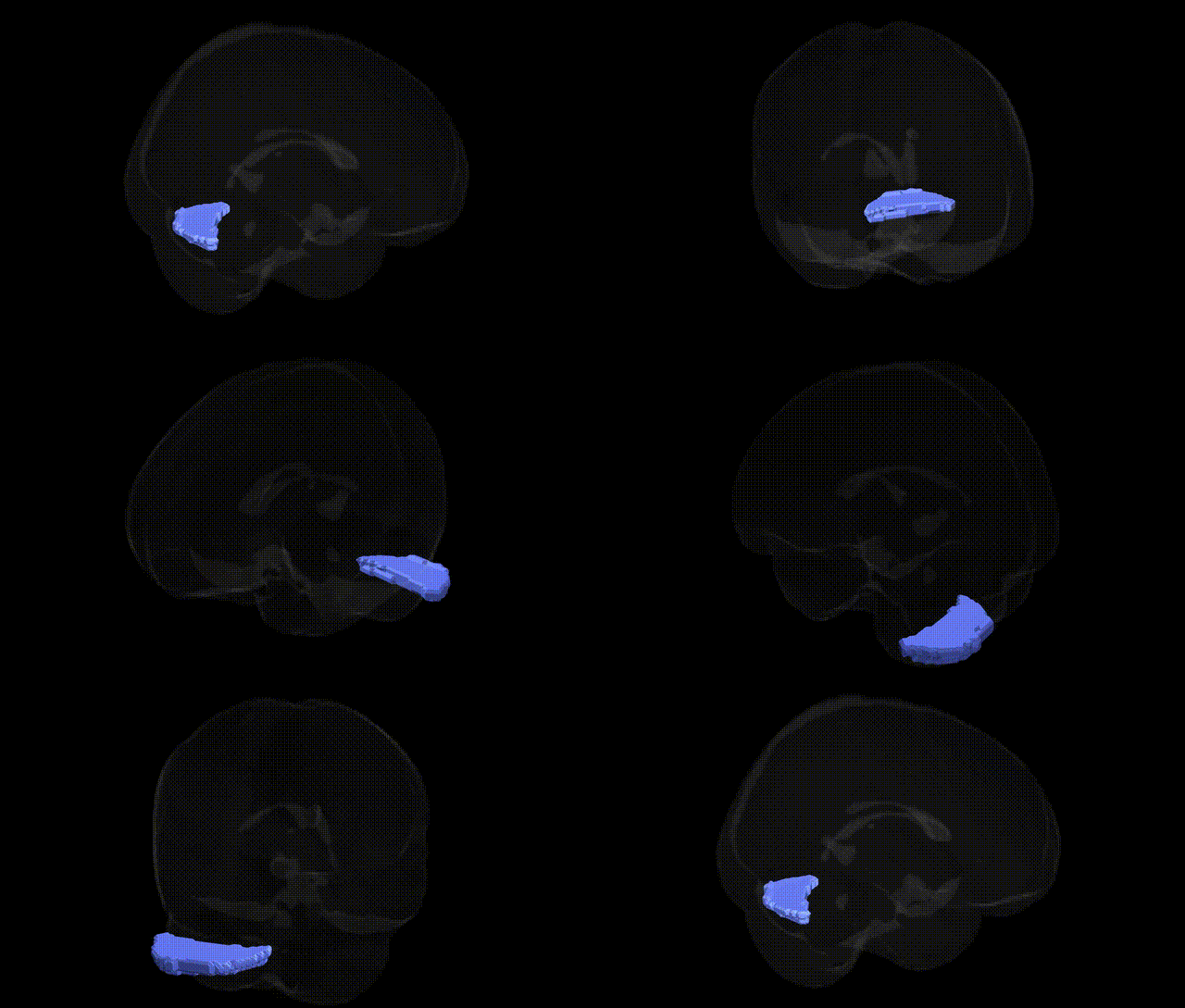
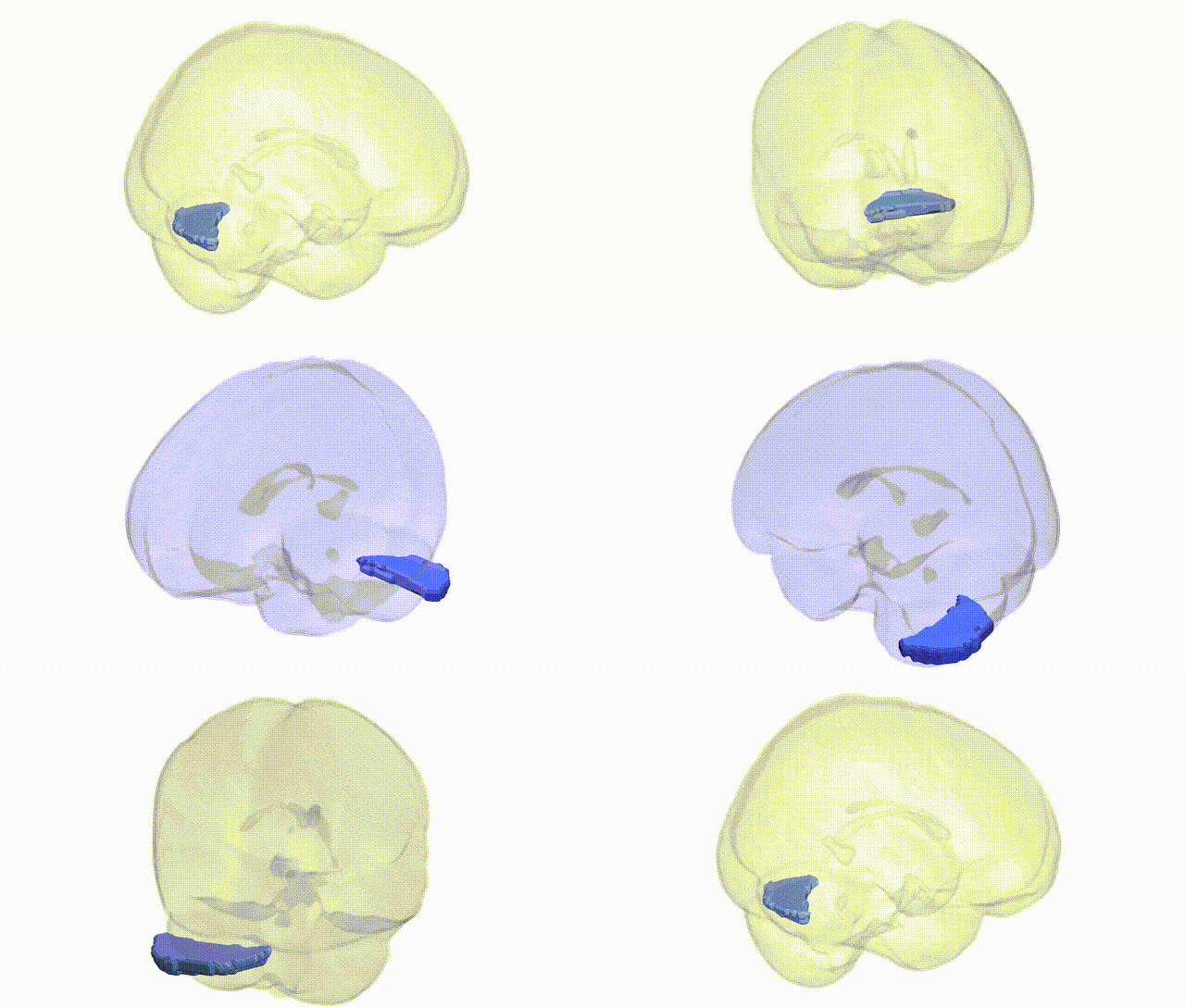
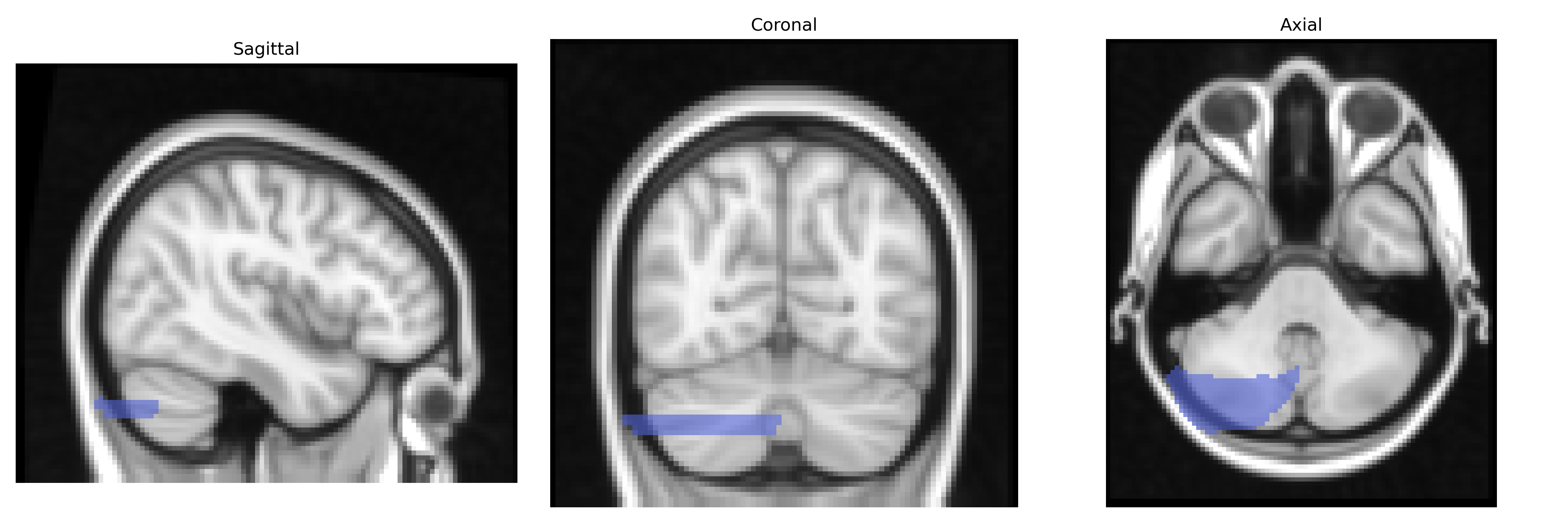
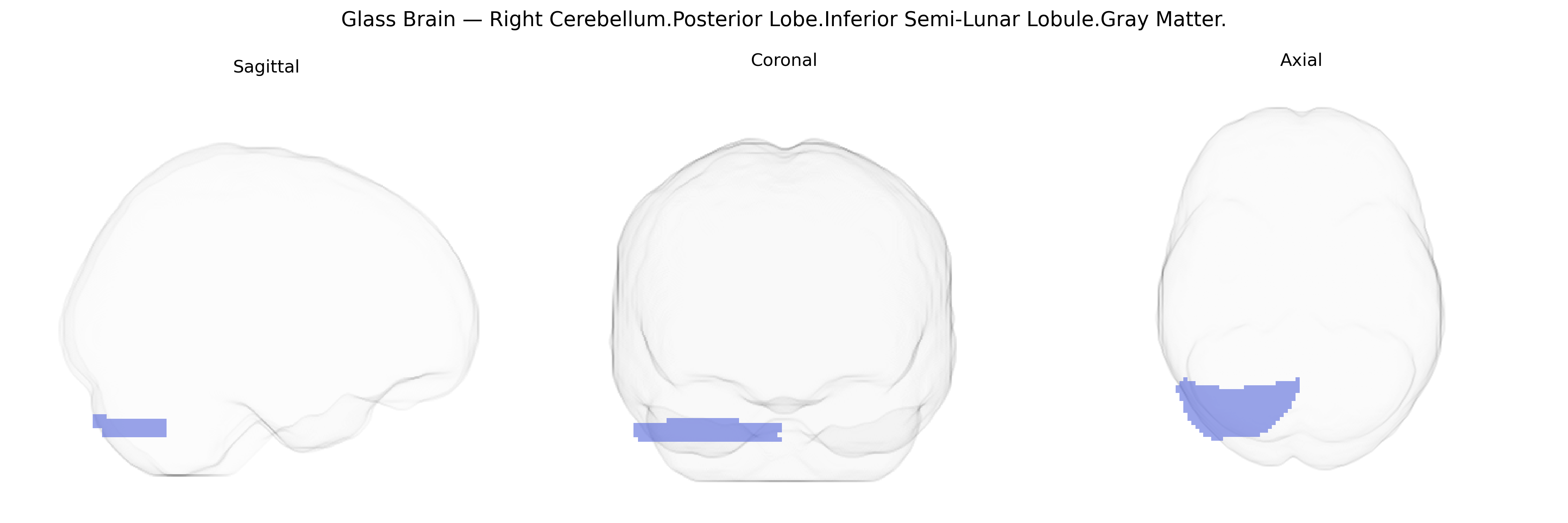
The bilateral Right Cerebellum Posterior Lobe Inferior Semi-Lunar Lobule Gray Matter corresponds to the gray matter portion of lobule VIIB (part of the inferior semilunar lobule) within the posterior lobe of the cerebellum, located on the right side but labeled bilaterally in the Talairach 2 mm Atlas. This lobule participates in higher-order cerebellar functions, including aspects of motor coordination, timing, and cognitive processing such as working memory and executive functions, through its extensive connections with cerebral association cortices. As gray matter, it primarily contains the cerebellar cortex, with its layered organization (molecular layer, Purkinje cell layer, and granular layer) integrating mossy and climbing fiber inputs and modulating deep cerebellar nuclei activity. There is no direct link for the “inferior semi-lunar lobule,” but it is part of the broader posterior lobe of the cerebellum: Cerebellum.
The bilateral right cerebellum posterior lobe, specifically the inferior semi-lunar lobule gray matter region (as defined in the Talairach 2 mm atlas), has not been the direct focus of many region-specific genetic association studies, but GWAS and imaging-genetics research implicate this posterior cerebellar territory in several heritable neuropsychiatric and cognitive phenotypes. Large-scale GWAS of brain structure (e.g., ENIGMA and UK Biobank cohorts) consistently demonstrate substantial heritability of cerebellar gray-matter volume and surface features, with common variants in genes involved in neurodevelopment, synaptic signaling, and axonal guidance (such as KIAA0319, DCC, and CACNA1C among others) associated with cerebellar morphology, though findings are typically reported at the level of whole lobules or total cerebellar volume rather than this precise lobular subdivision. Imaging-genetics work in schizophrenia, bipolar disorder, major depressive disorder, autism spectrum disorder, and ADHD has repeatedly shown genetically influenced alterations in posterior cerebellar regions involved in cognitive and affective processing, with polygenic risk scores for these disorders associated with differences in cerebellar volume and connectivity. Additionally, cerebellar posterior lobe gray matter—including inferior semi-lunar areas—has been implicated via genetic studies in traits such as general cognitive ability, reading and language skills, and motor coordination, often through distributed brain networks where cerebellar contributions emerge in conjunction with cortical and subcortical regions. Overall, genetic associations involving this region are best characterized as part of broader cerebellar and cortico-cerebellar circuits rather than as highly specific to the inferior semi-lunar lobule.
Overview generated by GPT-4o (2026).
Region ID: 2
Hemisphere: bilateral
Atlas: Talairach labels 2mm
Full Quality Version: Download MP4
Full Quality Version: Download MP4
Wali Sidiqyar*, Gaurav Rudravaram*, Elyssa M. McMaster, Trent M. Schwartz, Adam M. Saunders, Kurt G. Schilling, Bennett A. Landman "Introducing SPINS: A Shared Public Visualization Library of Neuroanatomical Structures." Medical Imaging with Deep Learning- short paper
This resource is licensed under CC0 1.0 Universal (Public Domain).