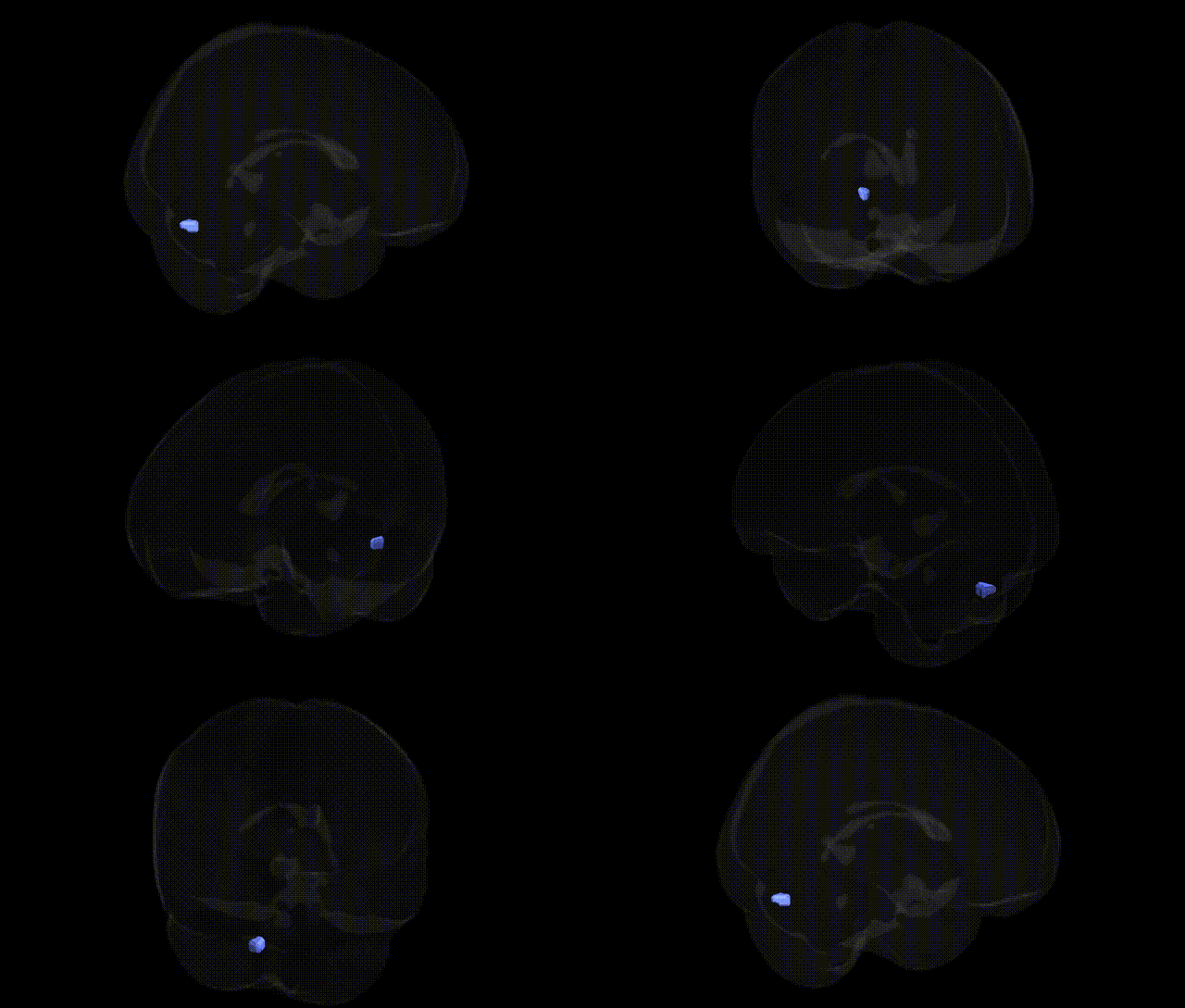
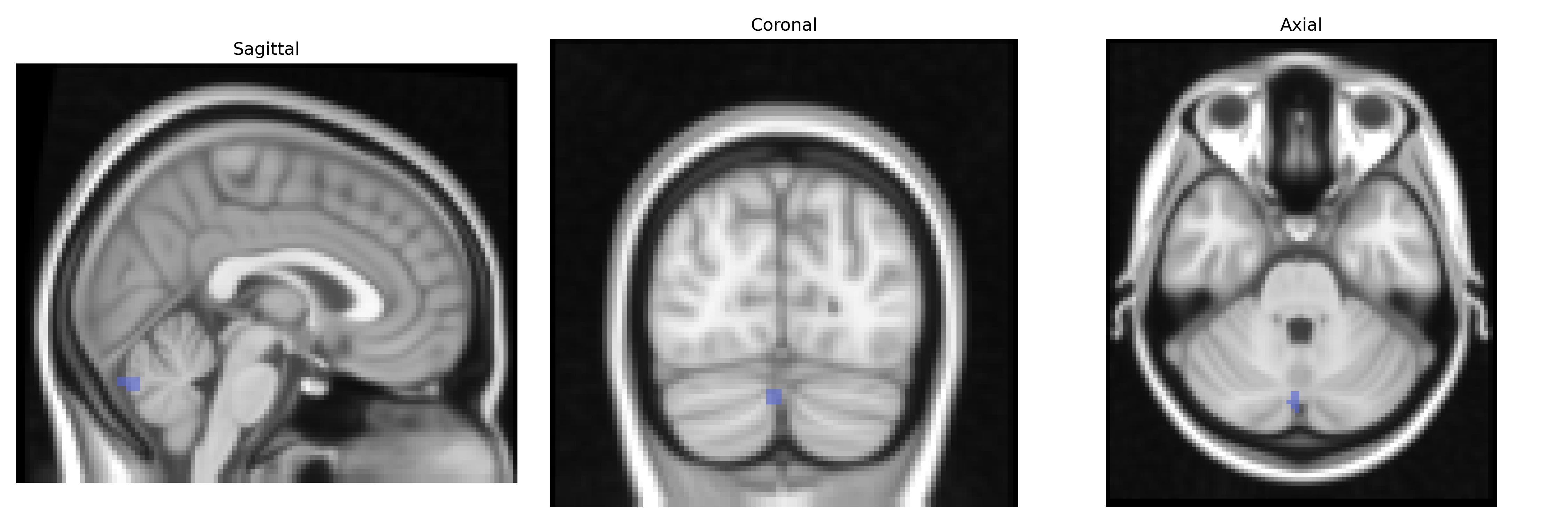
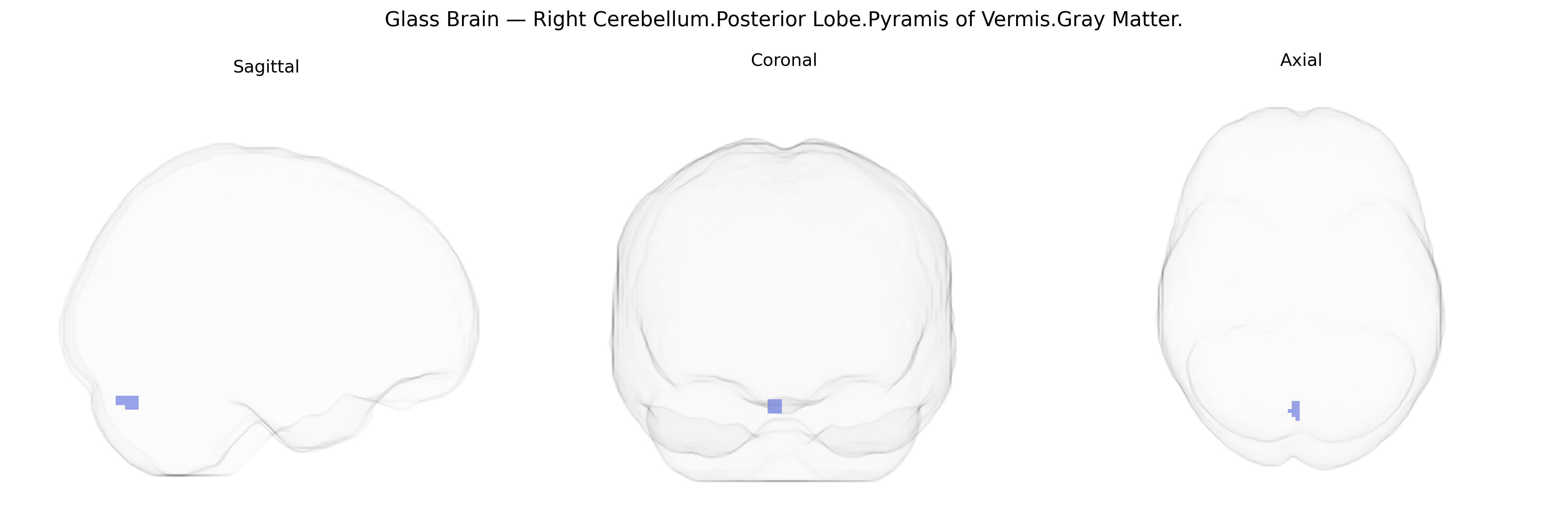
The bilateral Right Cerebellum.Posterior Lobe.Pyramis of Vermis.Gray Matter refers to gray matter located in the pyramis, a midline lobule of the cerebellar vermis situated within the posterior lobe and extending into the right cerebellar hemisphere. This region is part of the spinocerebellum, receiving predominantly spinal and somatosensory input and contributing to the regulation of muscle tone, posture, and the fine-tuning of ongoing movements, particularly of the trunk and proximal limbs. Functionally, the pyramis participates in error correction and timing of motor activity via connections with deep cerebellar nuclei and descending motor pathways, and can be implicated in ataxia and other cerebellar motor syndromes when damaged. There is no direct link for the pyramis of vermis; see the related structure Cerebellar vermis.
The bilateral Right Cerebellum, Posterior Lobe, Pyramis of Vermis Gray Matter, as defined in the Talairach 2mm Atlas, participates in motor coordination, timing, and aspects of affective and cognitive processing, and genetic associations typically emerge from broader cerebellar or vermis-focused analyses rather than this microanatomical label specifically. GWAS and imaging-genetics studies have linked variation in cerebellar volume, cortical thickness, and microstructure to common variants near genes involved in neurodevelopment and synaptic function, including KIAA0319, CADM2, RELN, and multiple loci in the 3p24–p26 and 6p22 regions, though these associations usually span wider posterior cerebellar territories. Cerebellar vermis morphology, encompassing the pyramis, has repeatedly been implicated in autism spectrum disorder, ADHD, bipolar disorder, and schizophrenia, where risk variants (e.g., in DISC1, CACNA1C, and genes in glutamatergic and GABAergic pathways) show convergent effects on cortico-cerebellar circuits rather than isolated impact on the pyramis. Polygenic scores for cognitive performance, educational attainment, and general intelligence correlate with structural and functional measures in posterior cerebellar regions, suggesting distributed genetic influences on cerebellar contributions to higher-order cognition. Additionally, variants affecting neurodevelopmental patterning (e.g., in FOXP2-related networks, WNT and SHH signaling genes) and neuroinflammatory or metabolic pathways have been associated with cerebellar abnormalities in GWAS of migraine, essential tremor, and ataxias, but fine-grained mapping rarely isolates the Right Posterior Lobe Pyramis of Vermis Gray Matter as a distinct genetic target. Overall, known genetic associations point to polygenic and pleiotropic influences on cerebellar vermis structure and function, with this region participating in larger cerebellar circuits impacted by risk loci for neurodevelopmental and psychiatric disorders, cognitive traits, and motor-control phenotypes.
Overview generated by GPT-4o (2026).
Region ID: 83
Hemisphere: bilateral
Atlas: Talairach labels 2mm
Full Quality Version: Download MP4
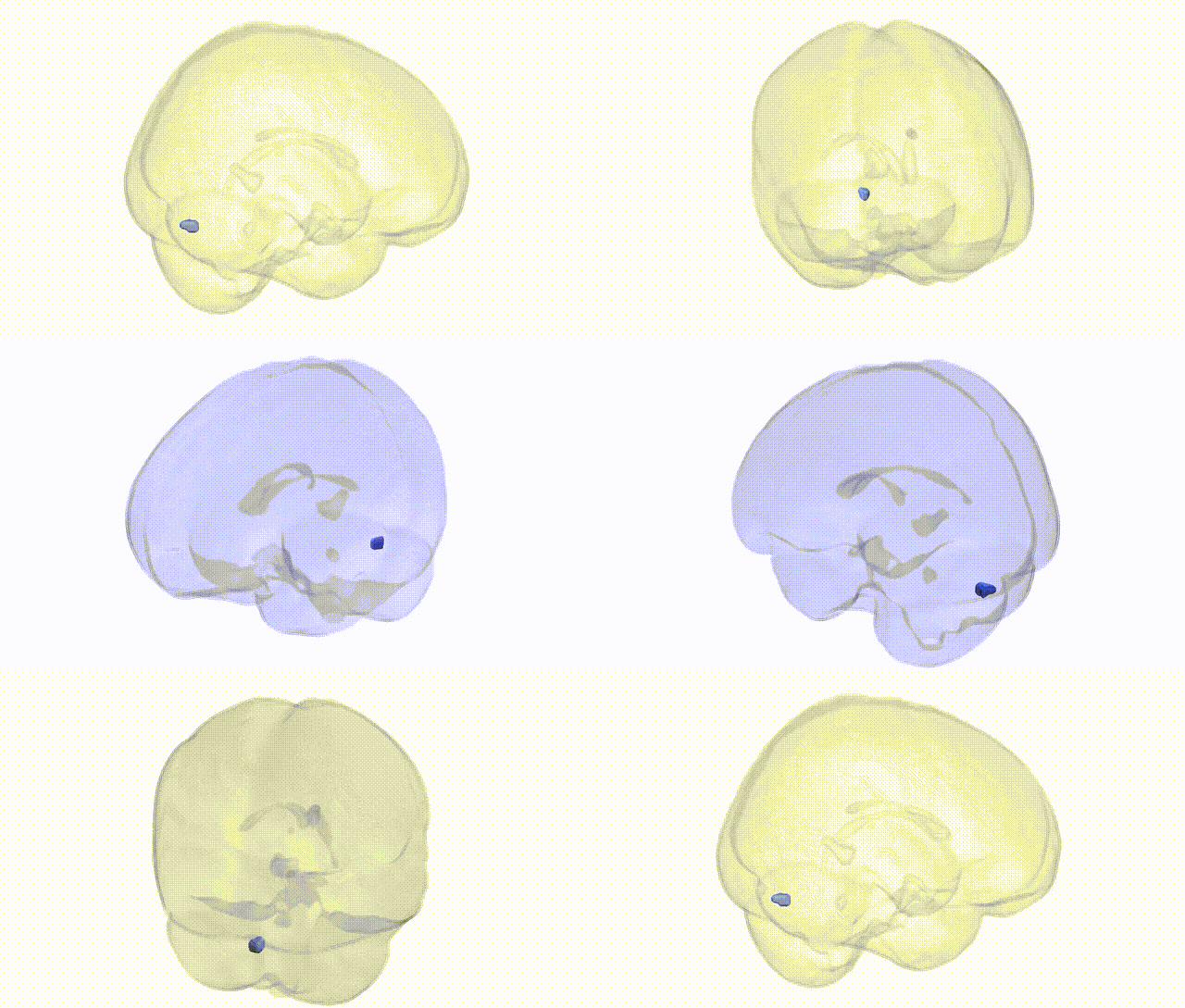
Full Quality Version: Download MP4
Wali Sidiqyar*, Gaurav Rudravaram*, Elyssa M. McMaster, Trent M. Schwartz, Adam M. Saunders, Kurt G. Schilling, Bennett A. Landman "Introducing SPINS: A Shared Public Visualization Library of Neuroanatomical Structures." Medical Imaging with Deep Learning- short paper
This resource is licensed under CC0 1.0 Universal (Public Domain).