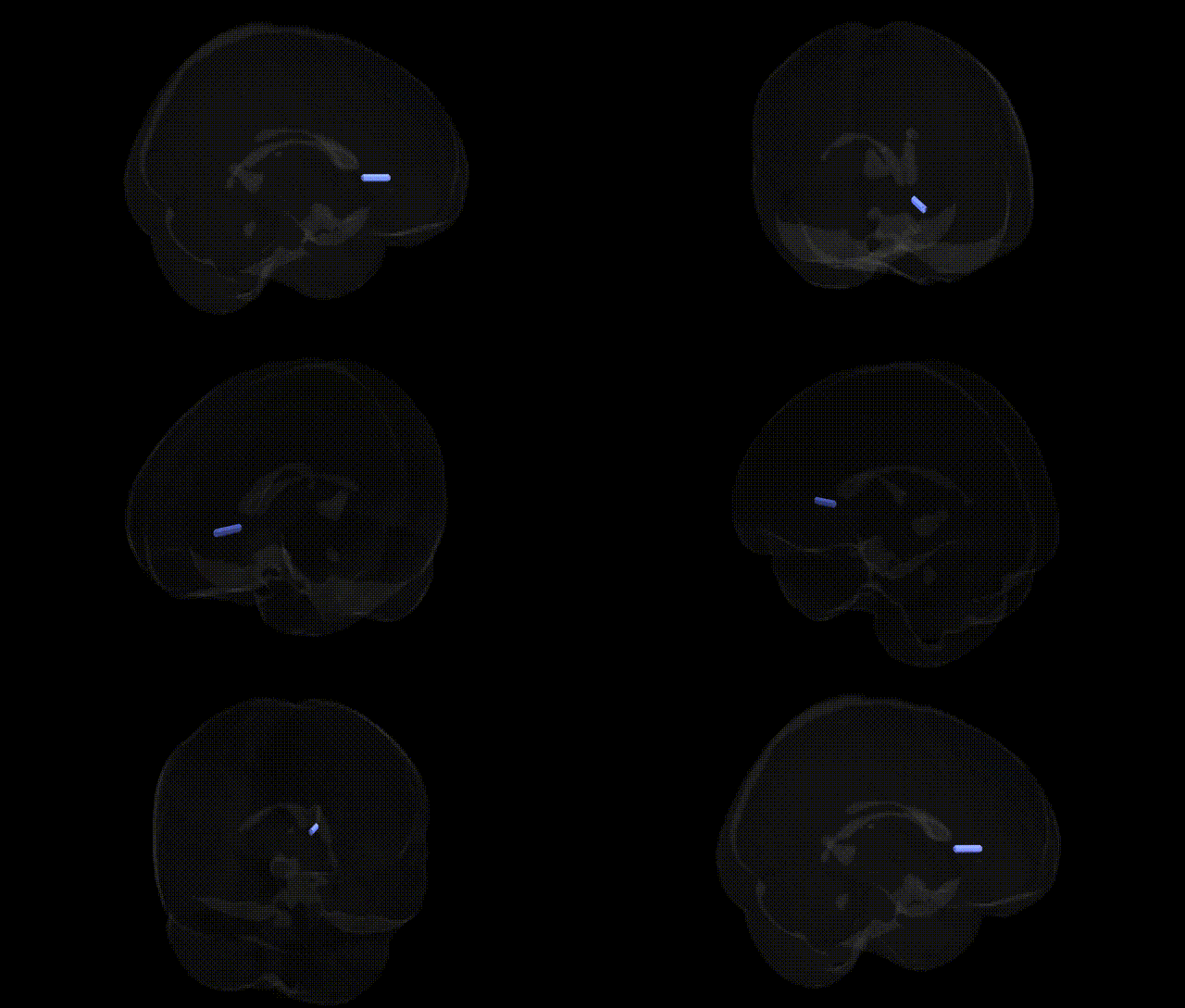
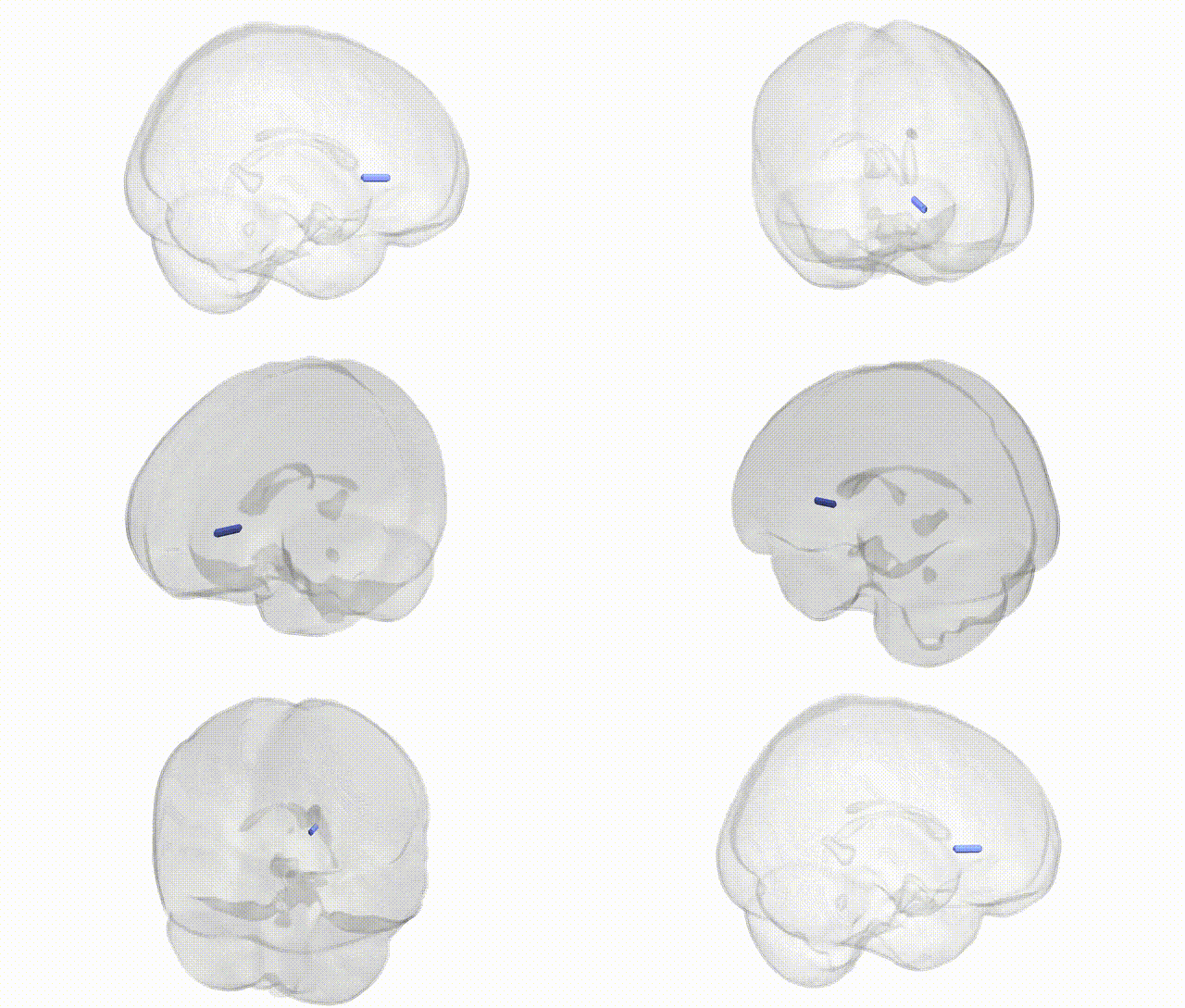
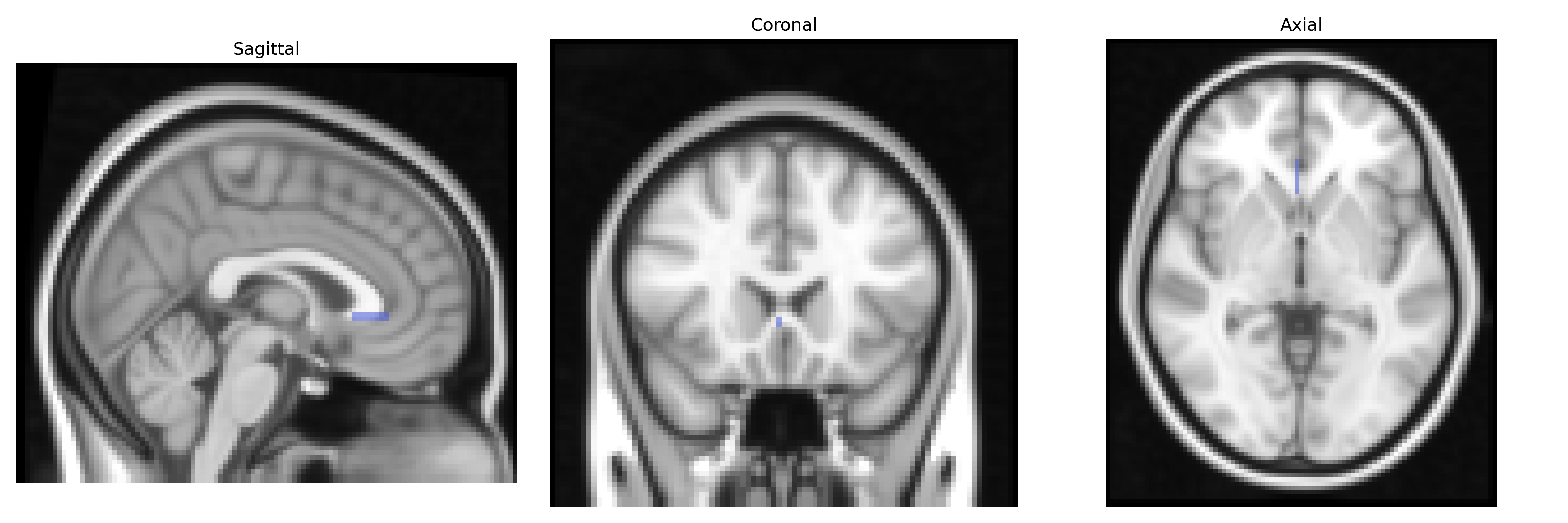
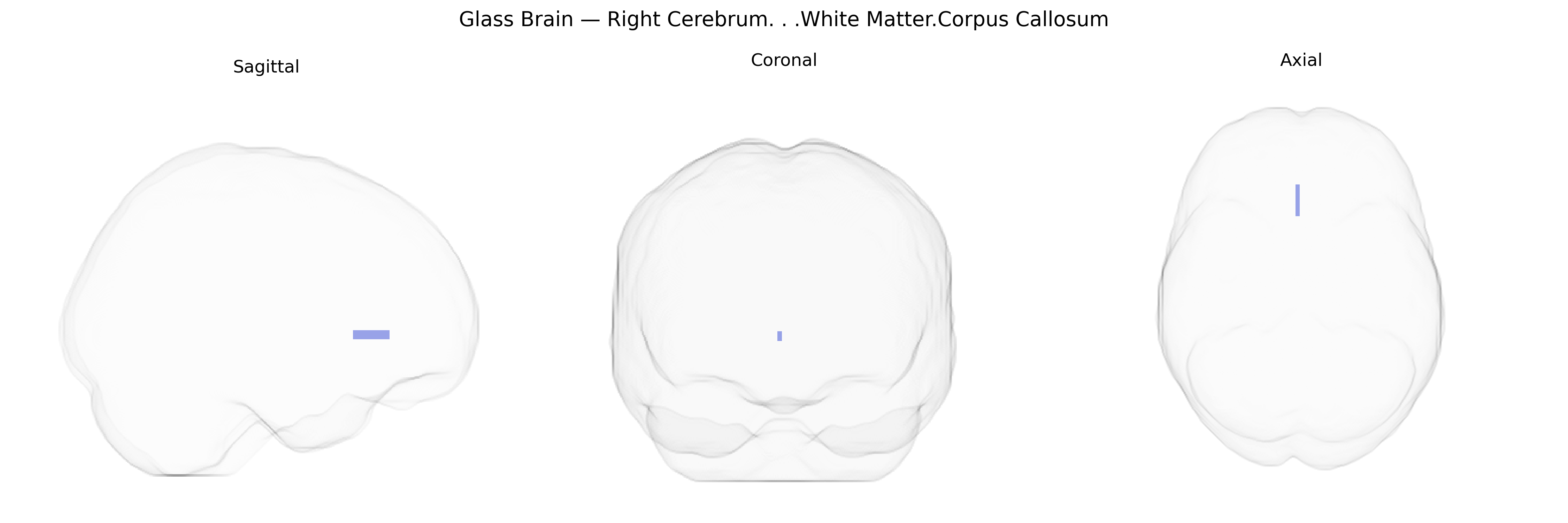
The bilateral Right Cerebrum White Matter of the Corpus Callosum corresponds to interhemispheric commissural fibers that connect homologous regions of the cerebral cortex across the midline. Structurally, the corpus callosum is the largest white matter tract in the brain, composed predominantly of myelinated axons organized into distinct subregions (rostrum, genu, body, isthmus, and splenium), each linking specific frontal, parietal, temporal, and occipital cortical areas. Functionally, these callosal fibers mediate the transfer and integration of sensory, motor, and cognitive information between hemispheres, supporting coordinated bimanual movements, bilateral sensory processing, language lateralization, and higher-order cognitive operations such as attention and executive function. The integrity of corpus callosum white matter is critical for normal hemispheric communication, and its disruption is implicated in a range of neurological and psychiatric conditions, including callosal agenesis, multiple sclerosis, traumatic brain injury, and disorders of interhemispheric coordination.
The bilateral right cerebrum white matter of the corpus callosum, as defined in the Talairach 2 mm atlas, has been repeatedly implicated in genetic studies of brain structure, cognitive function, and neuropsychiatric disorders. Twin and family studies show high heritability of corpus callosum volume, microstructure (e.g., fractional anisotropy), and midsagittal area, with common variants near genes involved in axon guidance, myelination, and cell adhesion (such as CNTNAP2, NRG1, ROBO1/2, LINGO1, and MAG) associated with callosal integrity in large imaging–genetics cohorts like ENIGMA and UK Biobank. GWAS of diffusion MRI metrics have identified multiple loci influencing corpus callosum white matter properties that overlap with risk loci for schizophrenia, bipolar disorder, major depressive disorder, autism spectrum disorder, and ADHD, consistent with well-documented callosal abnormalities in these conditions. Variants in genes related to neurodevelopment and interhemispheric connectivity (e.g., DCC and other axon guidance genes) have been linked to agenesis or dysgenesis of the corpus callosum, while polygenic scores for educational attainment, general cognitive ability, and processing speed correlate with callosal microstructure, suggesting a shared genetic architecture between callosal white matter organization and higher-order cognition. Additionally, callosal white matter measures show genetic overlap with traits such as handedness, motor coordination, and susceptibility to traumatic brain injury, further underscoring the corpus callosum’s role as a genetically influenced hub of interhemispheric communication relevant to both brain health and disease.
Overview generated by GPT-4o (2026).
Region ID: 652
Hemisphere: bilateral
Atlas: Talairach labels 2mm
Full Quality Version: Download MP4
Full Quality Version: Download MP4
Wali Sidiqyar*, Gaurav Rudravaram*, Elyssa M. McMaster, Trent M. Schwartz, Adam M. Saunders, Kurt G. Schilling, Bennett A. Landman "Introducing SPINS: A Shared Public Visualization Library of Neuroanatomical Structures." Medical Imaging with Deep Learning- short paper
This resource is licensed under CC0 1.0 Universal (Public Domain).