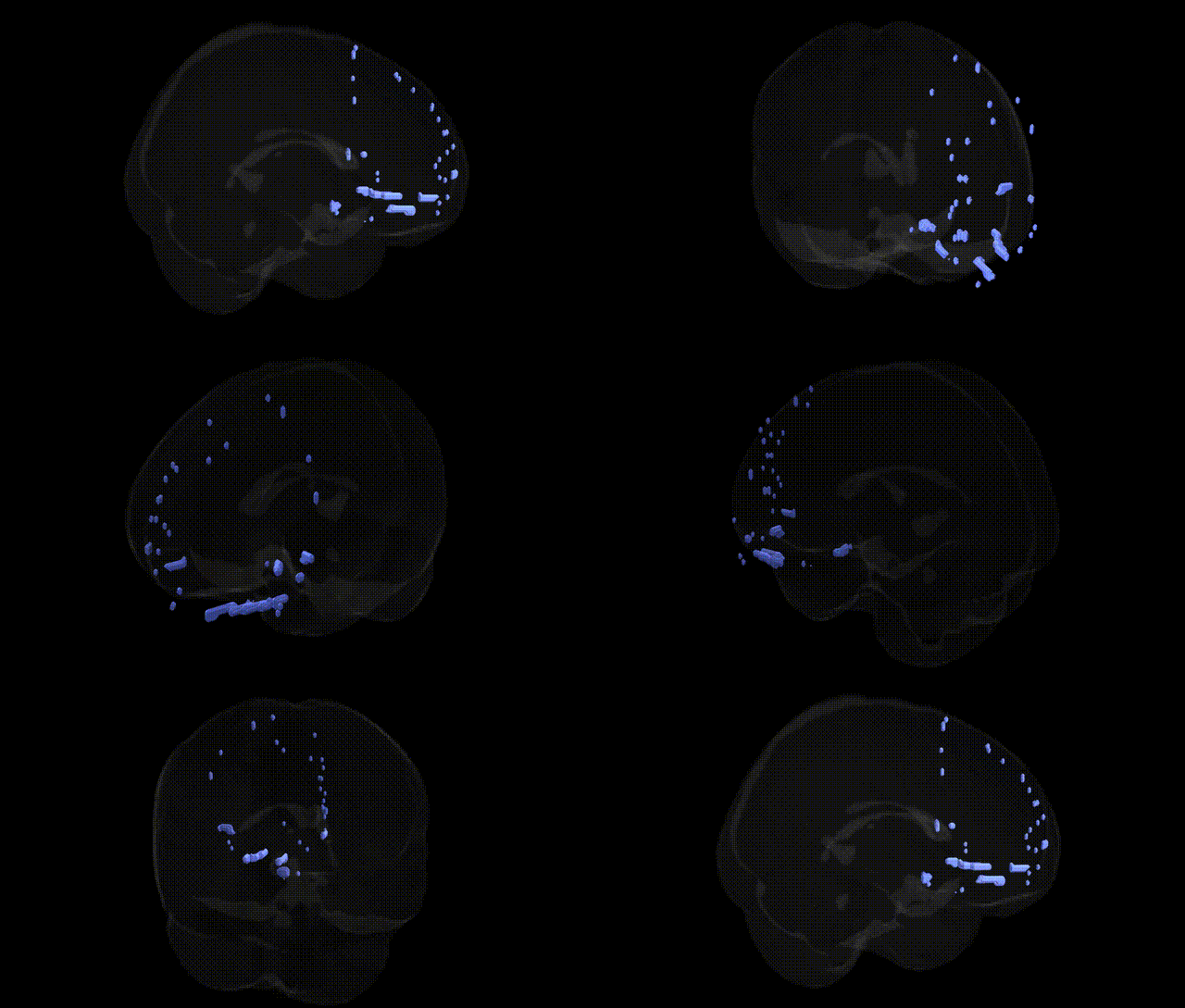
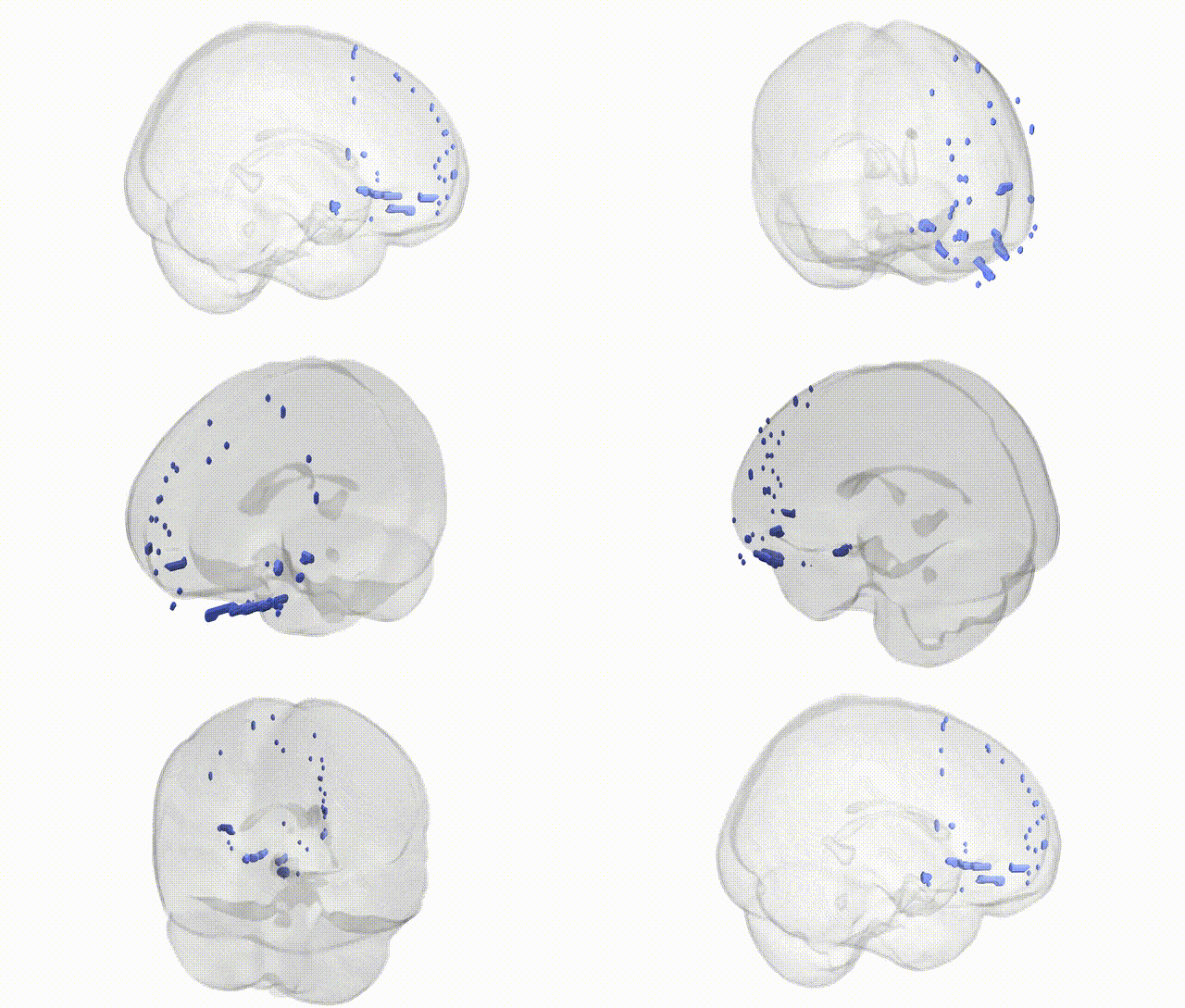
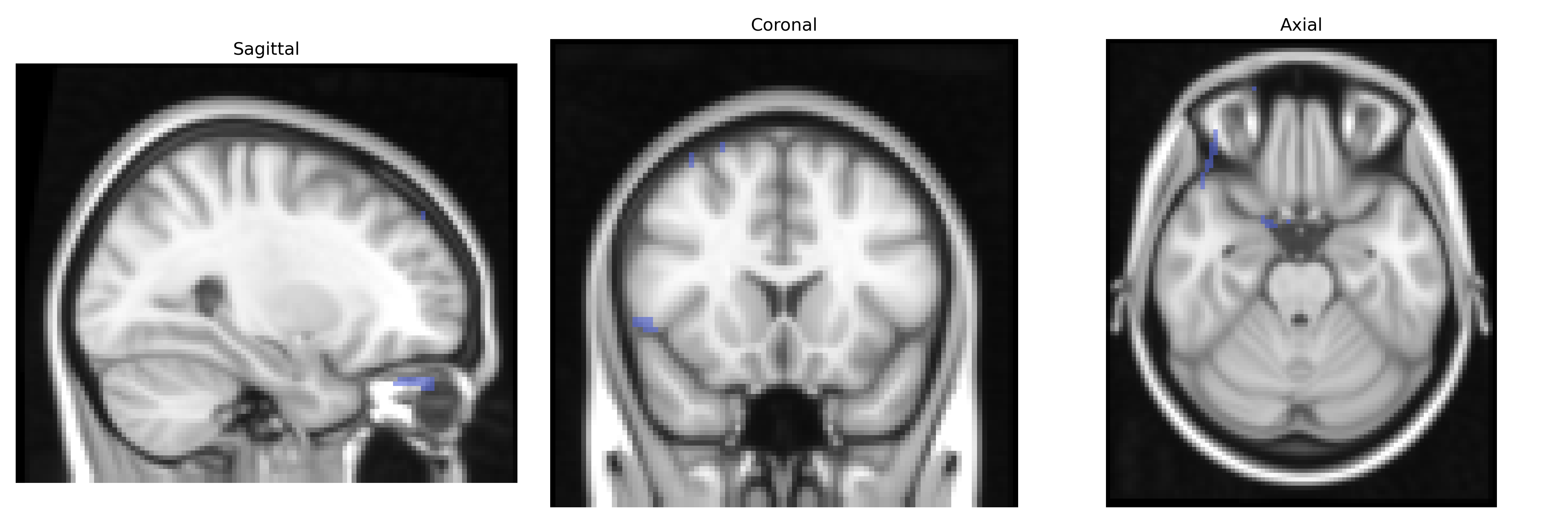
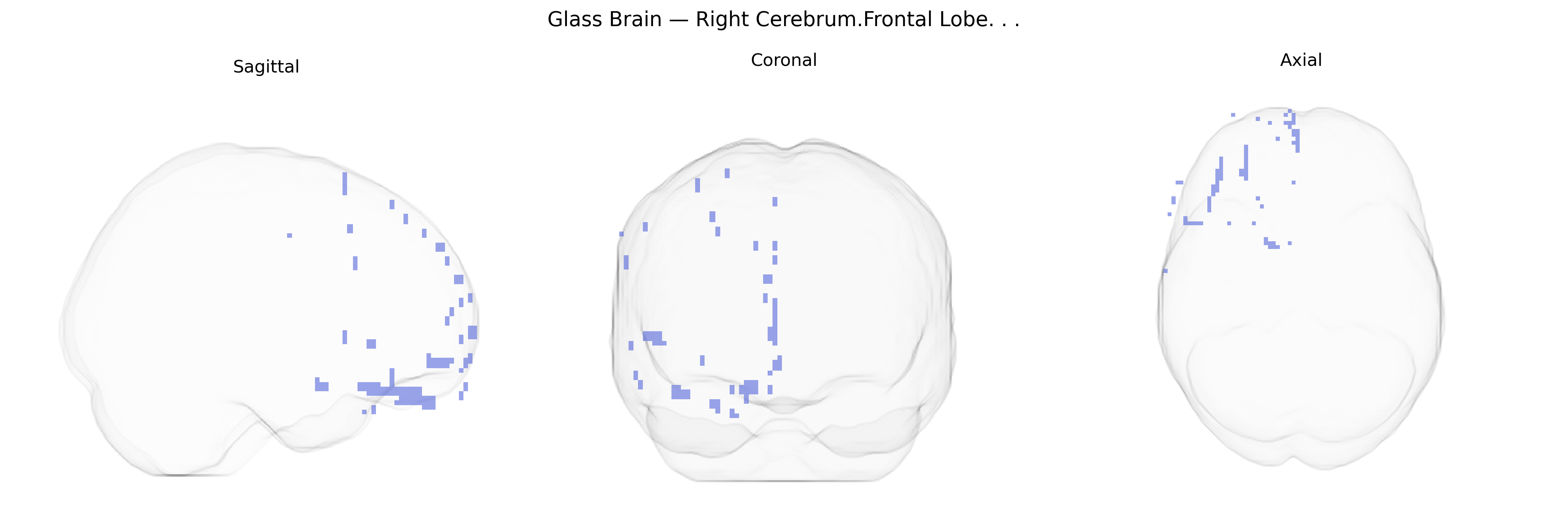
The bilateral right cerebrum frontal lobe encompasses cortical territories in the anterior portion of the right hemisphere, including regions implicated in executive functions, voluntary motor control, and higher-order cognitive integration. Structurally, it includes portions of the primary motor cortex, premotor and supplementary motor areas, and association cortices involved in planning, decision-making, working memory, attention, and aspects of social cognition and emotional regulation. Functionally, activity within this lobe contributes to the initiation and modulation of goal-directed behavior, the temporal organization of actions, inhibitory control, and the contextual evaluation of sensory and internal information. Lateralization to the right hemisphere is often associated with processes such as spatial attention, aspects of nonverbal communication, and certain components of affective processing.
The bilateral right frontal lobe (as defined in Talairach 2 mm atlas labeling of the right cerebrum frontal lobe) is a key association cortex region implicated by numerous genetic studies, particularly GWAS of brain structure and function, cognition, and psychiatric risk. Large imaging-genetics consortia (e.g., ENIGMA, UK Biobank) have identified common variants in genes related to neurodevelopment (such as those involved in axon guidance, synaptic formation, and cortical patterning—examples include CNTNAP2, NRGN, DISC1, and multiple 3p, 10p, and 17q loci) that influence frontal cortical thickness, surface area, and volume, often bilaterally but with some hemisphere- and subregion-specific effects. Polygenic risk scores for schizophrenia, bipolar disorder, major depressive disorder, ADHD, and autism spectrum conditions consistently associate with structural and functional alterations in right frontal regions, including dorsolateral and orbitofrontal cortex, linking distributed genetic risk to executive function, impulse control, and social cognition. GWAS of cognitive traits (general intelligence, educational attainment, working memory) and personality dimensions (e.g., neuroticism, impulsivity) also show that genetic variants affecting cortical development, synaptic signaling (especially glutamatergic and GABAergic), and myelination contribute to variability in right frontal lobe morphology and activation during tasks requiring cognitive control. In addition, several neuropsychiatric and neurological GWAS implicate gene sets involved in immune signaling and microglial function as modulators of frontal cortical integrity. Overall, known genetic associations for the right frontal lobe reflect highly polygenic influences that overlap across brain structure, cognitive traits, and psychiatric disorders, rather than single-region-specific genes, with the frontal cortex serving as a convergent anatomical substrate for diverse genomic risk architectures.
Overview generated by GPT-4o (2026).
Region ID: 108
Hemisphere: bilateral
Atlas: Talairach labels 2mm
Full Quality Version: Download MP4
Full Quality Version: Download MP4
Wali Sidiqyar*, Gaurav Rudravaram*, Elyssa M. McMaster, Trent M. Schwartz, Adam M. Saunders, Kurt G. Schilling, Bennett A. Landman "Introducing SPINS: A Shared Public Visualization Library of Neuroanatomical Structures." Medical Imaging with Deep Learning- short paper
This resource is licensed under CC0 1.0 Universal (Public Domain).