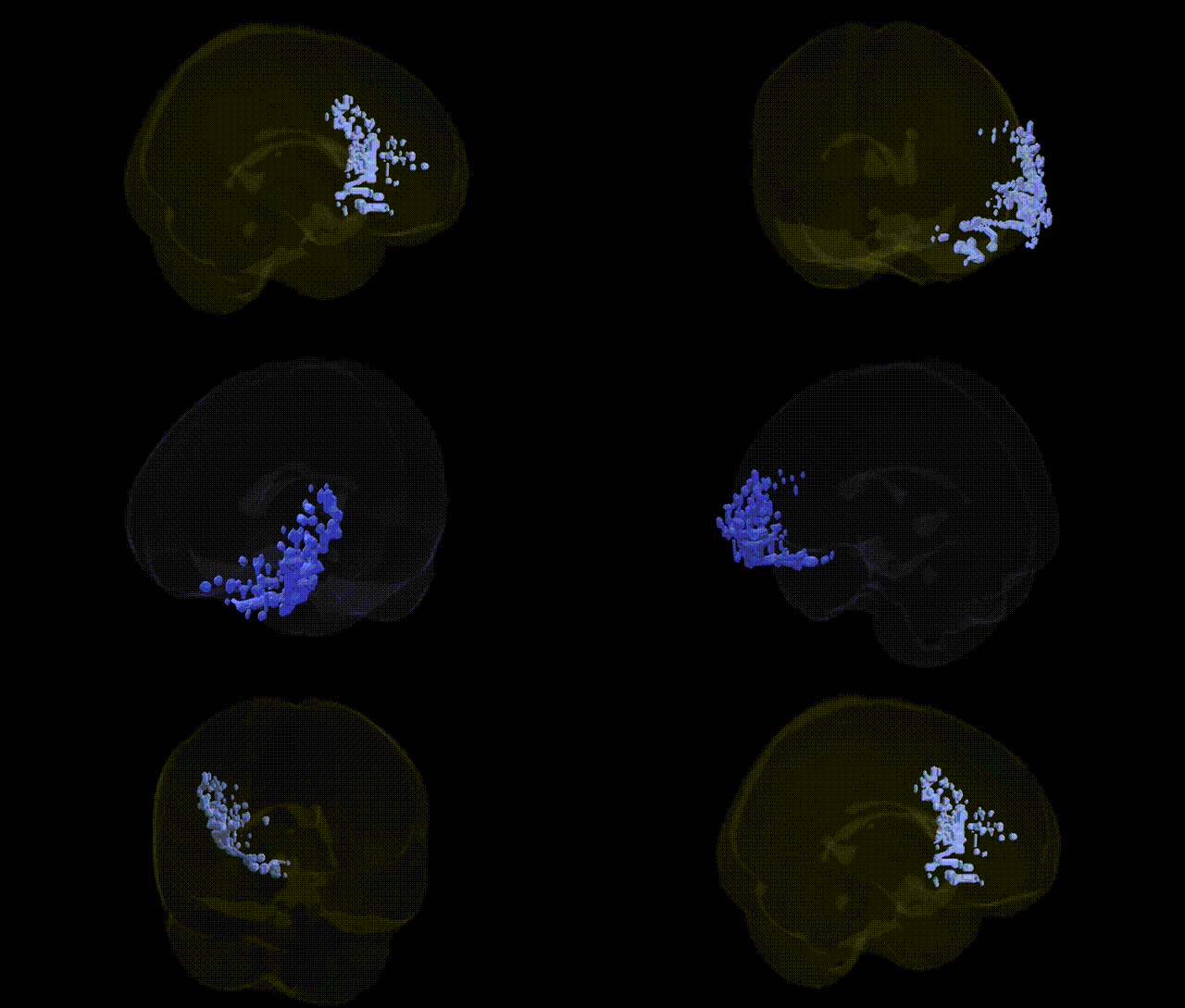
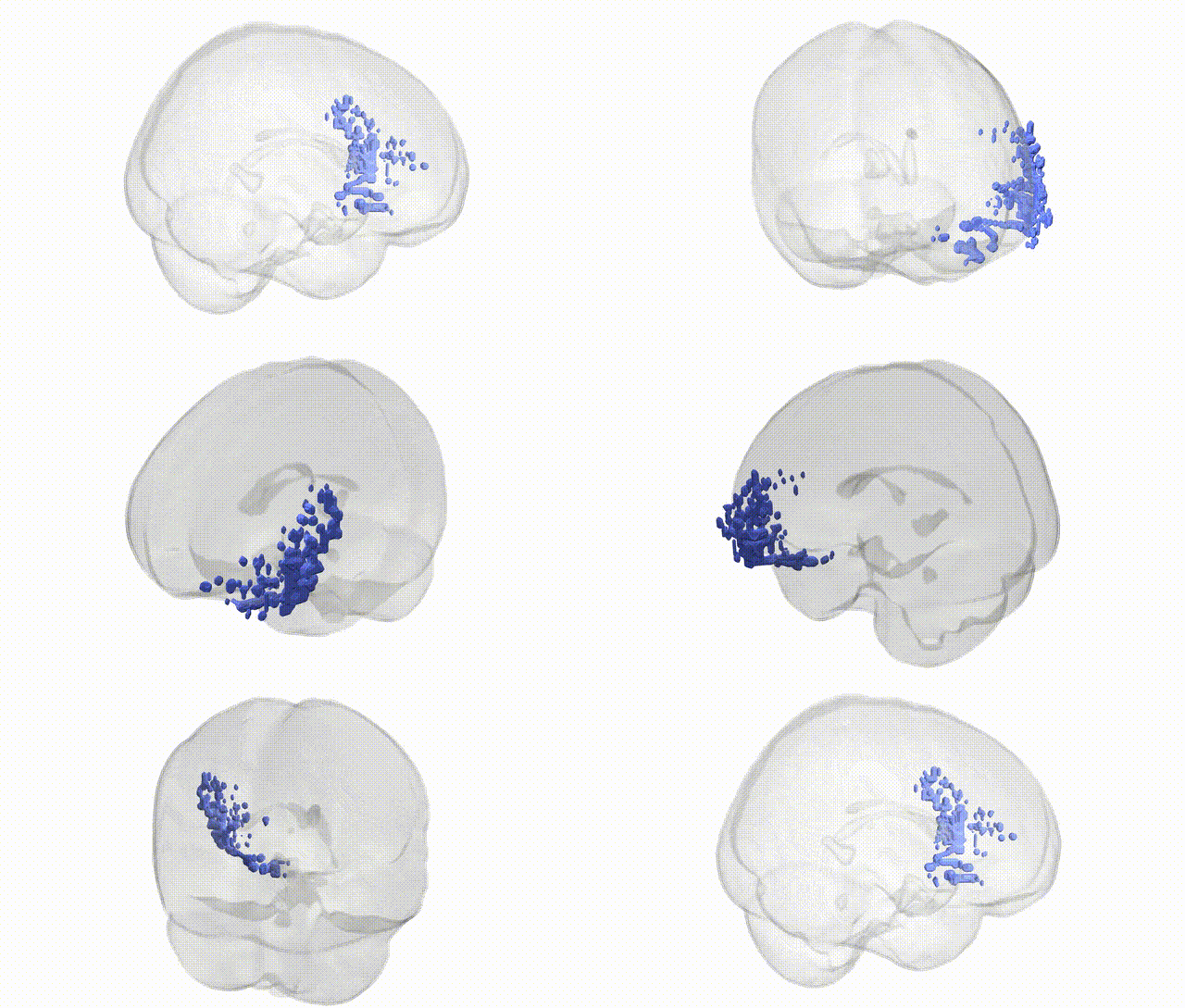
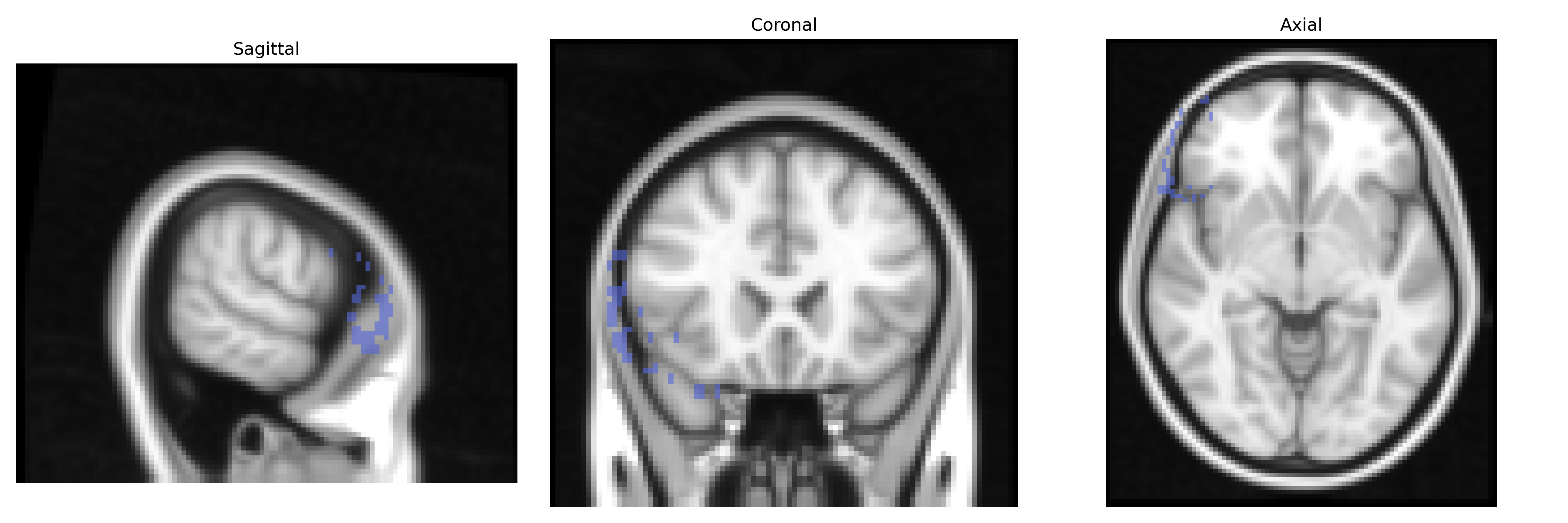
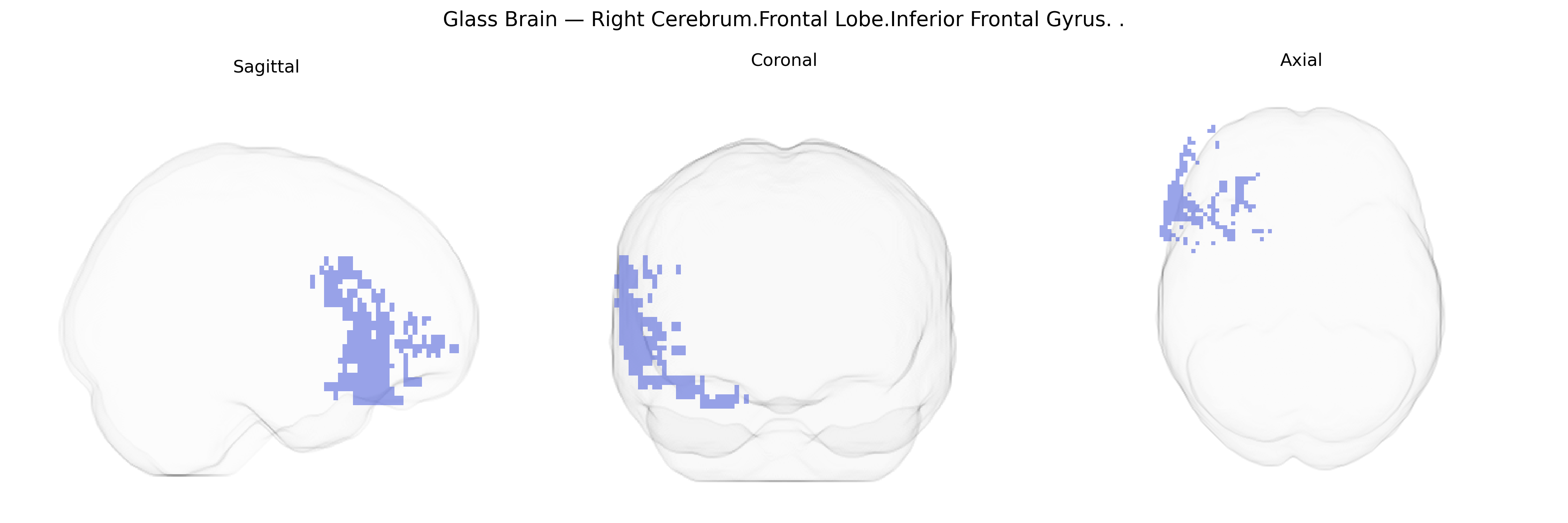
The bilateral Right Cerebrum.Frontal Lobe.Inferior Frontal Gyrus, as defined in the Talairach 2 mm Atlas, refers to the inferior frontal gyrus (IFG) of the right frontal lobe, a cortical region implicated in higher-order cognitive and language-related processes. Structurally, it lies on the lateral surface of the frontal lobe, inferior to the middle frontal gyrus and anterior to the precentral gyrus, and is typically subdivided into pars opercularis, pars triangularis, and pars orbitalis. Functionally, the right IFG is associated with response inhibition, attentional control, aspects of emotional and social cognition, and prosodic elements of speech (such as intonation and affective tone), complementing the left-hemisphere language-dominant IFG (Broca’s area). Its connectivity includes reciprocal projections with other frontal regions, the temporal lobe, parietal cortex, and subcortical structures, supporting its role in executive control and integration of multimodal information. There is no direct Wikipedia article for this exact Talairach label; a closely related structure is the Inferior frontal gyrus.
The bilateral inferior frontal gyrus (IFG) of the right frontal lobe, as defined in the Talairach 2 mm atlas, has been implicated in numerous genetic and imaging-genetics studies, particularly GWAS and candidate gene analyses linking structural and functional variation in this region to language, cognitive control, and psychiatric risk. Variants in genes related to synaptic plasticity and neurodevelopment (e.g., BDNF, CNTNAP2, FOXP2) have been associated with IFG volume, cortical thickness, or activation during language and phonological tasks, while large-scale GWAS of brain morphology (such as ENIGMA and UK Biobank-based consortia) have identified polygenic influences on frontal lobe measures that encompass IFG, including loci in genes involved in axon guidance, neuronal migration, and glutamatergic signaling. Right IFG activation and structure show heritability and have been genetically correlated with traits such as verbal fluency, response inhibition, working memory, and general cognitive ability, as well as with risk for disorders including attention-deficit/hyperactivity disorder, schizophrenia, autism spectrum disorder, and mood disorders, where risk alleles often map to synaptic and transcriptional regulatory pathways. Imaging-genetics studies in addiction and impulsivity have linked dopaminergic and serotonergic gene variants (e.g., DRD2/ANKK1, COMT, SLC6A4) to altered right IFG recruitment during inhibition and risk-taking tasks, while GWAS of stuttering and speech sound disorders highlight genes impacting fronto-striatal and fronto-temporal networks that prominently involve IFG. Overall, evidence supports a highly polygenic architecture in which common and rare variants across neurodevelopmental, synaptic, and neurotransmitter-related genes modulate the structure and function of the right IFG, contributing to interindividual differences in language, executive function, and vulnerability to neuropsychiatric conditions.
Overview generated by GPT-4o (2026).
Region ID: 187
Hemisphere: bilateral
Atlas: Talairach labels 2mm
Full Quality Version: Download MP4
Full Quality Version: Download MP4
Wali Sidiqyar*, Gaurav Rudravaram*, Elyssa M. McMaster, Trent M. Schwartz, Adam M. Saunders, Kurt G. Schilling, Bennett A. Landman "Introducing SPINS: A Shared Public Visualization Library of Neuroanatomical Structures." Medical Imaging with Deep Learning- short paper
This resource is licensed under CC0 1.0 Universal (Public Domain).