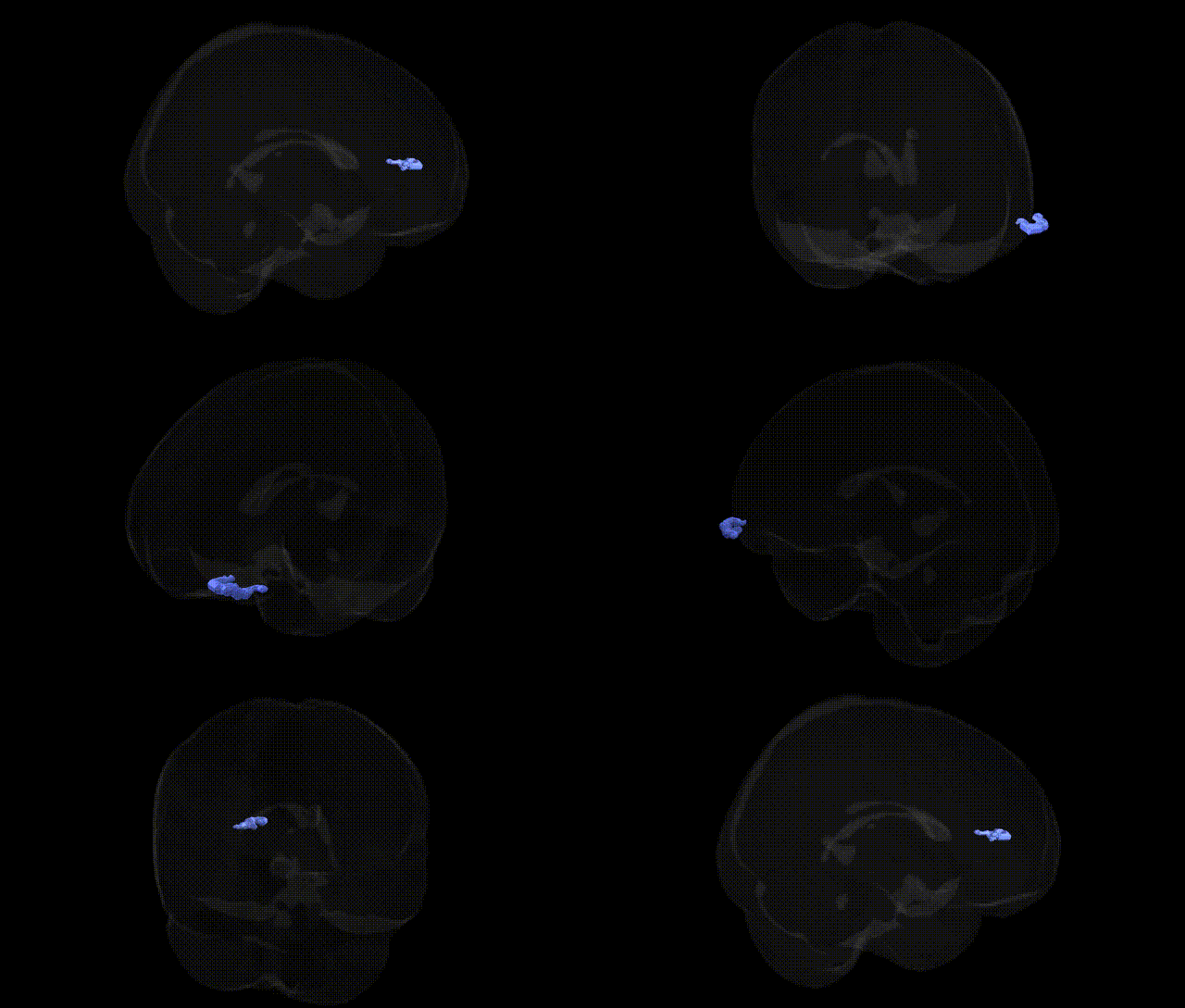
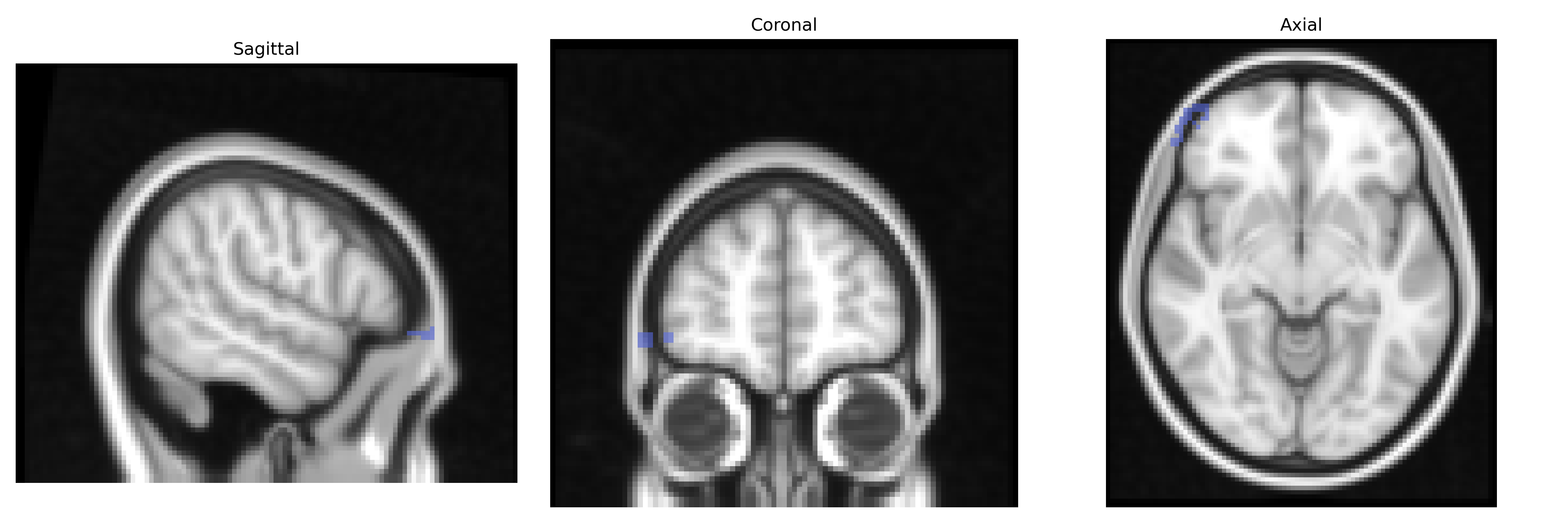
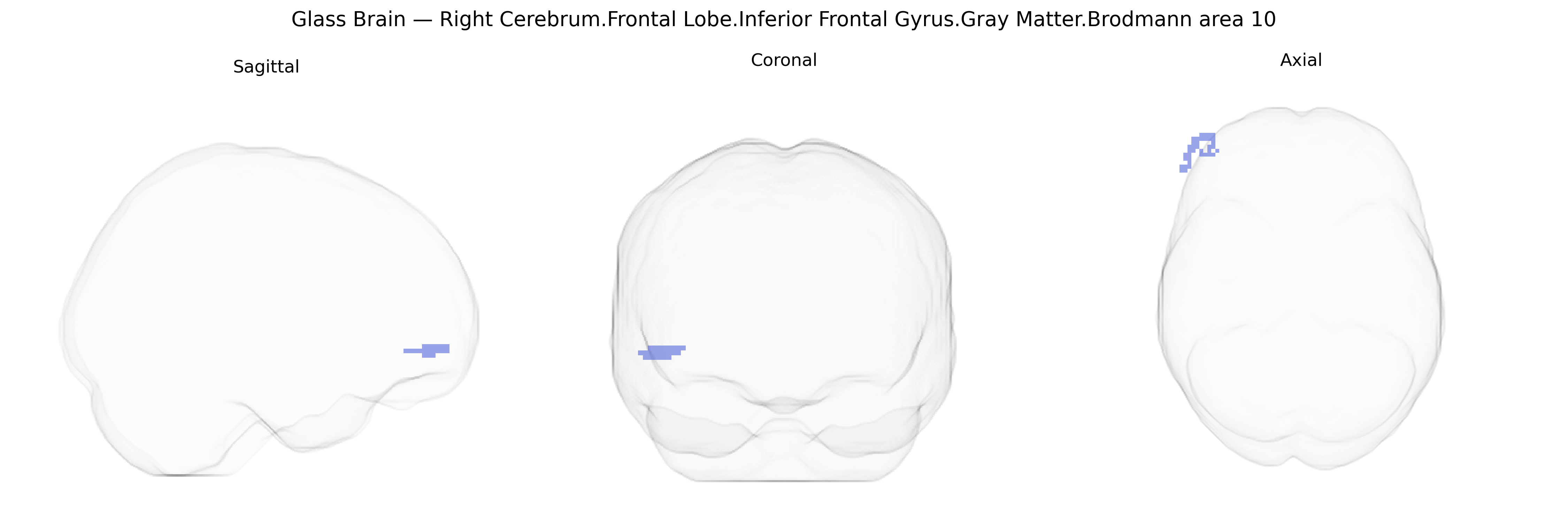
The bilateral Right Cerebrum.Frontal Lobe.Inferior Frontal Gyrus.Gray Matter.Brodmann area 10 corresponds to a portion of the frontopolar cortex located at the most anterior aspect of the frontal lobe, extending into the inferior frontal gyrus and characterized cytoarchitectonically by the granular structure of Brodmann area 10. This region is implicated in higher-order associative functions including prospective memory, complex decision-making, integration of multiple cognitive and affective signals over extended time scales, and the management of multitasking and behavioral planning. It is strongly interconnected with other prefrontal areas, limbic structures, and association cortices, and plays a key role in human-specific aspects of cognition such as abstract reasoning and social cognition. There is no direct link for this exact Talairach label; a closely related structure is Brodmann area 10.
Genetic associations with the bilateral Right Cerebrum Frontal Lobe Inferior Frontal Gyrus gray matter in Brodmann area 10 (BA10) from the Talairach 2 mm atlas arise largely from imaging genetics and GWAS of brain structure and function rather than region-specific single-gene studies. BA10, a key hub for higher-order executive function, prospective planning, social cognition, and valuation, shows heritable variation in cortical thickness and surface area, with large-scale GWAS (e.g., ENIGMA and UK Biobank-based studies) identifying loci in and near genes such as HMGA2, PAX6, FGFR1, MEF2C, and other neurodevelopmental and synaptic genes that influence frontal cortical morphology, including superior and medial frontal areas overlapping or adjacent to BA10. Polygenic risk scores for schizophrenia, bipolar disorder, major depressive disorder, and ADHD have been associated with altered volume or thickness in anterior frontal regions encompassing BA10, and risk variants in genes like CACNA1C, DRD2, GRM3, and CNTNAP2 have been linked to functional changes in frontopolar and inferior frontal circuitry relevant to working memory, cognitive control, and social cognition. GWAS of cognitive traits (general intelligence, educational attainment, executive function) and personality dimensions (e.g., openness, neuroticism) have implicated distributed frontal networks including BA10, with variants in genes related to synaptic plasticity and cortical development (such as BDNF and KIBRA/WFS1 pathways) showing imaging correlates in anterior frontal cortex. Additionally, genetic liability for autism spectrum disorder and social anxiety is associated with atypical activation and connectivity of BA10 and neighboring medial/inferior frontal regions in task-based and resting-state fMRI, linking risk genes that modulate excitatory–inhibitory balance (e.g., GABAergic and glutamatergic signaling genes) to functional alterations in this territory. Overall, BA10 emerges in genetic studies as a convergent anatomical and functional node influenced by polygenic variation related to neurodevelopment, cognition, and psychiatric vulnerability, though most findings pertain to broader anterior frontal areas rather than Talairach-defined BA10 in strict isolation.
Overview generated by GPT-4o (2026).
Region ID: 484
Hemisphere: bilateral
Atlas: Talairach labels 2mm
Full Quality Version: Download MP4
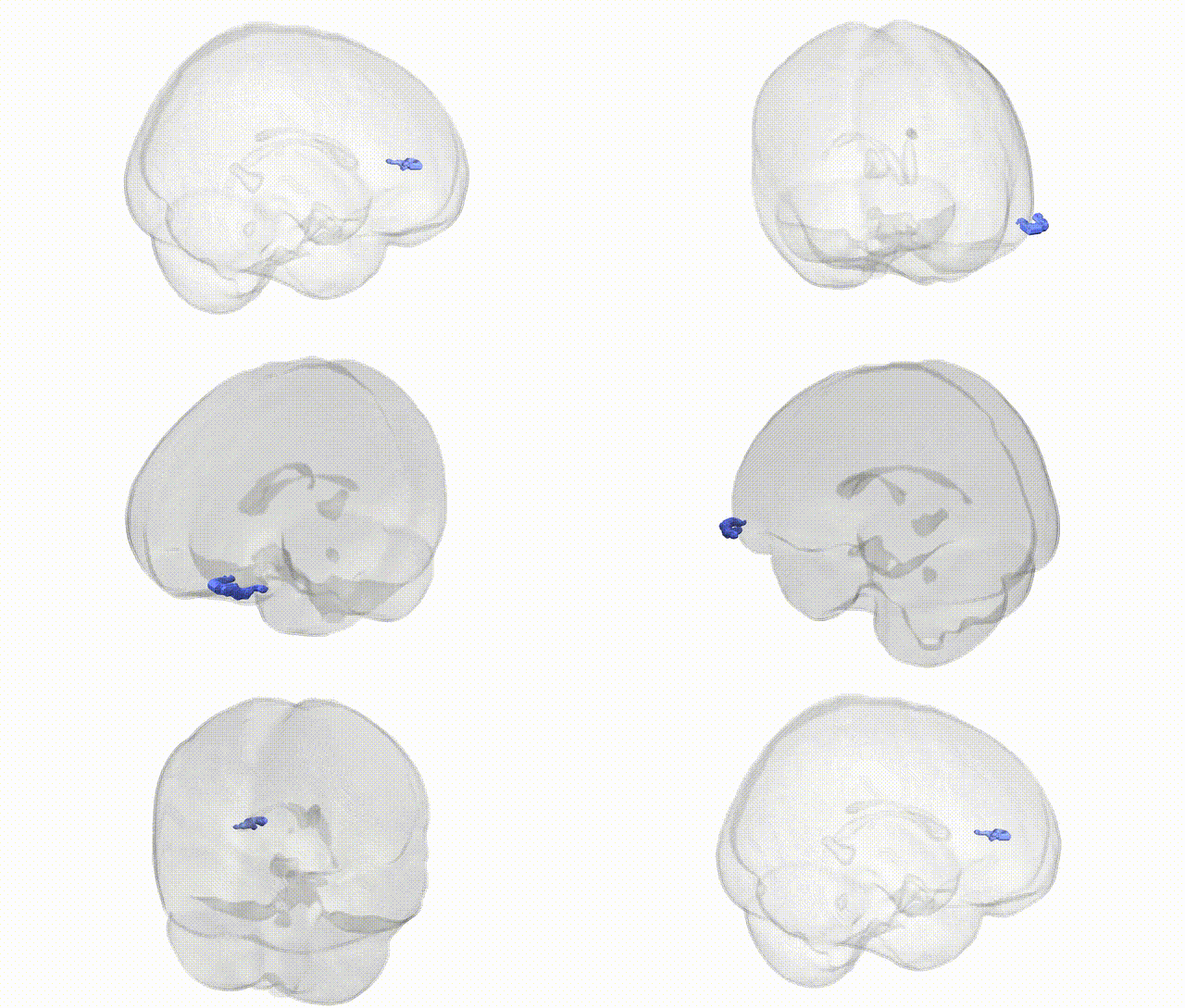
Full Quality Version: Download MP4
Wali Sidiqyar*, Gaurav Rudravaram*, Elyssa M. McMaster, Trent M. Schwartz, Adam M. Saunders, Kurt G. Schilling, Bennett A. Landman "Introducing SPINS: A Shared Public Visualization Library of Neuroanatomical Structures." Medical Imaging with Deep Learning- short paper
This resource is licensed under CC0 1.0 Universal (Public Domain).