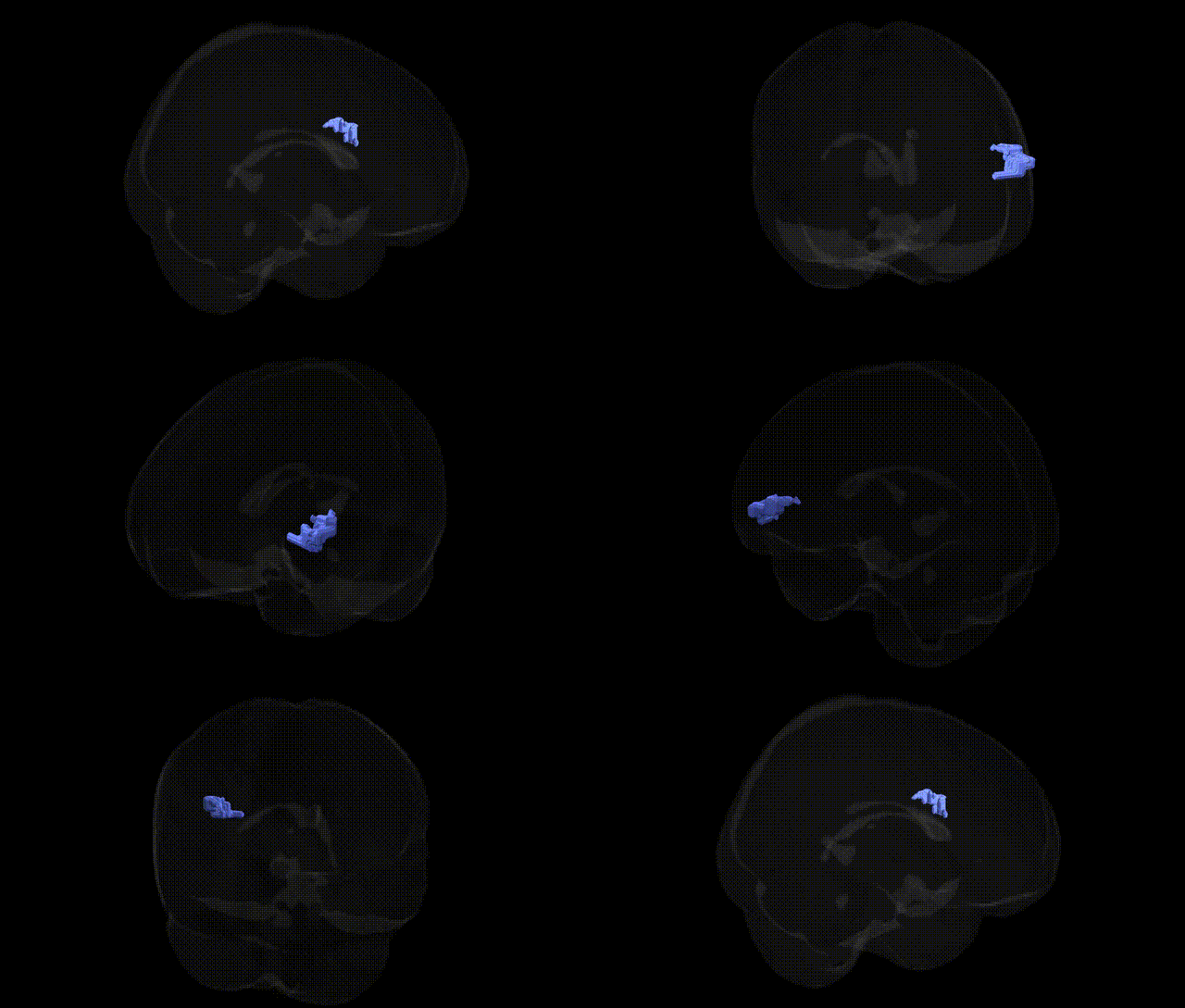
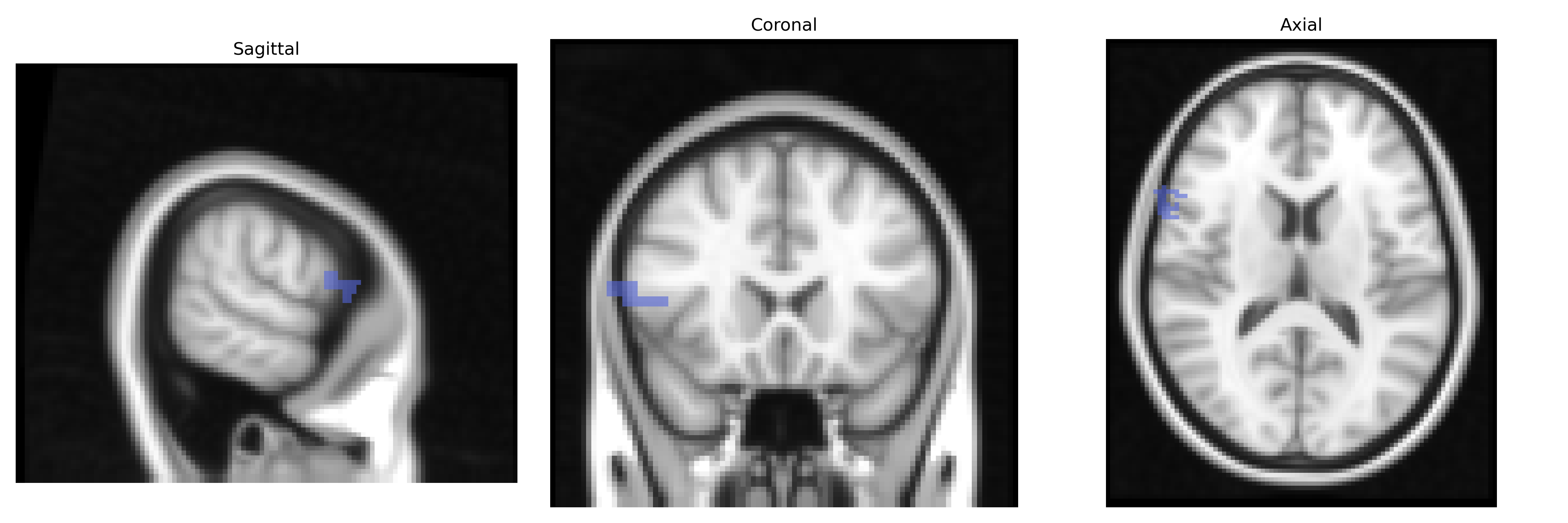
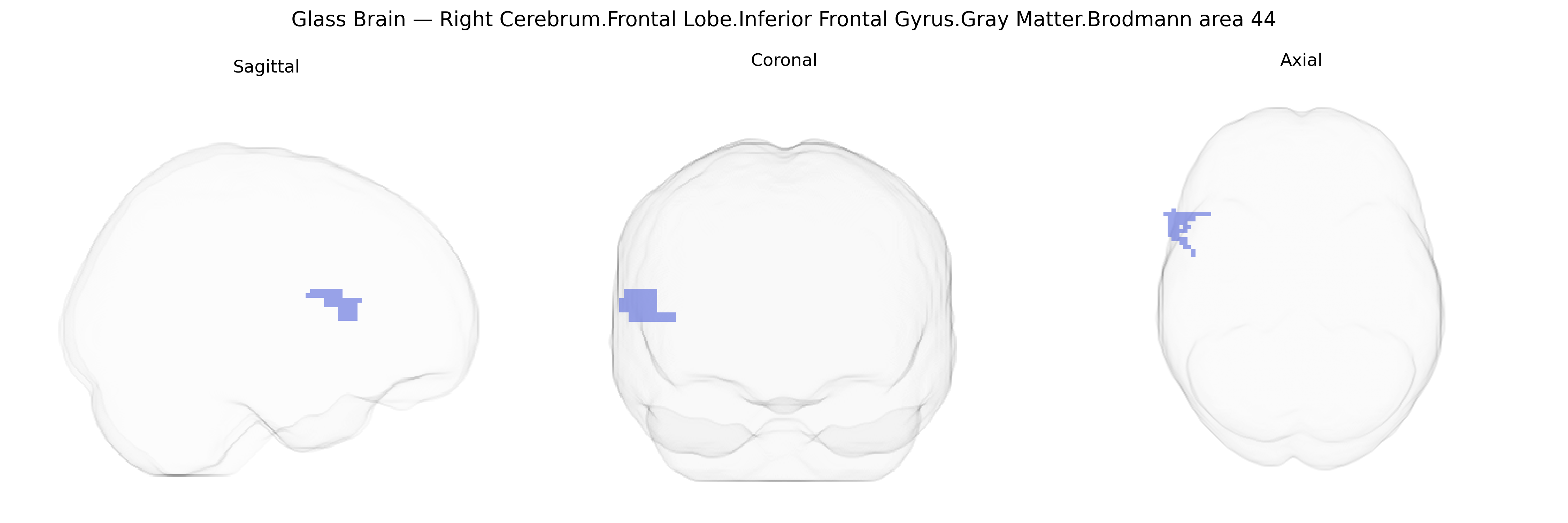
Bilateral Right Cerebrum.Frontal Lobe.Inferior Frontal Gyrus.Gray Matter.Brodmann area 44 corresponds to the right-hemisphere homolog of Broca’s area, situated in the posterior portion of the inferior frontal gyrus and involved in higher-order aspects of language, speech motor planning, and complex action sequencing. Although classic Broca’s area is typically described in the left hemisphere, the right BA44 contributes to prosody, emotional intonation, and pragmatic aspects of communication, and participates in broader networks for motor control, working memory, and syntactic processing. Cytoarchitectonically, BA44 is characterized by agranular frontal cortex with distinctive laminar organization, and functionally it is tightly integrated with temporal and parietal language-related regions via dorsal fronto-temporal pathways. There is no direct link for this exact Talairach label; a closely related structure is Broca’s area.
Brodmann area 44 in the inferior frontal gyrus (classically overlapping Broca’s area) has been repeatedly implicated in genetic studies of language, speech, and higher-order cognitive traits, though most findings are indirect via imaging genetics rather than region-specific GWAS. Variants in FOXP2, a key speech and language gene, and its downstream network have been associated with structural and functional differences in inferior frontal regions including BA44, linking this area to developmental speech and language disorders. Imaging GWAS and large-scale neuroimaging consortia (e.g., ENIGMA, UK Biobank) have identified common variants influencing frontal lobe and inferior frontal gyrus gray matter volume and cortical thickness, some mapping to genes involved in neurodevelopment, synaptic function, and axon guidance (such as those in the glutamatergic and neuroplasticity pathways), with downstream effects on language ability, verbal fluency, educational attainment, general cognitive performance, and reading skills. BA44 has also been implicated in polygenic architectures of neuropsychiatric conditions: schizophrenia and bipolar disorder show genetically mediated alterations in inferior frontal structure and activation patterns; autism spectrum conditions and specific language impairment have been linked to genetic variants that affect fronto-temporal language networks including BA44; and common risk alleles for attention-deficit/hyperactivity disorder and major depressive disorder are associated with atypical frontal network connectivity that encompasses this region. Additionally, candidate and GWAS-based studies of stuttering, dyslexia, and aphasia-related recovery sometimes report associations between genetic variants and structural or functional measures in BA44, supporting its role as a convergent anatomical locus for multiple heritable language and cognitive phenotypes.
Overview generated by GPT-4o (2026).
Region ID: 749
Hemisphere: bilateral
Atlas: Talairach labels 2mm
Full Quality Version: Download MP4
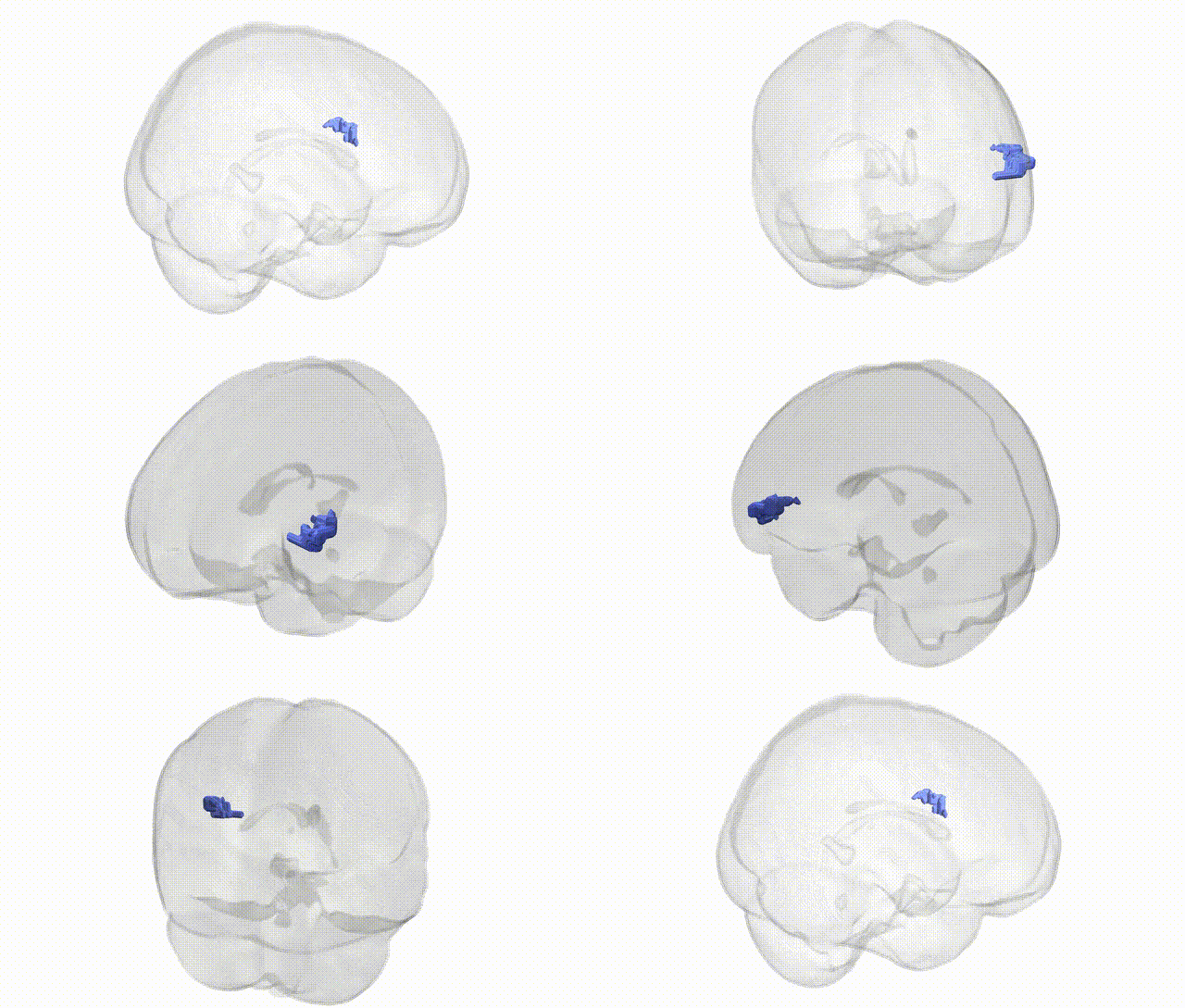
Full Quality Version: Download MP4
Wali Sidiqyar*, Gaurav Rudravaram*, Elyssa M. McMaster, Trent M. Schwartz, Adam M. Saunders, Kurt G. Schilling, Bennett A. Landman "Introducing SPINS: A Shared Public Visualization Library of Neuroanatomical Structures." Medical Imaging with Deep Learning- short paper
This resource is licensed under CC0 1.0 Universal (Public Domain).