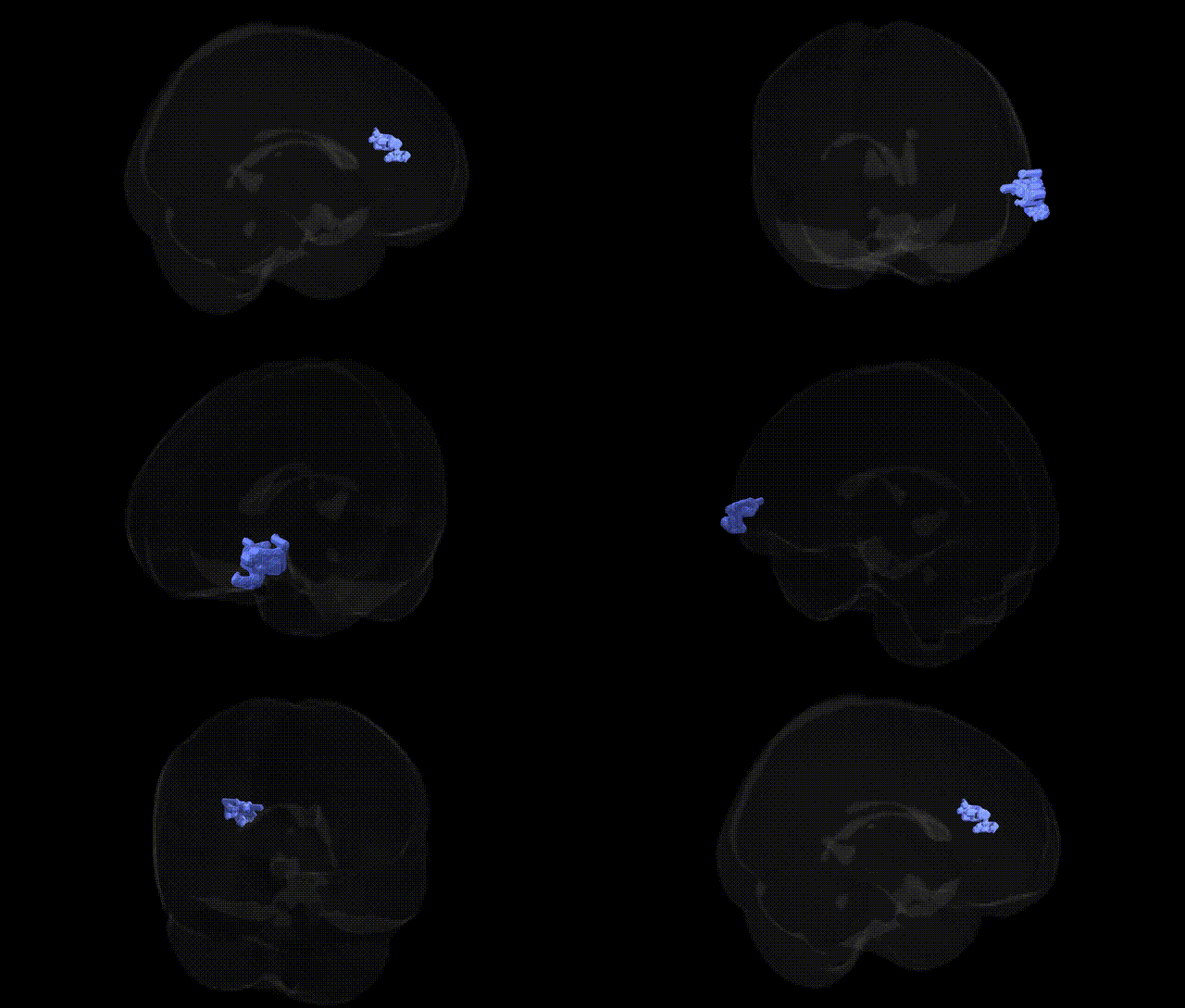
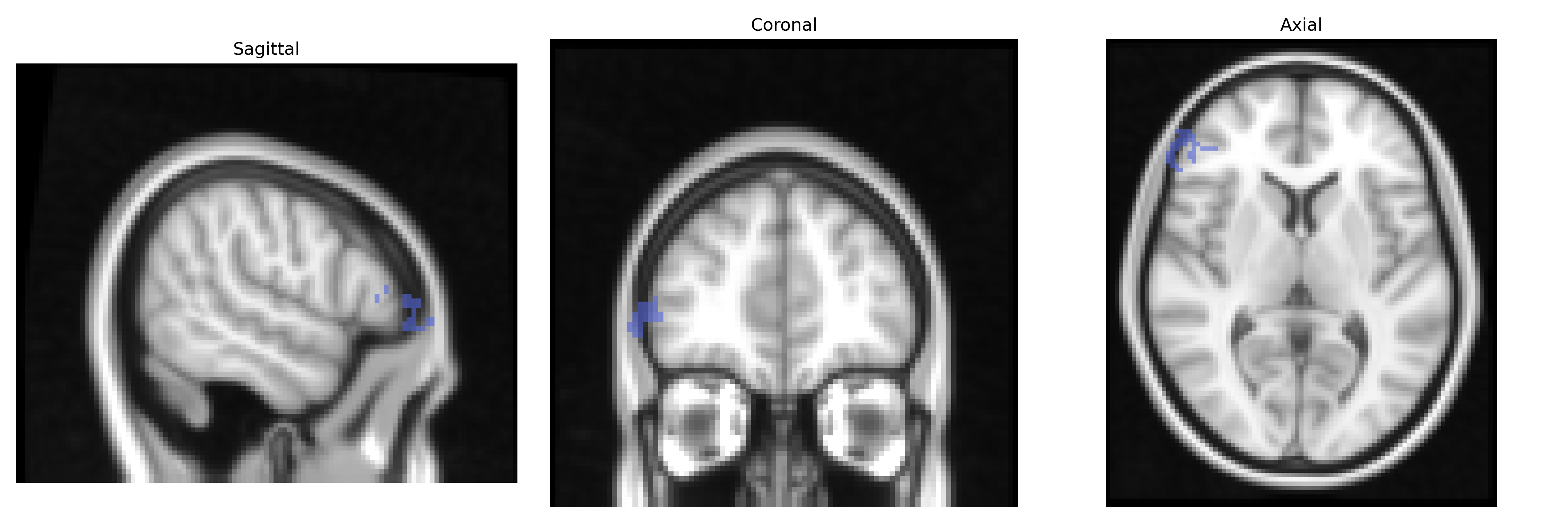
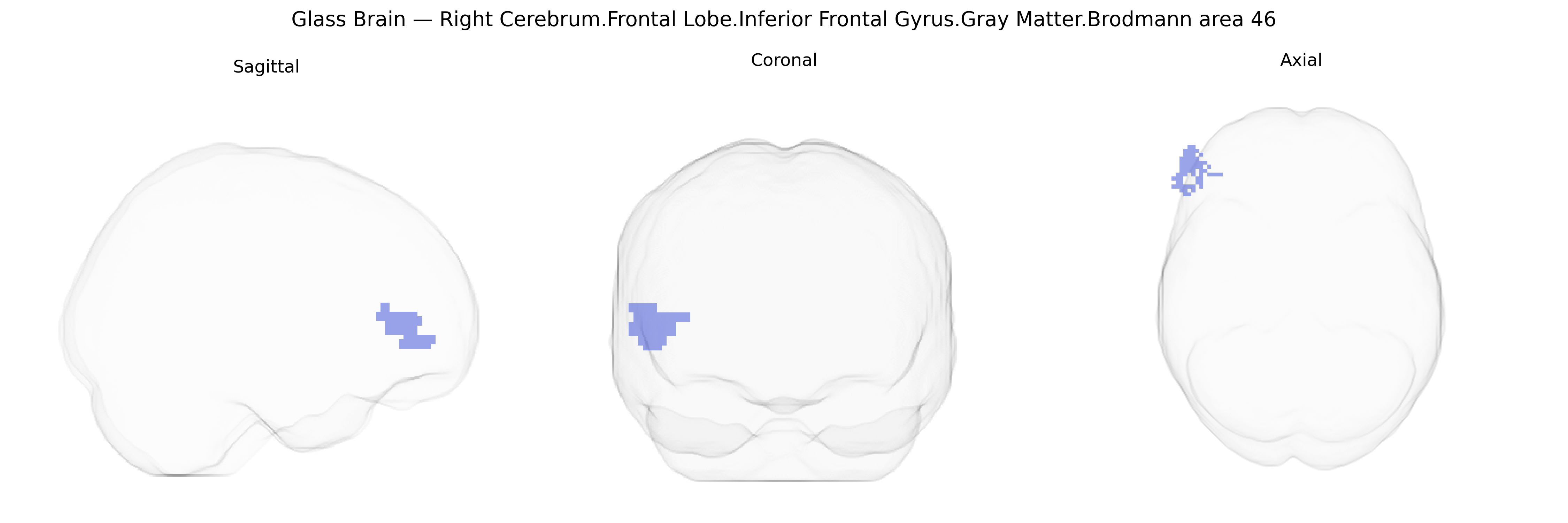
The bilateral Right Cerebrum.Frontal Lobe.Inferior Frontal Gyrus.Gray Matter.Brodmann area 46 corresponds to a dorsolateral segment of the prefrontal cortex implicated in high-level executive functions, including working memory, cognitive control, planning, and the manipulation of information over short time intervals. In the Talairach 2 mm atlas, this region lies within the inferior frontal gyrus of the right frontal lobe, though Brodmann area 46 is more commonly associated with the middle frontal gyrus and adjacent prefrontal territories, reflecting some overlap and variability in atlas-based parcellations. Functionally, this area participates in networks supporting attention, decision-making, and flexible behavioral adaptation, and is strongly interconnected with other prefrontal, parietal, and limbic structures. There is no direct link for this exact composite label; a closely related structure is Dorsolateral prefrontal cortex.
The bilateral Right Cerebrum.Frontal Lobe.Inferior Frontal Gyrus.Gray Matter.Brodmann area 46 (BA46) region, corresponding largely to dorsolateral prefrontal cortex, has been implicated in multiple genetic and GWAS findings relating to cognition, psychiatric risk, and brain structure. Imaging genetics studies consistently show heritable variation in BA46 gray matter volume and cortical thickness, with polygenic scores for general cognitive ability and educational attainment (e.g., aggregating variants near genes such as KIBRA/WFS1, CHRM2, CNTNAP2, and others) predicting structural and functional measures in this region. Large-scale GWAS of brain MRI phenotypes (e.g., ENIGMA and UK Biobank) have identified common variants influencing frontal cortical thickness and surface area, some mapping to genes involved in synaptic function and neurodevelopment (such as C4A/C4B in the MHC region, GRIN2A, and BDNF), which in turn show downstream associations with BA46-related measures. Psychiatric GWAS and imaging–genetic overlap studies link schizophrenia and bipolar disorder risk loci (including CACNA1C, ZNF804A, and DRD2) with altered BA46 structure and activation, particularly during working memory and cognitive control tasks. Similarly, risk alleles for major depressive disorder and anxiety (e.g., in SLC6A4, CRHR1, and various genome-wide significant loci from large consortia) have been associated with functional dysregulation in BA46 and adjacent inferior frontal regions. In addiction-related genetics, variants affecting dopaminergic and glutamatergic signaling (such as in OPRM1, DRD2/ANKK1, and GRM3) have been tied to impaired inhibitory control and altered activation of inferior frontal/dorsolateral prefrontal areas, including BA46. Across these studies, BA46 emerges as a key genetically modulated hub for executive function, working memory, and top-down control, with multiple polygenic and single-variant influences converging on its structure and function in relation to cognition and neuropsychiatric disorders.
Overview generated by GPT-4o (2026).
Region ID: 608
Hemisphere: bilateral
Atlas: Talairach labels 2mm
Full Quality Version: Download MP4
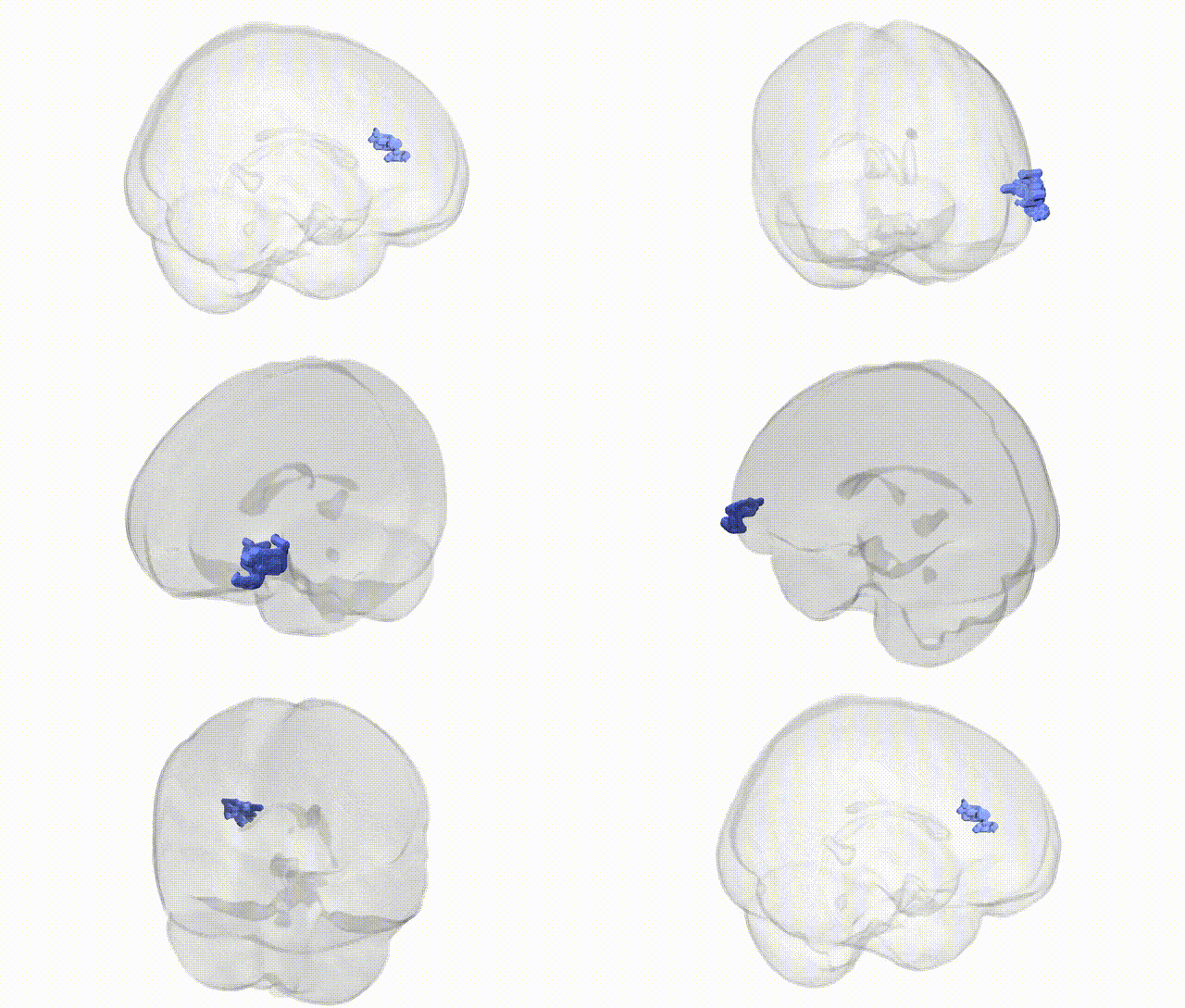
Full Quality Version: Download MP4
Wali Sidiqyar*, Gaurav Rudravaram*, Elyssa M. McMaster, Trent M. Schwartz, Adam M. Saunders, Kurt G. Schilling, Bennett A. Landman "Introducing SPINS: A Shared Public Visualization Library of Neuroanatomical Structures." Medical Imaging with Deep Learning- short paper
This resource is licensed under CC0 1.0 Universal (Public Domain).