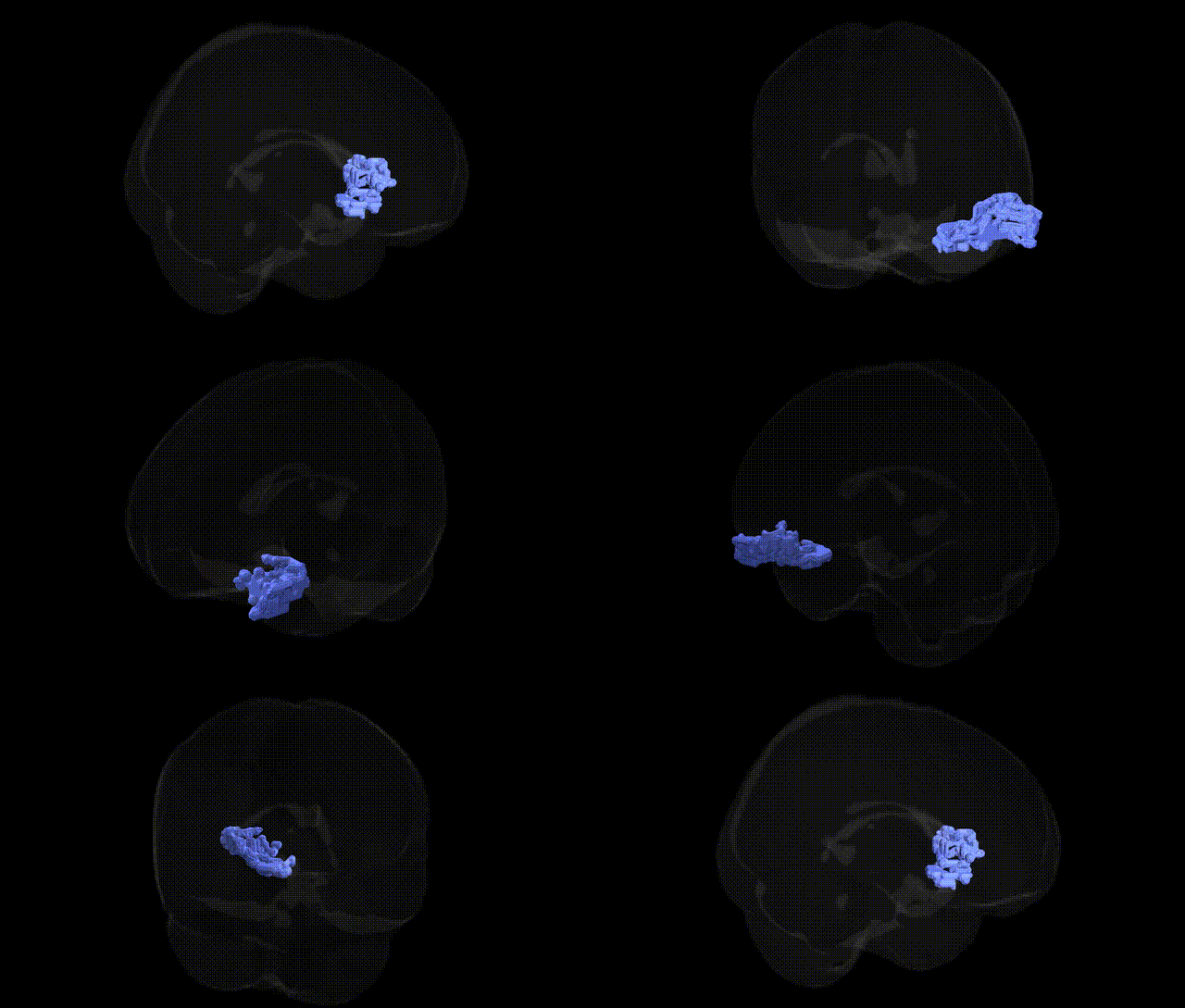
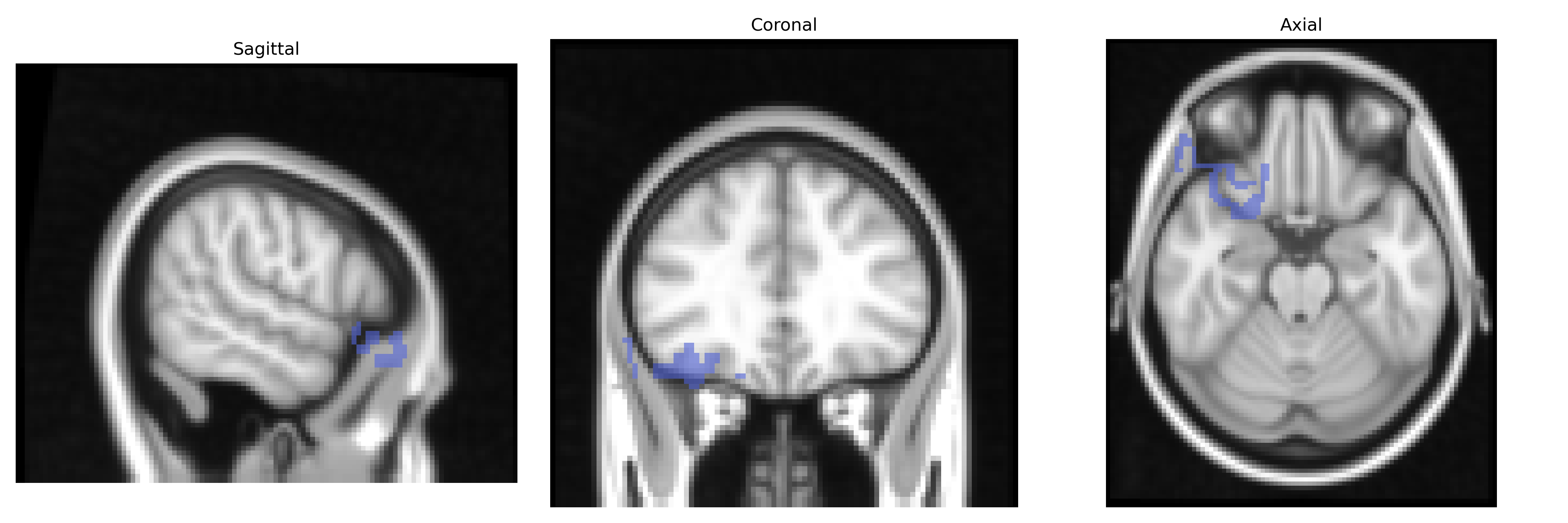
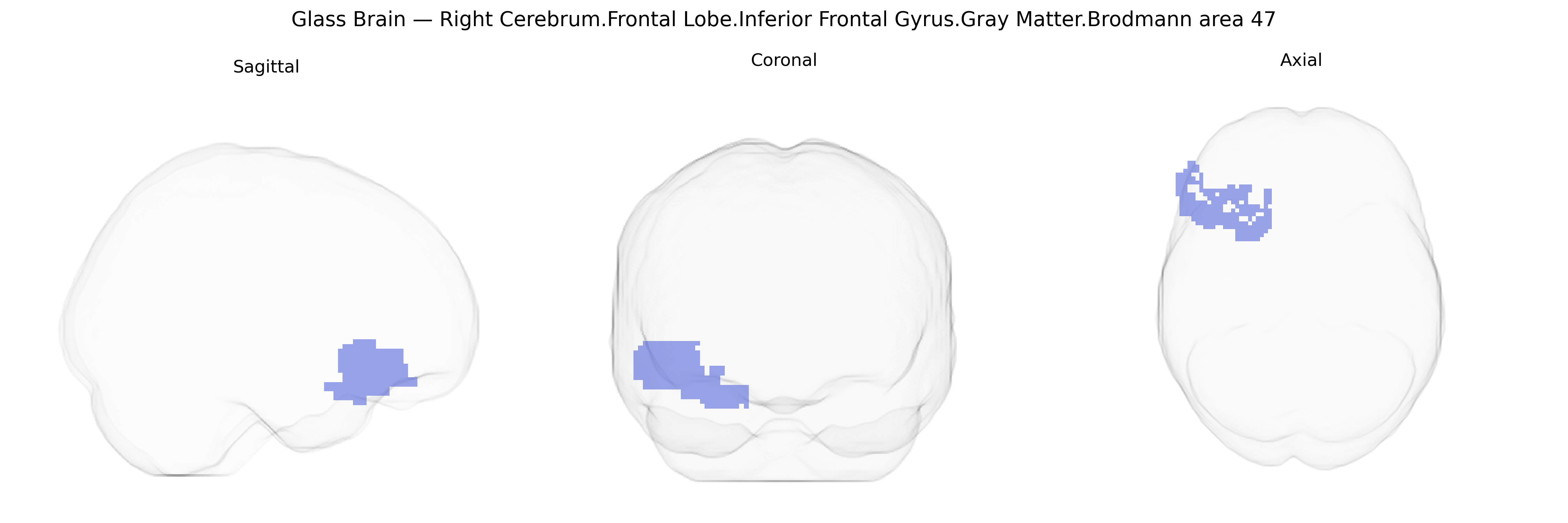
The bilateral Right Cerebrum.Frontal Lobe.Inferior Frontal Gyrus.Gray Matter.Brodmann area 47 corresponds to a ventrolateral prefrontal cortical territory occupying the orbital and ventral portions of the inferior frontal gyrus, typically extending into the frontal operculum and orbitofrontal cortex. Brodmann area 47 is implicated in higher-order cognitive and affective functions, including semantic processing, language comprehension, controlled retrieval of information from long-term memory, and aspects of social cognition and reward-related decision-making. Cytoarchitectonically, it is an association cortex characterized by granular frontal layering and extensive connectivity with temporal, limbic, and other prefrontal regions, supporting integrative processing of emotional and contextual information. There is no direct link to this exact Talairach-defined label; a closely related structure is Brodmann area 47.
The bilateral right inferior frontal gyrus (IFG) in Brodmann area 47, a ventrolateral prefrontal region implicated in language, semantic processing, inhibitory control, and social-emotional cognition, has been repeatedly highlighted in imaging genetics and GWAS of brain structure, cognition, and psychiatric risk. Large-scale neuroimaging GWAS (e.g., ENIGMA and UK Biobank) have identified common variants associated with cortical thickness and surface area in inferior frontal regions and adjacent orbitofrontal/ventrolateral prefrontal cortex, including loci near genes involved in neurodevelopment, synaptic function, and cell adhesion (such as CNTNAP2, DCDC2, FOXP2-related pathways, and various glutamatergic and GABAergic genes), which show correlations with gray matter measures overlapping BA47. In psychiatric genetics, BA47/IFG has emerged as a key node in case–control and PRS-based imaging studies of major depressive disorder, bipolar disorder, schizophrenia, obsessive-compulsive disorder, and autism spectrum disorder, where higher polygenic risk scores often associate with altered volume, thickness, or functional activation in this region, particularly in tasks requiring affect regulation or cognitive control. GWAS of personality traits (e.g., neuroticism), risk-taking behavior, and substance use have reported variants whose brain-structural or functional mediation effects map to inferior frontal and orbitofrontal areas, suggesting that genetic influences on impulsivity and emotional reactivity partially converge on BA47 circuitry. Additionally, language-related and reading-disorder genetics (specific language impairment, dyslexia) and FOXP2-network studies frequently implicate ventrolateral prefrontal regions, including inferior frontal areas, in the downstream brain-structural and functional consequences of relevant variants, though these findings are typically left-lateralized and not BA47-specific. Overall, genetic associations linked to BA47 tend to be distributed and polygenic, with risk alleles for psychiatric and cognitive traits exerting subtle, additive effects on right inferior frontal gray matter and its role in emotion, inhibition, and complex cognition rather than reflecting region-specific “BA47 genes.”
Overview generated by GPT-4o (2026).
Region ID: 188
Hemisphere: bilateral
Atlas: Talairach labels 2mm
Full Quality Version: Download MP4
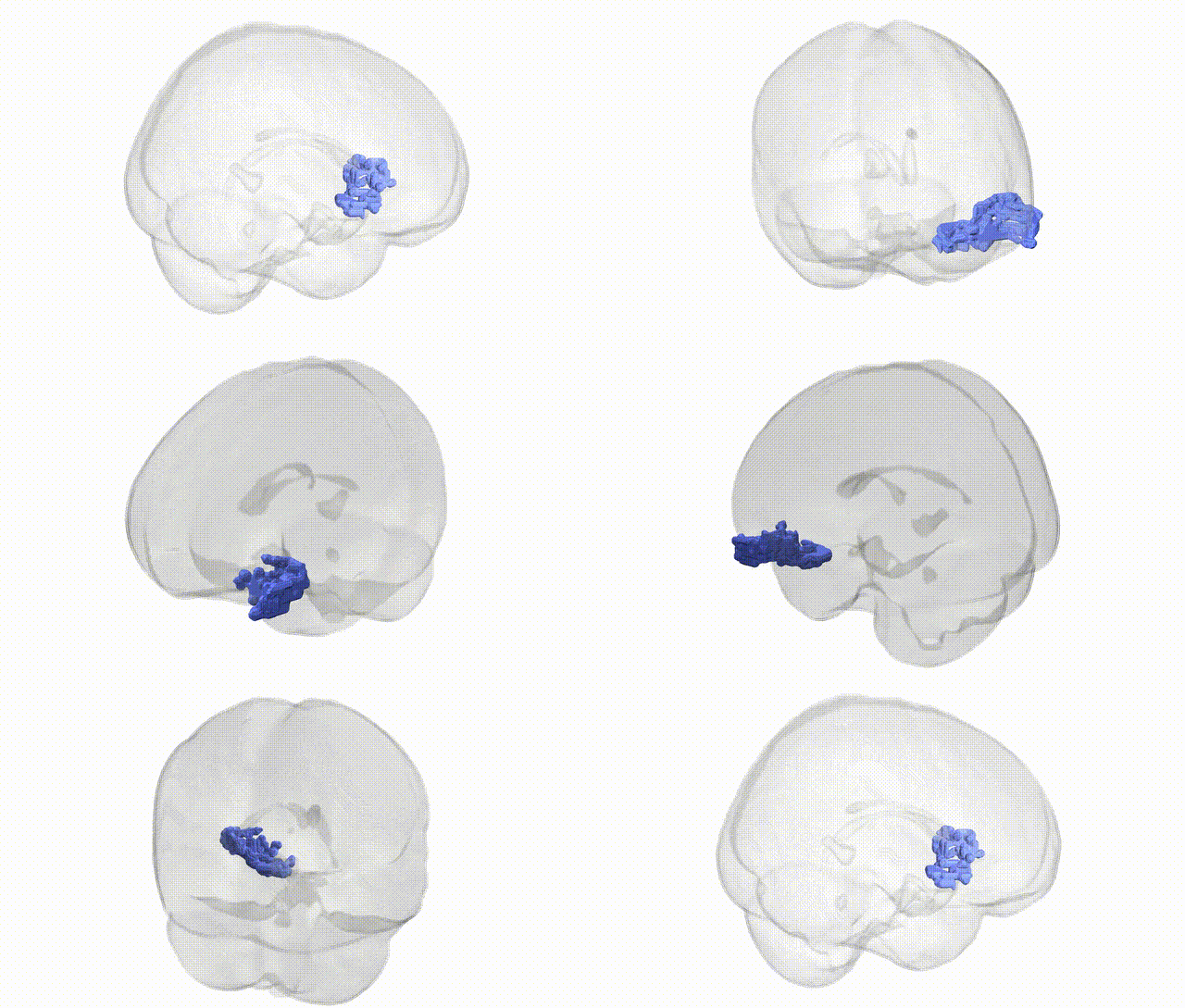
Full Quality Version: Download MP4
Wali Sidiqyar*, Gaurav Rudravaram*, Elyssa M. McMaster, Trent M. Schwartz, Adam M. Saunders, Kurt G. Schilling, Bennett A. Landman "Introducing SPINS: A Shared Public Visualization Library of Neuroanatomical Structures." Medical Imaging with Deep Learning- short paper
This resource is licensed under CC0 1.0 Universal (Public Domain).