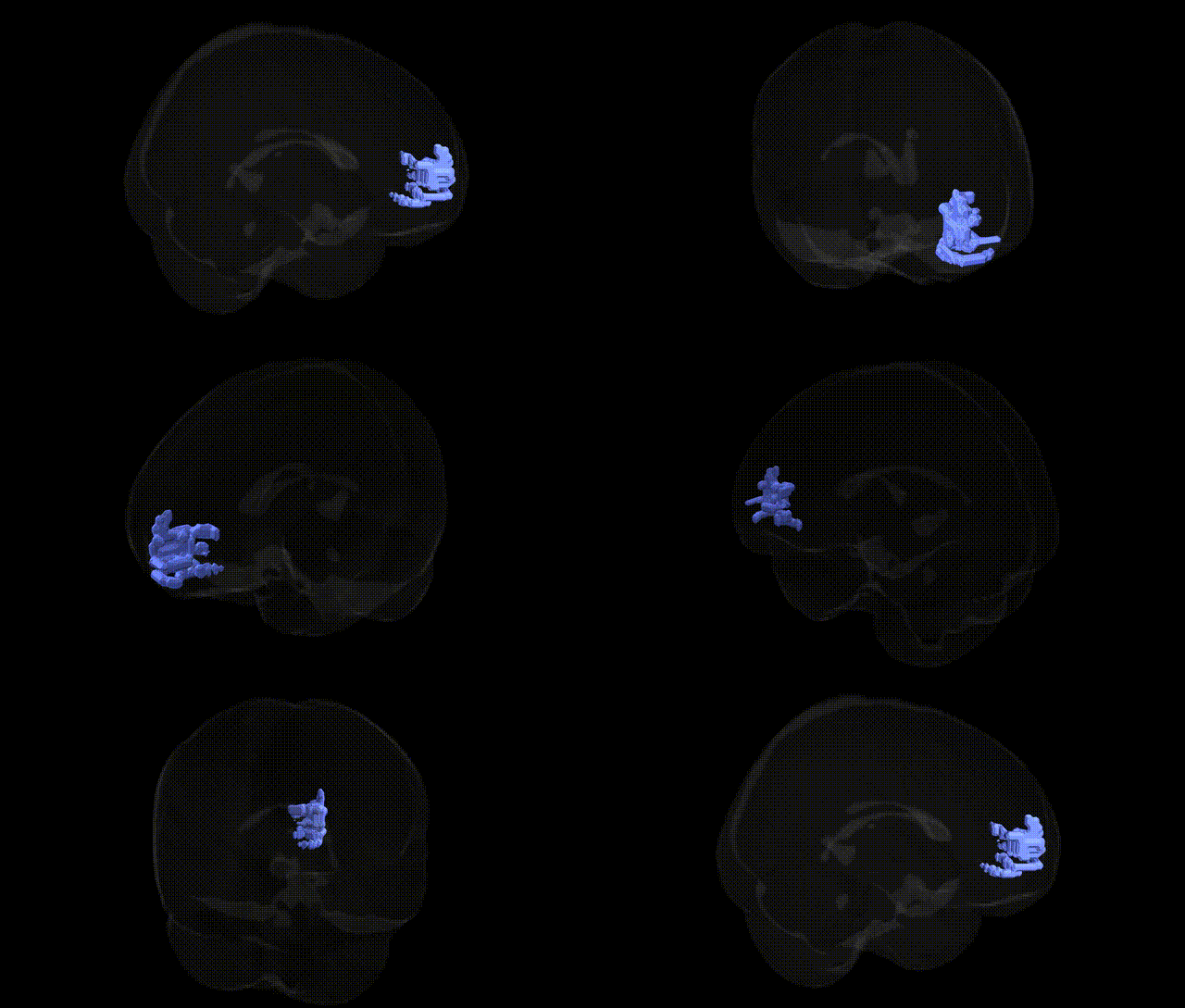
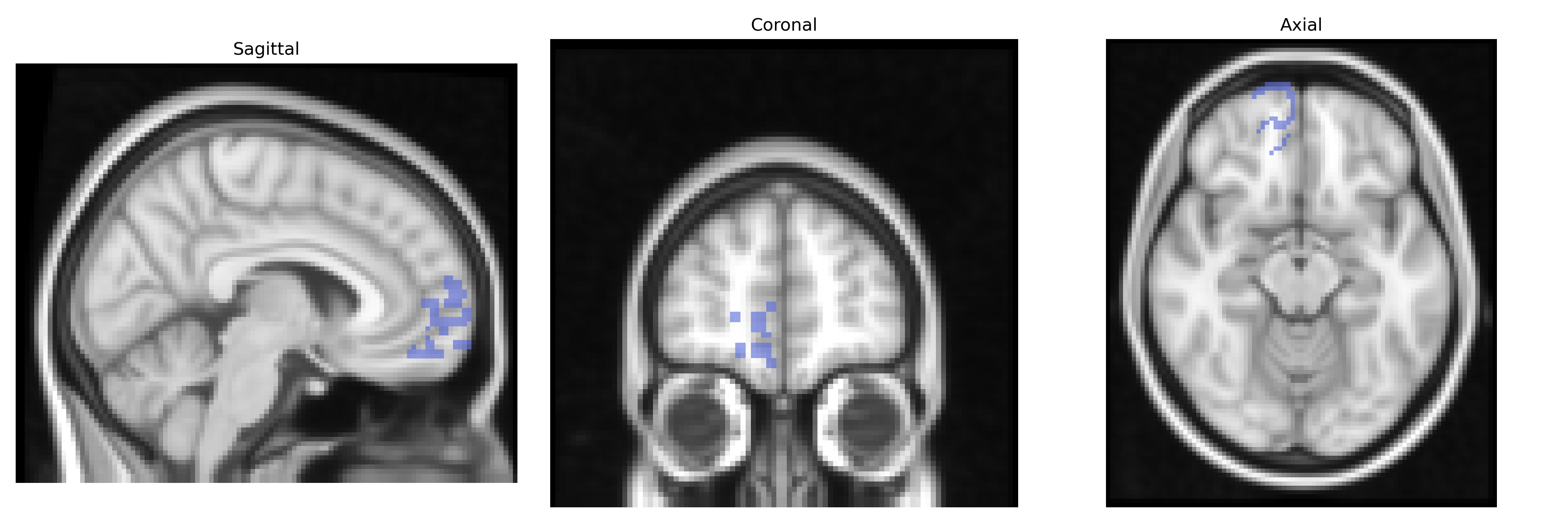
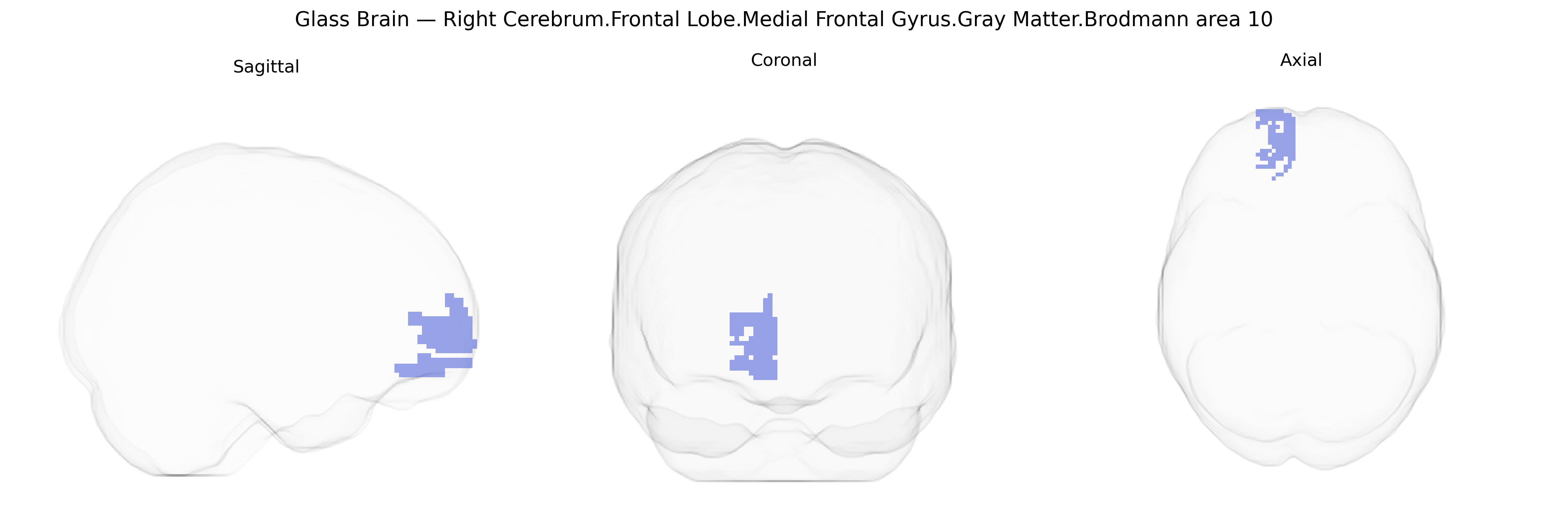
The bilateral Right Cerebrum.Frontal Lobe.Medial Frontal Gyrus.Gray Matter.Brodmann area 10, as defined in the Talairach 2 mm Atlas, corresponds to the anterior part of the medial frontal cortex, largely overlapping the frontal pole and frontomedial prefrontal region. Brodmann area 10 is among the most evolutionarily expanded cortical territories in humans and is implicated in high-level executive functions, including prospective memory, planning, complex decision-making, and integration of internally generated information with external stimuli. It plays a central role in multitasking, evaluation of future outcomes, social cognition, and the regulation of goal-directed behavior, often interacting with adjacent prefrontal and limbic structures to support abstract reasoning and self-referential processing. There is no direct Wikipedia article for this specific Talairach label; a closely related and encompassing structure is Brodmann area 10.
The bilateral medial frontal gyrus gray matter in Brodmann area 10 (right cerebrum, frontal lobe), a key hub for high-level executive and socio-emotional processing, has been implicated in multiple genetic and GWAS findings, though usually as part of broader prefrontal or frontopolar regions rather than this Talairach-defined parcel alone. Common variants in genes affecting synaptic function and neurodevelopment (e.g., DISC1, NRG1, CACNA1C, and GRM3) and polygenic risk scores for schizophrenia, bipolar disorder, and major depressive disorder have been associated with altered volume, cortical thickness, or functional activity in medial and frontopolar prefrontal cortex, including BA10. Large neuroimaging GWAS from consortia such as ENIGMA and UK Biobank have linked numerous loci (for example near genes like HMGA2, KIAA0586, and FOXP1, among others) to global and regional frontal cortical measures that encompass medial BA10, with these structural traits often mediating or correlating with genetic risk for psychiatric conditions and cognitive performance. Genetic variants influencing intelligence, educational attainment, and decision-making traits show replicated associations with frontomedial cortical thickness or activation patterns during higher-order cognition and value-based choice, while risk alleles for disorders such as ADHD, autism spectrum disorder, and obsessive-compulsive disorder have been tied to atypical connectivity and morphology in medial frontal and anterior prefrontal circuits that include BA10. Overall, current evidence supports a polygenic architecture in which many small-effect variants—primarily in neurodevelopmental, synaptic, and transcriptional regulatory pathways—contribute to interindividual differences in BA10 structure and function, linking this region to psychiatric vulnerability, cognitive ability, and personality-related traits in imaging-genetics and GWAS frameworks.
Overview generated by GPT-4o (2026).
Region ID: 408
Hemisphere: bilateral
Atlas: Talairach labels 2mm
Full Quality Version: Download MP4
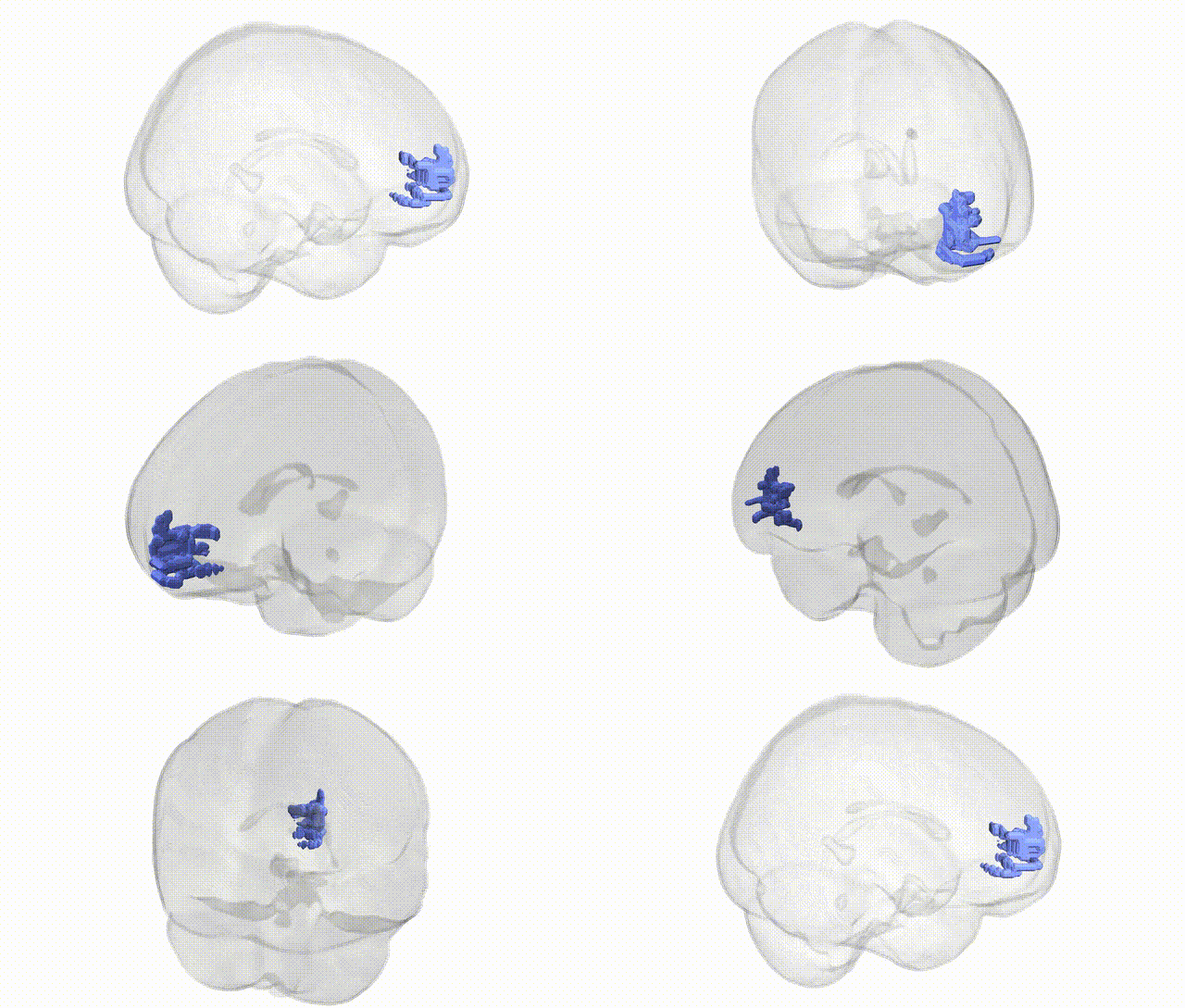
Full Quality Version: Download MP4
Wali Sidiqyar*, Gaurav Rudravaram*, Elyssa M. McMaster, Trent M. Schwartz, Adam M. Saunders, Kurt G. Schilling, Bennett A. Landman "Introducing SPINS: A Shared Public Visualization Library of Neuroanatomical Structures." Medical Imaging with Deep Learning- short paper
This resource is licensed under CC0 1.0 Universal (Public Domain).