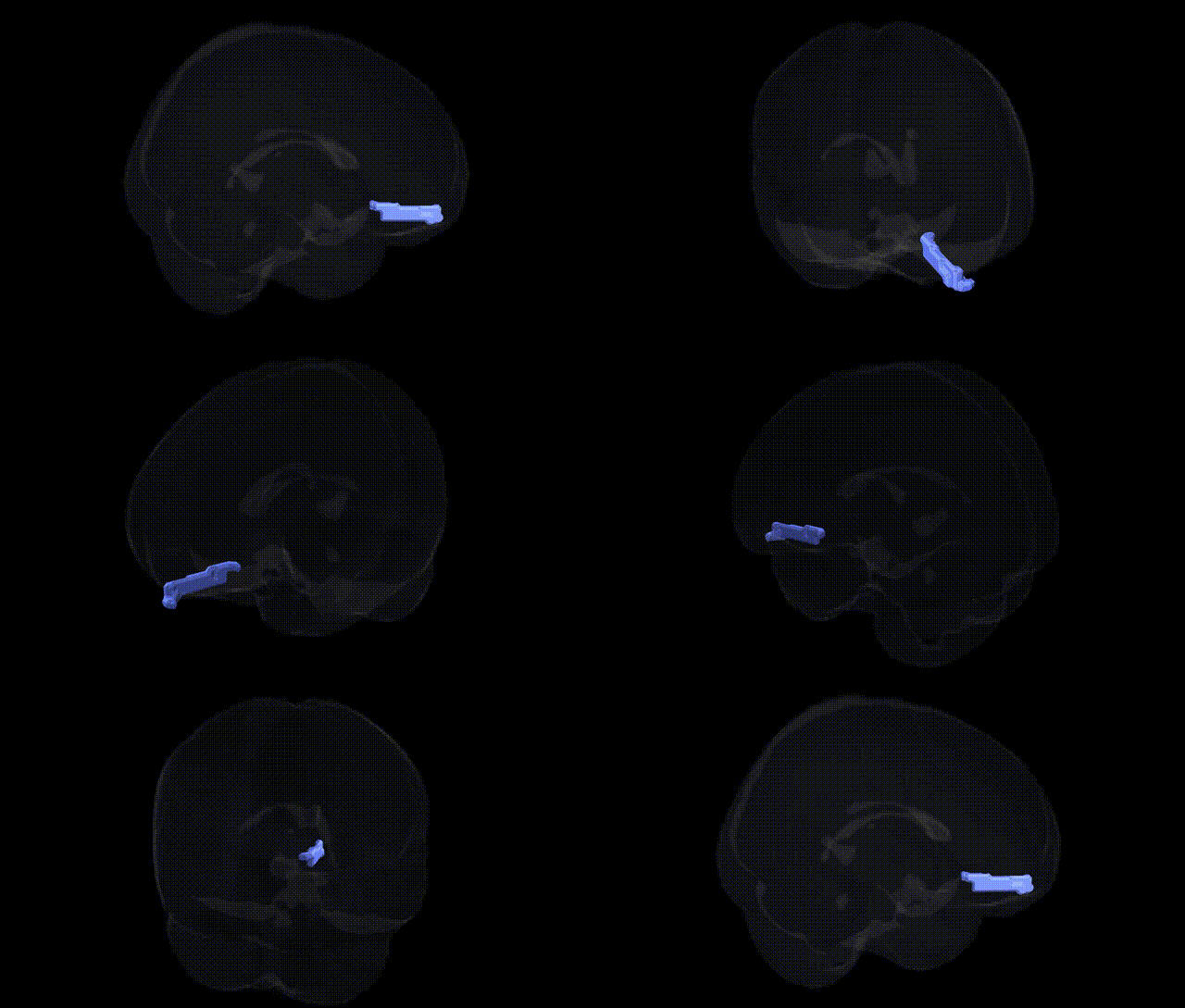
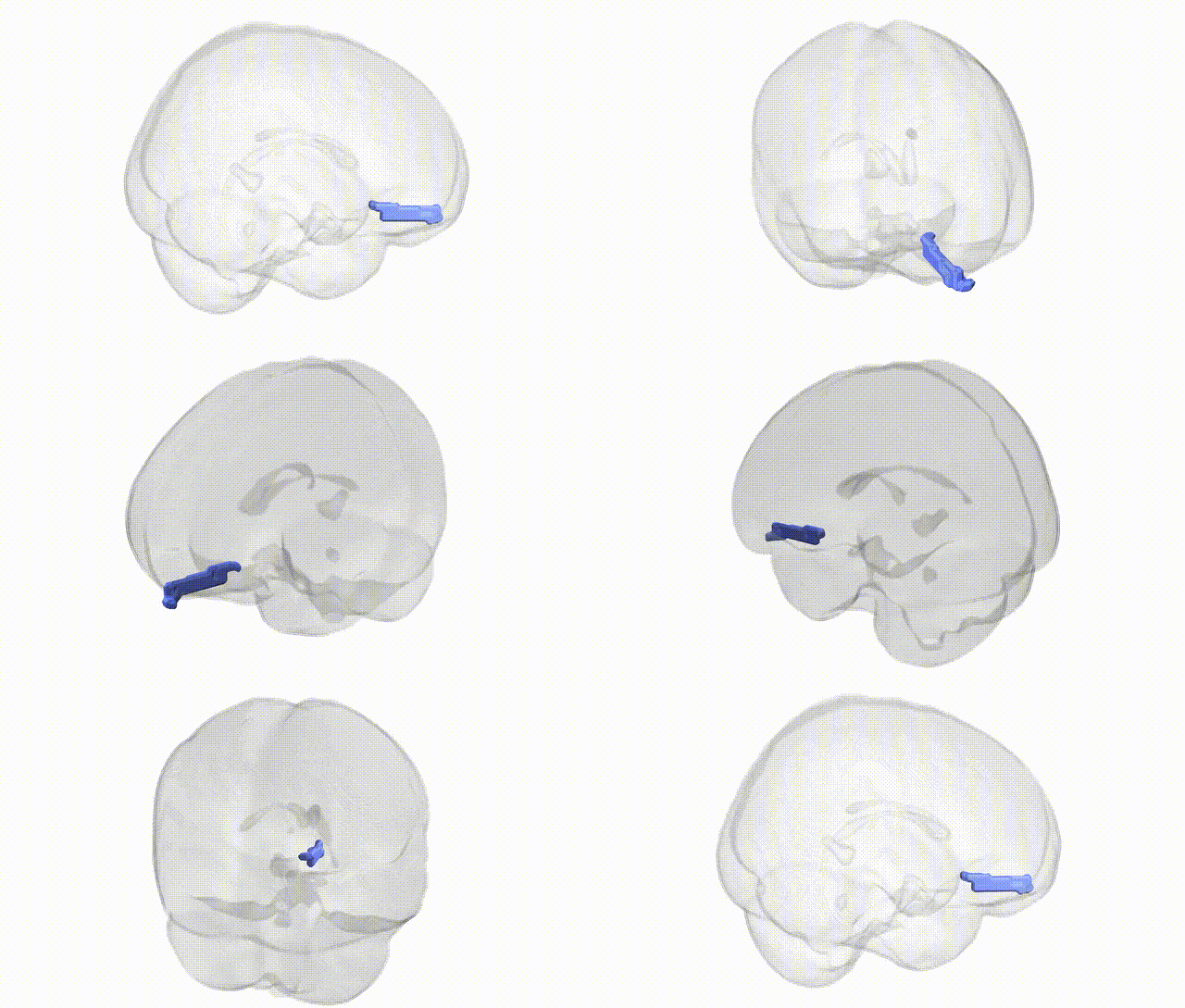
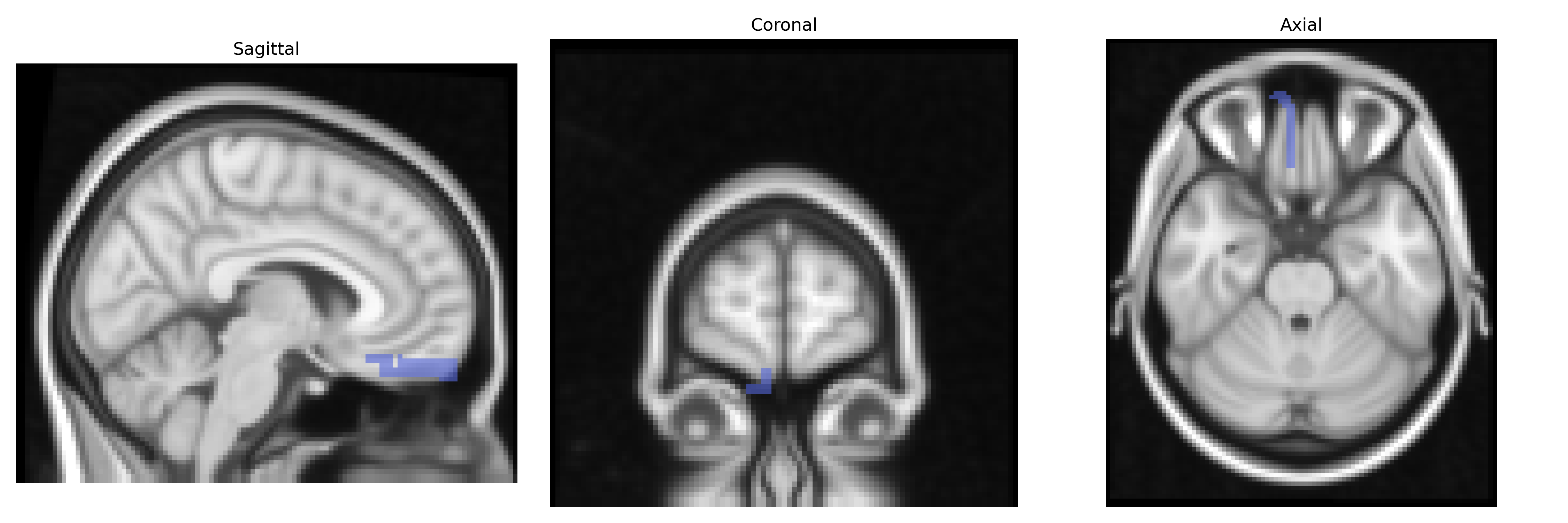
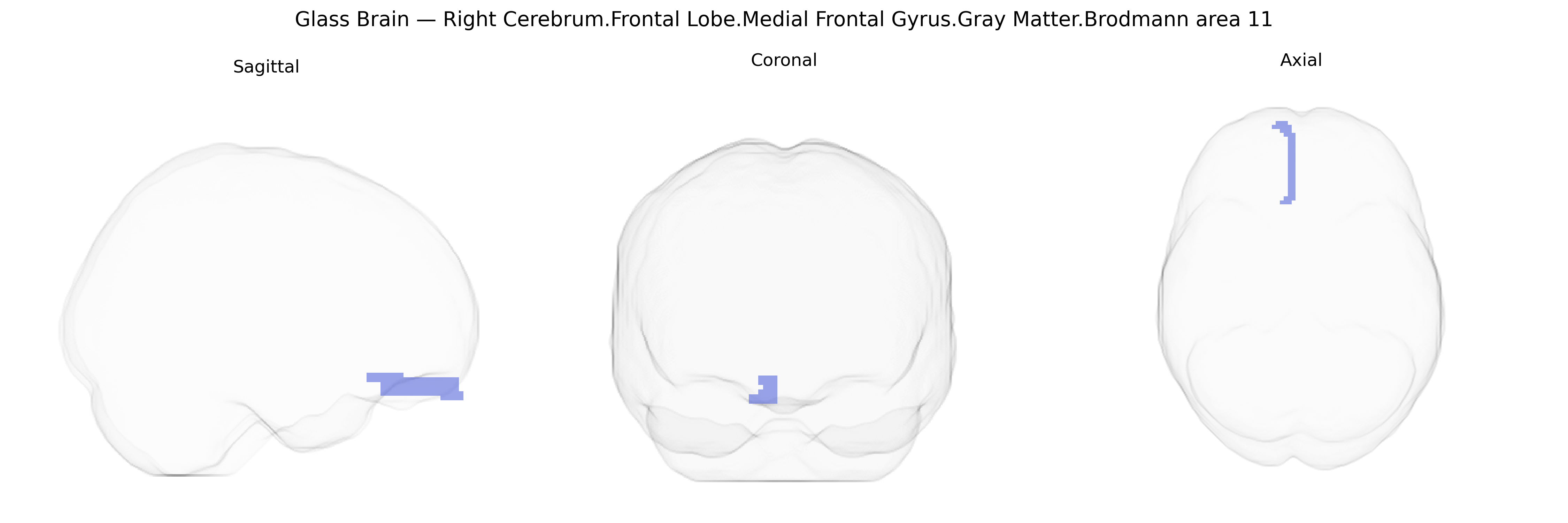
Bilateral Right Cerebrum.Frontal Lobe.Medial Frontal Gyrus.Gray Matter.Brodmann area 11 corresponds to the orbitofrontal portion of the prefrontal cortex, situated on the ventromedial surface of the frontal lobe and implicated in high-level evaluative functions. This region integrates sensory, emotional, and reward-related information to guide decision-making, expectation of outcomes, and adaptive behavioral responses, and is central to processes such as value-based judgment, social and emotional regulation, and inhibitory control over impulsive actions. Cytoarchitectonically, Brodmann area 11 is characterized by granular prefrontal cortex features and dense reciprocal connectivity with limbic structures (including the amygdala), other prefrontal areas, and sensory association cortices, supporting its role in integrating affective and cognitive signals. A direct Wikipedia article on this exact Talairach label does not exist; a closely related structure is the orbitofrontal cortex: Orbitofrontal cortex.
The medial frontal gyrus within Brodmann area 11 (right frontal lobe gray matter) is part of the orbitomedial prefrontal cortex implicated in decision making, reward processing, and emotion regulation, and genetic associations typically involve broader medial/orbitofrontal or ventromedial prefrontal regions rather than this Talairach-defined parcel specifically. GWAS and imaging-genetics studies have linked common variants in genes related to synaptic function and neurodevelopment—including CACNA1C, ZNF804A, DRD2, and various glutamatergic and GABAergic pathway genes—to structural and functional measures in medial/orbitofrontal prefrontal cortex, often in the context of psychiatric disorders such as schizophrenia, bipolar disorder, major depressive disorder, and anxiety. Polygenic risk scores for these disorders have been associated with altered gray matter volume, cortical thickness, or activation patterns in medial/orbitofrontal prefrontal regions during tasks involving reward, valuation, or emotional processing. Additional GWAS of brain morphology have identified loci (e.g., near HMGA2, KIAA0586, and others) associated with global and regional frontal cortical measures, with some studies reporting specific effects on orbitofrontal/medial frontal thickness or surface area, though resolution rarely isolates BA11 alone. Traits including impulsivity, neuroticism, risk-taking, and substance use have also shown genetic correlations with orbitofrontal/medial prefrontal structure and function in imaging-genetic and large-scale GWAS meta-analyses, supporting a role for heritable variation in this region in personality and behavioral regulation, albeit at a spatial granularity coarser than the bilateral Right Cerebrum.Frontal Lobe.Medial Frontal Gyrus.Gray Matter.Brodmann area 11 label.
Overview generated by GPT-4o (2026).
Region ID: 236
Hemisphere: bilateral
Atlas: Talairach labels 2mm
Full Quality Version: Download MP4
Full Quality Version: Download MP4
Wali Sidiqyar*, Gaurav Rudravaram*, Elyssa M. McMaster, Trent M. Schwartz, Adam M. Saunders, Kurt G. Schilling, Bennett A. Landman "Introducing SPINS: A Shared Public Visualization Library of Neuroanatomical Structures." Medical Imaging with Deep Learning- short paper
This resource is licensed under CC0 1.0 Universal (Public Domain).