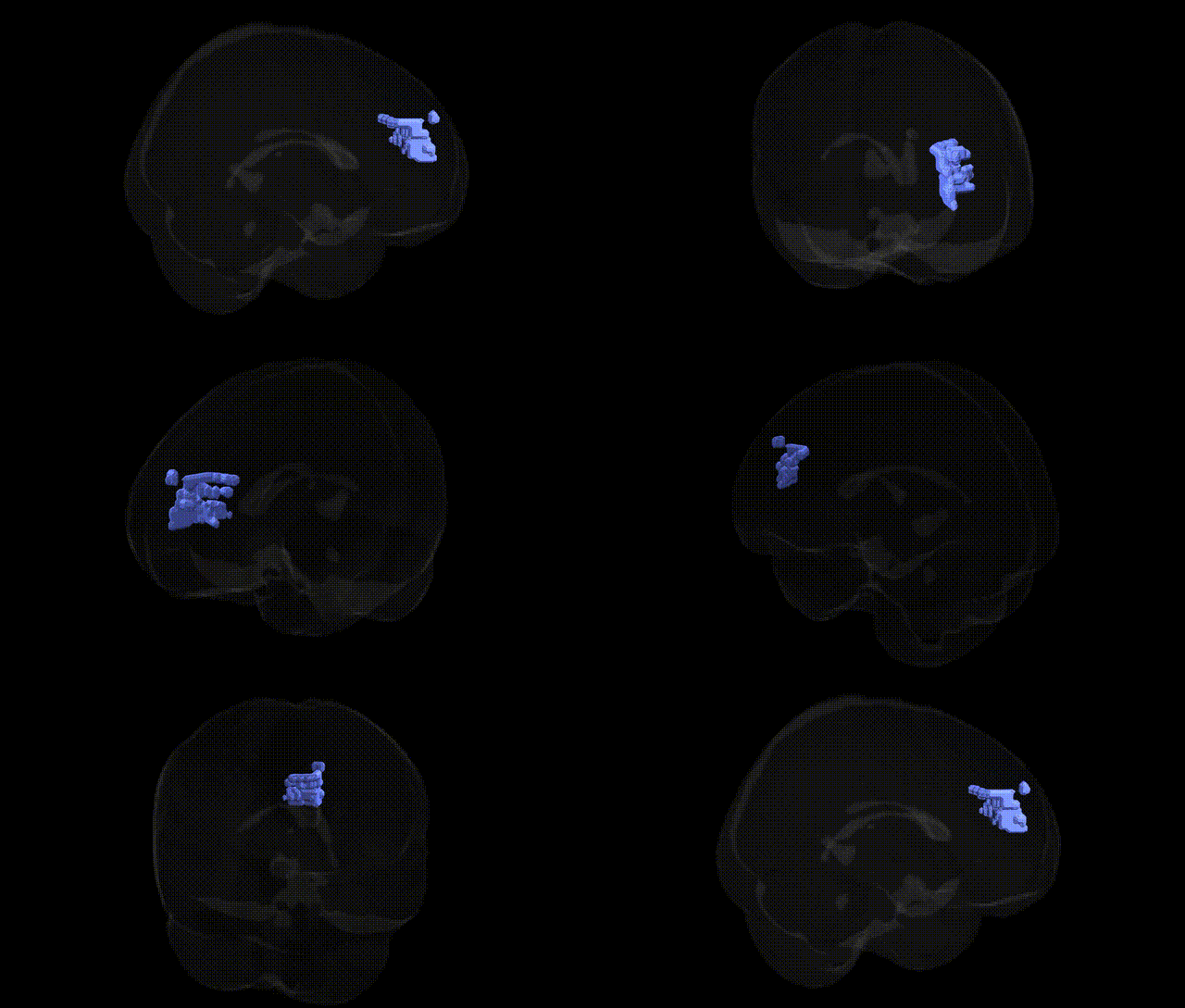
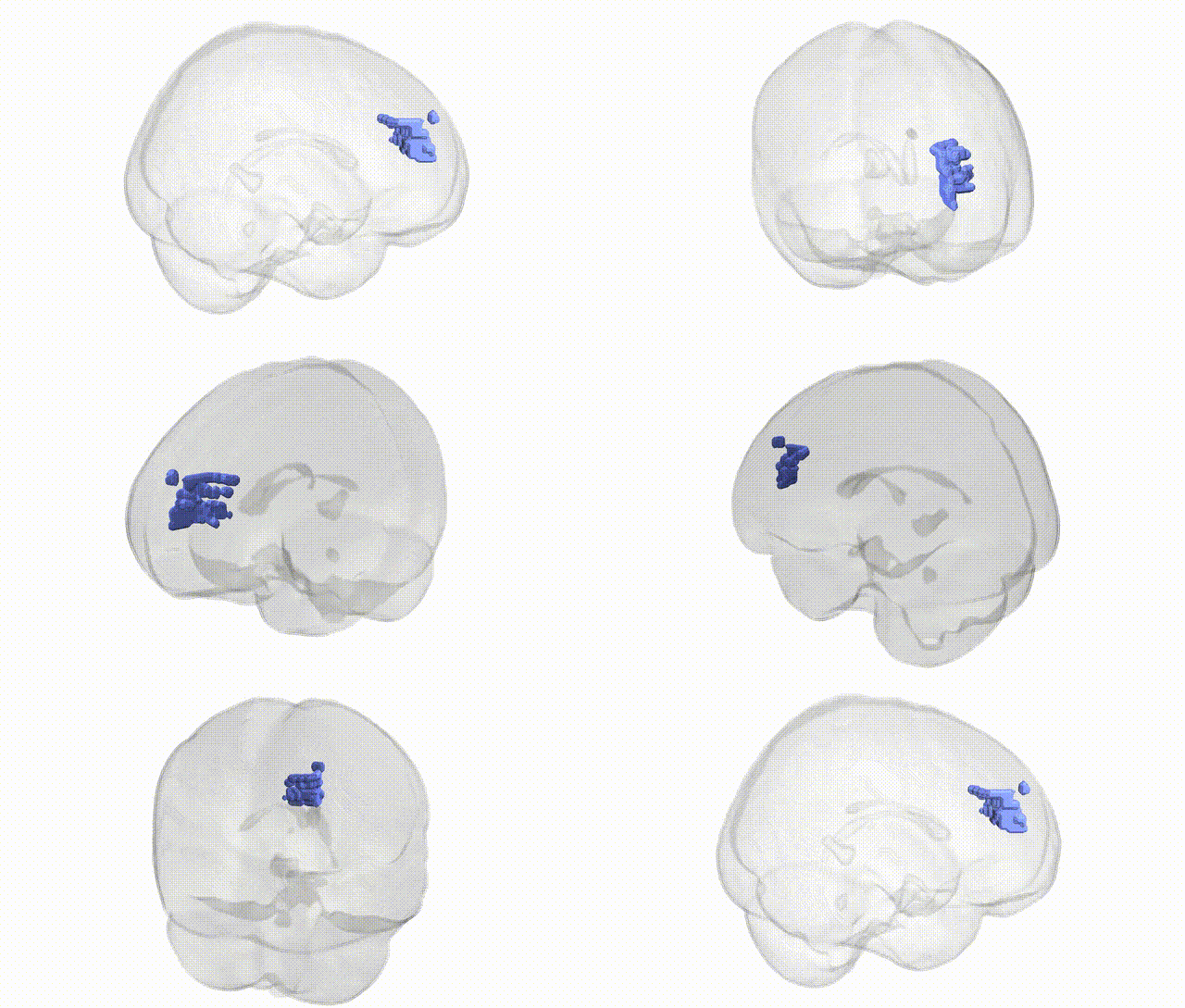
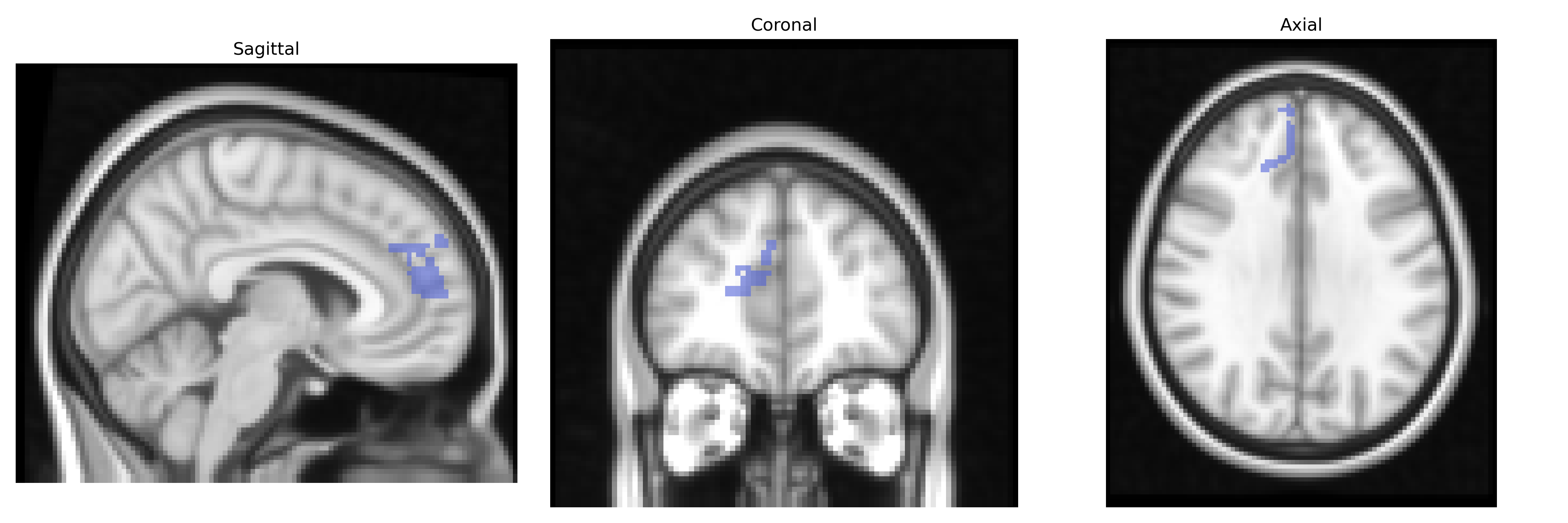
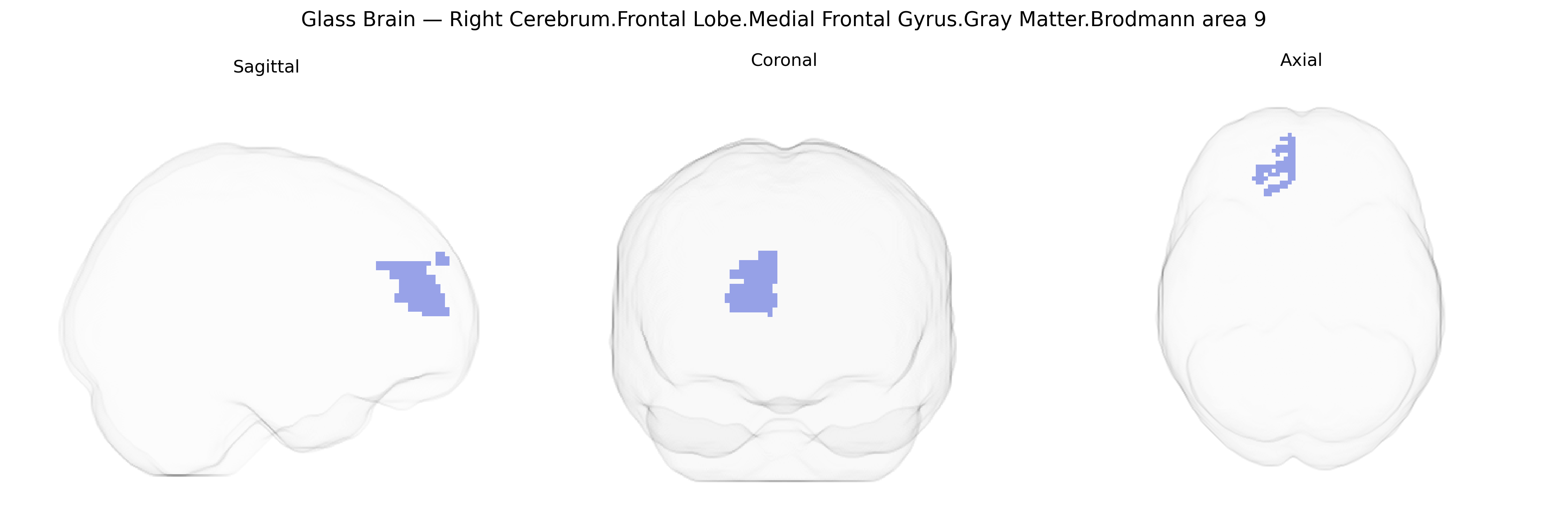
The bilateral Right Cerebrum.Frontal Lobe.Medial Frontal Gyrus.Gray Matter.Brodmann area 9 corresponds to a portion of the dorsomedial prefrontal cortex within the frontal lobe, situated on the medial surface superior to the cingulate sulcus. Cytoarchitectonically defined as Brodmann area 9, this region is characterized by granular prefrontal cortex with well-developed layer IV and prominent pyramidal neurons in layers III and V. Functionally, it is implicated in executive functions, including working memory, planning, cognitive control, and aspects of social cognition such as mentalizing and evaluative judgment. It forms part of large-scale cortical networks connecting to other prefrontal, parietal, and limbic structures, contributing to goal-directed behavior and regulation of thought and emotion. There is no direct Wikipedia article for this exact Talairach label; a closely related structure is Brodmann area 9.
Genetic associations involving the bilateral Right Cerebrum.Frontal Lobe.Medial Frontal Gyrus.Gray Matter.Brodmann area 9 (BA9) from the Talairach 2 mm atlas largely reflect the role of dorsomedial/dorsolateral prefrontal circuitry in cognition, mood regulation, and higher-order executive function. GWAS and imaging-genetics studies have linked variation in genes related to synaptic plasticity, neurotransmission, and neurodevelopment (including CACNA1C, DISC1, COMT, DRD2, BDNF, and GRM3) with structural and functional measures in BA9, such as cortical thickness, gray matter volume, and task-related activation. BA9 has been repeatedly implicated in schizophrenia and bipolar disorder through genetic risk score studies that show case–control differences in prefrontal morphology and connectivity as a function of polygenic liability, as well as in major depressive disorder where risk alleles in serotonergic and glutamatergic genes correspond to altered BA9 activation during emotion and cognitive control tasks. Imaging-GWAS of brain morphology (for example, large ENIGMA and UK Biobank analyses) have identified loci influencing frontal cortical thickness and surface area that overlap risk variants for neuropsychiatric conditions and cognitive performance, suggesting partially shared genetic architecture. Moreover, BA9-related activation and structure have been associated with genetic variants linked to general intelligence, working memory, and educational attainment, and with genes affecting risk for attention-deficit/hyperactivity disorder and obsessive–compulsive disorder, indicating that this medial frontal region serves as a convergence point for genetic influences on executive control, affect regulation, and complex cognition.
Overview generated by GPT-4o (2026).
Region ID: 815
Hemisphere: bilateral
Atlas: Talairach labels 2mm
Full Quality Version: Download MP4
Full Quality Version: Download MP4
Wali Sidiqyar*, Gaurav Rudravaram*, Elyssa M. McMaster, Trent M. Schwartz, Adam M. Saunders, Kurt G. Schilling, Bennett A. Landman "Introducing SPINS: A Shared Public Visualization Library of Neuroanatomical Structures." Medical Imaging with Deep Learning- short paper
This resource is licensed under CC0 1.0 Universal (Public Domain).