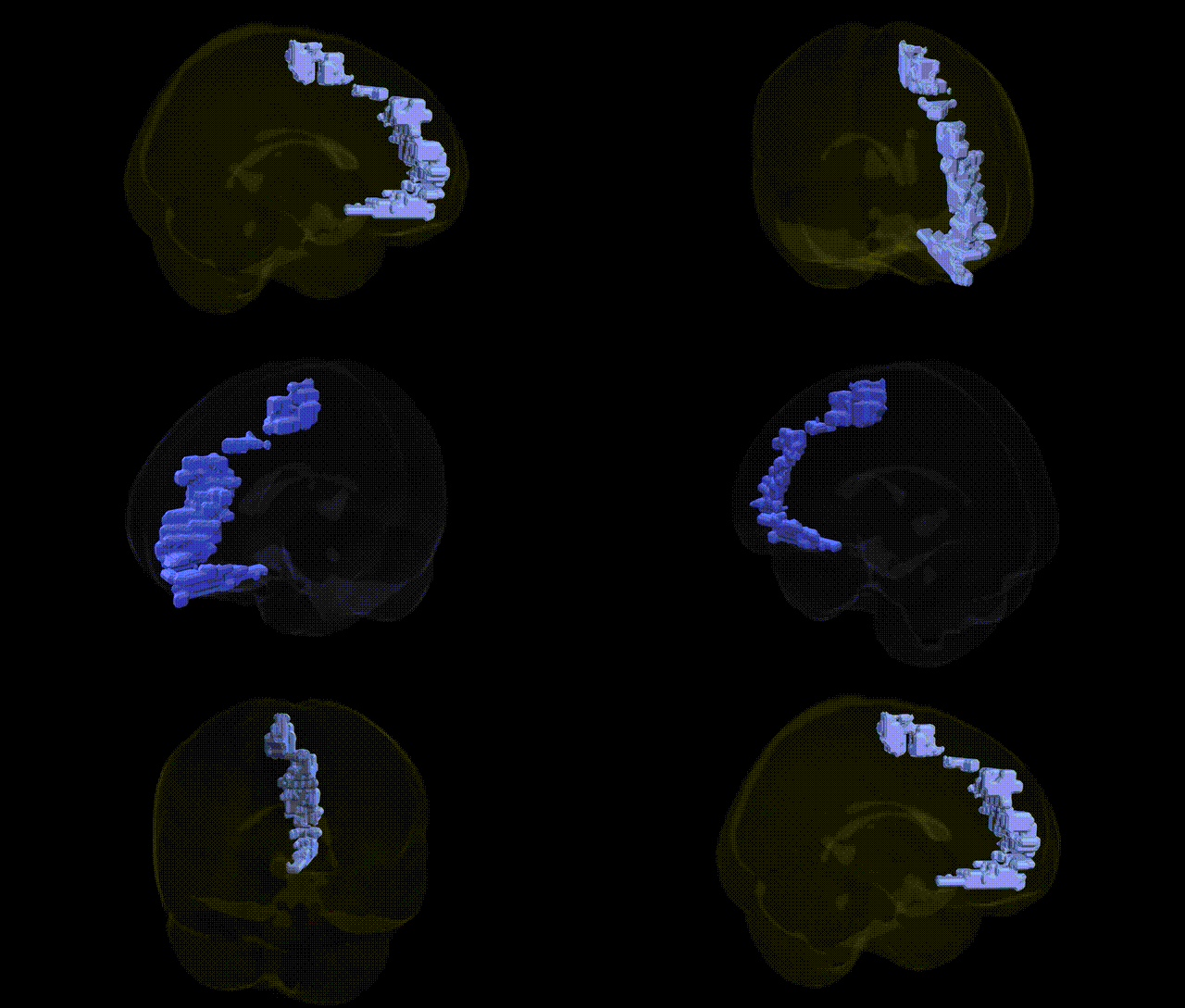
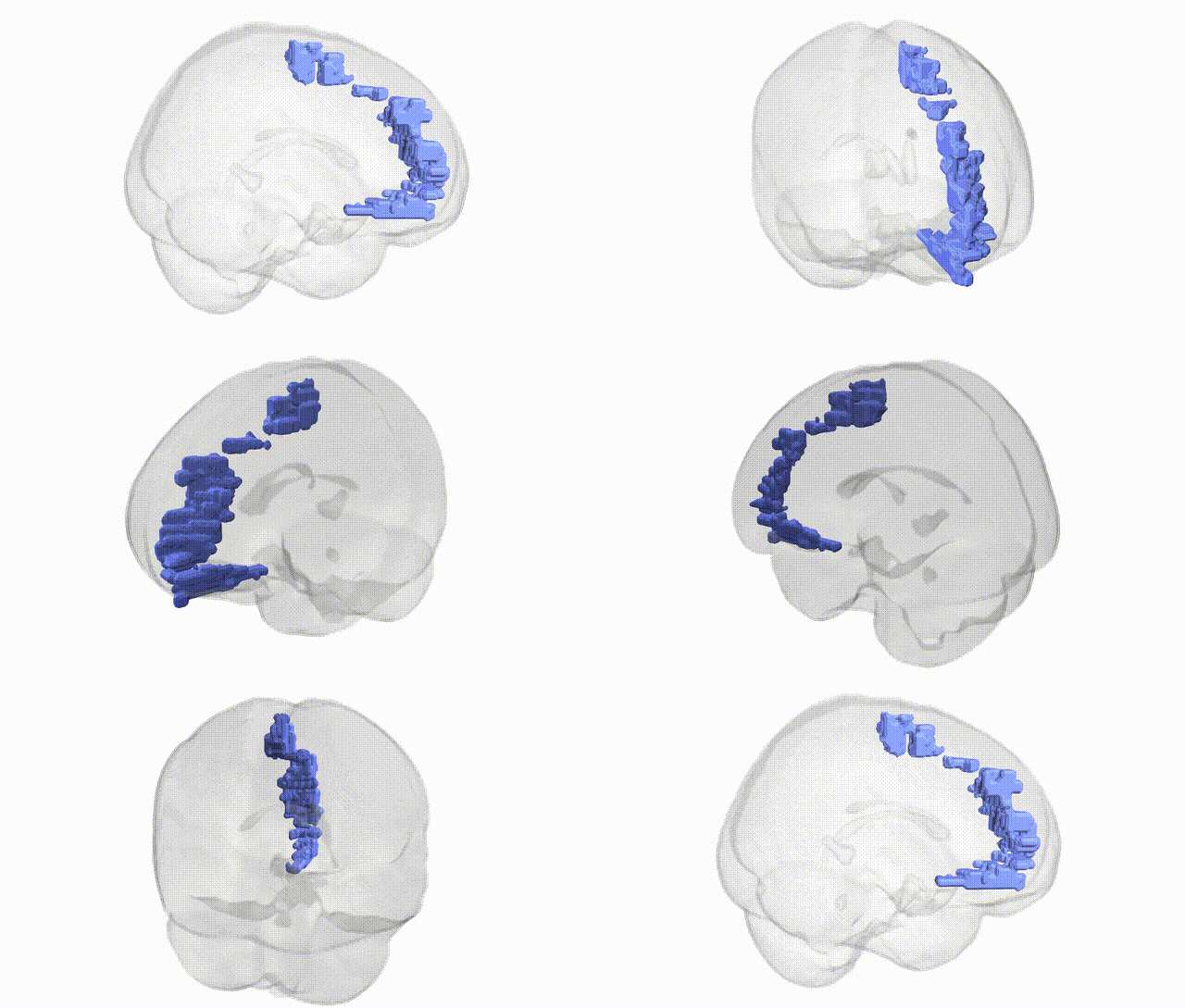
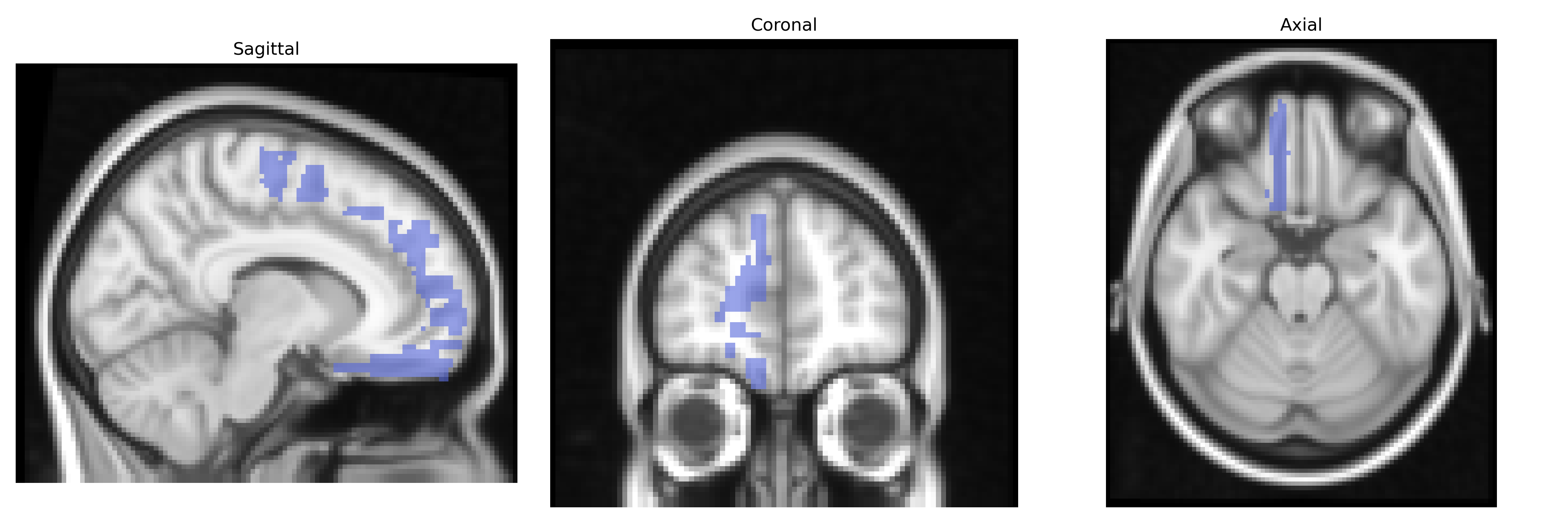
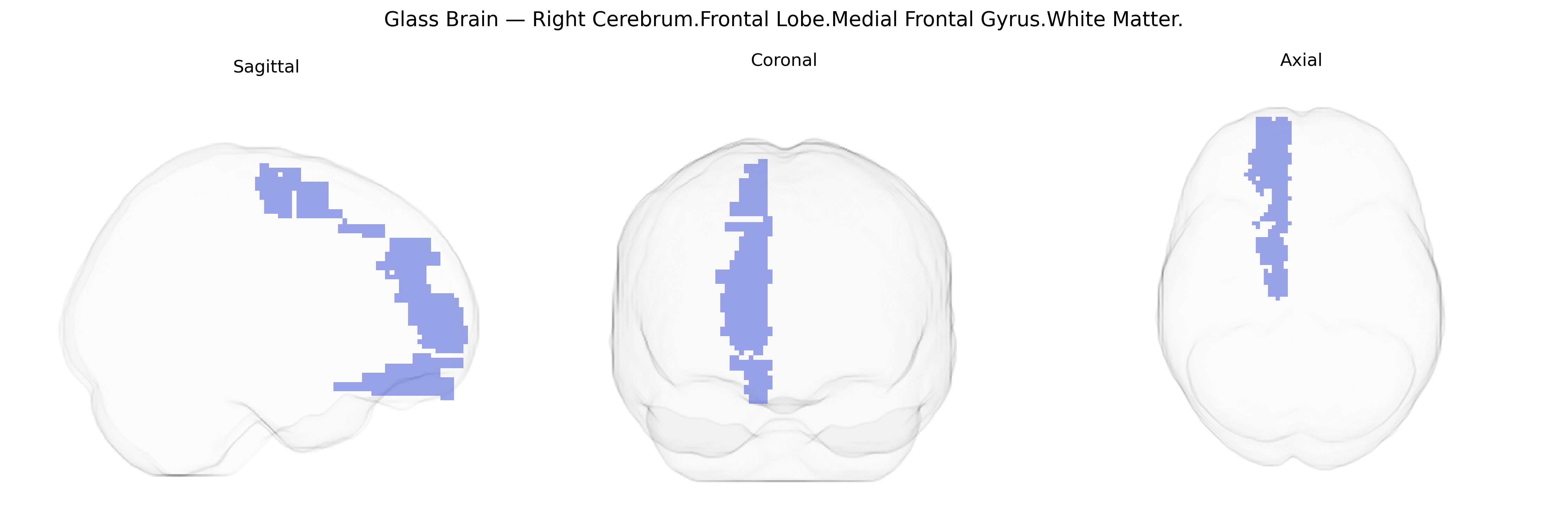
The bilateral Right Cerebrum.Frontal Lobe.Medial Frontal Gyrus.White Matter, as defined in the Talairach 2 mm Atlas, refers to the subcortical myelinated fiber tracts underlying the medial frontal gyrus in the right frontal lobe, encompassing interconnecting association and projection pathways that link medial frontal cortical areas with other frontal, limbic, and subcortical regions. This white matter substrate supports functions attributed to the medial frontal cortex, including aspects of executive control, motivation, decision‑making, and self‑referential processing, by facilitating efficient communication among distributed neural networks. While the atlas label itself is not a standard anatomical term with a dedicated article, it corresponds most closely to the medial frontal gyrus and associated medial prefrontal/white matter pathways within the frontal lobe. There is no direct link; a related structure is the Medial frontal gyrus.
The bilateral Right Cerebrum.Frontal Lobe.Medial Frontal Gyrus.White Matter region, corresponding broadly to medial prefrontal and anterior cingulate–adjacent white matter tracts in the Talairach 2 mm atlas, has been implicated in numerous imaging‑genetics and GWAS-based endophenotype studies, although few report associations at this exact label. Large neuroimaging GWAS (e.g., ENIGMA, UK Biobank) have identified common variants in genes involved in axonal development, myelination, and synaptic signaling—such as CNTNAP2, NRG1, MAG, and multiple loci within the major histocompatibility complex (MHC)—that influence frontal white matter integrity (typically measured via fractional anisotropy or regional volume), with effects often strongest in medial frontal pathways. Variants in genes conferring risk for schizophrenia (e.g., CACNA1C, GRIN2A, and polygenic risk scores based on broad GWAS hits), bipolar disorder, and major depressive disorder have been repeatedly associated with altered medial frontal white matter microstructure, while autism spectrum disorder risk loci (including those affecting synaptic adhesion and neurodevelopmental pathways) have been linked to atypical fronto‑striatal and fronto‑limbic tracts passing through this region. GWAS of cognitive traits such as general intelligence, executive function, and educational attainment have found that higher polygenic scores correlate with greater integrity or volume in frontal white matter, including medial frontal segments, suggesting a genetic contribution to cognitive performance mediated through this circuitry. Additionally, risk variants for attention-deficit/hyperactivity disorder and substance use disorders have been associated with disrupted medial prefrontal white matter connectivity, highlighting this region as a convergence zone where diverse neuropsychiatric and cognitive genetic influences manifest in structural brain phenotypes.
Overview generated by GPT-4o (2026).
Region ID: 231
Hemisphere: bilateral
Atlas: Talairach labels 2mm
Full Quality Version: Download MP4
Full Quality Version: Download MP4
Wali Sidiqyar*, Gaurav Rudravaram*, Elyssa M. McMaster, Trent M. Schwartz, Adam M. Saunders, Kurt G. Schilling, Bennett A. Landman "Introducing SPINS: A Shared Public Visualization Library of Neuroanatomical Structures." Medical Imaging with Deep Learning- short paper
This resource is licensed under CC0 1.0 Universal (Public Domain).