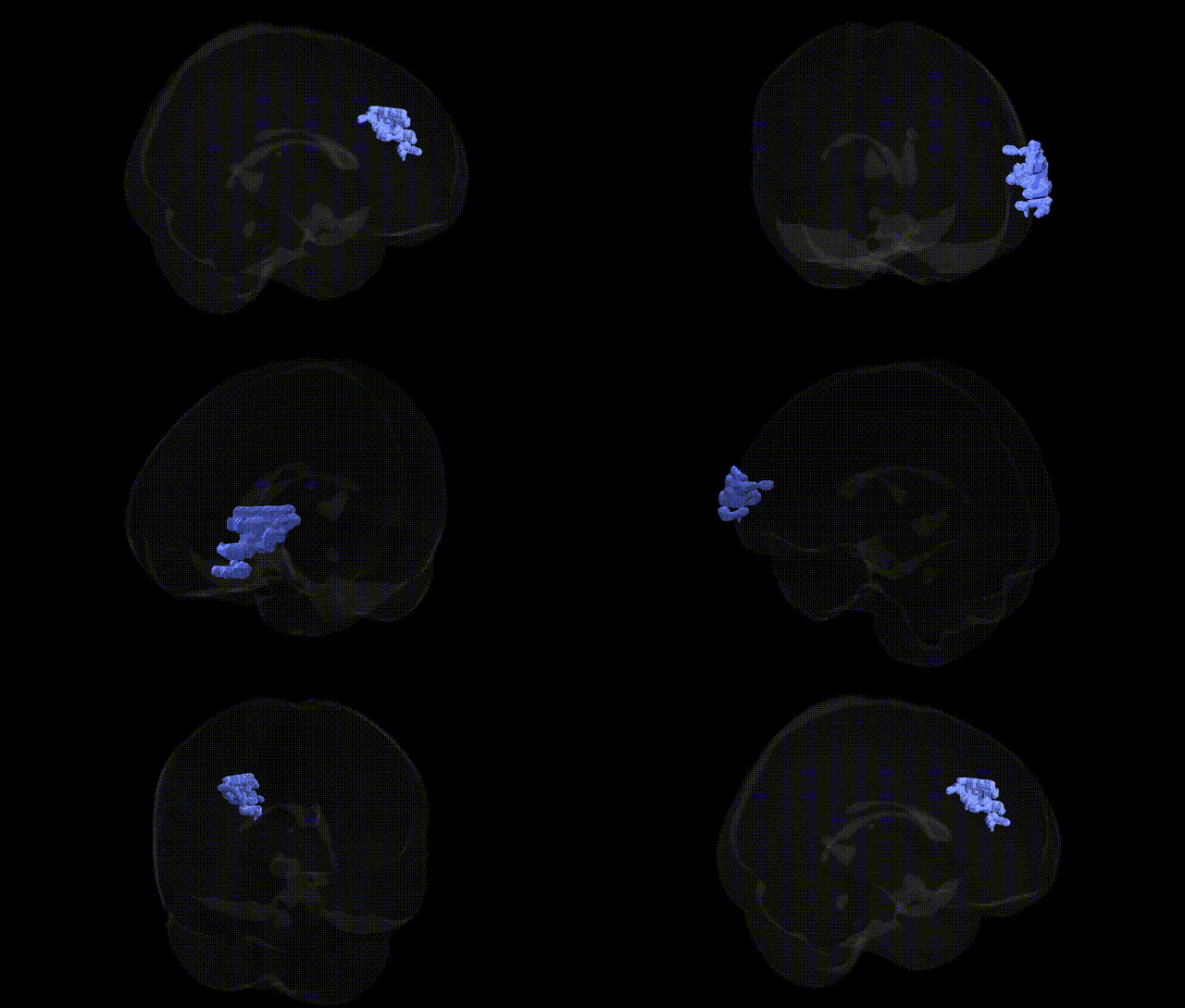
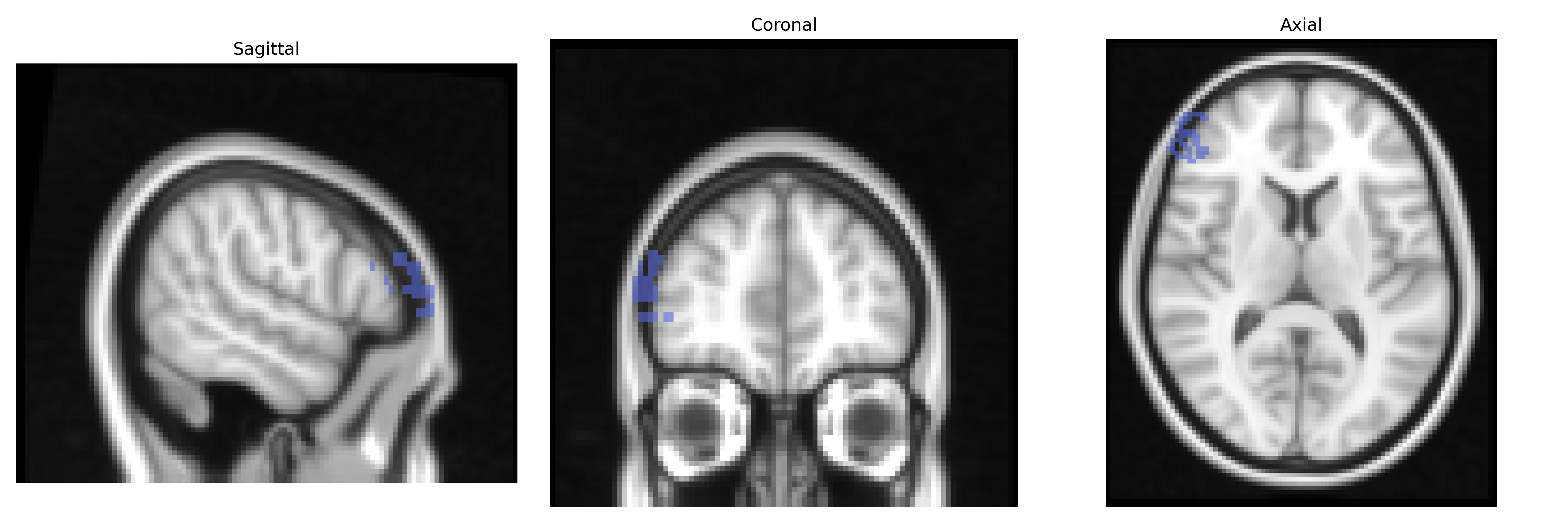
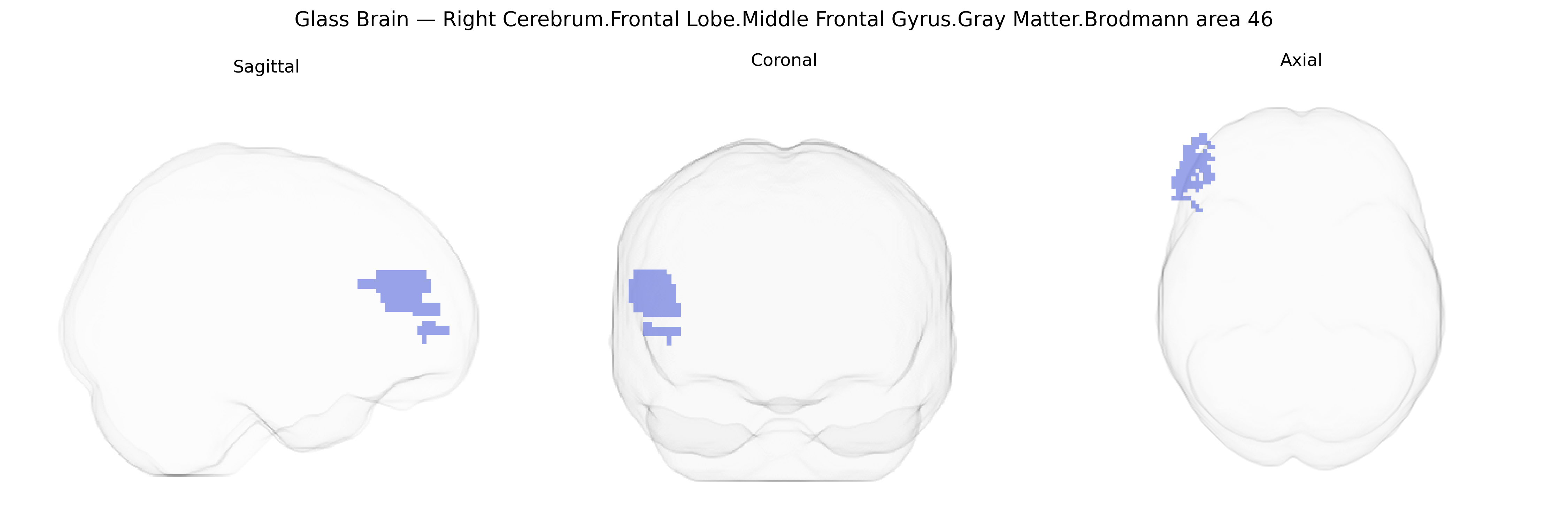
The bilateral Right Cerebrum.Frontal Lobe.Middle Frontal Gyrus.Gray Matter.Brodmann area 46 corresponds to a dorsolateral prefrontal cortical region implicated in higher-order executive functions, including working memory, cognitive control, planning, and the regulation of attention. Cytoarchitectonically defined as Brodmann area 46, it occupies part of the middle frontal gyrus, integrating multimodal information to support flexible behavior, decision-making, and the manipulation of information in mind over short time intervals. This region is a key node in frontoparietal control networks and is frequently activated in tasks requiring rule maintenance, context updating, and resistance to interference, and it is also implicated in clinical conditions involving disruptions of executive functioning. There is no direct Wikipedia link for this exact Talairach label; a closely related structure is Dorsolateral prefrontal cortex.
The bilateral right middle frontal gyrus gray matter in Brodmann area 46 (DLPFC) has been repeatedly implicated in genetic and GWAS-based studies of cognition, psychiatric disorders, and brain structure. Imaging genetics research links common variants in genes such as COMT (dopaminergic modulation), DRD2, and BDNF (e.g., Val66Met) to altered activation, connectivity, and gray matter volume in BA46 during working memory and executive control tasks. Large-scale GWAS of cortical thickness and surface area (e.g., ENIGMA, UK Biobank) have identified multiple loci across the genome—often near genes involved in neurodevelopment (e.g., FOXP2-related networks, CENPO, PLEKHM1, microtubule and synaptic genes)—that influence frontal lobe morphology, including middle frontal regions overlapping BA46. BA46 shows structural and functional changes associated with polygenic risk for schizophrenia, bipolar disorder, major depressive disorder, and ADHD, and is consistently engaged in GWAS-informed endophenotypes such as working memory, general cognitive ability, and educational attainment. Variants in APOE and other Alzheimer’s disease risk genes have been associated with accelerated atrophy or altered activation in dorsolateral prefrontal cortex, while fronto-parietal control network genes identified through transcriptomic and connectomic analyses show enriched expression patterns in BA46 that align with GWAS signals for intelligence and neuropsychiatric risk. Overall, genetic findings converge on BA46 as a key node where common neurodevelopmental and neurotransmission-related variants affect executive function, cognitive performance, and vulnerability to major psychiatric and neurodegenerative disorders.
Overview generated by GPT-4o (2026).
Region ID: 658
Hemisphere: bilateral
Atlas: Talairach labels 2mm
Full Quality Version: Download MP4
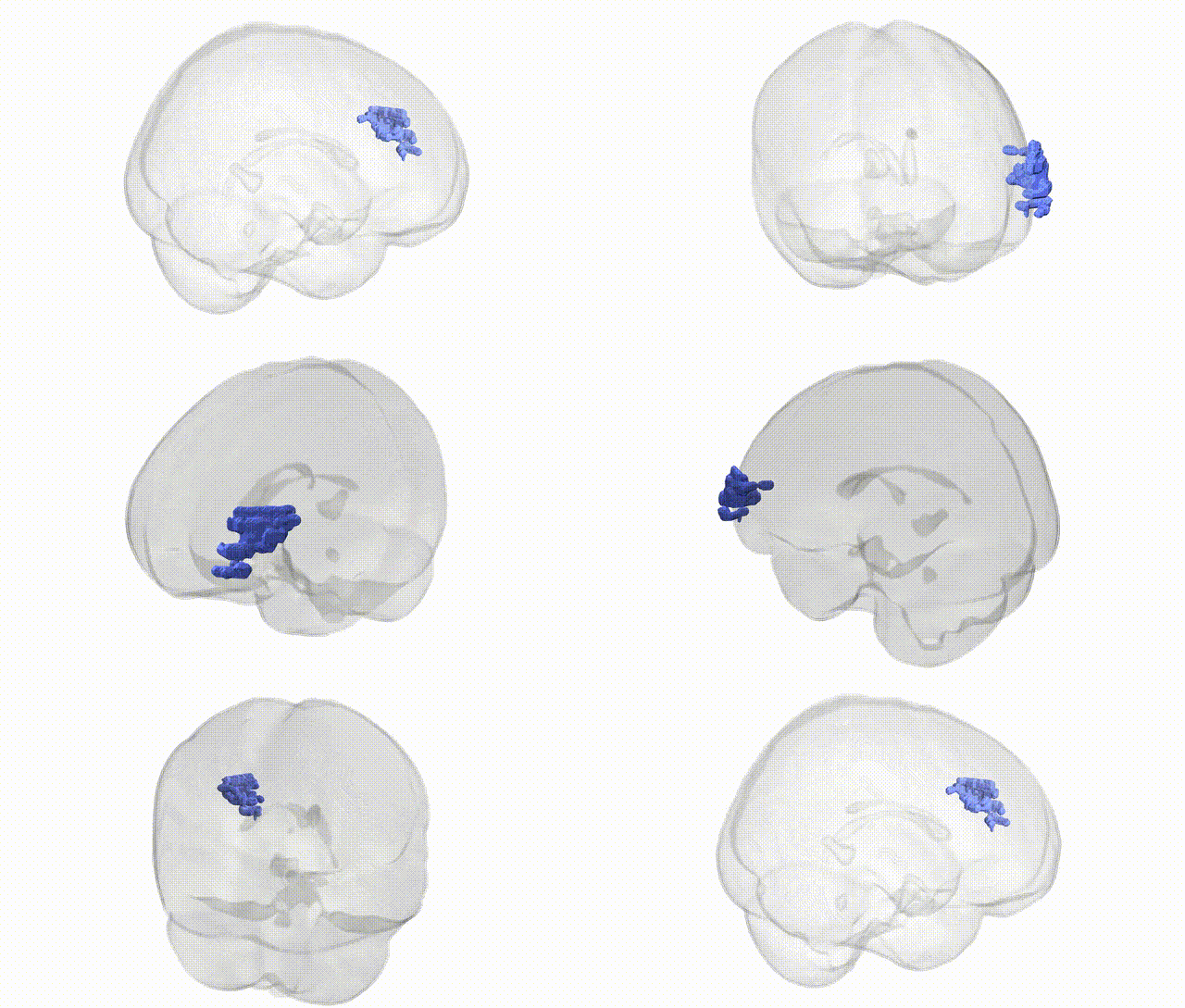
Full Quality Version: Download MP4
Wali Sidiqyar*, Gaurav Rudravaram*, Elyssa M. McMaster, Trent M. Schwartz, Adam M. Saunders, Kurt G. Schilling, Bennett A. Landman "Introducing SPINS: A Shared Public Visualization Library of Neuroanatomical Structures." Medical Imaging with Deep Learning- short paper
This resource is licensed under CC0 1.0 Universal (Public Domain).