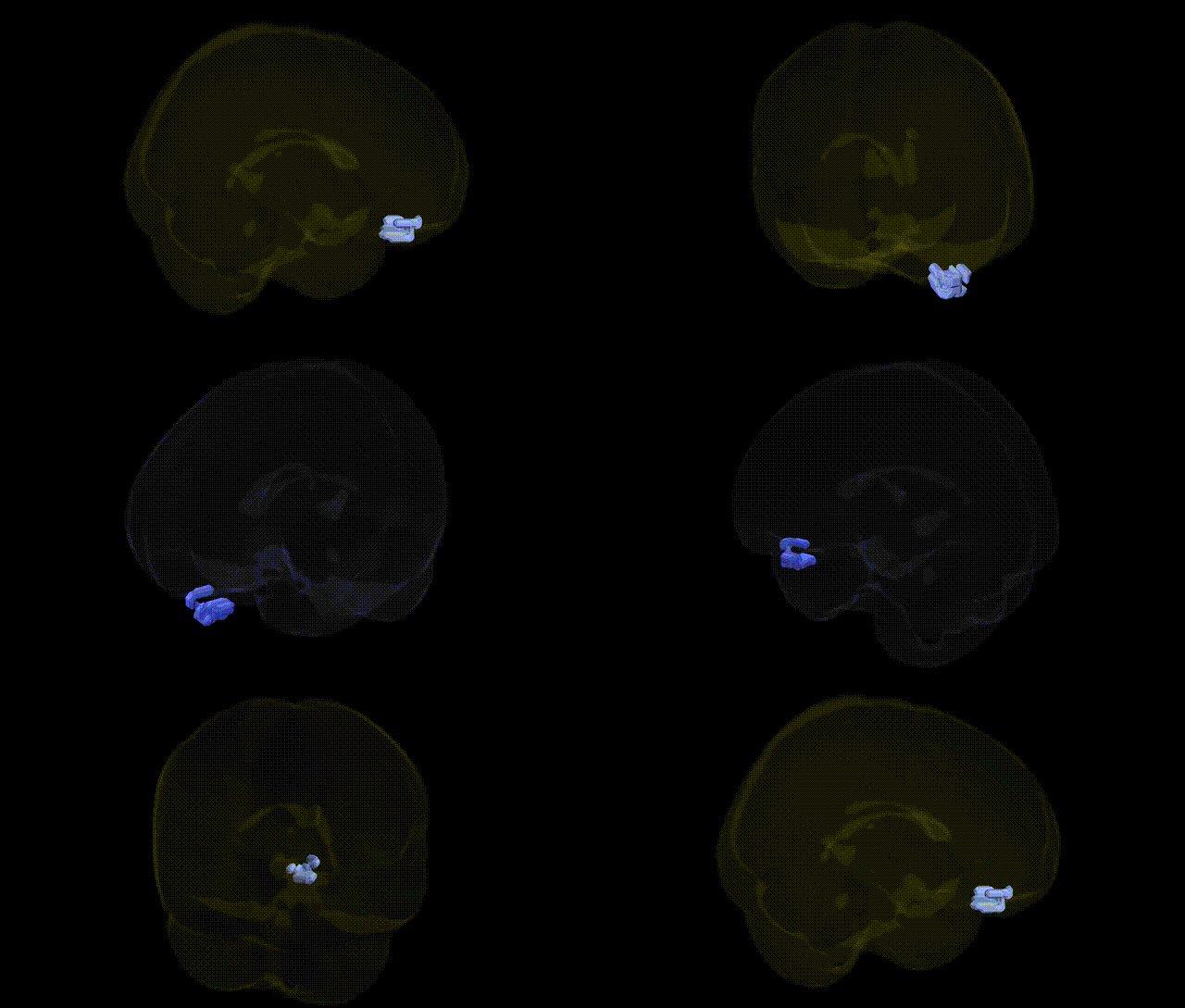
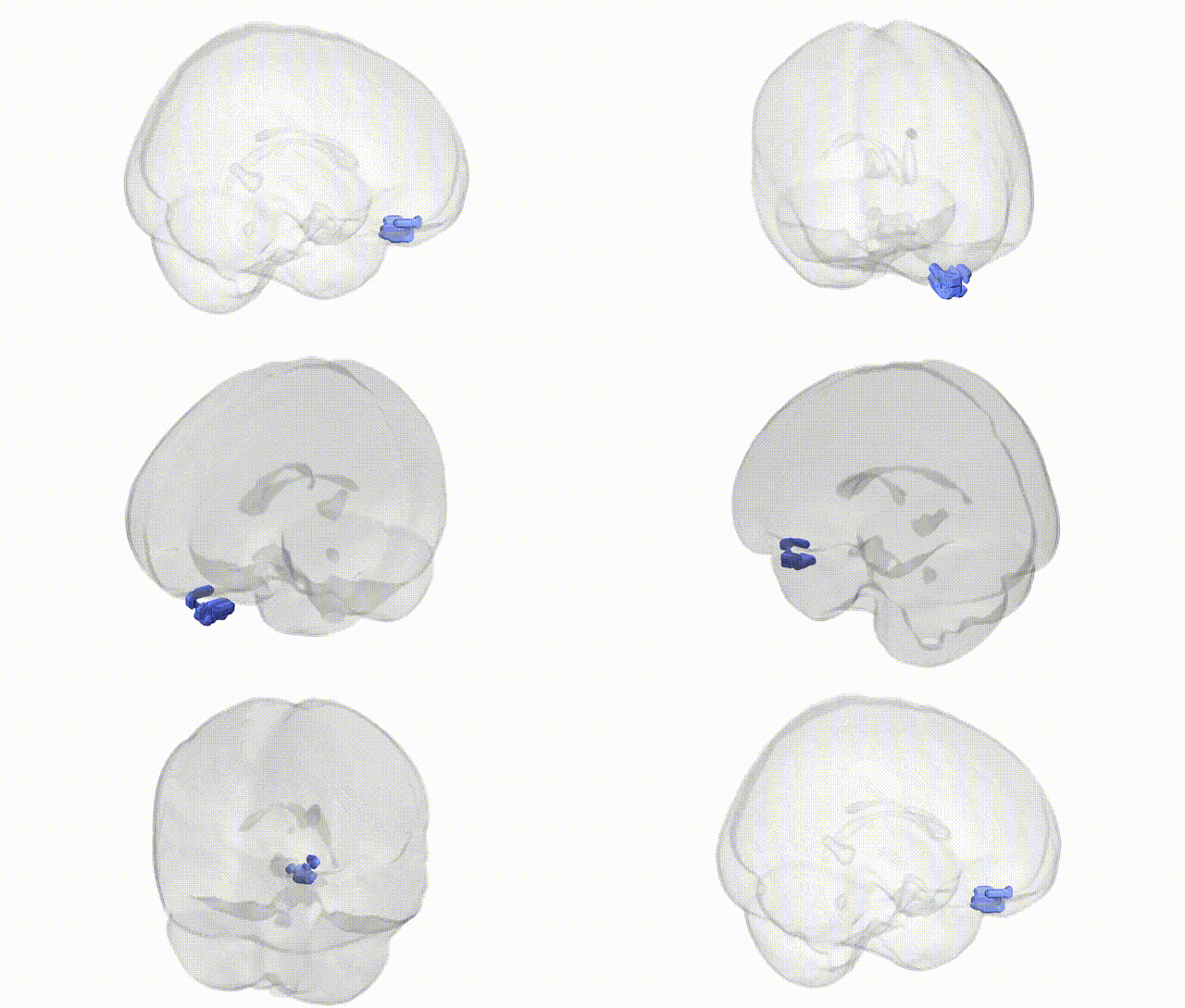
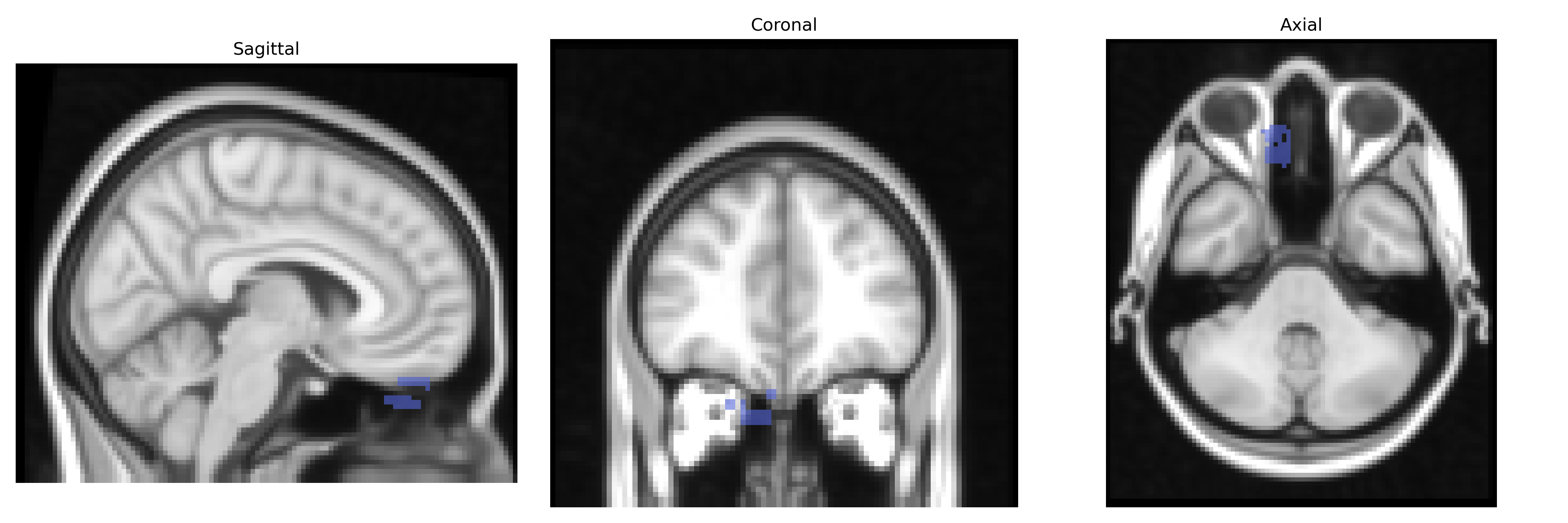
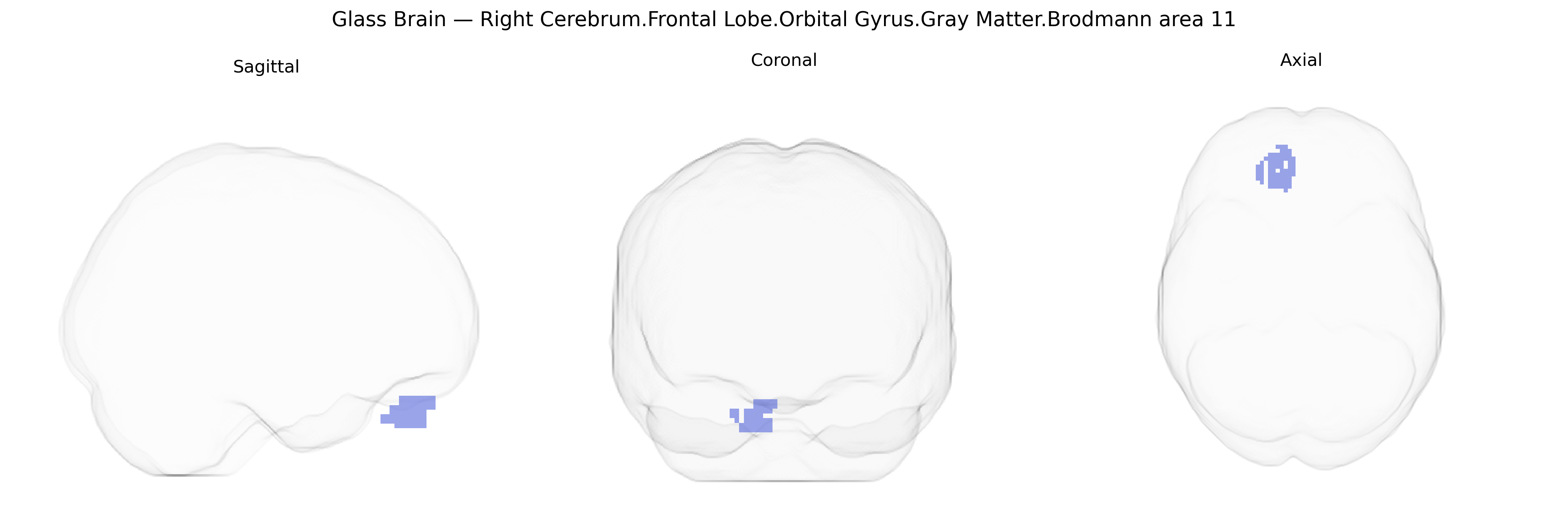
The bilateral Right Cerebrum.Frontal Lobe.Orbital Gyrus.Gray Matter.Brodmann area 11 corresponds to agranular orbitofrontal cortex located on the ventral surface of the frontal lobe, overlying the orbits. Brodmann area 11 is part of the prefrontal cortex involved in higher-order associative functions, including evaluation of reward and punishment, decision-making, emotional and social behavior, and integration of sensory and visceral information for adaptive responses. Neuronal populations in this region show strong connectivity with limbic structures (such as the amygdala) and other prefrontal territories, supporting roles in affective regulation, value-based choice, and modulation of autonomic and endocrine outputs. There is no direct Wikipedia article for this exact Talairach label; a closely related structure is the orbitofrontal cortex: Orbitofrontal cortex.
The bilateral right orbital frontal Brodmann area 11 (Right Cerebrum.Frontal Lobe.Orbital Gyrus.Gray Matter.BA11) is a key node in reward valuation, decision-making, and affect regulation, and genetic associations that implicate this region largely arise from imaging genetics, GWAS of brain structure, and disorder-related studies using neuroimaging endophenotypes. Common variants in genes related to synaptic plasticity and glutamatergic signaling (e.g., BDNF Val66Met, GRM3, and related pathways) have been repeatedly linked to orbital prefrontal morphology and functional activation, particularly in tasks involving reward, emotional processing, and cognitive control, although these effects are generally small and polygenic. Large-scale GWAS of cortical thickness and surface area have identified loci (e.g., near genes involved in neurodevelopment and cell adhesion such as CENPO, PLEKHM1, and others) associated with frontal pole and orbitofrontal measures that overlap with BA11 territory, indicating that many common variants jointly influence gray matter structure in this region. Psychiatric genetics has linked BA11 involvement to polygenic risk for major depressive disorder, bipolar disorder, schizophrenia, and substance use disorders, with higher polygenic burden often associated with altered orbital frontal volume or activity, and specific candidate genes (e.g., COMT, 5-HTTLPR/SLC6A4, DRD2/DRD4) showing modest associations with BA11 activation patterns during risk-taking and reward tasks. GWAS of behavioral traits such as impulsivity, delay discounting, neuroticism, and risk tolerance have found that polygenic scores for these traits predict structural and functional variation in orbitofrontal BA11, suggesting that genetic influences on personality and decision-making partly converge on this region. In neurodegenerative and neurodevelopmental conditions, risk variants in genes such as APOE (for Alzheimer’s disease) and CNTNAP2, NRXN1, and CHD8 (implicated in autism spectrum conditions and related phenotypes) have been associated with orbitofrontal and adjacent prefrontal abnormalities, further supporting a genetically mediated vulnerability of BA11 circuitry. Overall, current evidence indicates that BA11 structure and function is highly polygenic, shaped by distributed common and rare variants, with no single “BA11 gene,” but consistent involvement of neurodevelopmental, synaptic, and neurotransmitter-related genes in GWAS and imaging genetics studies that link this orbital frontal region to mood, psychosis, addiction, personality, and cognitive control traits.
Overview generated by GPT-4o (2026).
Region ID: 109
Hemisphere: bilateral
Atlas: Talairach labels 2mm
Full Quality Version: Download MP4
Full Quality Version: Download MP4
Wali Sidiqyar*, Gaurav Rudravaram*, Elyssa M. McMaster, Trent M. Schwartz, Adam M. Saunders, Kurt G. Schilling, Bennett A. Landman "Introducing SPINS: A Shared Public Visualization Library of Neuroanatomical Structures." Medical Imaging with Deep Learning- short paper
This resource is licensed under CC0 1.0 Universal (Public Domain).