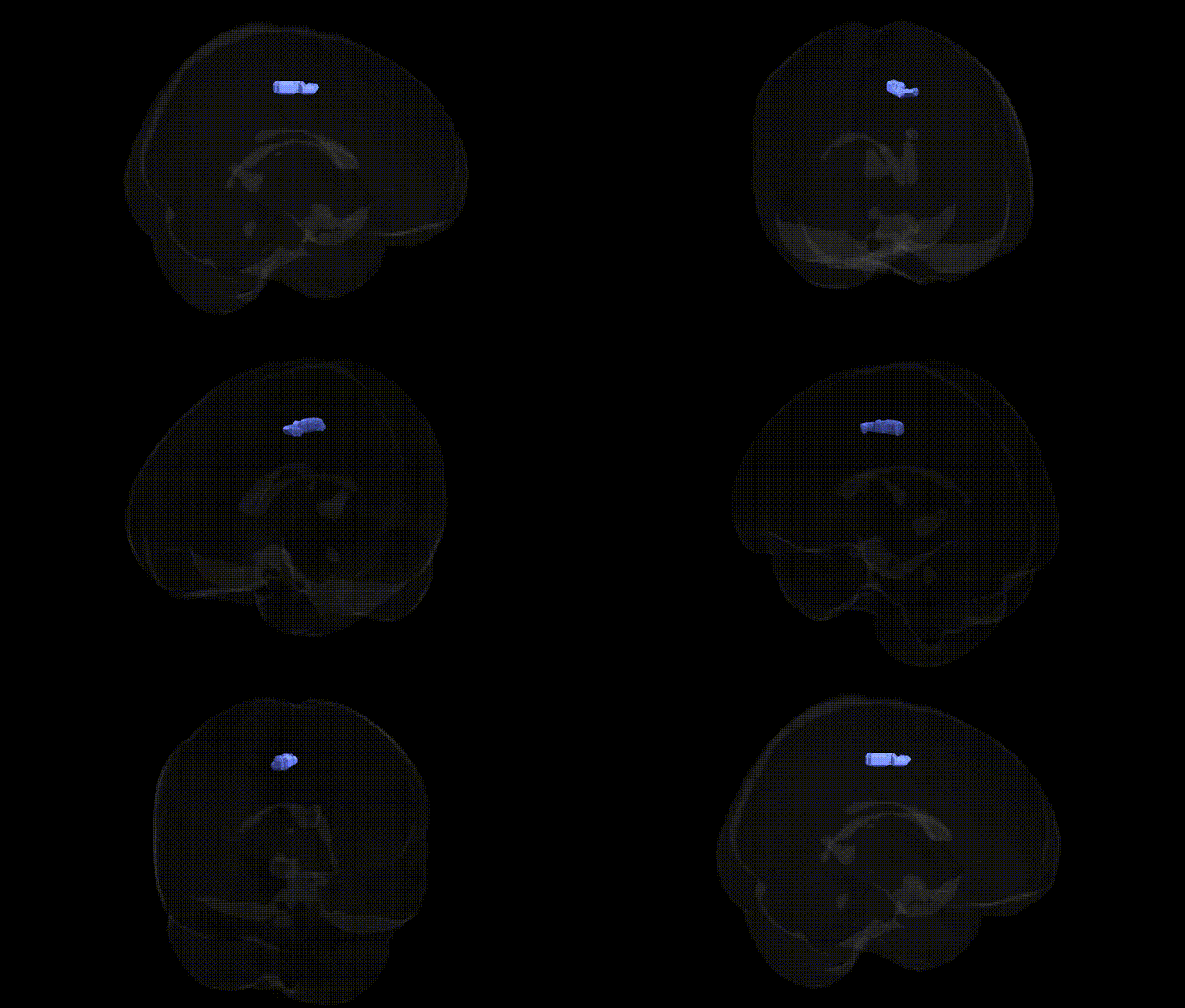
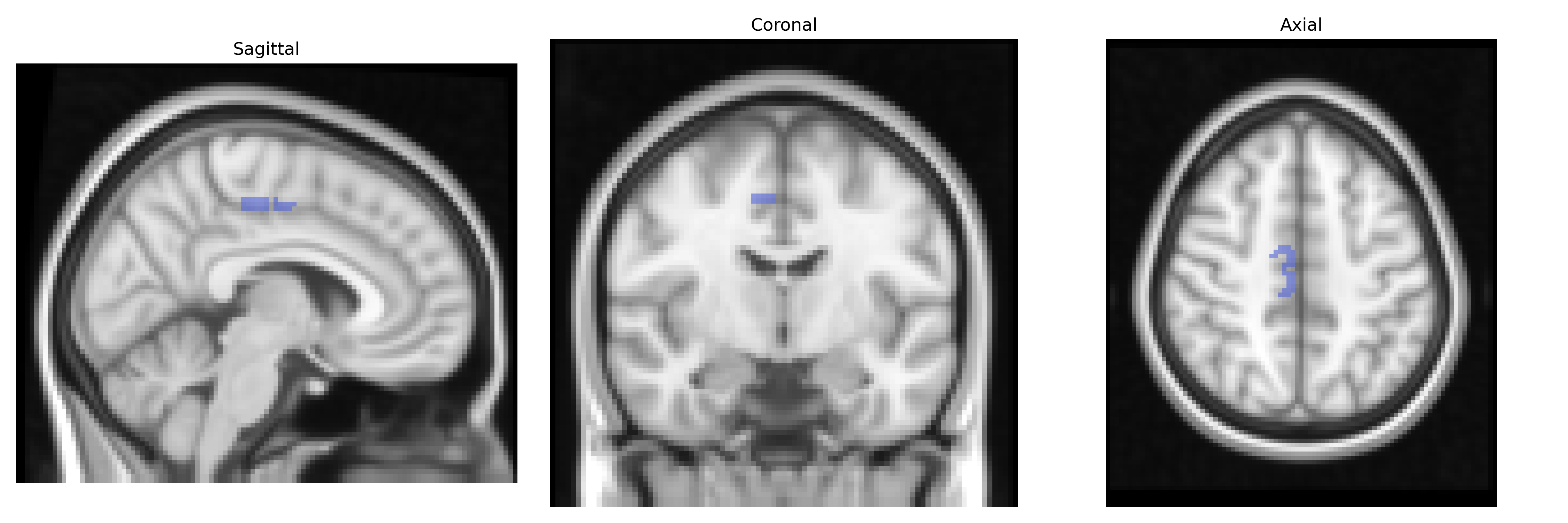
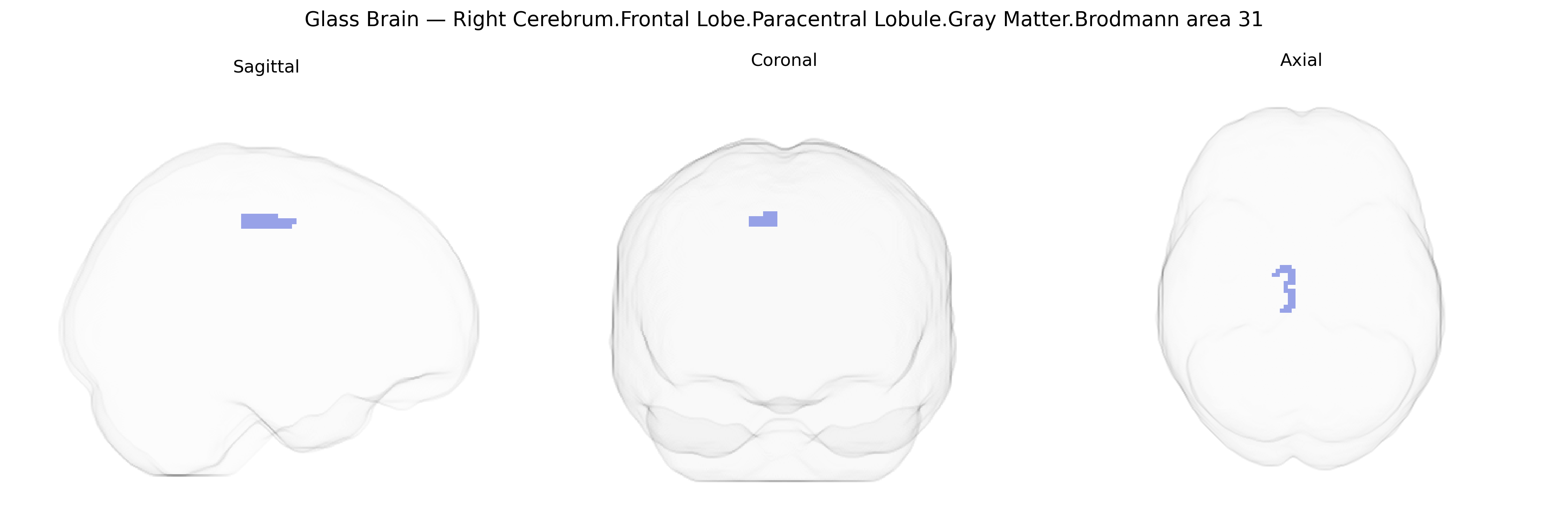
The bilateral Right Cerebrum.Frontal Lobe.Paracentral Lobule.Gray Matter.Brodmann area 31 region, as labeled in the Talairach 2 mm Atlas, corresponds primarily to cortical territory in the medial posterior frontal–parietal transition zone associated with the posterior cingulate cortex and adjacent medial parietal structures. Brodmann area 31 is a higher-order association area implicated in the default mode network, integrating multimodal sensory information with internal cognitive and emotional states, and is involved in episodic memory, self-referential thought, and aspects of visuospatial and attentional processing. Functionally, this region participates in evaluation of environmental context and internal milieu, contributing to adaptive behavioral responses and complex cognitive functions. There is no direct Wikipedia article for “Brodmann area 31” as a standalone entry; a closely related and overlapping structure is the Posterior cingulate cortex.
The bilateral Right Cerebrum.Frontal Lobe.Paracentral Lobule.Gray Matter.Brodmann area 31 (BA31) region, a medial posterior frontal/precuneus-adjacent area centrally involved in the default mode network, has been implicated in multiple genetic and GWAS findings through imaging-genetics and disorder-focused studies. Large-scale neuroimaging GWAS (e.g., ENIGMA, UK Biobank) have identified heritable variation in cortical thickness, surface area, and functional connectivity involving BA31, with associated loci including genes linked to synaptic function, neurodevelopment, and myelination (such as MAPT, APOE, GRIN2B, and several glutamatergic and GABAergic pathway genes), although effects are generally small and polygenic. BA31 shows altered structure or activity in genetically influenced conditions such as major depressive disorder, schizophrenia, bipolar disorder, Alzheimer’s disease, and autism spectrum disorder, often in relation to default mode network dysregulation. In Alzheimer’s disease, GWAS variants in APOE and other risk loci are associated with atrophy and hypometabolism in posterior medial cortical regions overlapping BA31; schizophrenia and depression risk variants have been linked to altered connectivity and gray matter volume in this region; and polygenic risk scores for cognitive performance and educational attainment correlate with structural and functional metrics in BA31 as part of fronto-parietal and default-mode networks. Overall, genetic findings indicate that BA31 is a highly polygenic, moderately heritable association cortex region whose structure and connectivity are sensitive to common risk variants for neuropsychiatric and neurodegenerative disorders, as well as cognitive and personality traits, rather than being driven by single, large-effect genes.
Overview generated by GPT-4o (2026).
Region ID: 1049
Hemisphere: bilateral
Atlas: Talairach labels 2mm
Full Quality Version: Download MP4
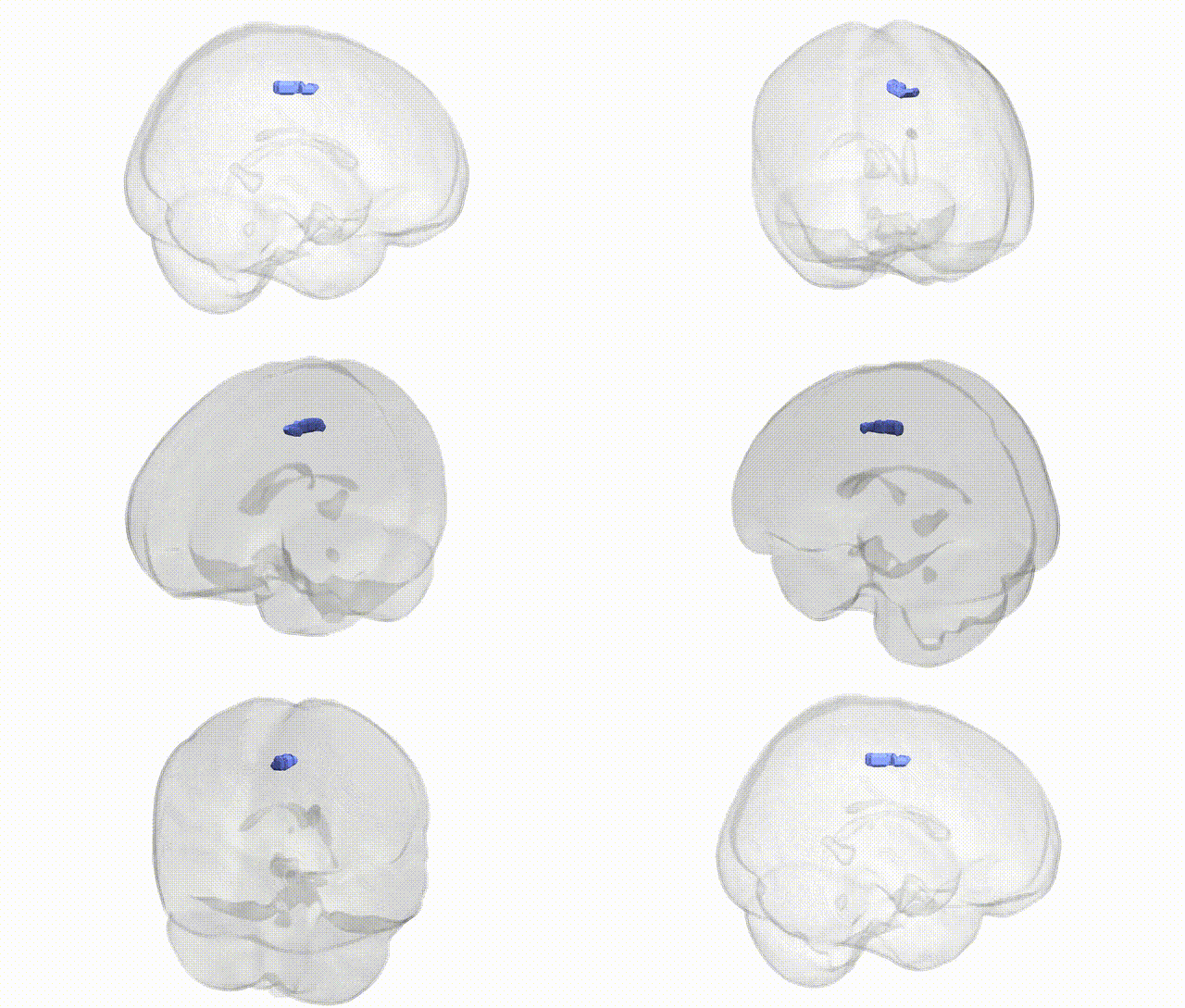
Full Quality Version: Download MP4
Wali Sidiqyar*, Gaurav Rudravaram*, Elyssa M. McMaster, Trent M. Schwartz, Adam M. Saunders, Kurt G. Schilling, Bennett A. Landman "Introducing SPINS: A Shared Public Visualization Library of Neuroanatomical Structures." Medical Imaging with Deep Learning- short paper
This resource is licensed under CC0 1.0 Universal (Public Domain).