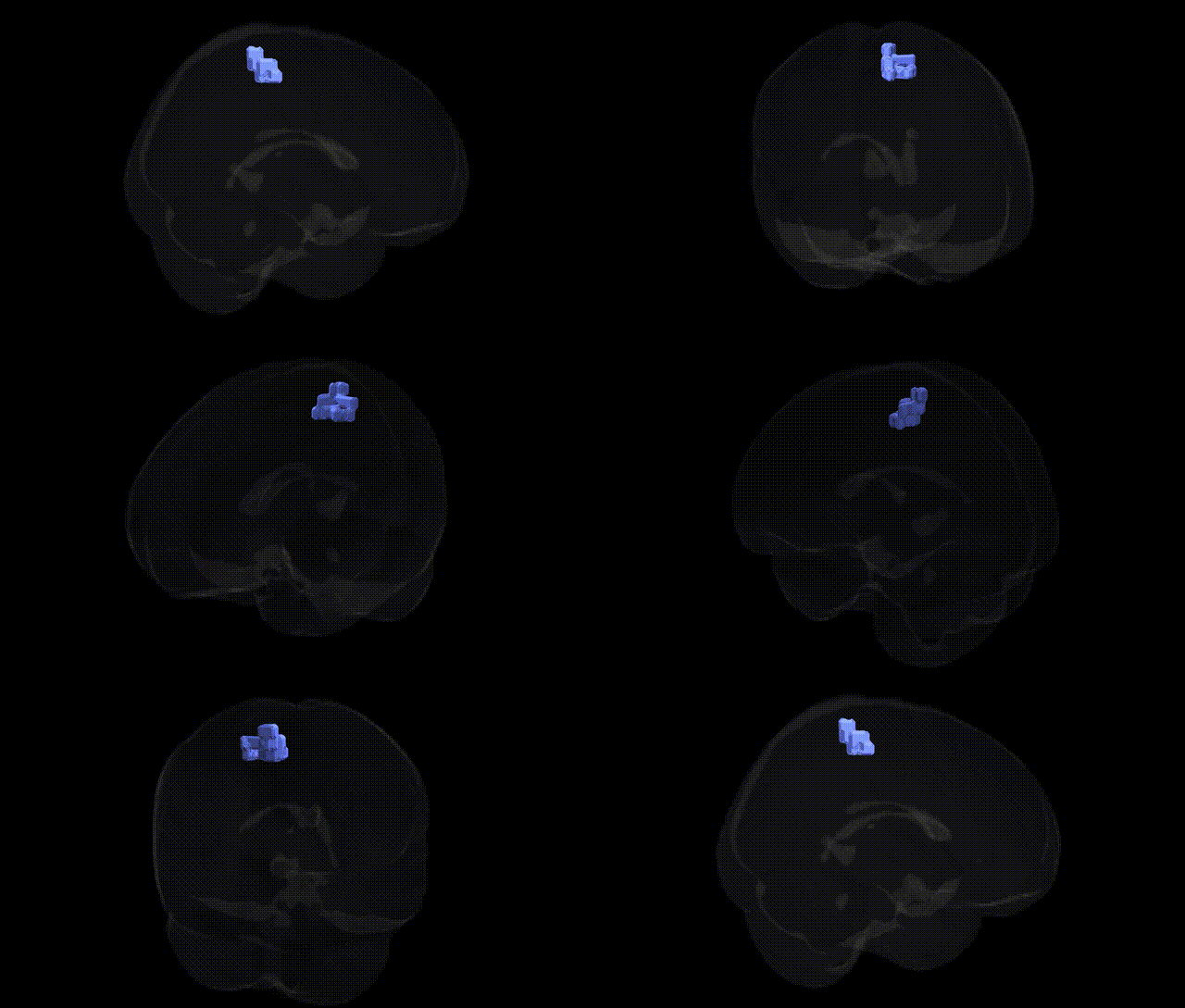
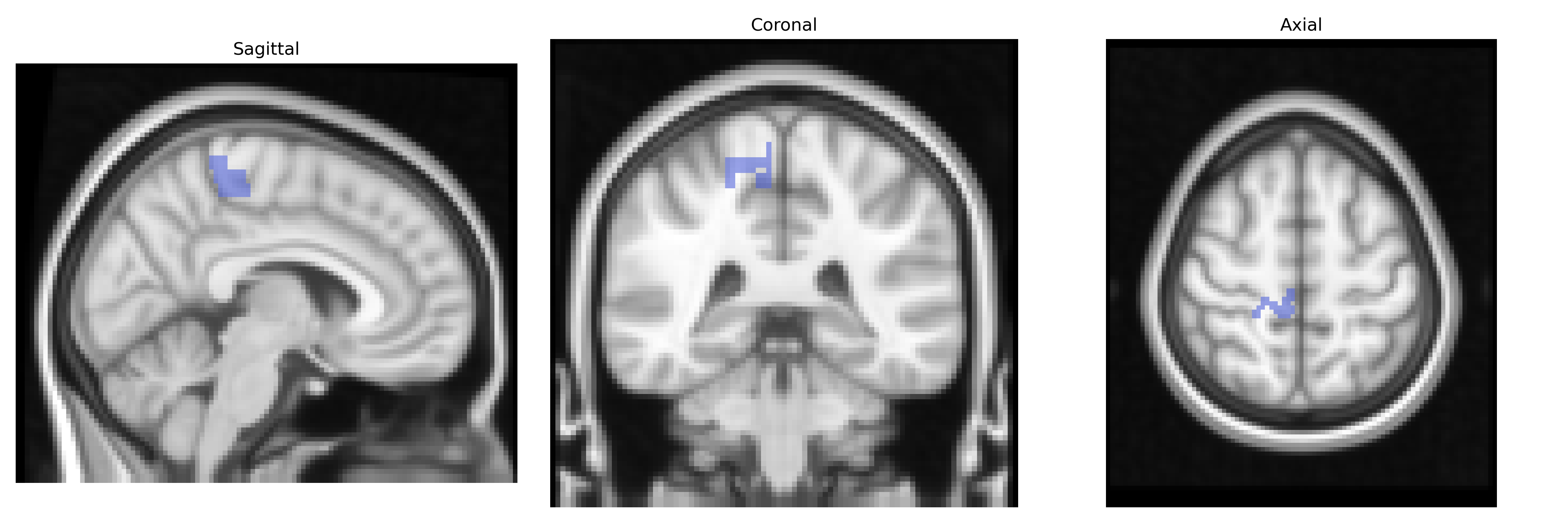
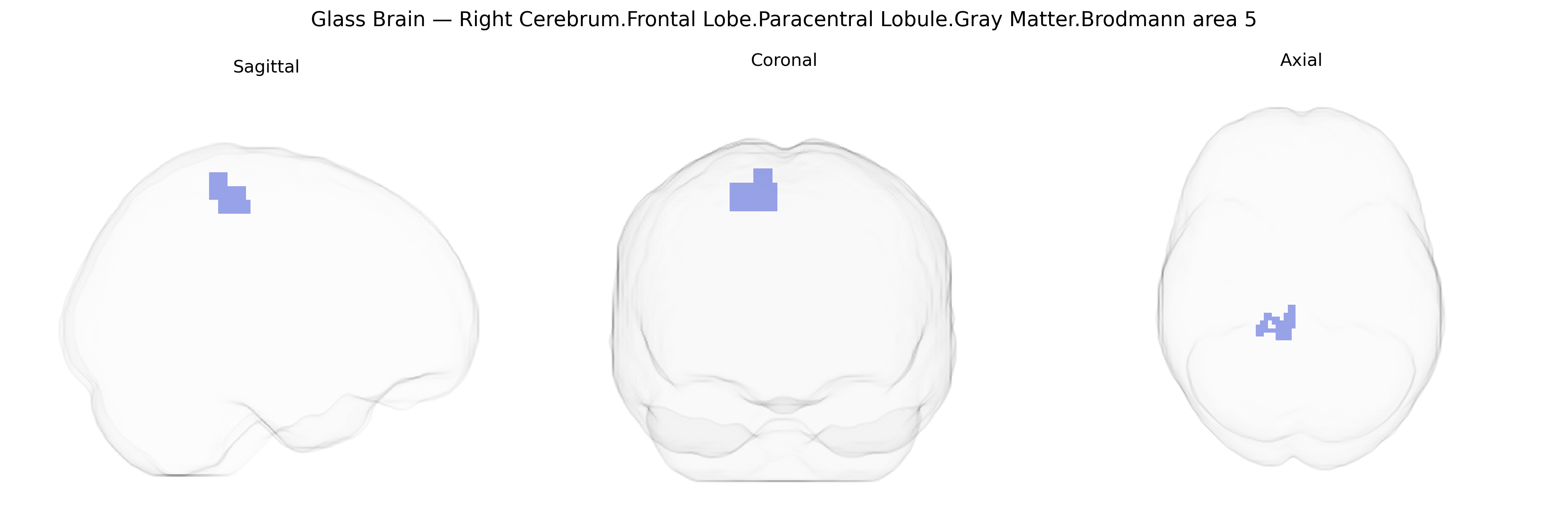
The bilateral Right Cerebrum.Frontal Lobe.Paracentral Lobule.Gray Matter.Brodmann area 5 corresponds to a portion of the superior medial frontal cortex bordering the parietal lobe, functionally part of the somatosensory association cortex. Brodmann area 5 integrates tactile and proprioceptive information from the primary somatosensory cortex to support higher-order processing of body position, complex sensorimotor coordination, and aspects of spatial perception related to movement and limb orientation. In the paracentral lobule, this region contributes to the integration of sensory feedback with motor functions, facilitating refined voluntary movements and postural control. There is no direct Wikipedia article for this specific Talairach-defined region; a closely related structure is Brodmann area 5.
The bilateral right paracentral lobule (frontal lobe gray matter; Brodmann area 5 in some Talairach-based atlases, though more classically BA5 is parietal) has been implicated in genetic studies primarily through its roles in sensorimotor function, somatosensory integration, and motor control. GWAS and imaging-genetics studies of cortical thickness, surface area, and gyrification have linked common variants in genes involved in neurodevelopment and synaptic function—such as those in the MAPT region on chromosome 17, CNTNAP2, and multiple loci near FOXP2, DCC, and PAX6—to structural variation in central sensorimotor regions, including the paracentral lobule. Large consortia (e.g., ENIGMA, UK Biobank) have reported polygenic influences on the morphology of this area associated with general cognitive performance, motor coordination, and reaction time. Clinically, genetic risk factors for multiple sclerosis (e.g., HLA-DRB1*15:01 and other immune-related loci), amyotrophic lateral sclerosis, and familial forms of spastic paraplegia have been associated with lesions, atrophy, or functional disturbances in the paracentral lobule due to its role in lower limb motor and sensory representation. Additionally, GWAS of chronic pain, especially low back and limb pain, and of movement disorders such as Parkinson’s disease and dystonia have shown convergent involvement of sensorimotor cortical networks that include this region, often mediated by variants in dopaminergic, glutamatergic, and axonal guidance pathways, although these associations are typically network-level rather than uniquely specific to Brodmann area 5.
Overview generated by GPT-4o (2026).
Region ID: 1070
Hemisphere: bilateral
Atlas: Talairach labels 2mm
Full Quality Version: Download MP4
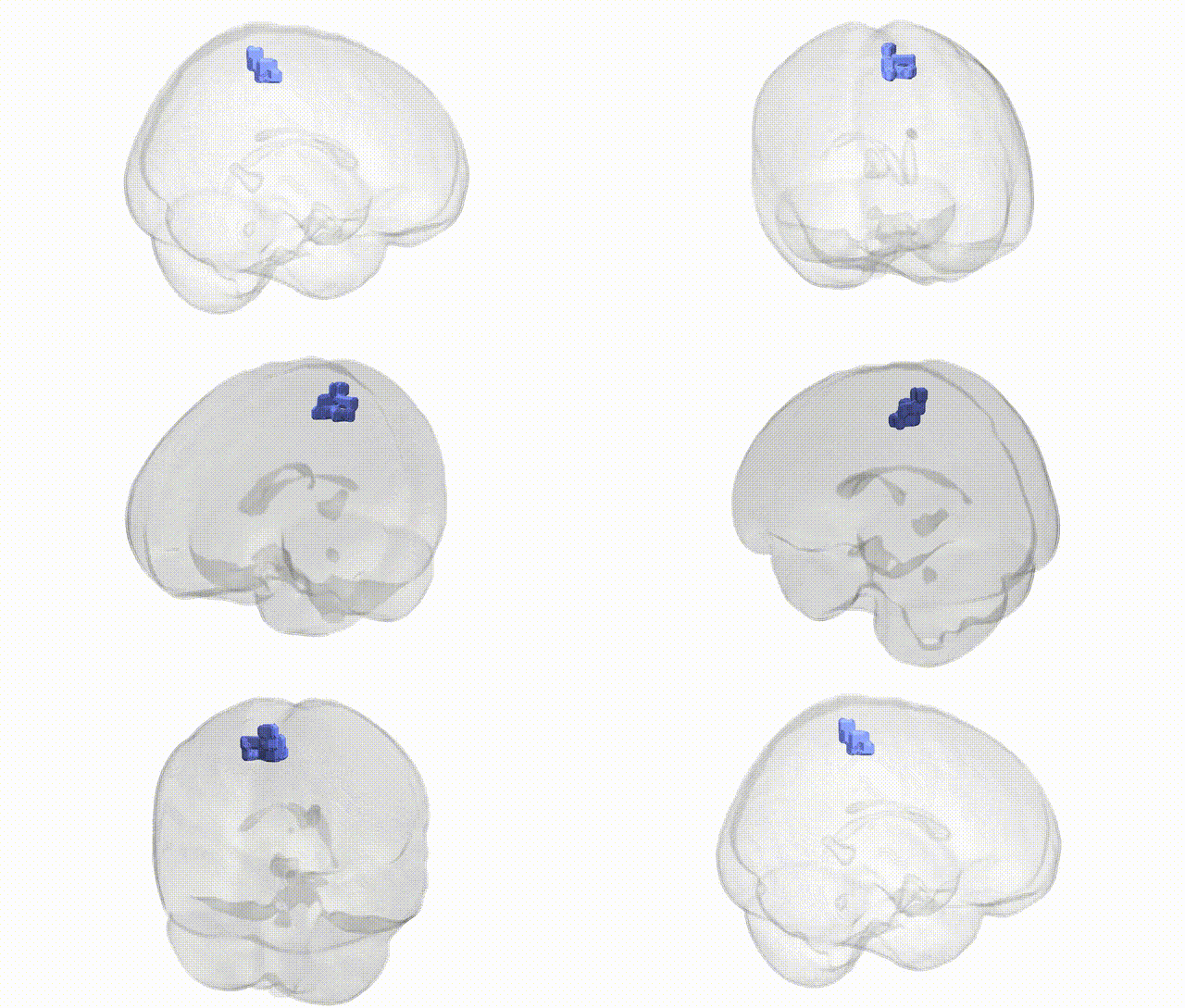
Full Quality Version: Download MP4
Wali Sidiqyar*, Gaurav Rudravaram*, Elyssa M. McMaster, Trent M. Schwartz, Adam M. Saunders, Kurt G. Schilling, Bennett A. Landman "Introducing SPINS: A Shared Public Visualization Library of Neuroanatomical Structures." Medical Imaging with Deep Learning- short paper
This resource is licensed under CC0 1.0 Universal (Public Domain).