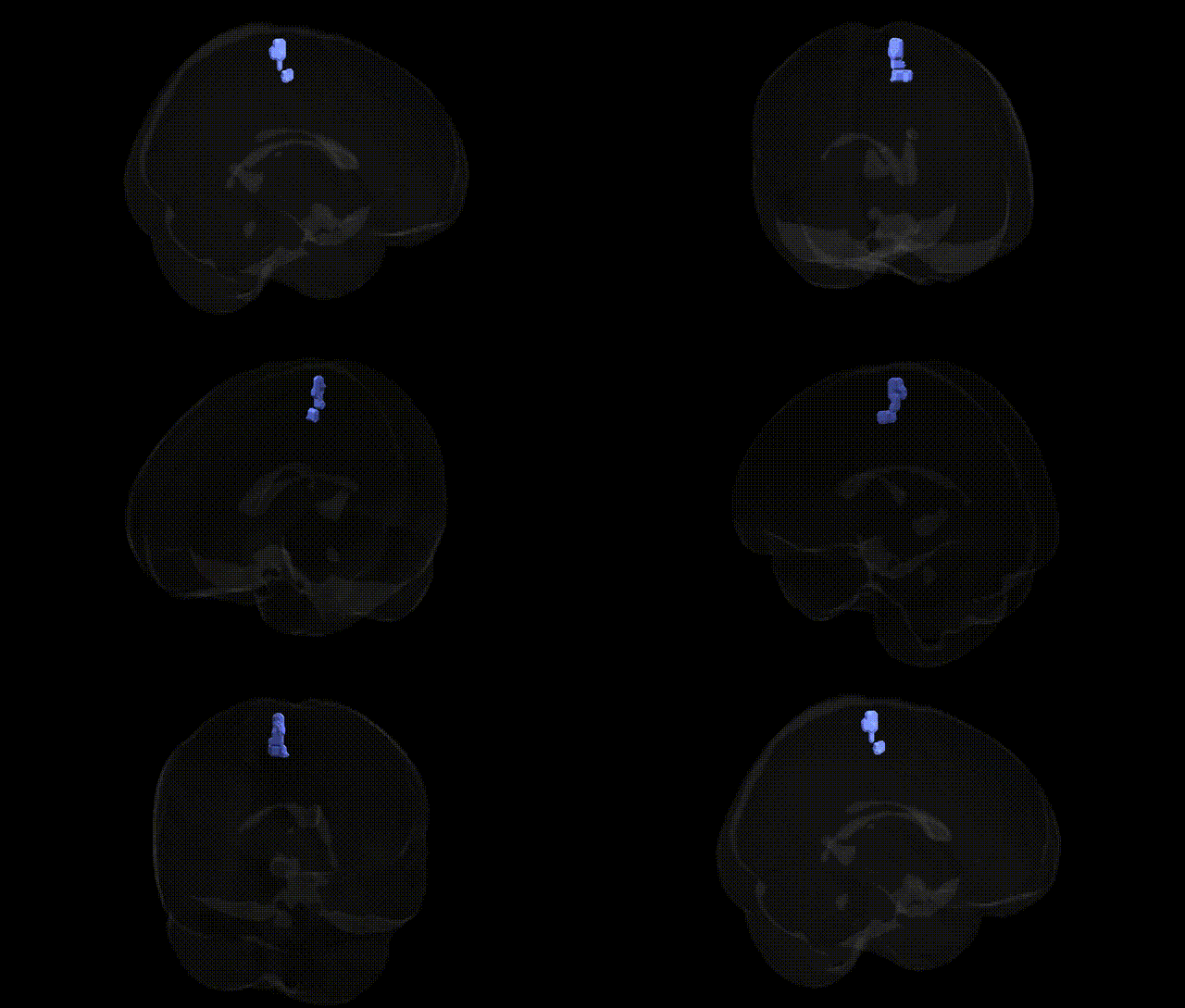
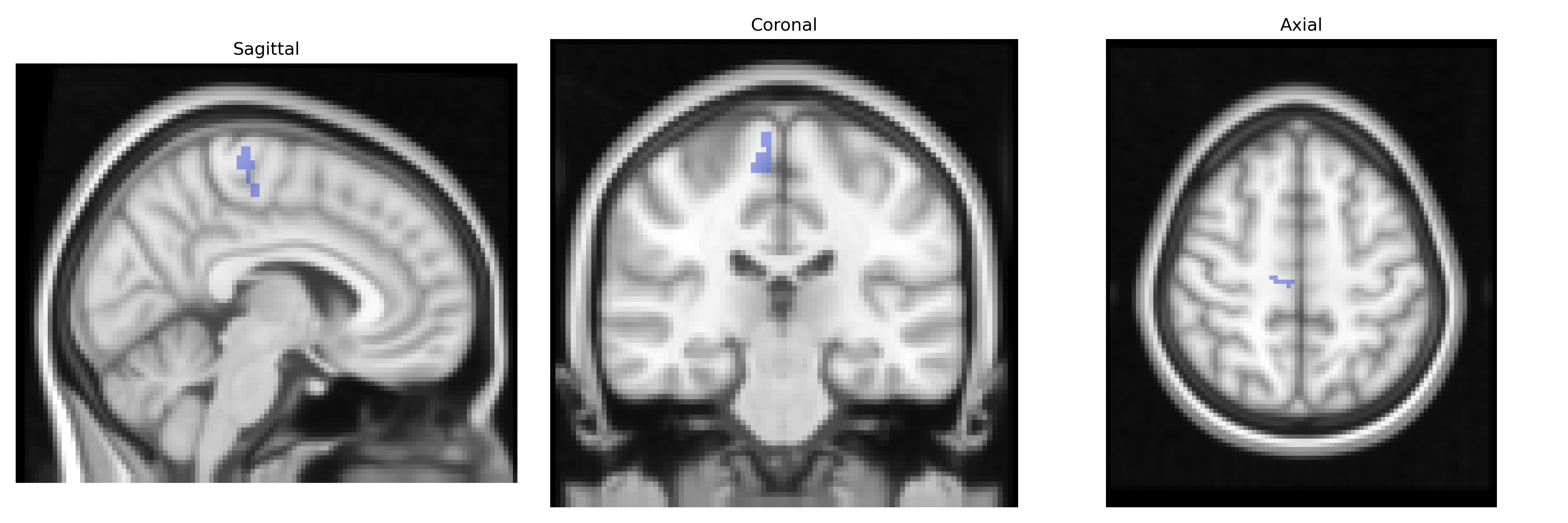
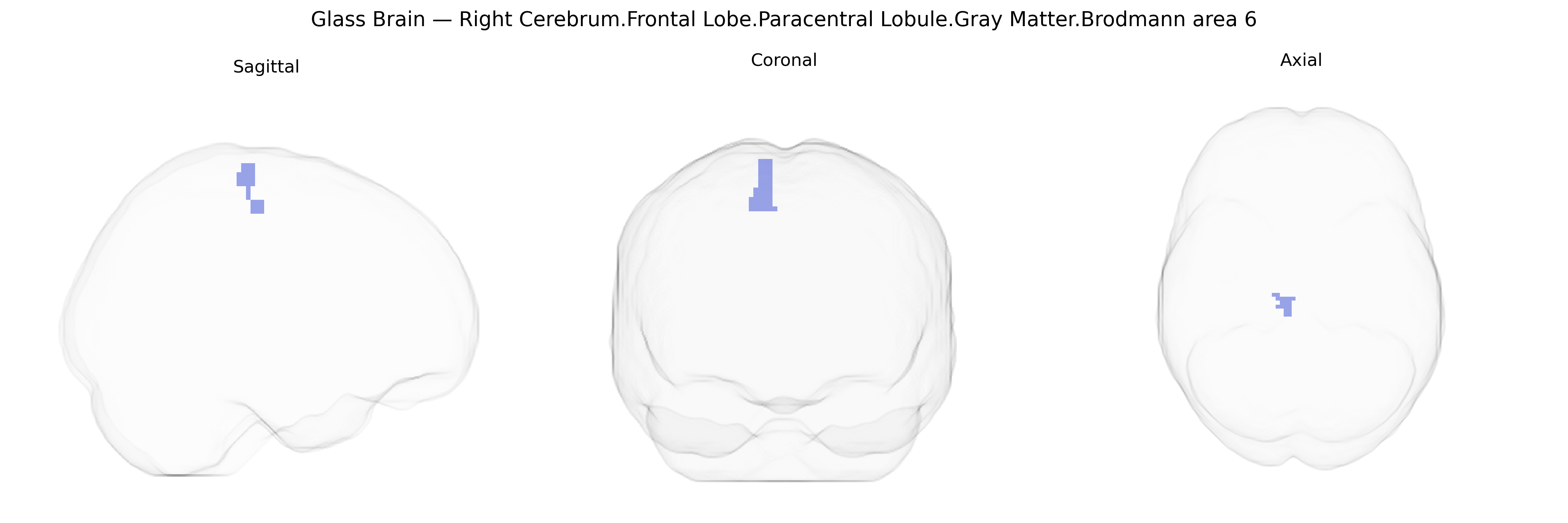
The bilateral Right Cerebrum.Frontal Lobe.Paracentral Lobule.Gray Matter.Brodmann area 6 corresponds to a portion of the premotor and supplementary motor cortex situated in the medial aspect of the frontal lobe within the paracentral lobule. This region is primarily involved in the planning, initiation, and coordination of voluntary movements, including complex motor sequences and postural adjustments, and integrates sensory and motor information for the preparation of actions. Brodmann area 6 contributes to motor learning and the organization of movements guided by internal plans rather than immediate external stimuli and has strong connections with primary motor cortex, basal ganglia, and cerebellar circuits. There is no dedicated Wikipedia article for this exact Talairach-labeled region; a closely related structure is Brodmann area 6.
The bilateral right paracentral lobule (frontal lobe, gray matter, Brodmann area 6) is part of the medial premotor and supplementary motor network, and genetic associations typically implicate it via motor control, sensorimotor integration, and higher-order cognitive traits rather than as an isolated locus. Large neuroimaging GWAS (e.g., ENIGMA, UK Biobank) have identified common variants in genes involved in neurodevelopment, synaptic function, and myelination (such as variants near MAPT, BDNF, CNTNAP2, and FOXP1) that modulate cortical thickness or surface area in premotor and medial frontal regions including BA6, although these effects are usually distributed and not specific to the paracentral lobule alone. Polygenic risk scores for schizophrenia, major depressive disorder, and ADHD show associations with altered structure and functional activation in medial premotor regions, and variants in glutamatergic and GABAergic pathway genes (e.g., GRIN2A, GABRA2) have been linked to motor and inhibitory control tasks that recruit BA6. Motor-related disorders such as primary motor epilepsy and certain forms of familial spastic paraplegia and hereditary motor neuron disease involve networks encompassing the paracentral lobule, with causal variants in genes affecting corticospinal tract and upper motor neuron integrity (e.g., SPAST, ATL1) indirectly implicating this region through structural and functional connectivity changes. Additionally, GWAS of complex traits including general cognitive ability, educational attainment, and reaction time indicate that polygenic architectures influencing frontoparietal and premotor circuits also modulate morphology and activation patterns in BA6, suggesting that genetic influences on this area are largely pleiotropic and embedded within broader cortical and motor network genetics rather than confined to a single, region-specific gene set.
Overview generated by GPT-4o (2026).
Region ID: 1076
Hemisphere: bilateral
Atlas: Talairach labels 2mm
Full Quality Version: Download MP4
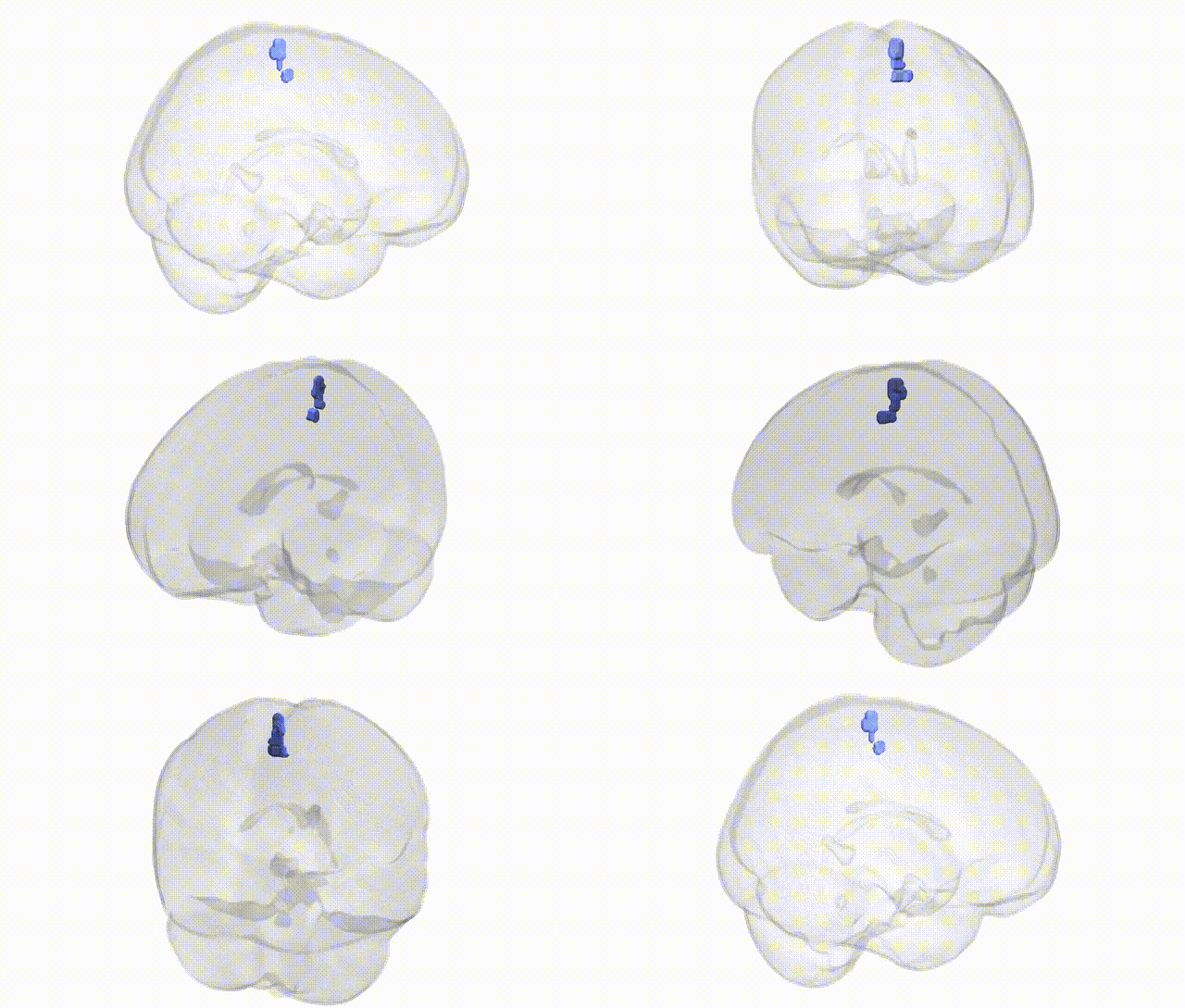
Full Quality Version: Download MP4
Wali Sidiqyar*, Gaurav Rudravaram*, Elyssa M. McMaster, Trent M. Schwartz, Adam M. Saunders, Kurt G. Schilling, Bennett A. Landman "Introducing SPINS: A Shared Public Visualization Library of Neuroanatomical Structures." Medical Imaging with Deep Learning- short paper
This resource is licensed under CC0 1.0 Universal (Public Domain).