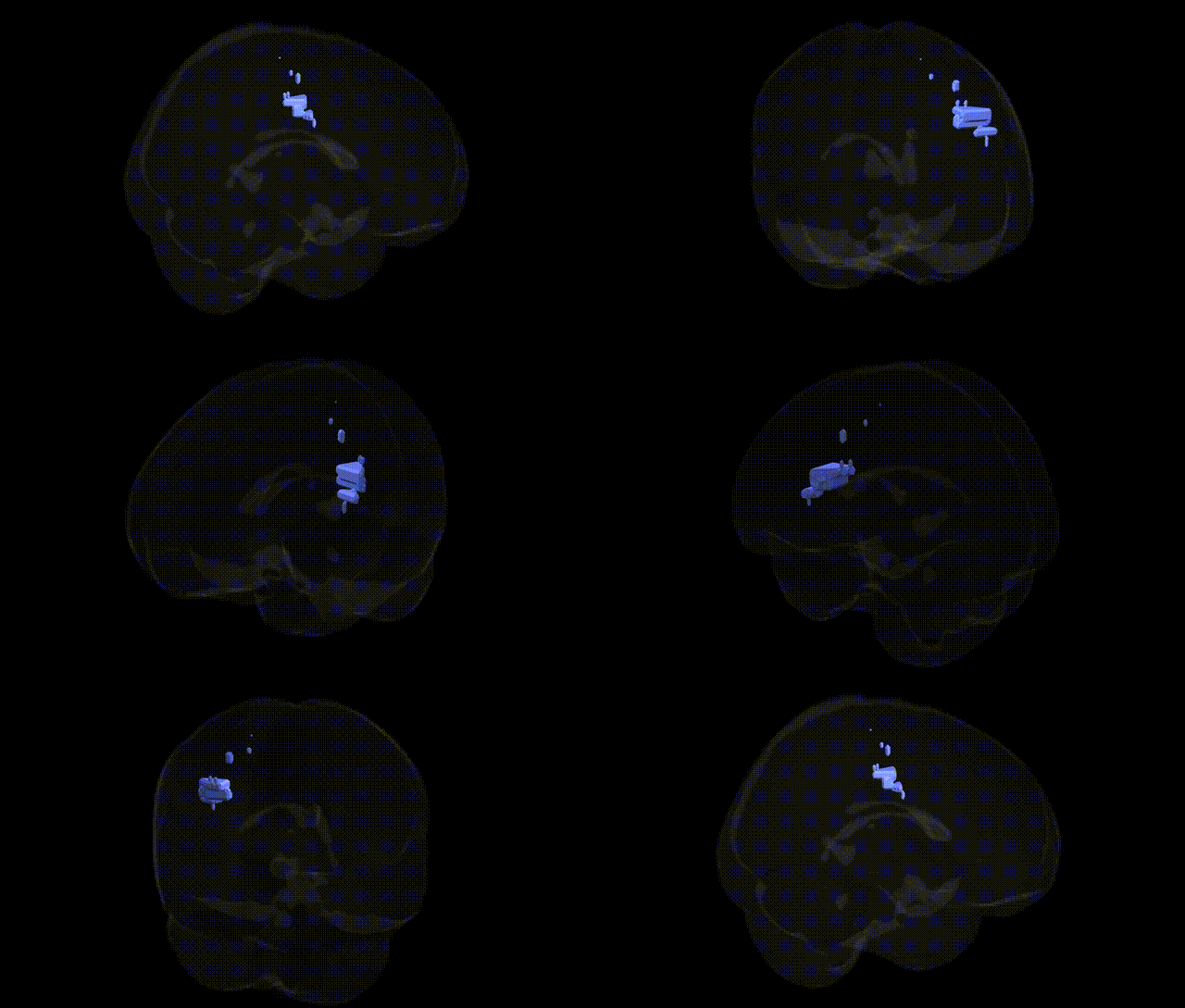
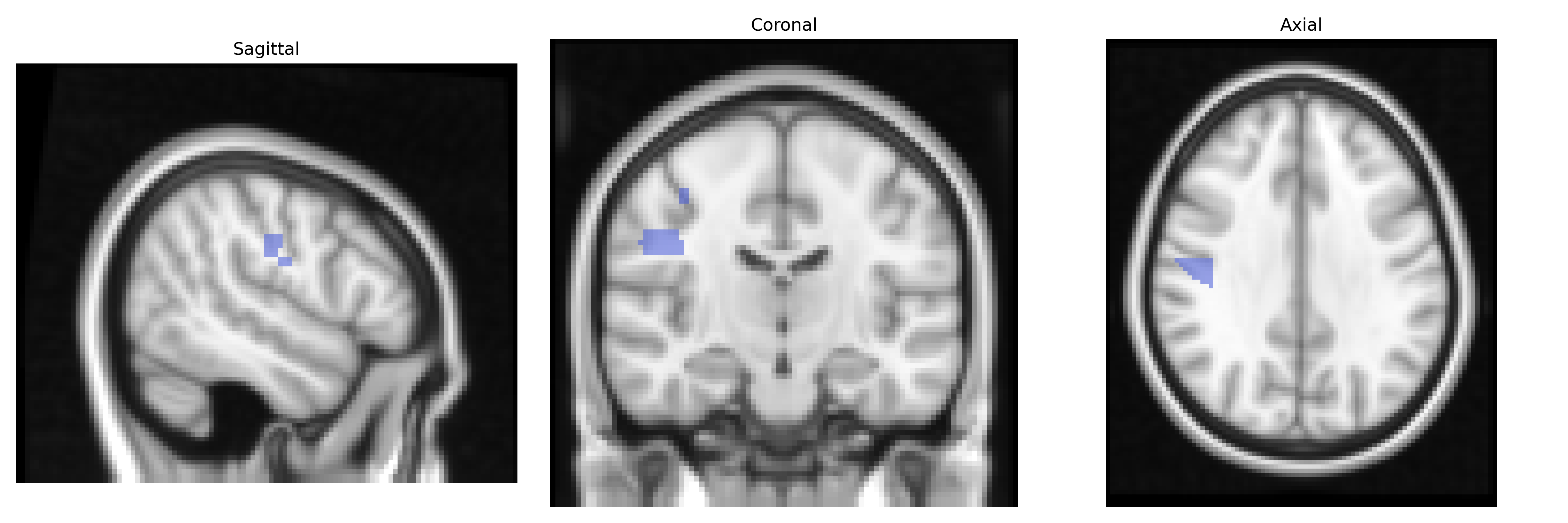
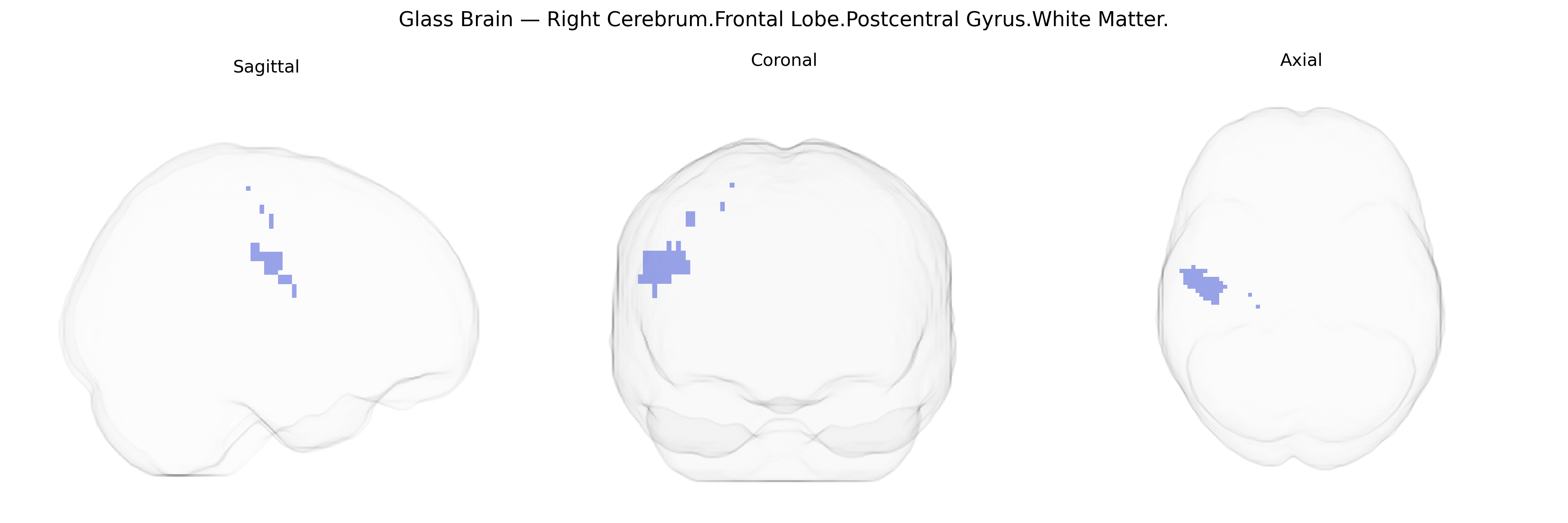
The bilateral Right Cerebrum.Frontal Lobe.Postcentral Gyrus.White Matter, as labeled in the Talairach 2 mm atlas, refers to subcortical white matter lying immediately deep to the cortex of the postcentral gyrus, a region classically associated with primary somatosensory processing. Although named “frontal” in this atlas hierarchy, the postcentral gyrus is anatomically part of the parietal lobe; its underlying white matter comprises bundles of myelinated axons that connect the somatosensory cortex with other cortical and subcortical regions, supporting the integration and transmission of tactile, proprioceptive, and nociceptive information. These fiber pathways participate in intra-hemispheric association circuits and thalamocortical loops that are essential for sensorimotor coordination and conscious perception of the body. There is no direct Wikipedia article for this specific white matter compartment; a closely related cortical structure is the Postcentral gyrus.
The bilateral right frontal lobe postcentral gyrus white matter, as defined in the Talairach 2mm atlas, corresponds primarily to corticocortical and thalamocortical projection pathways subserving somatosensory and sensorimotor integration; genetic associations identified in imaging genetics and GWAS largely implicate polygenic influences rather than single loci with large effects. Large-scale brain MRI GWAS (e.g., ENIGMA, UK Biobank) have reported variants near genes involved in axon guidance, myelination, and synaptic development (such as CNTNAP2, NPTN, CADM2, and multiple oligodendrocyte-related loci) that influence regional cortical thickness and white-matter microstructure, including fractional anisotropy and mean diffusivity in frontal sensorimotor tracts that intersect the postcentral gyrus. These structural measures in the frontal sensorimotor network show genetic correlations with general cognitive ability, educational attainment, motor performance, and risk for neurodevelopmental and psychiatric conditions, notably ADHD, autism spectrum disorder, schizophrenia, and major depression, all of which have been linked to widespread frontal and sensorimotor network alterations rather than to this specific gyrus alone. Additionally, variants within neuroinflammatory and neurovascular pathways have been associated with white-matter integrity and lesion burden in frontal regions in disorders such as multiple sclerosis and small-vessel cerebrovascular disease. Overall, current evidence points to diffuse, polygenic influences on frontal sensorimotor white matter—embedded in large-scale distributed networks—rather than discrete genetic effects uniquely localized to the bilateral right frontal postcentral gyrus white matter, and most findings derive from atlas-based or tract-based measures that approximate, rather than precisely isolate, this Talairach-defined region.
Overview generated by GPT-4o (2026).
Region ID: 834
Hemisphere: bilateral
Atlas: Talairach labels 2mm
Full Quality Version: Download MP4
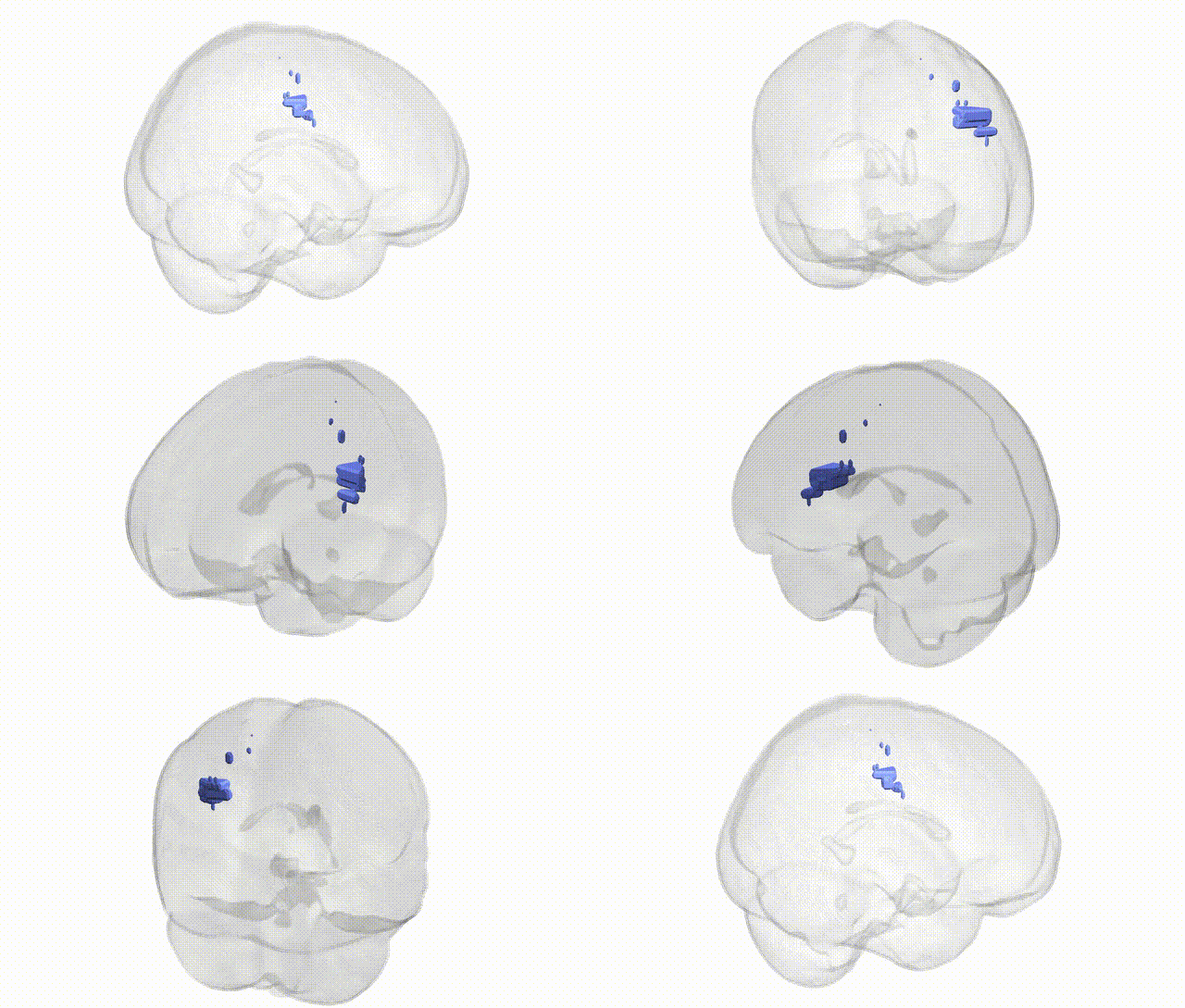
Full Quality Version: Download MP4
Wali Sidiqyar*, Gaurav Rudravaram*, Elyssa M. McMaster, Trent M. Schwartz, Adam M. Saunders, Kurt G. Schilling, Bennett A. Landman "Introducing SPINS: A Shared Public Visualization Library of Neuroanatomical Structures." Medical Imaging with Deep Learning- short paper
This resource is licensed under CC0 1.0 Universal (Public Domain).