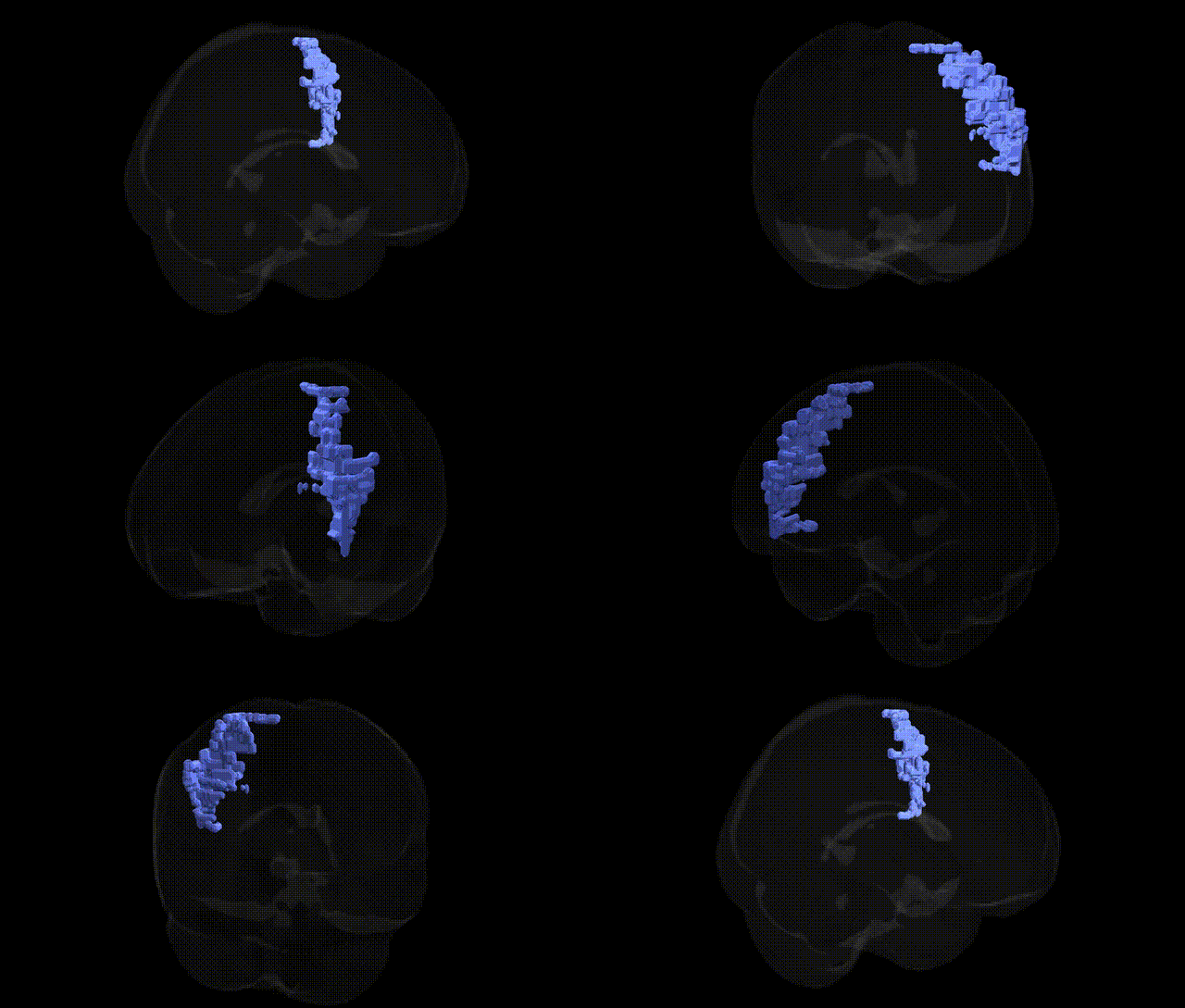
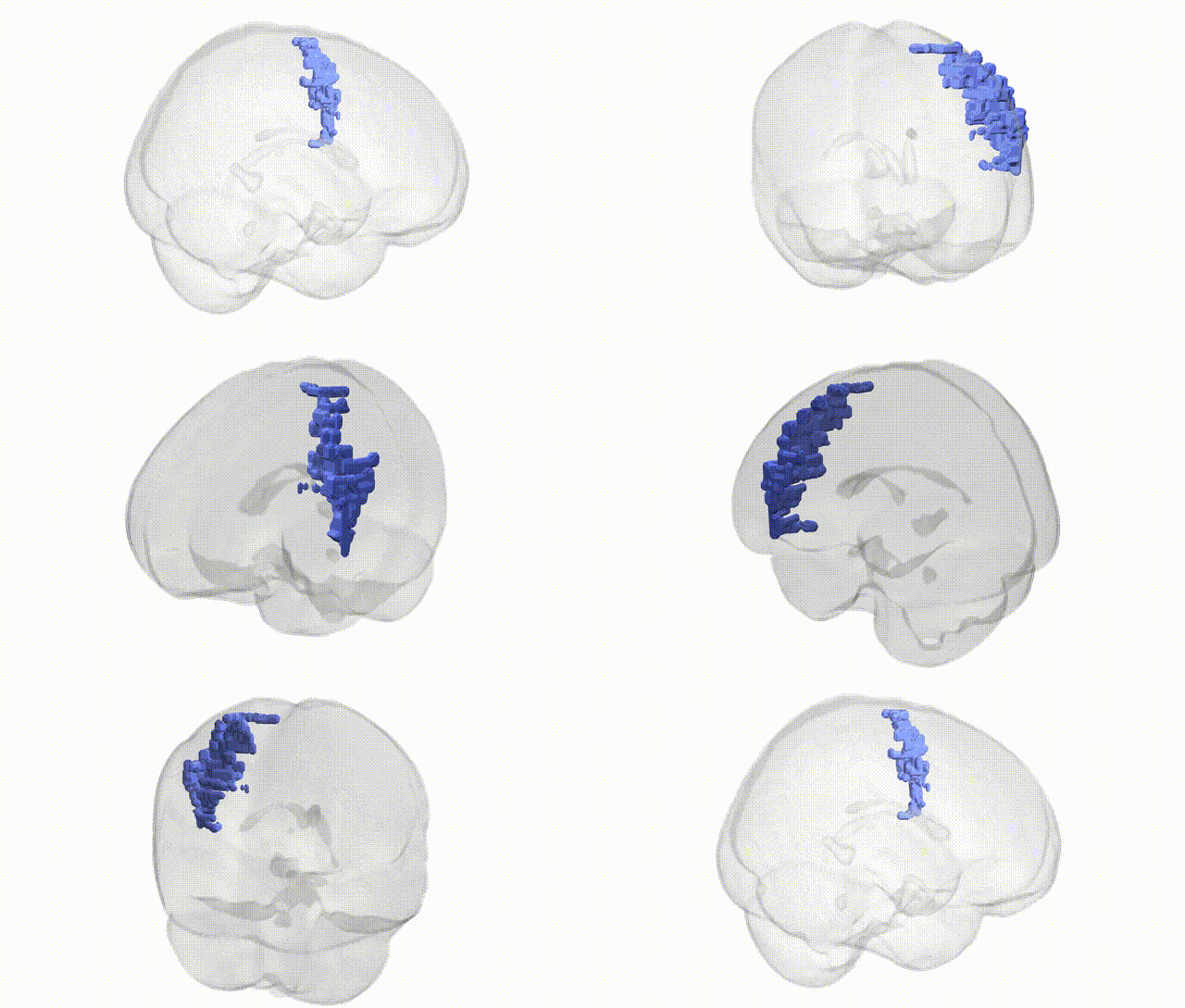
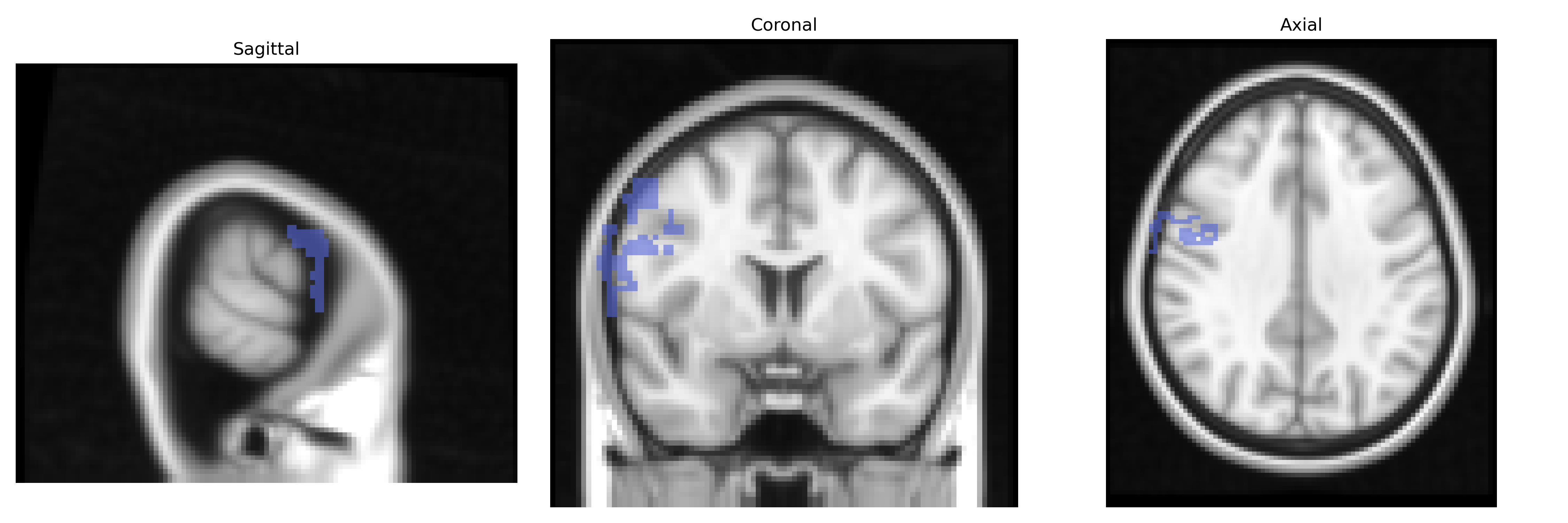
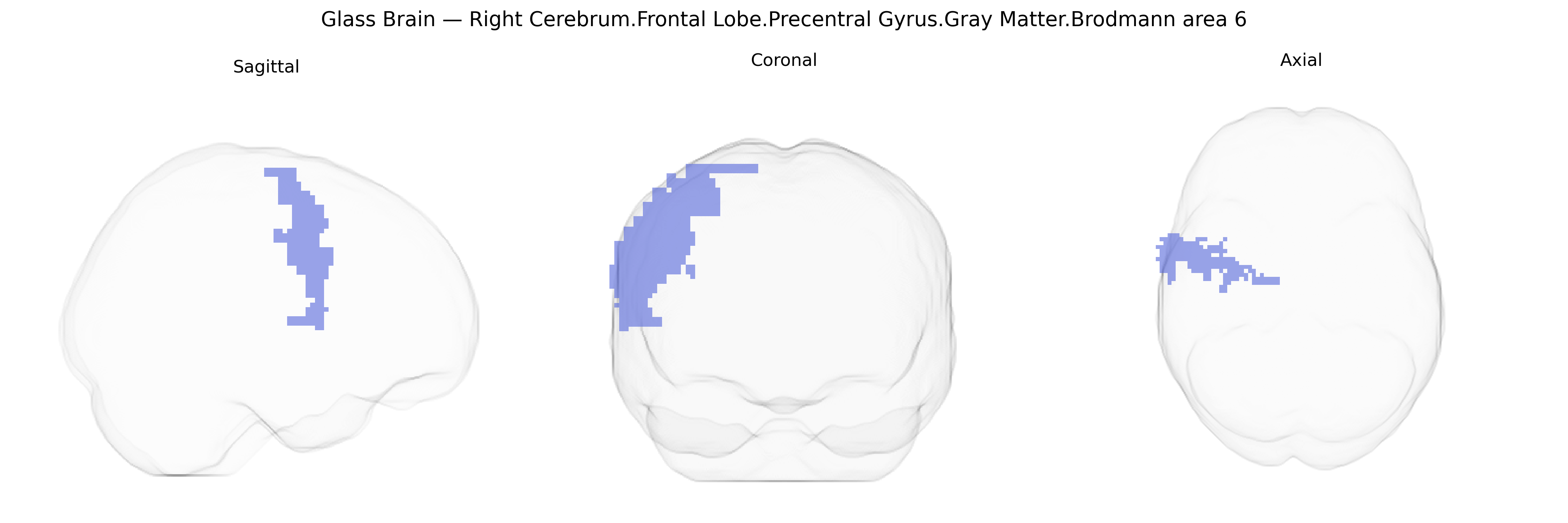
The bilateral Right Cerebrum.Frontal Lobe.Precentral Gyrus.Gray Matter.Brodmann area 6 corresponds to premotor cortex and supplementary motor areas located anterior to the primary motor cortex, primarily involved in the planning, sequencing, and preparation of voluntary movements rather than their direct execution. This agranular frontal region integrates sensory, motor, and cognitive information to organize complex motor programs, coordinate proximal and axial musculature, and contribute to motor learning and postural control. It is also implicated in higher-order aspects of action, such as motor imagery, anticipatory adjustments, and externally guided versus internally generated movement selection, with strong connections to primary motor cortex, parietal association areas, basal ganglia, and cerebellum. There is no direct link for this exact composite region; a closely related structure is Brodmann area 6.
The bilateral Right Cerebrum.Frontal Lobe.Precentral Gyrus.Gray Matter.Brodmann area 6, corresponding largely to premotor cortex and supplementary motor-related regions, has been implicated in several genetic and GWAS findings, though most studies reference it functionally rather than under that exact Talairach label. Large-scale neuroimaging GWAS (e.g., ENIGMA, UK Biobank) have identified associations between variants in genes such as HMGA2, IGF1, FOXO3, and multiple loci near microtubule and synaptic genes with cortical thickness, surface area, and gyrification in frontal premotor regions overlapping BA6. Motor-related disorders including Parkinson’s disease, dystonia, and Tourette syndrome show altered structure or activation in BA6, with genetic risk loci (e.g., SNCA, LRRK2, GBA for Parkinson’s; CELSR3, FLT3, and immune-related loci for Tourette) linked to patterns of motor circuit dysfunction that include premotor cortex. Autism spectrum disorder, ADHD, and schizophrenia GWAS (involving genes such as CACNA1C, GRIN2A, DRD2, and synaptic/immune-related loci) have also been associated with structural and functional abnormalities in BA6, especially in tasks involving motor planning, inhibition, and cognitive control. Polygenic risk scores for educational attainment and general cognitive ability correlate with frontal cortical measures including premotor regions, suggesting that distributed genetic influences on neurodevelopment and synaptic function affect BA6 morphology and connectivity. Although no single “BA6-specific” gene has been consistently identified, convergent evidence from imaging genetics points to a role for genes involved in neuronal migration, synaptic transmission, calcium signaling, and neurodevelopmental pathways in shaping structural variation and disorder-related alterations in this premotor brain area.
Overview generated by GPT-4o (2026).
Region ID: 683
Hemisphere: bilateral
Atlas: Talairach labels 2mm
Full Quality Version: Download MP4
Full Quality Version: Download MP4
Wali Sidiqyar*, Gaurav Rudravaram*, Elyssa M. McMaster, Trent M. Schwartz, Adam M. Saunders, Kurt G. Schilling, Bennett A. Landman "Introducing SPINS: A Shared Public Visualization Library of Neuroanatomical Structures." Medical Imaging with Deep Learning- short paper
This resource is licensed under CC0 1.0 Universal (Public Domain).