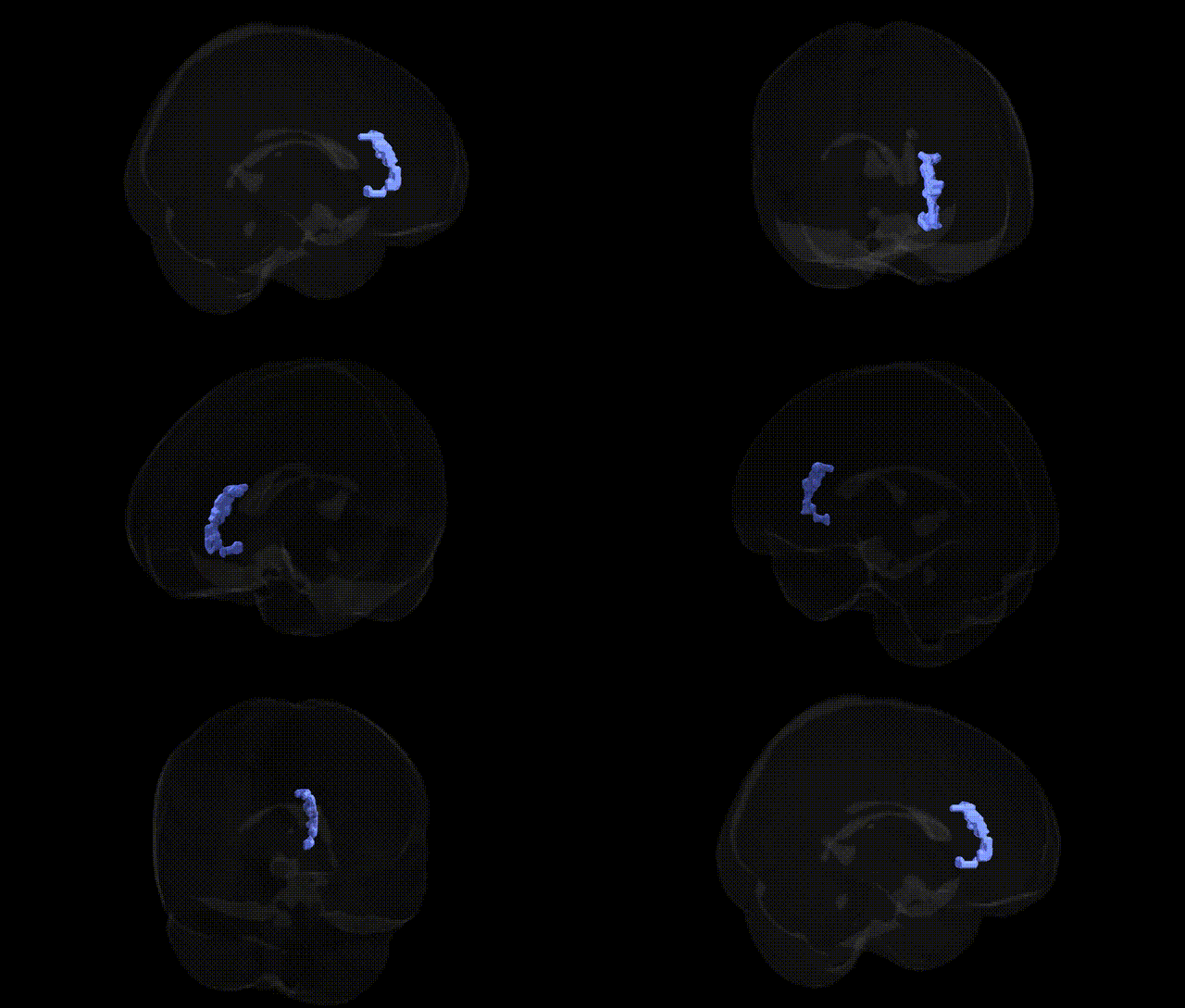
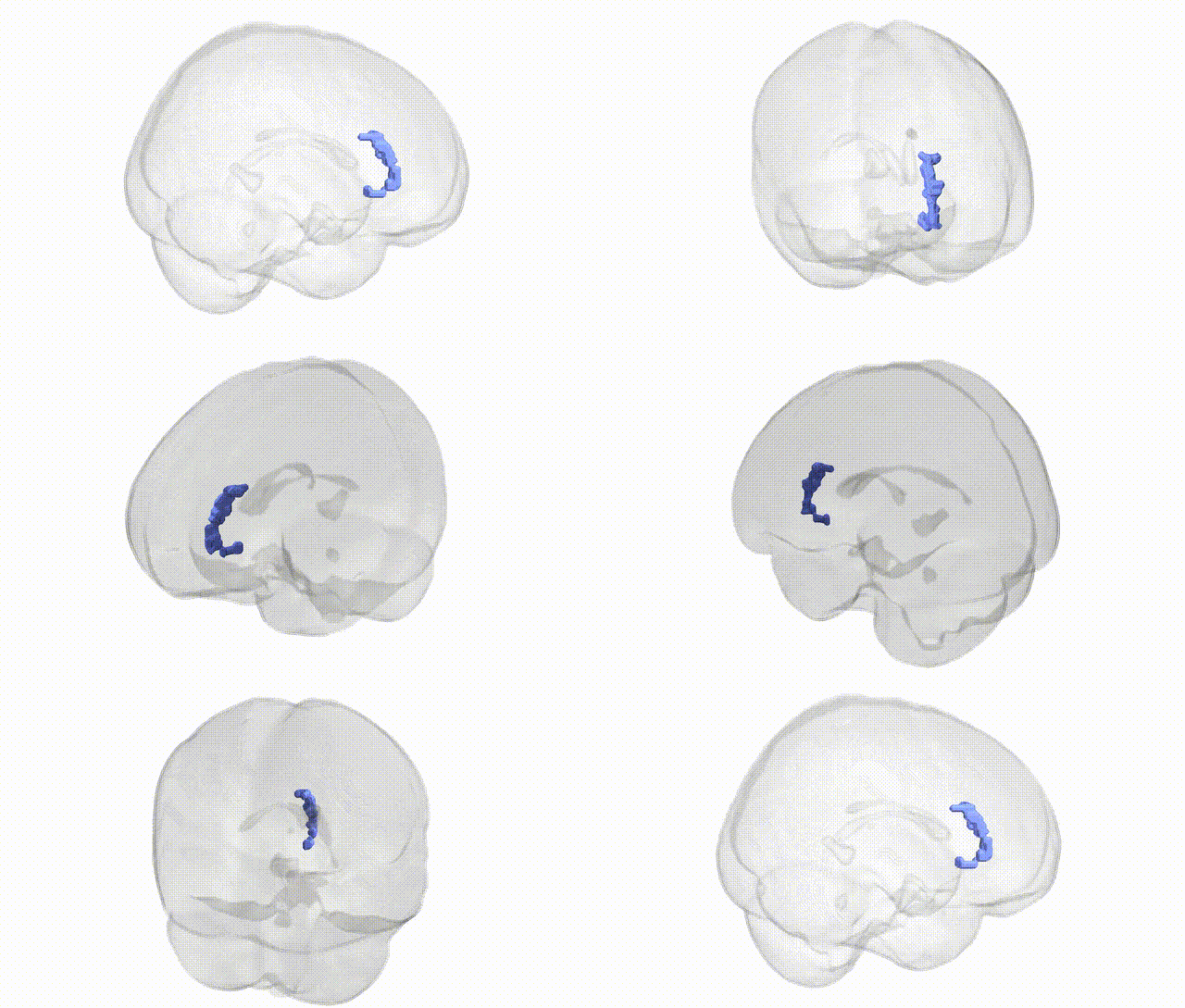
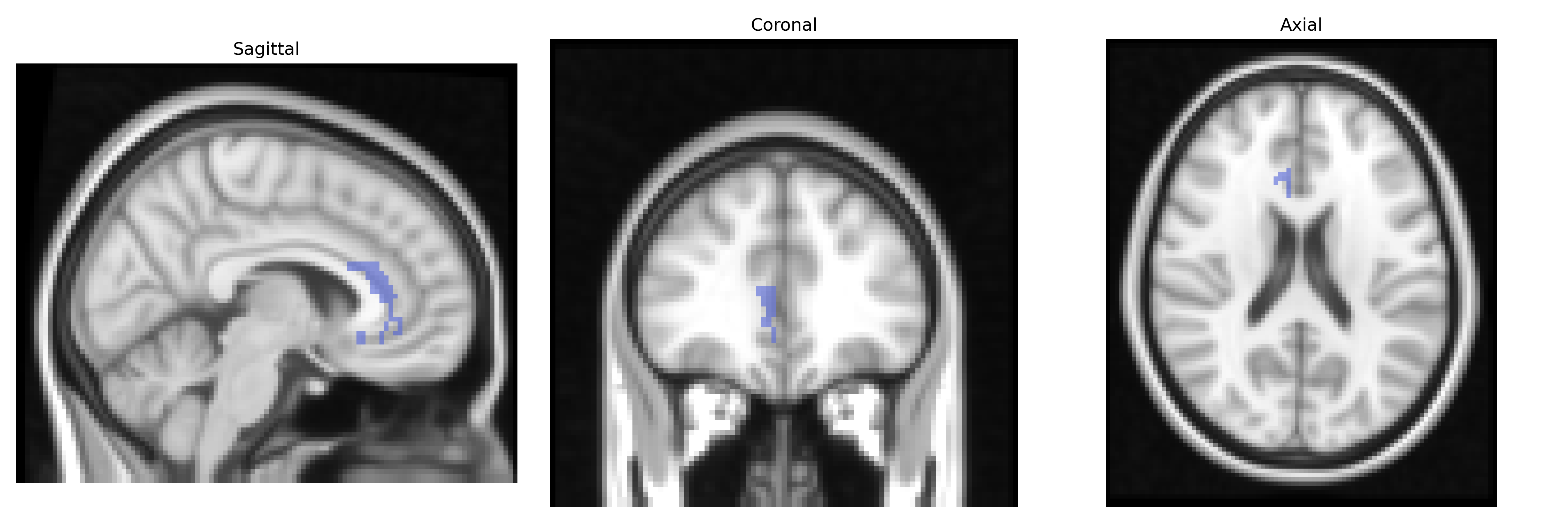
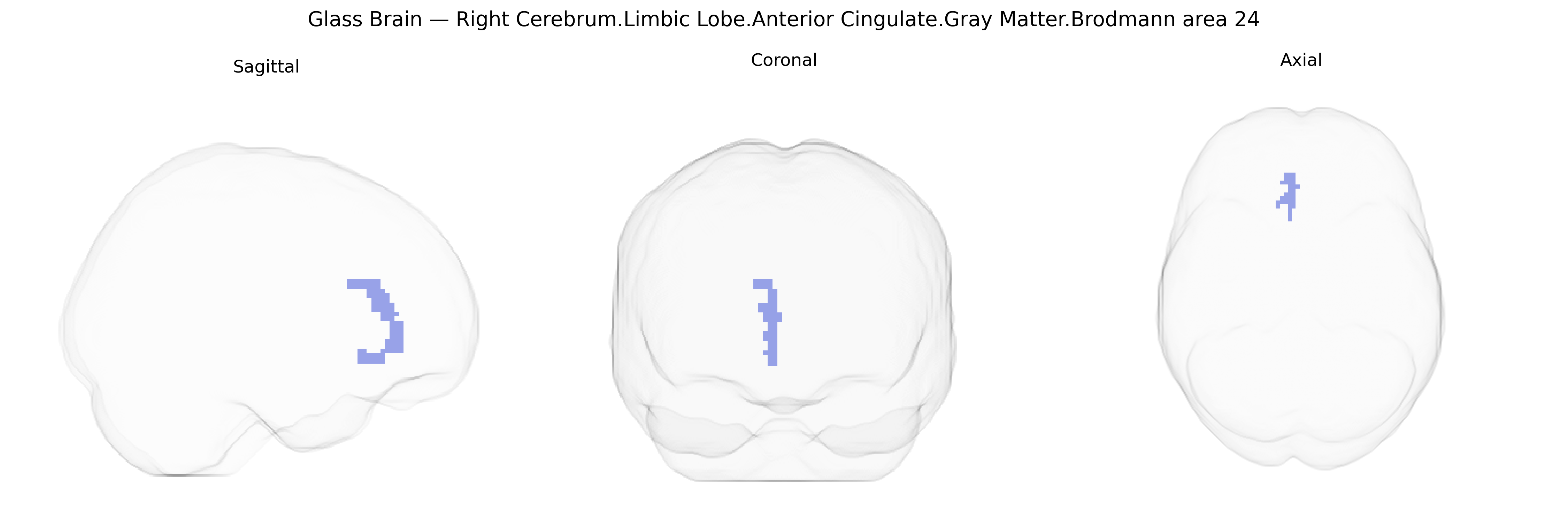
Bilateral Right Cerebrum.Limbic Lobe.Anterior Cingulate.Gray Matter.Brodmann area 24 corresponds to the anterior portion of the cingulate gyrus within the limbic lobe, situated on the medial surface of the frontal region of the cerebral cortex. Brodmann area 24 is agranular cortex involved in emotion processing, motivation, autonomic regulation, and aspects of cognitive control, integrating visceral and affective information with higher-order executive functions. Functionally, this region participates in error detection, conflict monitoring, pain affect, and modulation of autonomic responses, and is implicated in mood and anxiety disorders as well as in decision-making processes that rely on emotional valuation. This Talairach label identifies the gray matter of the anterior cingulate cortex corresponding to Brodmann’s cytoarchitectonic area 24. There is no direct link for the exact Talairach label; a closely related structure is the Anterior cingulate cortex.
The bilateral right anterior cingulate cortex (ACC; Brodmann area 24 in the limbic lobe) has been repeatedly implicated in genetic studies of psychiatric, cognitive, and pain-related traits, although most findings involve broader ACC or medial prefrontal regions rather than this exact Talairach parcel. GWAS and imaging genetics work link ACC structure and function to polygenic risk for major depressive disorder, schizophrenia, bipolar disorder, anxiety, and ADHD, with consistent associations between common variants in genes affecting glutamatergic (e.g., GRM3, GRIN2A), GABAergic, and monoaminergic transmission (e.g., SLC6A4, COMT) and ACC activation during emotion regulation, conflict monitoring, and reward processing. Variants in CACNA1C, ZNF804A, and other large-effect psychiatric GWAS loci have been associated with altered ACC connectivity within the default mode and salience networks, while ACC gray-matter volume shows heritability and polygenic correlations with depression, neuroticism, cognitive performance, and risk-taking. Pain GWAS and candidate gene studies (e.g., OPRM1, genes in inflammatory pathways) implicate ACC involvement in the affective dimension of pain and pain sensitivity. ACC abnormalities are also reported in genetic studies of obsessive–compulsive disorder and autism spectrum conditions, with risk variants influencing cortico-striatal-thalamo-cortical circuitry that includes area 24. Overall, genetic influences on ACC (including Brodmann area 24) appear highly polygenic and pleiotropic, contributing to shared vulnerability across affective, psychotic, and cognitive phenotypes rather than mapping cleanly to a single gene or disorder.
Overview generated by GPT-4o (2026).
Region ID: 470
Hemisphere: bilateral
Atlas: Talairach labels 2mm
Full Quality Version: Download MP4
Full Quality Version: Download MP4
Wali Sidiqyar*, Gaurav Rudravaram*, Elyssa M. McMaster, Trent M. Schwartz, Adam M. Saunders, Kurt G. Schilling, Bennett A. Landman "Introducing SPINS: A Shared Public Visualization Library of Neuroanatomical Structures." Medical Imaging with Deep Learning- short paper
This resource is licensed under CC0 1.0 Universal (Public Domain).