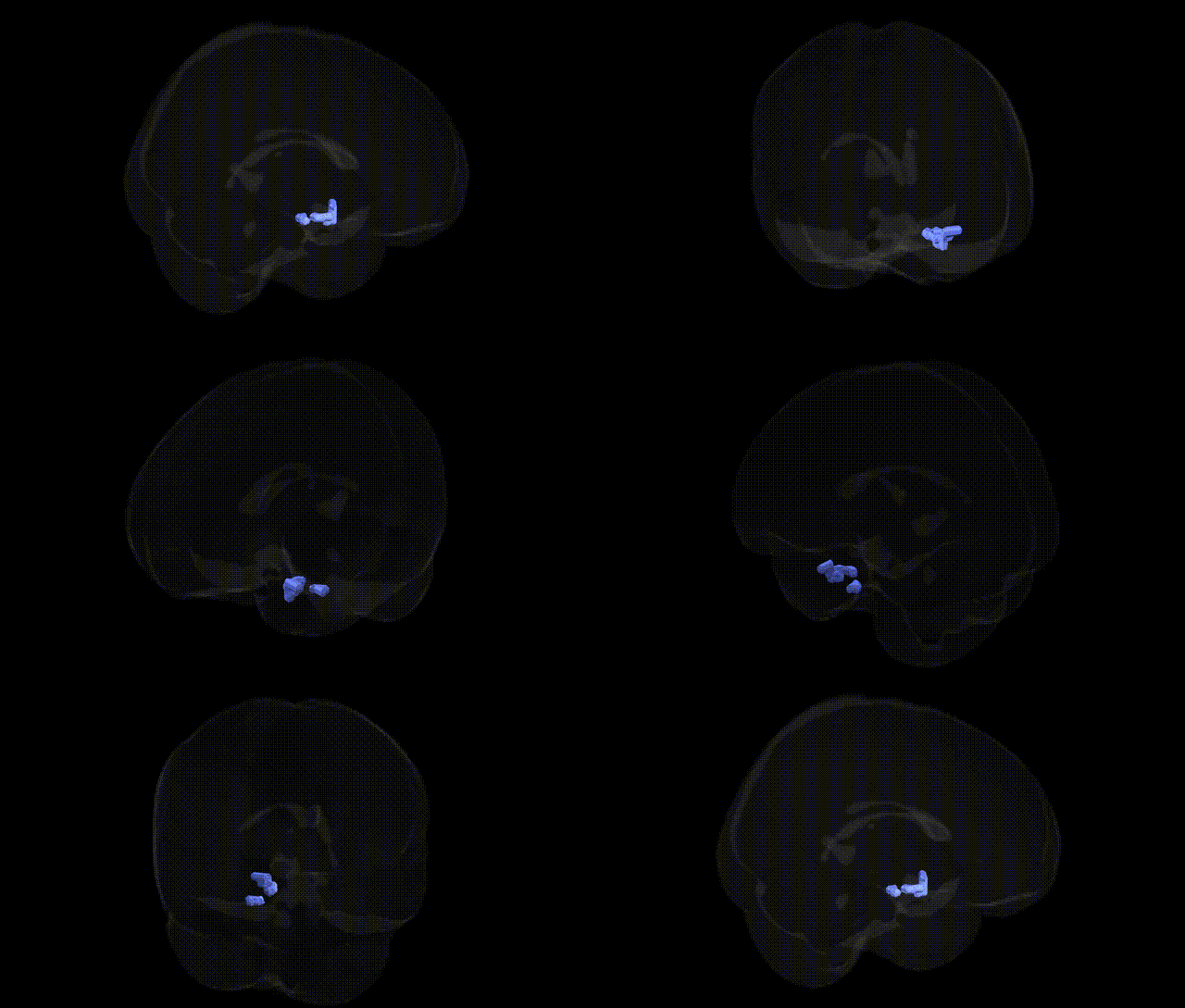
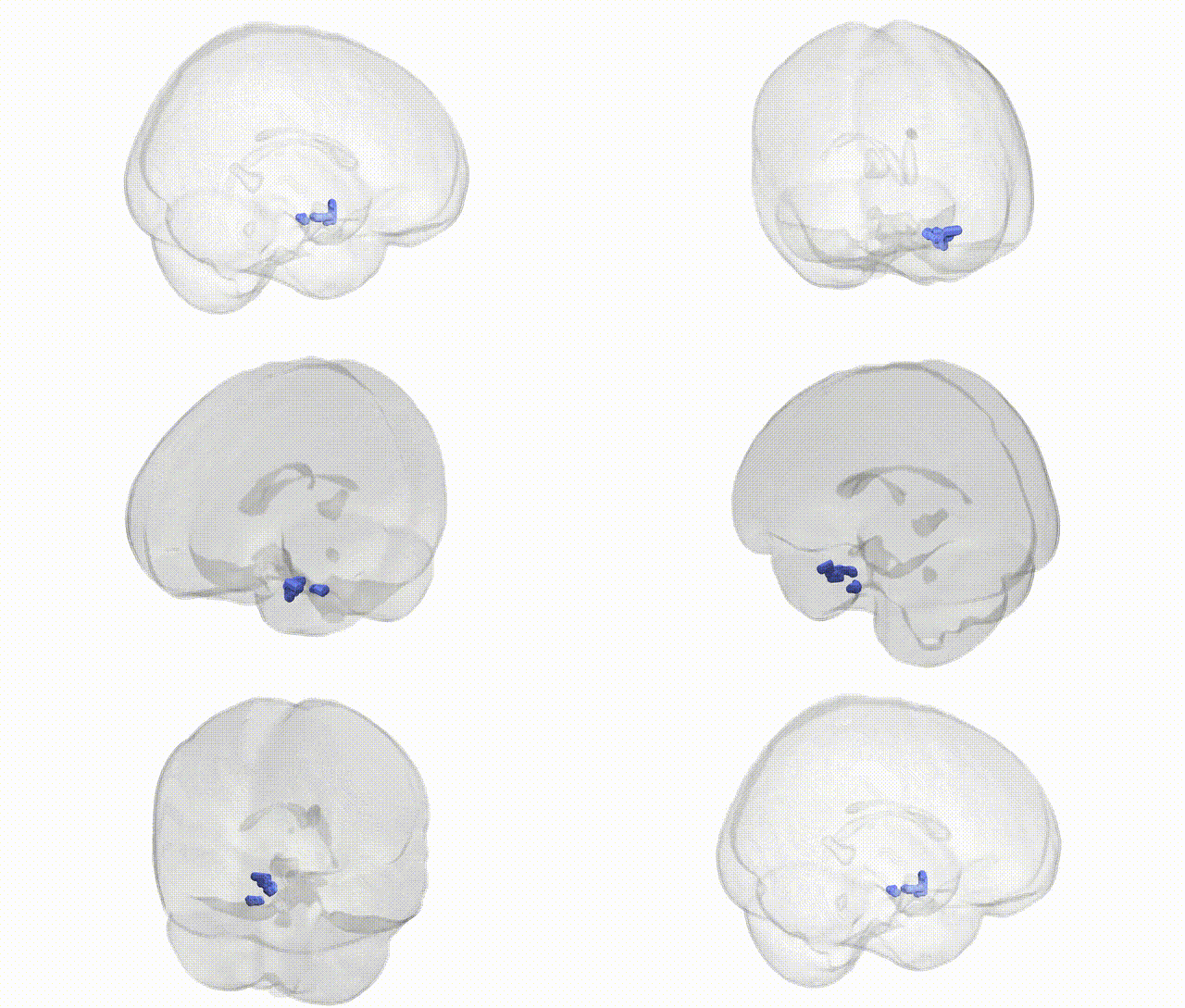
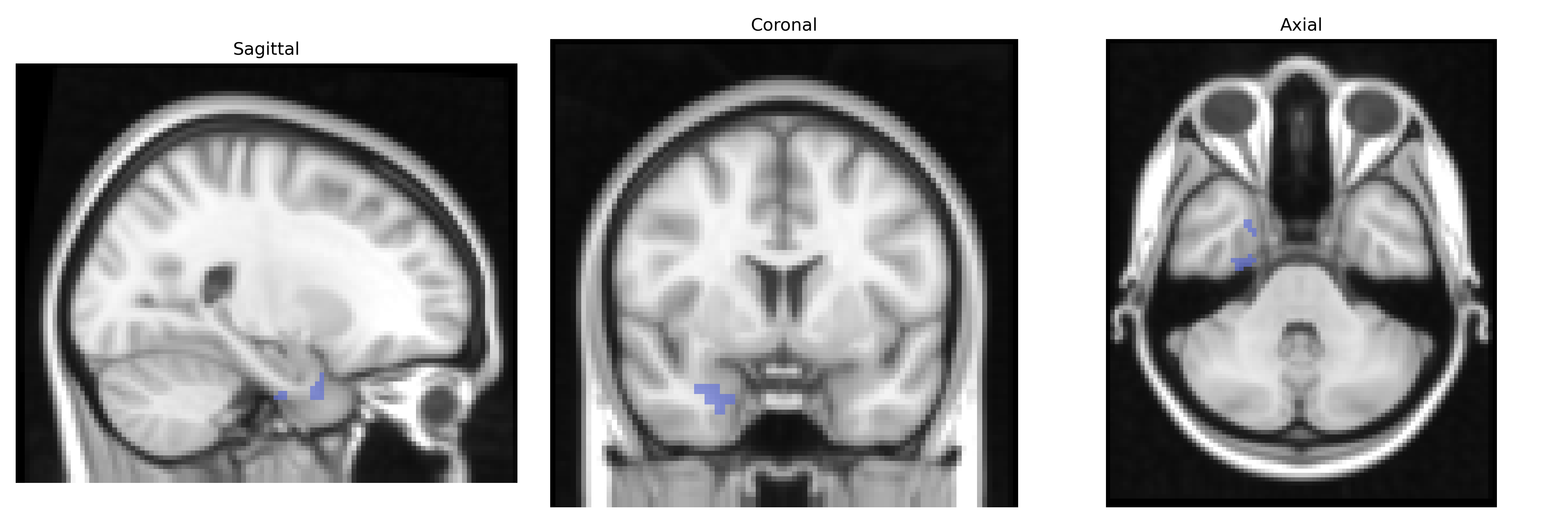
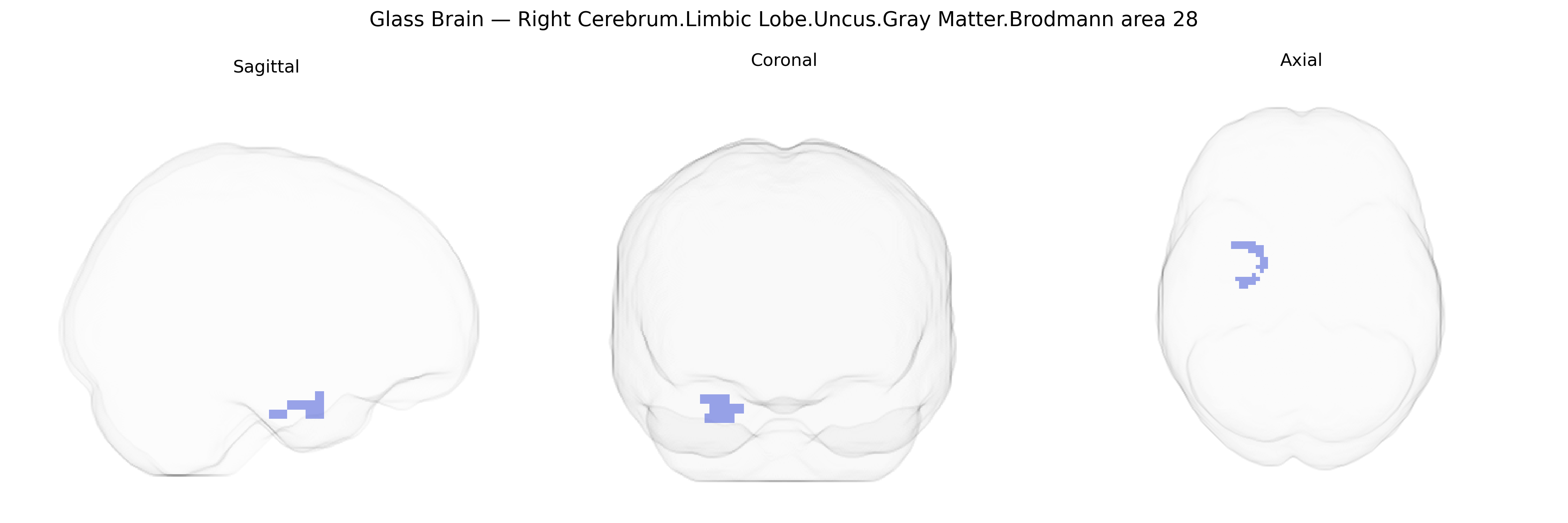
The bilateral Right Cerebrum.Limbic Lobe.Uncus.Gray Matter.Brodmann area 28 corresponds to the entorhinal cortex located in the medial temporal lobe, specifically in the anterior parahippocampal gyrus adjacent to the uncus. Brodmann area 28 is a key component of the limbic system and serves as a major interface between neocortical association areas and the hippocampal formation, relaying multimodal sensory information crucial for episodic memory and spatial navigation. Cytoarchitectonically, it is characterized by a distinct laminar organization with relatively simple, densely packed layers compared to neighboring neocortex, reflecting its transitional allocortical nature. Functionally, this region participates in memory encoding and consolidation, familiarity processing, and temporal association of events, and it is notably vulnerable to early pathological changes in neurodegenerative conditions such as Alzheimer’s disease.
Entorhinal cortex
The bilateral right cerebrum limbic lobe uncus (Brodmann area 28, roughly corresponding to entorhinal cortex/parahippocampal region) is a key medial temporal structure whose gray matter volume, thickness, and functional activity have been repeatedly implicated in genetic studies of memory, neurodegeneration, and psychiatric disease. Large GWAS of brain imaging phenotypes (e.g., ENIGMA, UK Biobank) have identified common variants near genes involved in synaptic function and neurodevelopment—such as BDNF, CLU, BIN1, APOE, and TREM2—that are associated with entorhinal/parahippocampal cortex morphology and vulnerability to Alzheimer’s disease, consistent with this region’s role as an early site of tau and amyloid pathology. Risk alleles for Alzheimer’s disease and other dementias show robust effects on cortical thinning and volume loss in BA28-related territories, and polygenic risk scores for Alzheimer’s and cognitive decline correlate with structural changes in this region. Additional GWAS and candidate-gene studies link variation in genes such as COMT, GRIN2B, and DISC1 to limbic and medial temporal alterations associated with schizophrenia, major depression, and anxiety phenotypes, with some imaging-genetics work specifically highlighting parahippocampal and entorhinal abnormalities. Moreover, genetic influences on episodic memory, spatial navigation, and olfactory processing—traits that rely heavily on entorhinal/uncal circuitry—have been traced to polymorphisms in neuroplasticity-related genes (including BDNF Val66Met), which modulate activation and structural measures in BA28-adjacent regions during memory tasks. Overall, imaging-genetics and GWAS findings converge on the uncus/BA28 area as a genetically sensitive hub for neurodegenerative risk, memory-related traits, and limbic contributions to psychiatric disorders.
Overview generated by GPT-4o (2026).
Region ID: 95
Hemisphere: bilateral
Atlas: Talairach labels 2mm
Full Quality Version: Download MP4
Full Quality Version: Download MP4
Wali Sidiqyar*, Gaurav Rudravaram*, Elyssa M. McMaster, Trent M. Schwartz, Adam M. Saunders, Kurt G. Schilling, Bennett A. Landman "Introducing SPINS: A Shared Public Visualization Library of Neuroanatomical Structures." Medical Imaging with Deep Learning- short paper
This resource is licensed under CC0 1.0 Universal (Public Domain).