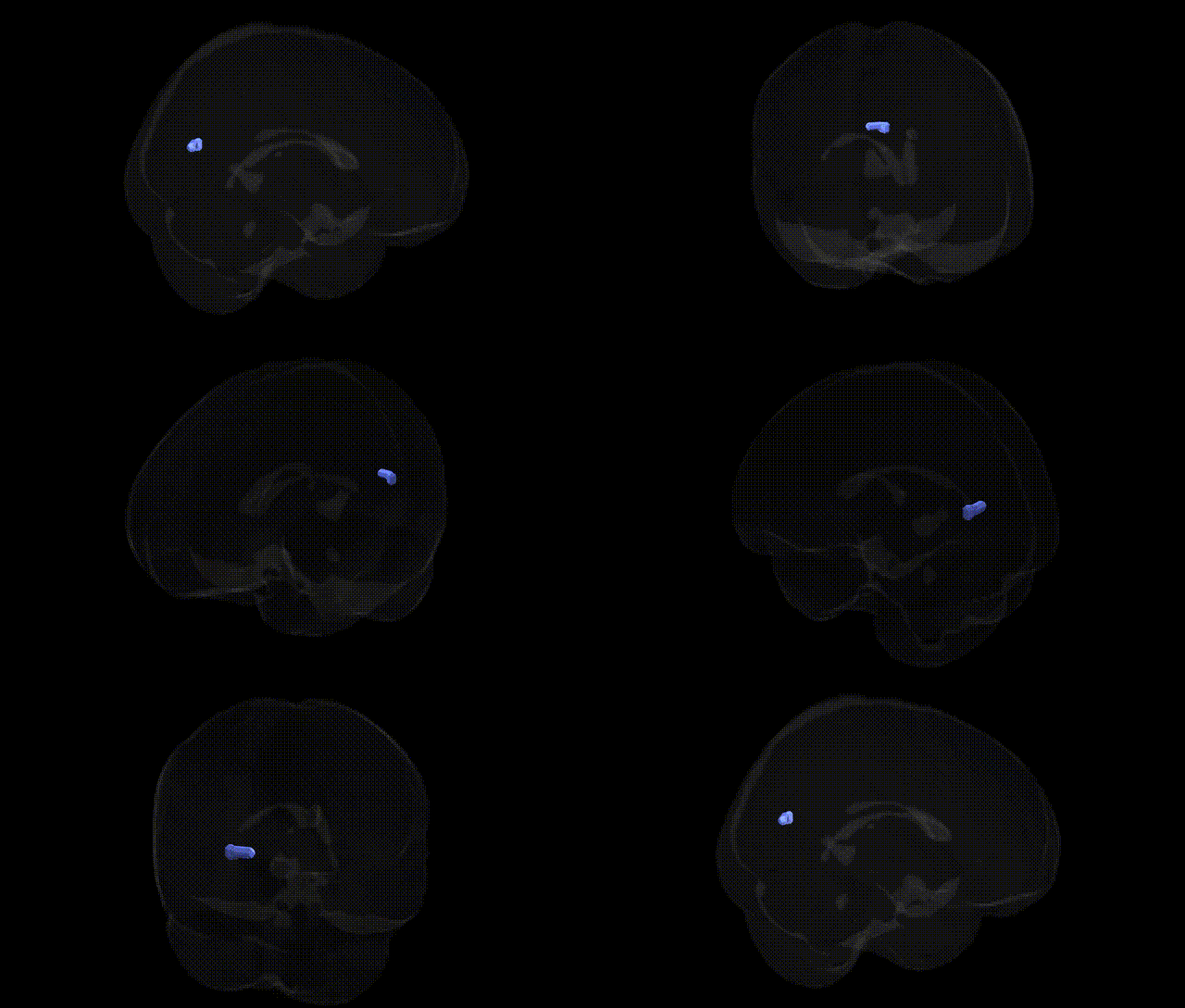
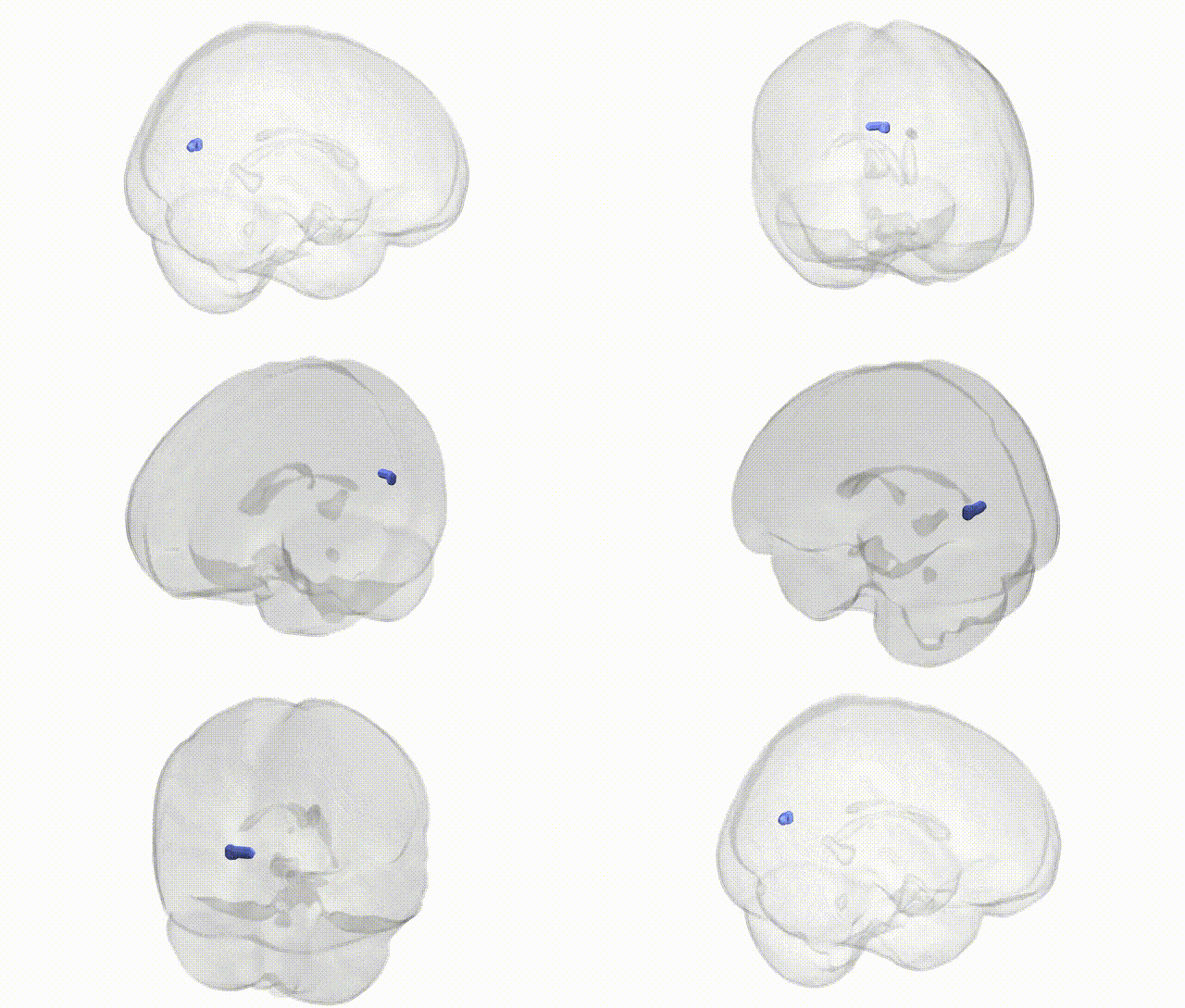
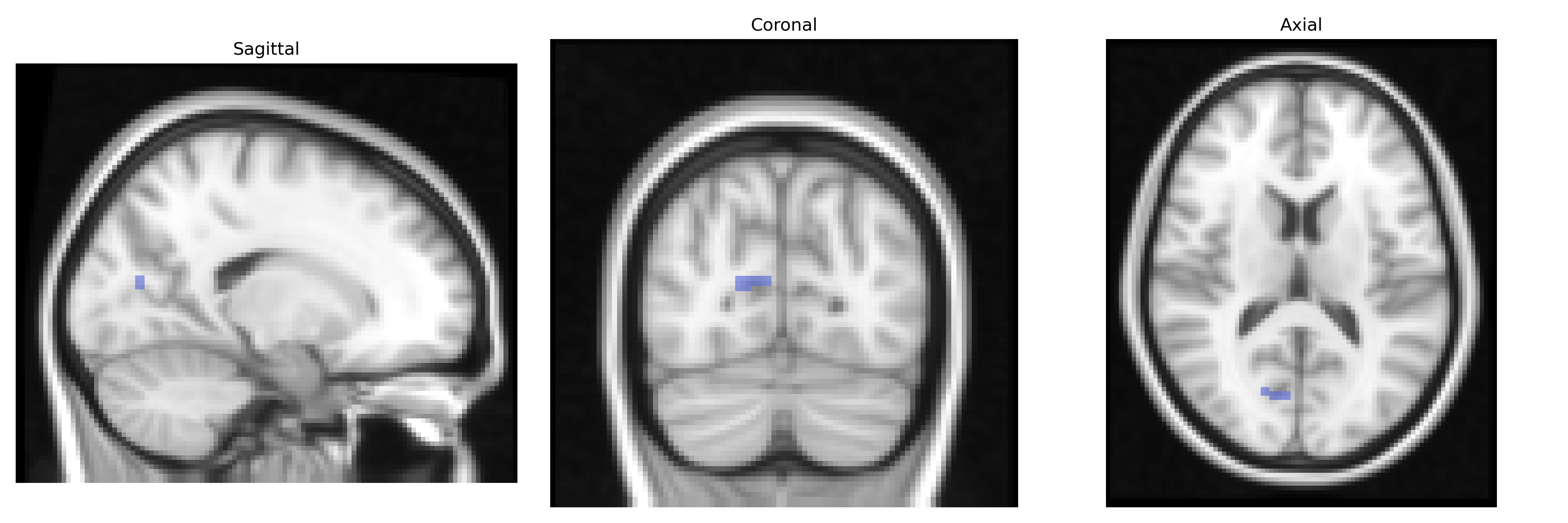
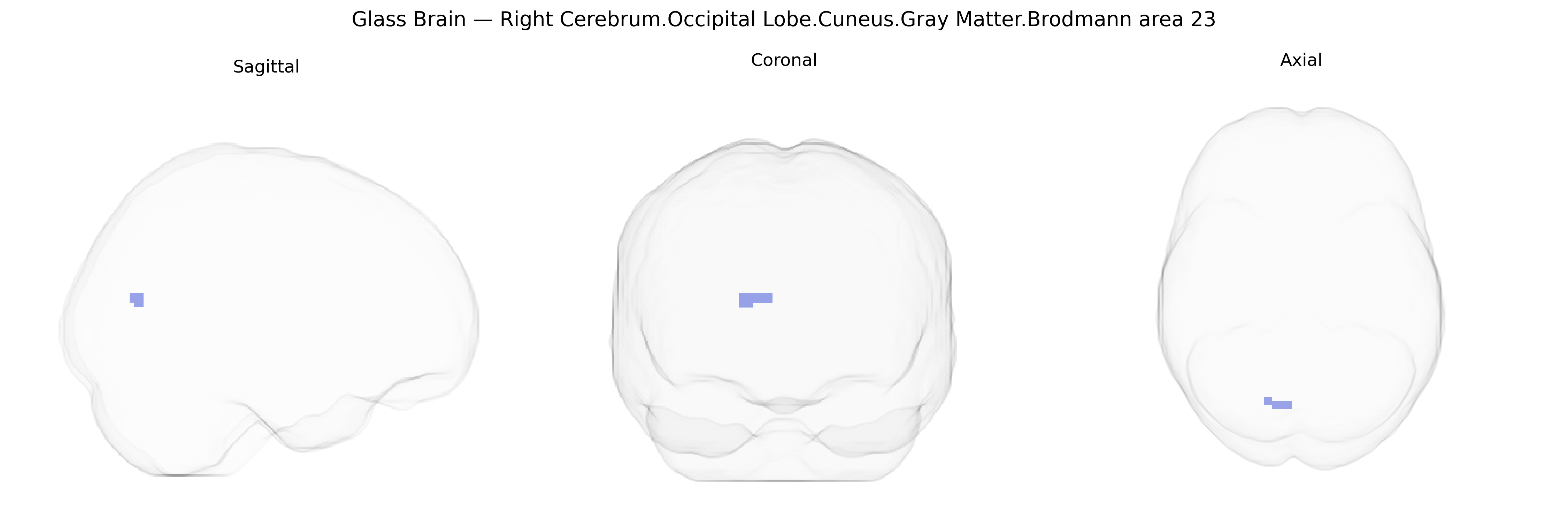
Bilateral Right Cerebrum.Occipital Lobe.Cuneus.Gray Matter.Brodmann area 23 corresponds to gray matter lying in the cuneus of the occipital lobe on the right side, within the Talairach 2 mm atlas labeling system, but functionally BA23 is classically defined in the ventral posterior cingulate cortex of the limbic lobe rather than the occipital cuneus. Brodmann area 23 is part of the posterior cingulate and retrosplenial region, strongly implicated in internally directed cognition, autobiographical memory, emotional processing, and default mode network activity, with extensive connectivity to the hippocampal formation, medial prefrontal cortex, and parietal association areas. In neuroimaging studies, activation of BA23 is frequently associated with tasks involving self-referential thought, episodic memory retrieval, and evaluation of emotional salience, and it plays a role in large-scale network dynamics altered in conditions such as Alzheimer’s disease, depression, and disorders of consciousness. There is no direct Wikipedia article for “Brodmann area 23,” but it is contained within the Posterior cingulate cortex.
The bilateral right cuneus gray matter (Brodmann area 23 in the Talairach 2 mm atlas, though BA23 is classically posterior cingulate and adjacent medial occipital) is part of the medial occipital/visual cortex and has been implicated in several genetic and GWAS findings through its role in visual processing, attention, and higher-order integration. Large neuroimaging GWAS (e.g., ENIGMA, UK Biobank) have identified common variants in genes such as HMGA2, IGF1, MAPT, and others associated with occipital and cuneus cortical thickness, surface area, and volume, linking this region to general brain development and cognitive performance. Polygenic risk for schizophrenia, major depressive disorder, bipolar disorder, and ADHD has been associated with structural and functional alterations in the cuneus, suggesting that genetic liability for these disorders partly manifests through visual and default-mode–network–related regions. APOE ε4 and other Alzheimer’s disease risk variants have been tied to early changes in posterior cortical areas including cuneus/posterior cingulate, reflecting vulnerability of this region in neurodegeneration. GWAS of traits such as intelligence, educational attainment, and visual perception/acuity show enrichment in networks that involve the cuneus, with implicated genes commonly related to synaptic function, neuronal migration, and myelination. Although few studies target the Talairach-defined “BA23 cuneus” label specifically, convergent genetic evidence points to this medial occipital territory as a locus where neurodevelopmental, neurodegenerative, and psychiatric risk variants affect cortical structure and connectivity.
Overview generated by GPT-4o (2026).
Region ID: 707
Hemisphere: bilateral
Atlas: Talairach labels 2mm
Full Quality Version: Download MP4
Full Quality Version: Download MP4
Wali Sidiqyar*, Gaurav Rudravaram*, Elyssa M. McMaster, Trent M. Schwartz, Adam M. Saunders, Kurt G. Schilling, Bennett A. Landman "Introducing SPINS: A Shared Public Visualization Library of Neuroanatomical Structures." Medical Imaging with Deep Learning- short paper
This resource is licensed under CC0 1.0 Universal (Public Domain).