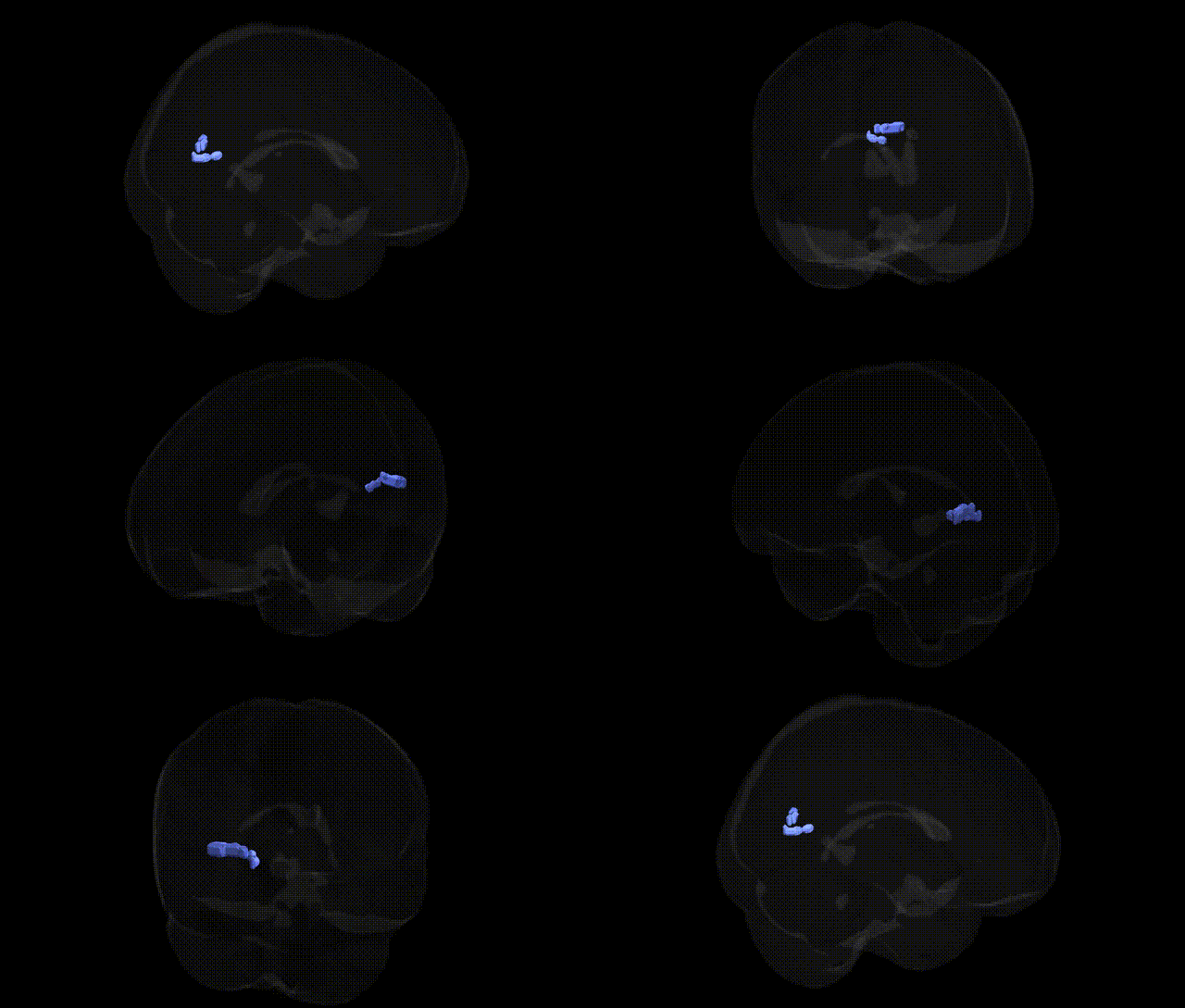
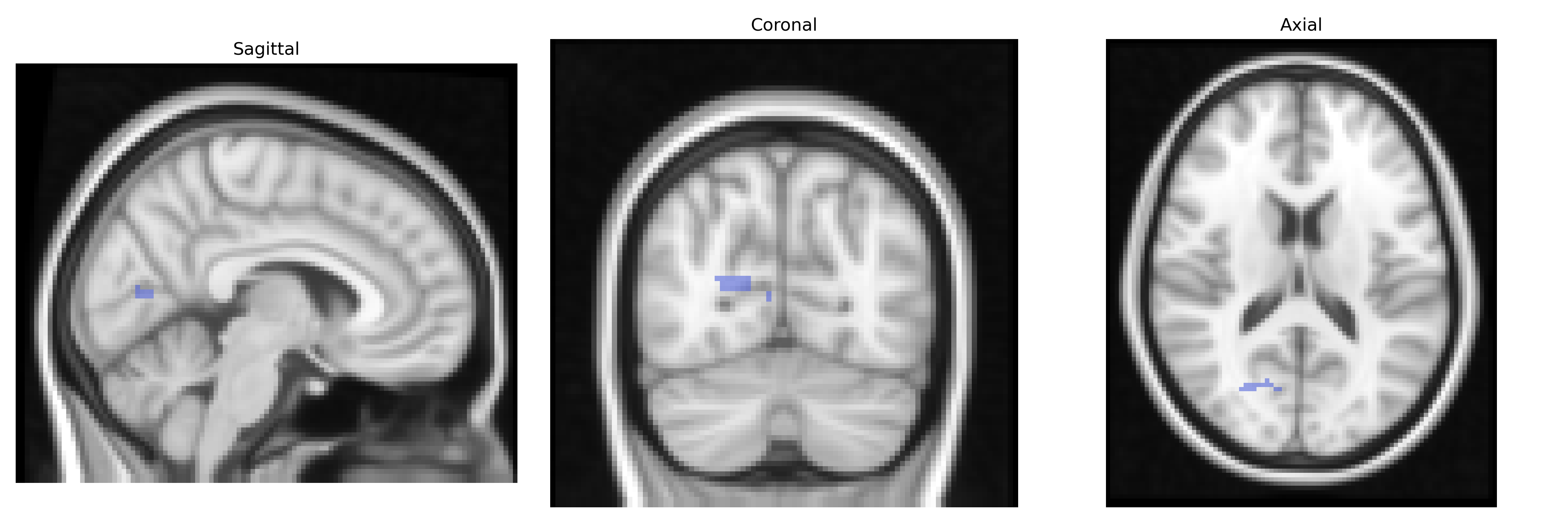
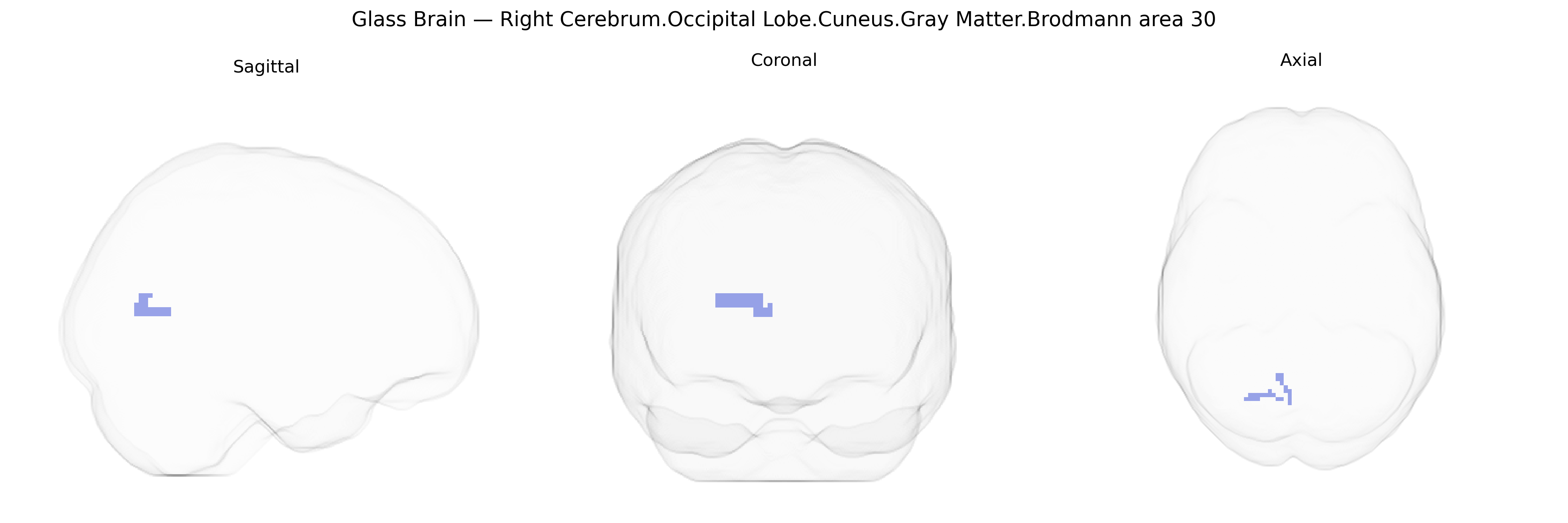
The bilateral Right Cerebrum.Occipital Lobe.Cuneus.Gray Matter.Brodmann area 30 corresponds to a retrosplenial cortical region situated in the medial occipital cortex, extending around the cuneus and adjacent posterior cingulate areas. Brodmann area 30 is part of the retrosplenial cortex, implicated in visuospatial processing, scene and contextual memory, navigation, and the integration of visual information with limbic and mnemonic networks. It contributes to the default mode and memory-related networks by connecting occipital visual areas with medial temporal and posterior cingulate structures, and shows activation in tasks involving spatial orientation, autobiographical memory, and environmental familiarity. There is no direct link for Brodmann area 30; a related structure is Retrosplenial cortex.
The bilateral Right Cerebrum Occipital Lobe Cuneus Gray Matter Brodmann area 30 (BA30), a retrosplenial/medial occipital region involved in visuospatial processing, memory, and scene construction, has been implicated in several genetic and GWAS-based findings, although most studies reference broader cuneus or retrosplenial areas rather than BA30 specifically. Large neuroimaging GWAS (e.g., ENIGMA, UK Biobank) have identified multiple loci influencing cortical thickness and surface area in the cuneus/medial occipital cortex, including variants near genes involved in synaptic development and neurogenesis (such as MIR137, CENPW, and others), some of which overlap with risk loci for schizophrenia, bipolar disorder, and major depressive disorder. Structural and functional abnormalities in this region have been repeatedly reported in carriers of APOE ε4 and other Alzheimer’s disease–related variants, consistent with retrosplenial/BA30 involvement in early AD-related hypometabolism and connectivity disruption. GWAS of visual and cognitive traits (e.g., general cognitive ability, educational attainment, and episodic memory) show polygenic overlap with genes influencing medial occipital and posterior cingulate/retrosplenial morphology and activation, suggesting that genetic architectures shaping BA30 structure and function contribute to higher-order visuospatial and mnemonic phenotypes. Additionally, disorders with known genetic loading—including schizophrenia, autism spectrum disorder, and PTSD—have shown altered activation or connectivity in the cuneus/BA30 region in imaging–genetics studies, though these associations are typically mediated by distributed polygenic risk rather than single-gene effects and are not yet specific to BA30 at fine-grained Talairach 2 mm resolution.
Overview generated by GPT-4o (2026).
Region ID: 661
Hemisphere: bilateral
Atlas: Talairach labels 2mm
Full Quality Version: Download MP4
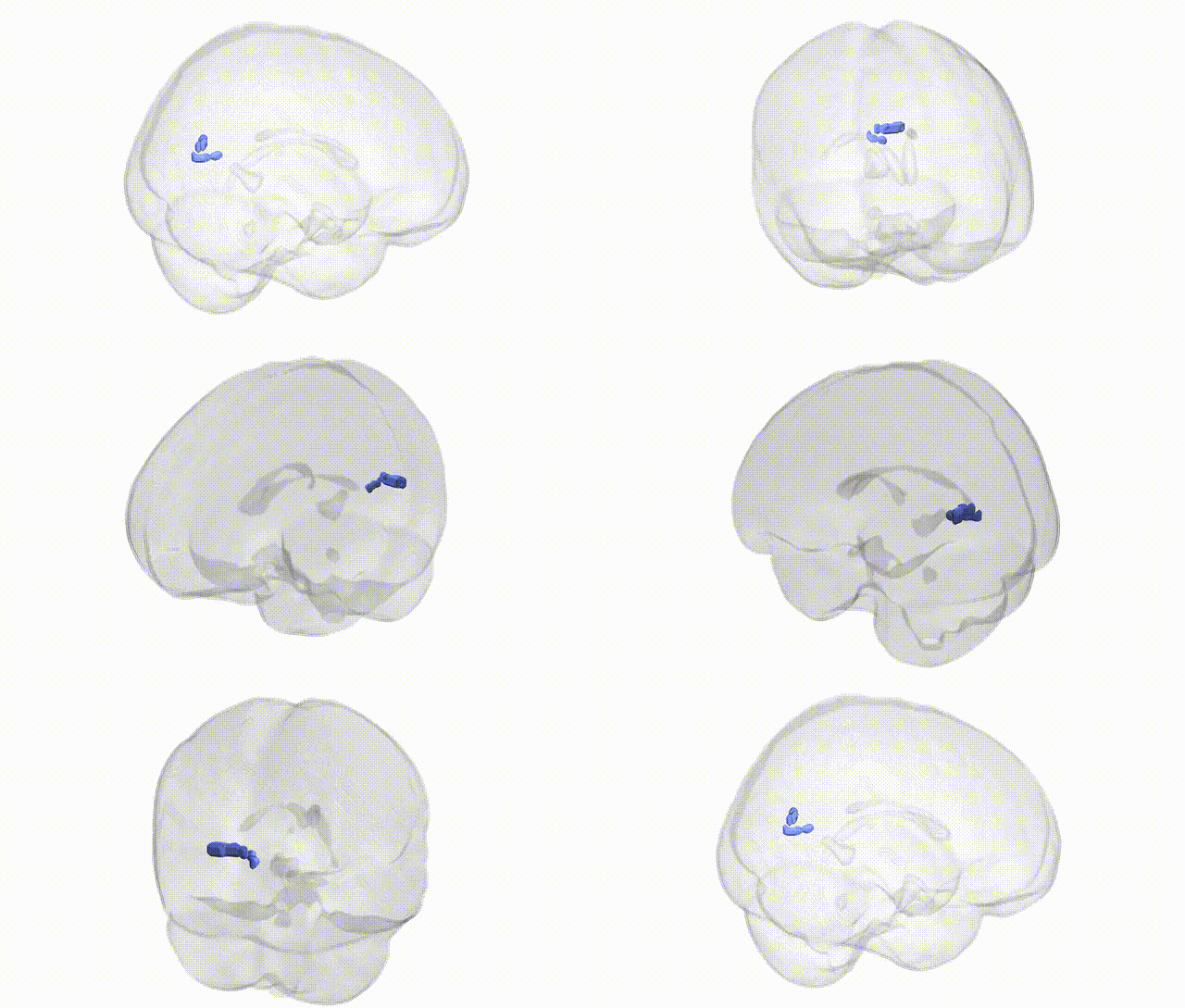
Full Quality Version: Download MP4
Wali Sidiqyar*, Gaurav Rudravaram*, Elyssa M. McMaster, Trent M. Schwartz, Adam M. Saunders, Kurt G. Schilling, Bennett A. Landman "Introducing SPINS: A Shared Public Visualization Library of Neuroanatomical Structures." Medical Imaging with Deep Learning- short paper
This resource is licensed under CC0 1.0 Universal (Public Domain).