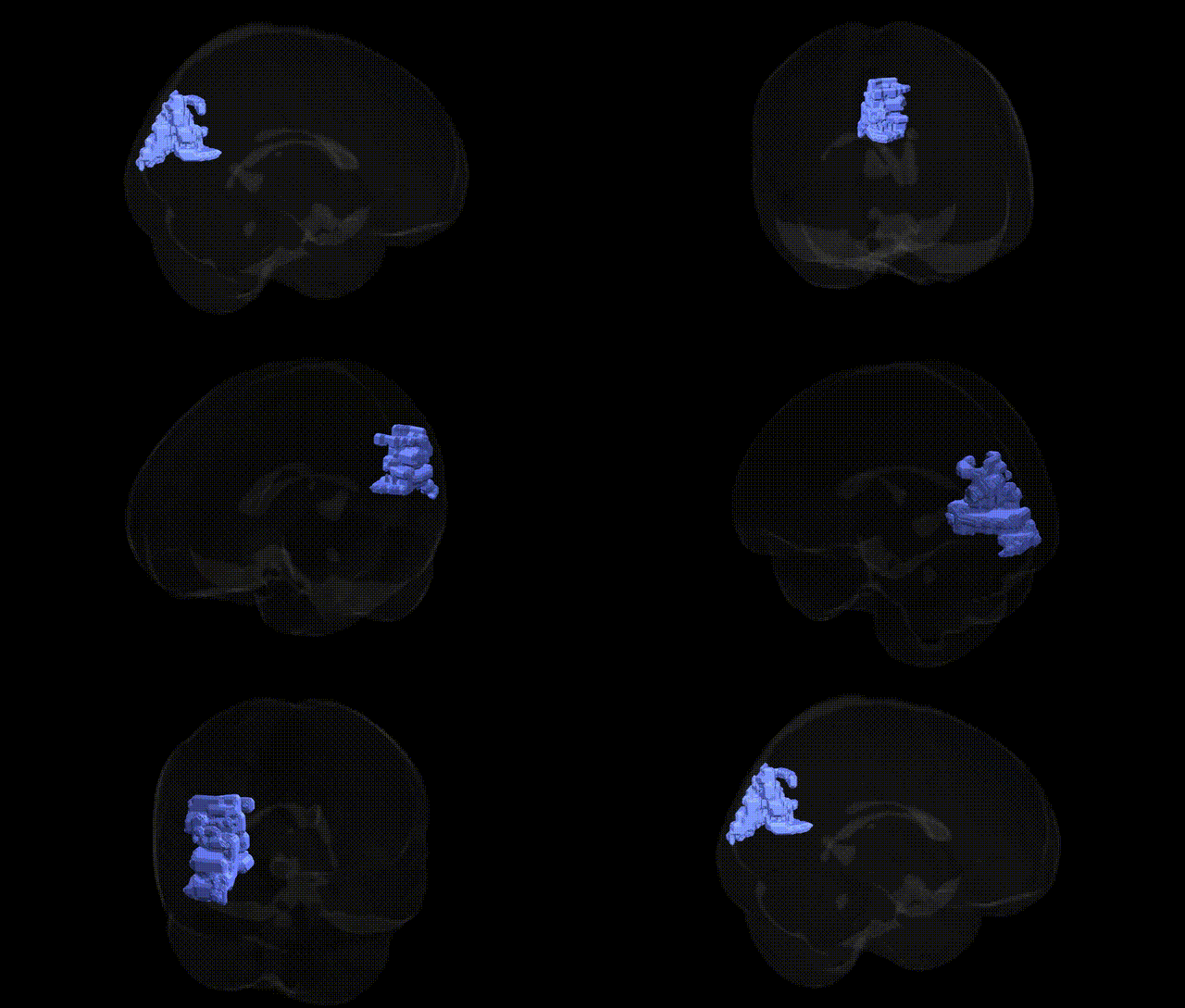
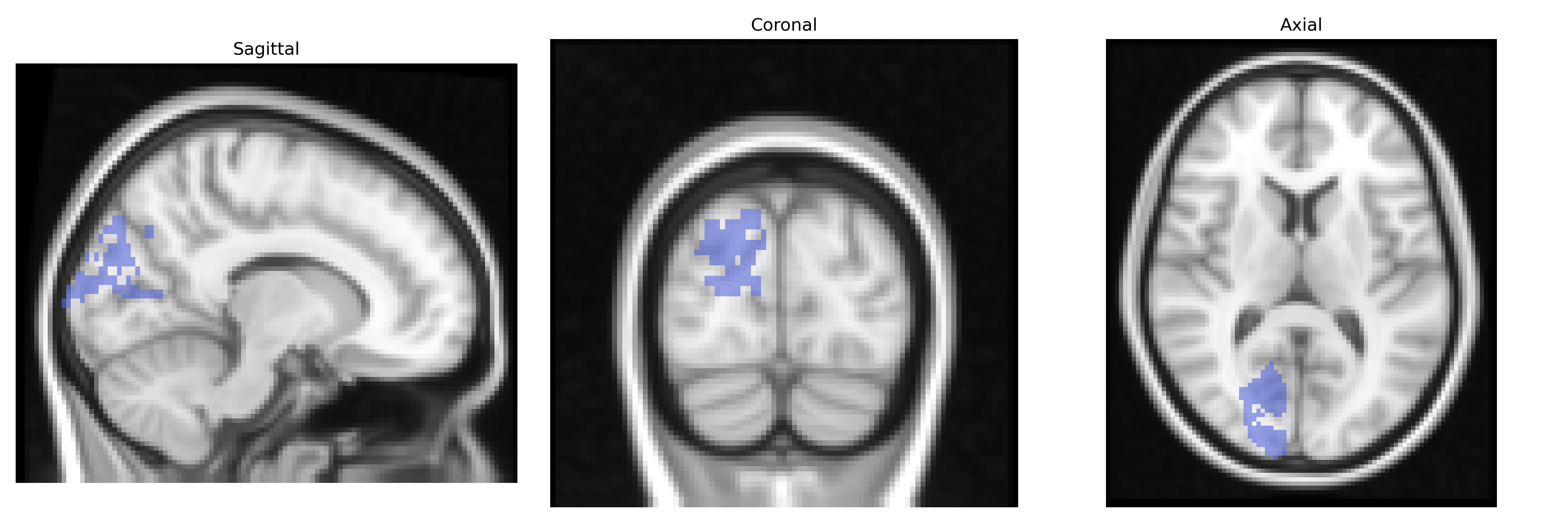
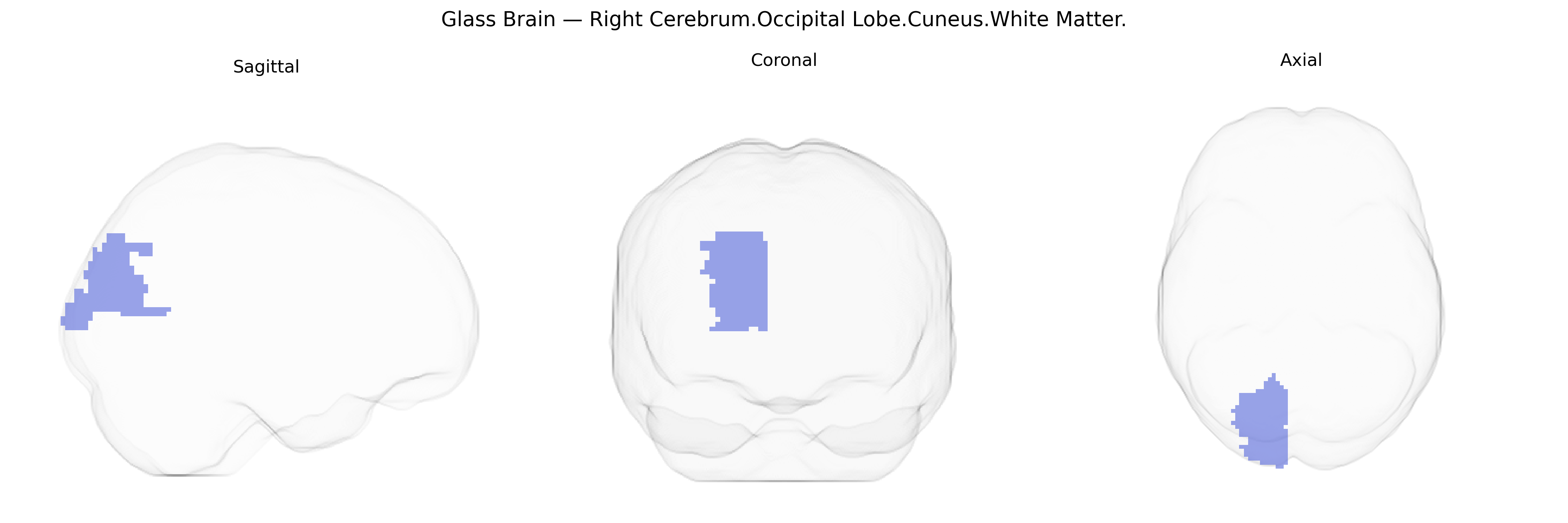
The bilateral Right Cerebrum.Occipital Lobe.Cuneus.White Matter corresponds to the subcortical fiber systems underlying the cuneus region of the occipital lobe, situated on the medial surface of the cerebral hemisphere above the calcarine sulcus. This white matter comprises association, projection, and commissural fibers that interconnect primary and secondary visual cortices with other occipital, parietal, and temporal areas, supporting integration and transmission of visual information related to basic visual processing, visuospatial analysis, and higher-order visual perception. As part of the occipital white matter, it contributes to the integrity of large-scale visual networks, including pathways linking the cuneus to dorsal visual stream structures involved in spatial orientation and motion processing. There is no direct Wikipedia article for this specific white matter subdivision; a related cortical region is the Cuneus.
The bilateral right cerebrum occipital lobe cuneus white matter, as defined in the Talairach 2 mm atlas, lies within the dorsal medial occipital cortex and participates in visual processing, visuospatial integration, and higher-order perceptual functions; genetic associations to this region emerge largely from imaging genetics and GWAS of brain structure and function rather than region-specific candidate studies. Large neuroimaging GWAS (e.g., ENIGMA, UK Biobank) have linked common variants in genes influencing axonal development, myelination, and synaptic organization (such as CNTNAP2, NRG3, and multiple loci near oligodendrocyte-related genes) to occipital white matter volumes and diffusion MRI measures (FA, MD) that include the cuneus region. Polygenic risk scores for schizophrenia, bipolar disorder, and major depressive disorder show associations with altered occipital and cuneus white matter microstructure, suggesting shared genetic architectures affecting visual and cognitive networks, while autism spectrum disorder risk variants and genes involved in synaptic plasticity (e.g., SHANK3-related pathways) have been associated with atypical occipital connectivity that encompasses cuneus white matter. GWAS of visual processing, reading ability, and cognitive traits (general intelligence, processing speed) have reported correlations between associated loci (including variants near HMGA2, FOXO3, and other neurodevelopmental genes) and structural metrics in occipital regions, including cuneus white matter, although these effects are dispersed and not specific to a single Talairach-defined parcel. Overall, genetic influences on this region reflect broad neurodevelopmental, myelination, and connectivity-related pathways rather than known single-gene effects, with its involvement observed across psychiatric, cognitive, and sensory traits in large-scale imaging genetic studies.
Overview generated by GPT-4o (2026).
Region ID: 486
Hemisphere: bilateral
Atlas: Talairach labels 2mm
Full Quality Version: Download MP4
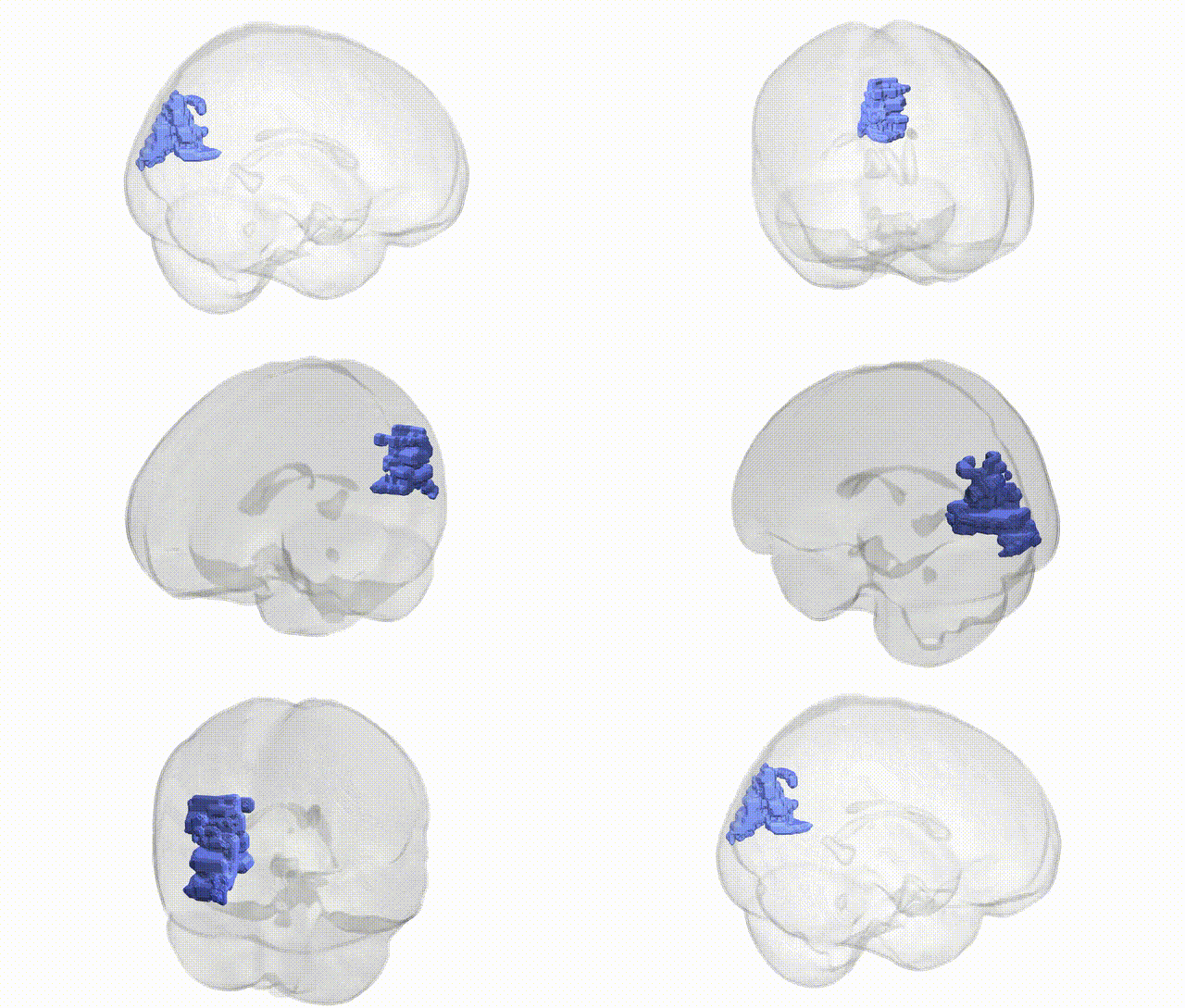
Full Quality Version: Download MP4
Wali Sidiqyar*, Gaurav Rudravaram*, Elyssa M. McMaster, Trent M. Schwartz, Adam M. Saunders, Kurt G. Schilling, Bennett A. Landman "Introducing SPINS: A Shared Public Visualization Library of Neuroanatomical Structures." Medical Imaging with Deep Learning- short paper
This resource is licensed under CC0 1.0 Universal (Public Domain).