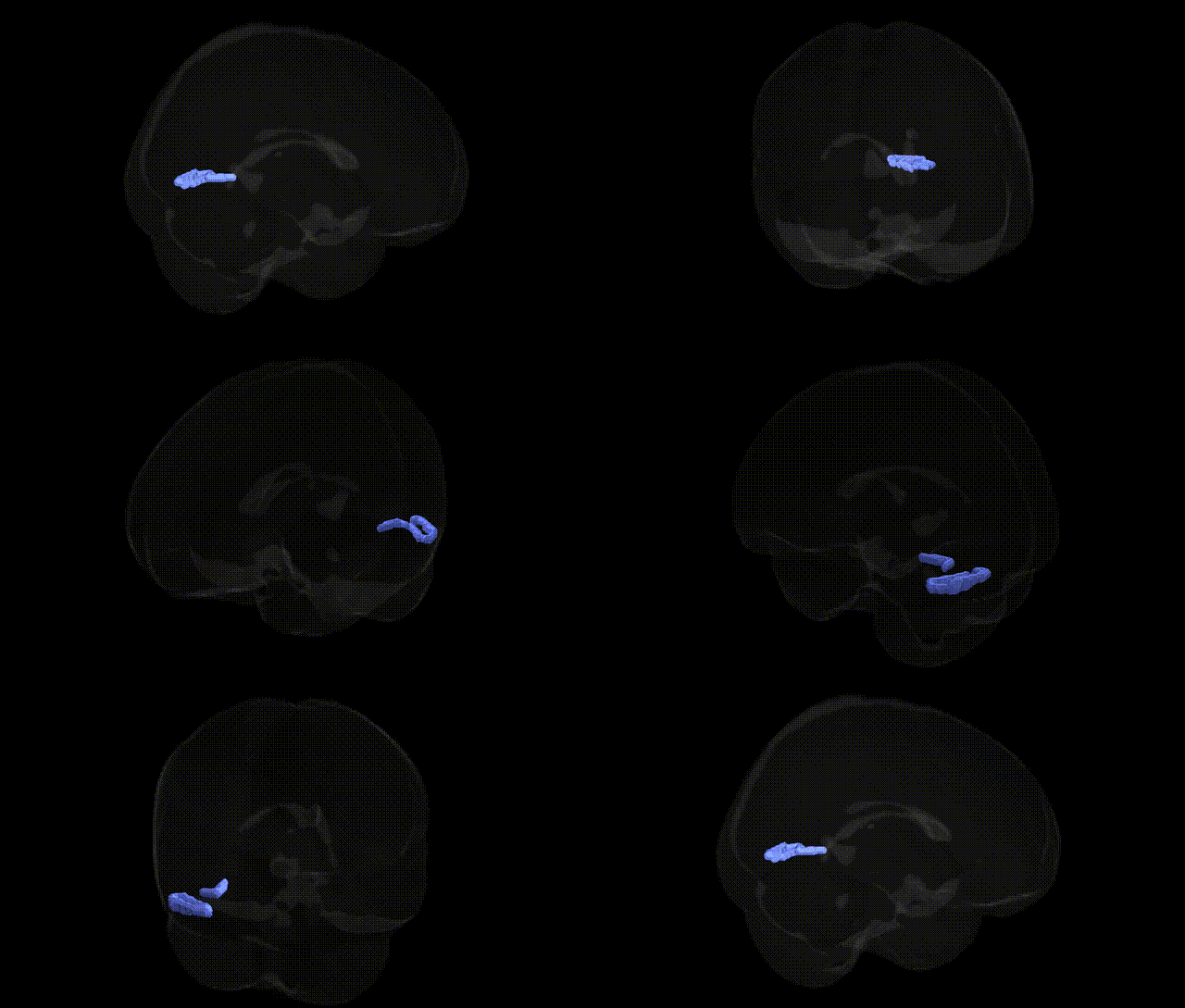
The bilateral Right Cerebrum.Occipital Lobe.Fusiform Gyrus.Gray Matter.Brodmann area 19 corresponds to associative visual cortex located in the fusiform portion of the occipital lobe, involved in higher-order processing and integration of visual information. As part of Brodmann area 19, this region participates in complex visual tasks such as form and pattern analysis, visual feature integration, and contributes to the processing streams that support object recognition and visual perception. Neuronal populations in this gray matter territory receive inputs from primary and secondary visual areas and relay processed information to temporal and parietal cortices, helping to construct coherent visual representations from raw retinal input. There is no direct Wikipedia article for this exact composite region; a closely related entry is Brodmann area 19.
The bilateral right occipital fusiform region corresponding to Brodmann area 19 (as defined in the Talairach 2 mm Atlas) lies within the occipitotemporal visual association cortex and overlaps the broader fusiform and lateral occipital areas that have been repeatedly implicated in genetic studies of visual processing, face perception, reading, and higher-order cognition. Large-scale GWAS and imaging‑genetics studies (e.g., UK Biobank and ENIGMA consortia) have identified multiple common variants associated with fusiform and lateral occipital cortical thickness, surface area, and gray‑matter volume, including loci near genes involved in neurodevelopment (such as PAX6, TBR1/TBR2-related pathways, BDNF, and other synaptic or axon‑guidance genes), although specific fine-mapped associations to BA19 subregions are still imprecise. Genetic influences on face‑selective fusiform activation have been demonstrated in twin and family studies, and susceptibility loci for developmental prosopagnosia and social perception traits have been reported in or near genes regulating posterior temporal and occipital development, indirectly implicating this area. Variants linked to dyslexia and reading-related traits (e.g., near DCDC2, KIAA0319) have been associated with altered structure and function of the occipitotemporal “visual word form” network, which often extends into BA19 territory. In psychiatric and neurodevelopmental GWAS, risk alleles for autism spectrum disorder, schizophrenia, and major depression show downstream effects on occipitotemporal and fusiform morphology or connectivity, with several polygenic risk scores correlating with reduced volume or altered activation in BA19-adjacent regions during visual, social, or language tasks. Neurodegenerative GWAS (e.g., for posterior cortical atrophy and atypical Alzheimer’s presentations) and studies of heritable migraine and visual aura also report structural and functional changes in right occipital association cortex, suggesting that genetic variation affecting visual association networks contributes to vulnerability in this region, although explicit, region‑specific BA19 genetic loci remain incompletely characterized and are typically subsumed within broader occipitotemporal or fusiform genetic signals.
Overview generated by GPT-4o (2026).
Region ID: 259
Hemisphere: bilateral
Atlas: Talairach labels 2mm
Full Quality Version: Download MP4
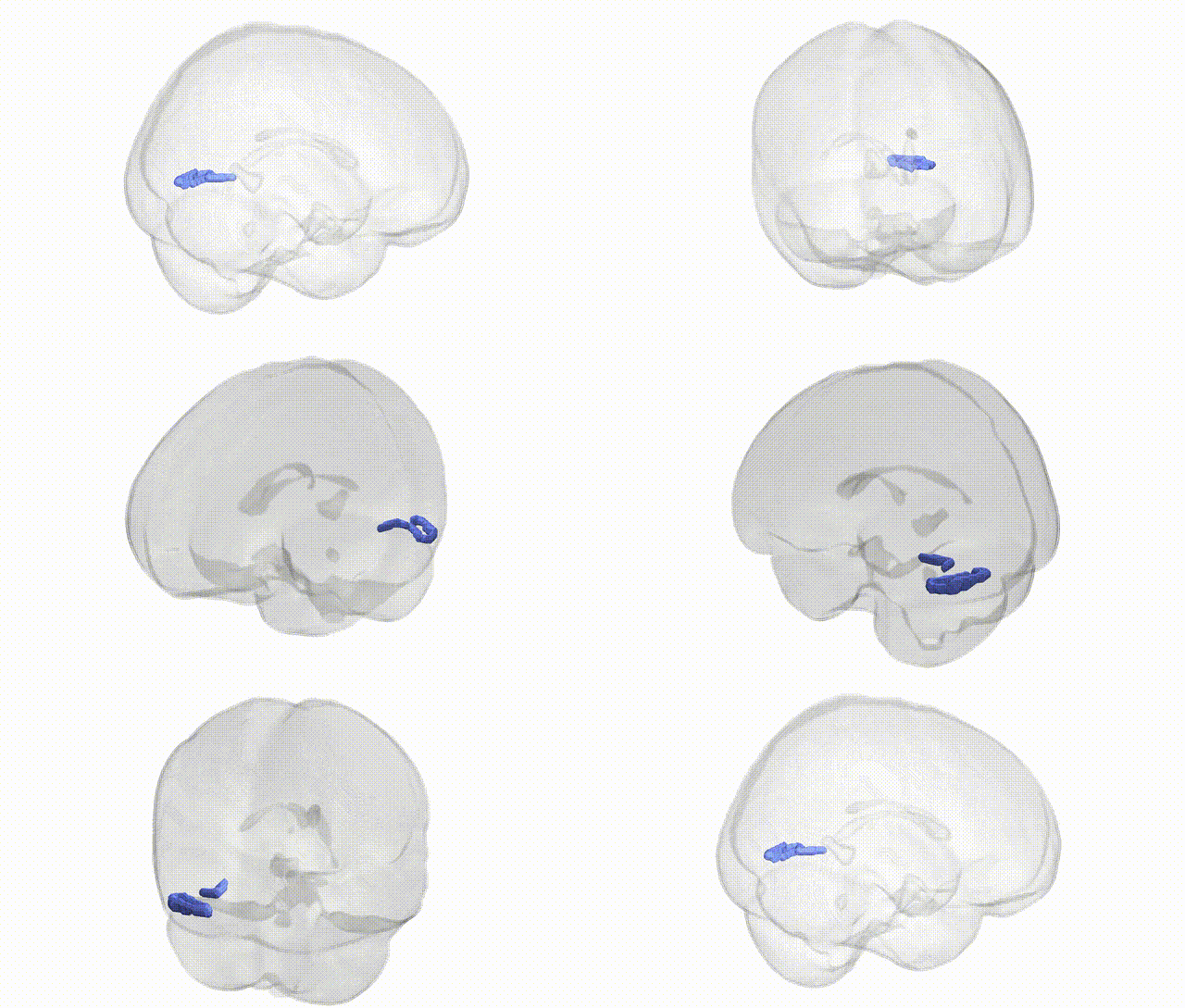
Full Quality Version: Download MP4
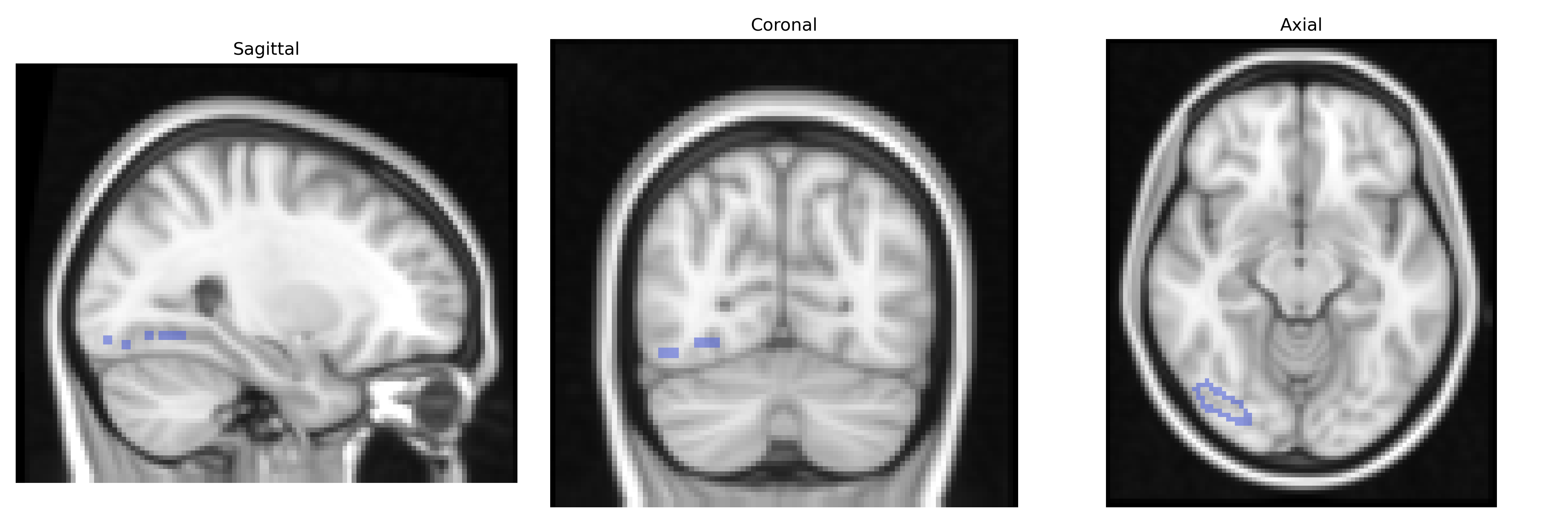
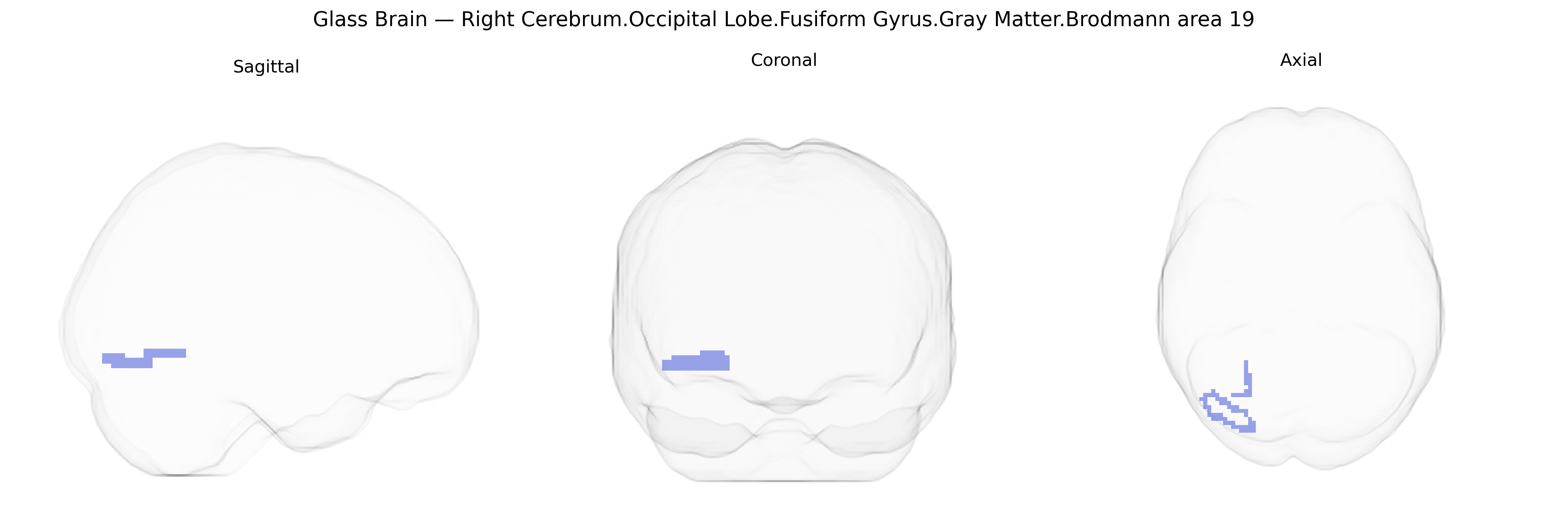
Wali Sidiqyar*, Gaurav Rudravaram*, Elyssa M. McMaster, Trent M. Schwartz, Adam M. Saunders, Kurt G. Schilling, Bennett A. Landman "Introducing SPINS: A Shared Public Visualization Library of Neuroanatomical Structures." Medical Imaging with Deep Learning- short paper
This resource is licensed under CC0 1.0 Universal (Public Domain).