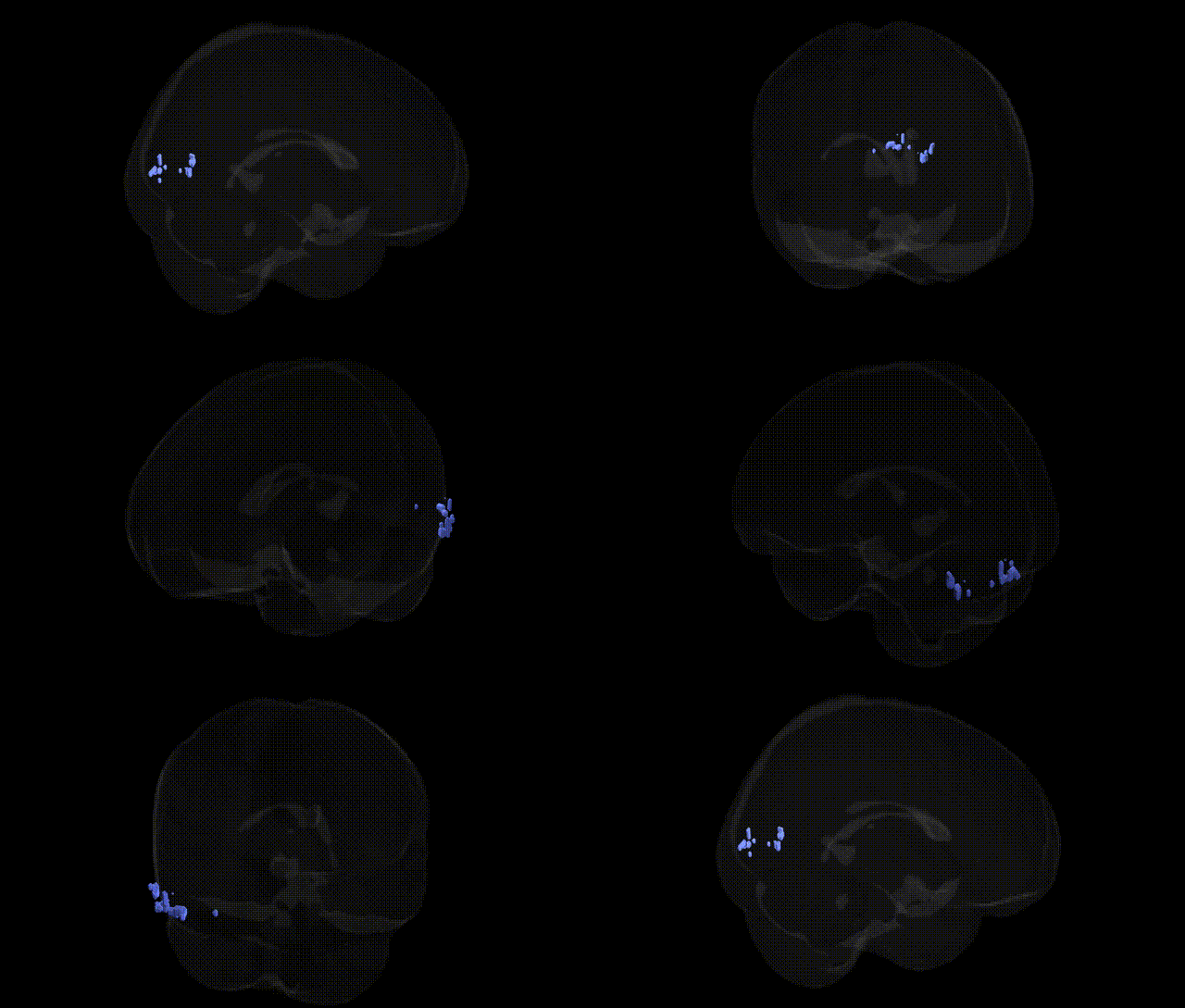
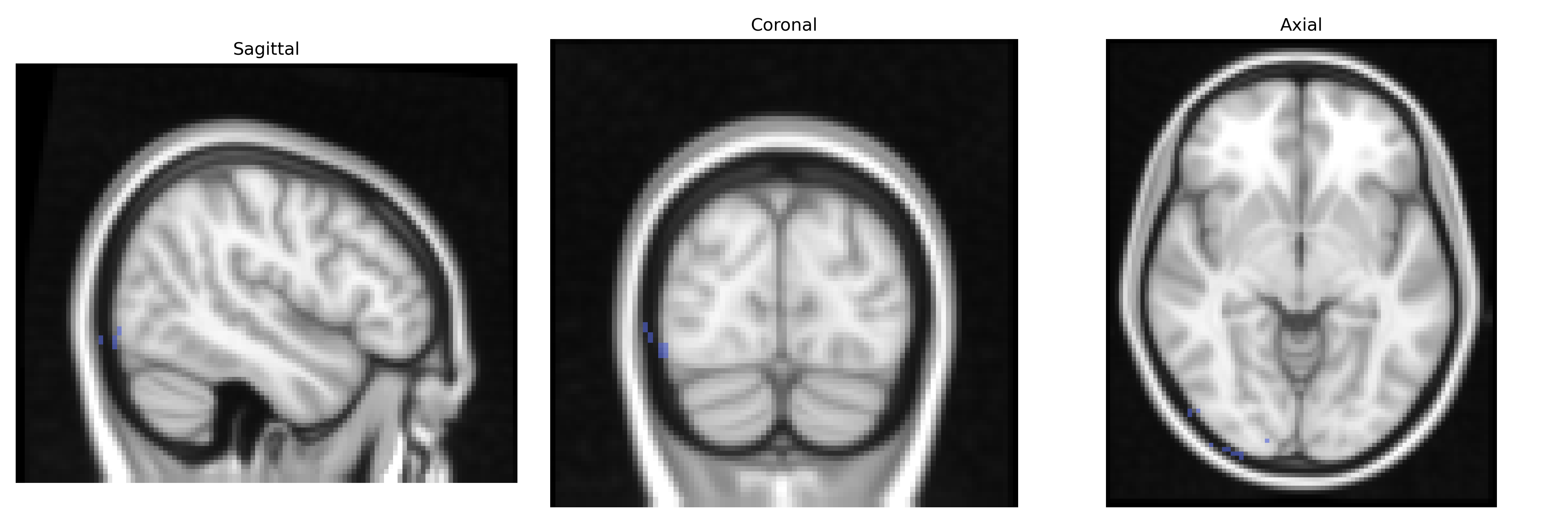
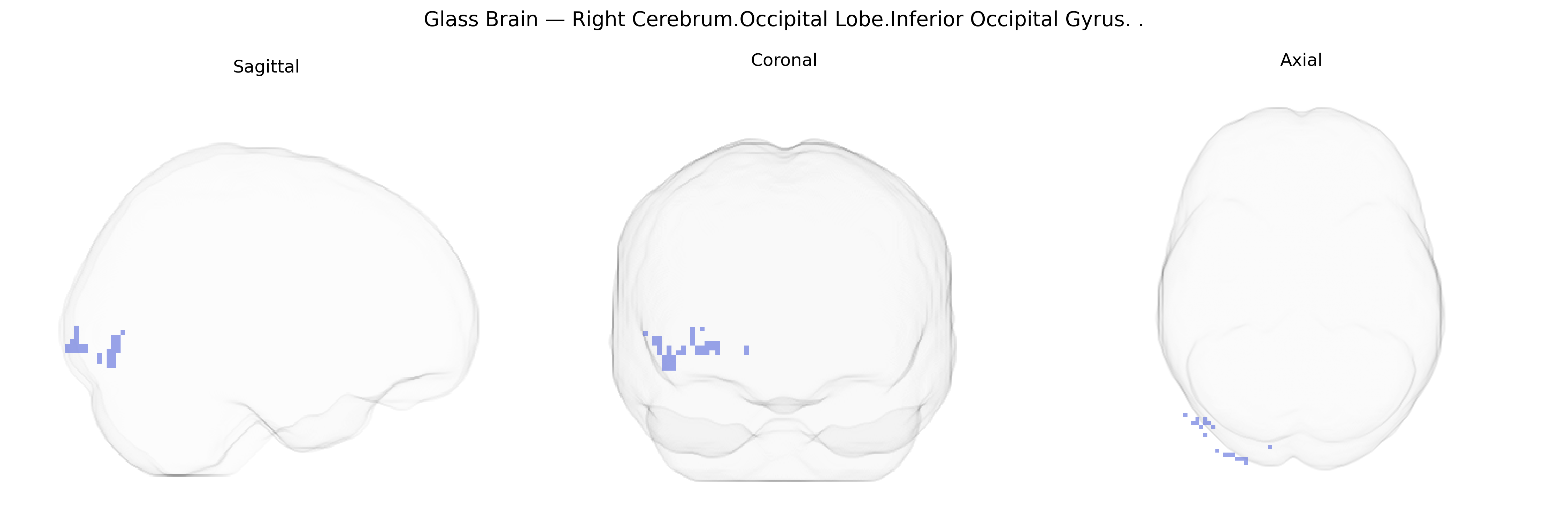
The bilateral Right Cerebrum.Occipital Lobe.Inferior Occipital Gyrus, as labeled in the Talairach 2 mm atlas, refers to the inferior portion of the occipital cortex on the right hemisphere, extending along the ventral surface of the occipital lobe adjacent to the temporal lobe. This region is primarily involved in early and intermediate stages of visual processing, including analysis of object features such as shape and form, and contributes to the ventral “what” visual stream that supports object recognition. It has strong connectivity with neighboring occipital gyri, the fusiform gyrus, and temporal visual association areas, and receives input from primary and secondary visual cortices. Functionally, it participates in integrating visual sensory input into coherent percepts and may be involved in processing complex visual stimuli, including faces and objects, in conjunction with nearby ventral occipitotemporal regions. There is no direct link, but it is closely related to the Occipital lobe.
The bilateral inferior occipital gyrus, part of the occipital lobe’s visual association cortex, has been implicated in genetics of visual processing, face perception, and neuropsychiatric disorders, though often under broader occipital or ventral visual stream definitions rather than atlas-specific Talairach labels. GWAS and imaging-genetics studies of cortical thickness, surface area, and regional volume have identified polygenic influences driven by common variants in neurodevelopmental and synaptic genes (e.g., loci near genes involved in axon guidance, neuronal migration, and synaptic plasticity), with occipital regions frequently showing strong heritability. Face- and object-recognition networks that include the inferior occipital gyrus (such as the occipital face area) have been linked to genetic risk for developmental prosopagnosia in family-based studies and to common variants associated with social cognition and autism spectrum conditions, although specific GWAS hits are typically reported at the level of functional networks rather than this single gyrus. In schizophrenia, bipolar disorder, and major depression, imaging-GWAS work has reported associations between risk polygenic scores and structural or functional alterations in occipital and ventral visual areas, including reduced cortical thickness or altered activation of the inferior occipital gyrus during visual and emotional tasks. Additionally, common variants affecting occipital cortex morphology and visual processing performance (e.g., visual acuity, motion perception, reading-related traits) have emerged in large datasets such as UK Biobank, with some loci overlapping genes involved in visual system development and myelination. Overall, genetic associations with the inferior occipital gyrus reflect its role within distributed visual and social-perceptual networks, with polygenic influences spanning neurodevelopmental and psychiatric risk genes, but few findings are uniquely and exclusively localized to this specific Talairach-defined region.
Overview generated by GPT-4o (2026).
Region ID: 257
Hemisphere: bilateral
Atlas: Talairach labels 2mm
Full Quality Version: Download MP4
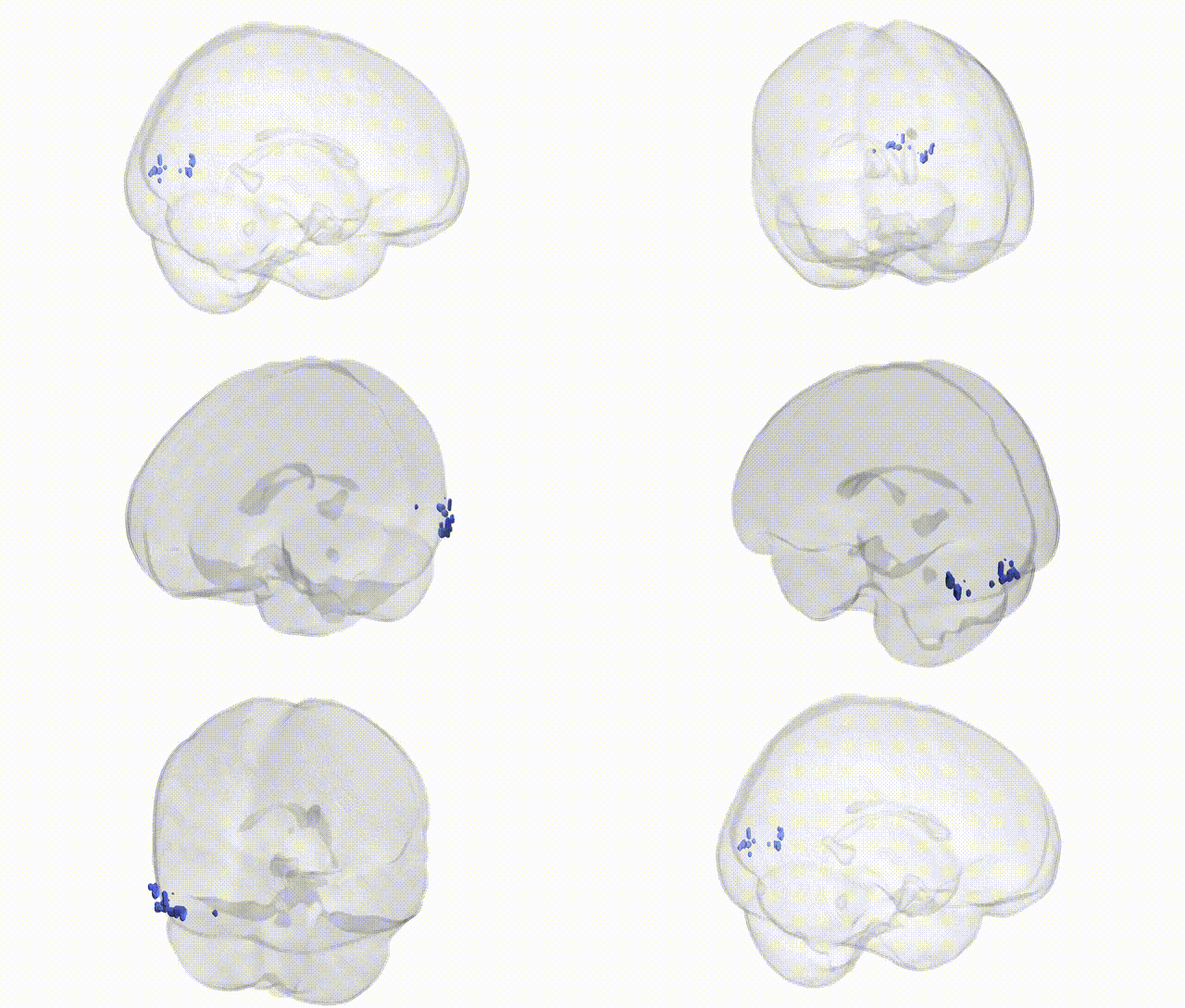
Full Quality Version: Download MP4
Wali Sidiqyar*, Gaurav Rudravaram*, Elyssa M. McMaster, Trent M. Schwartz, Adam M. Saunders, Kurt G. Schilling, Bennett A. Landman "Introducing SPINS: A Shared Public Visualization Library of Neuroanatomical Structures." Medical Imaging with Deep Learning- short paper
This resource is licensed under CC0 1.0 Universal (Public Domain).