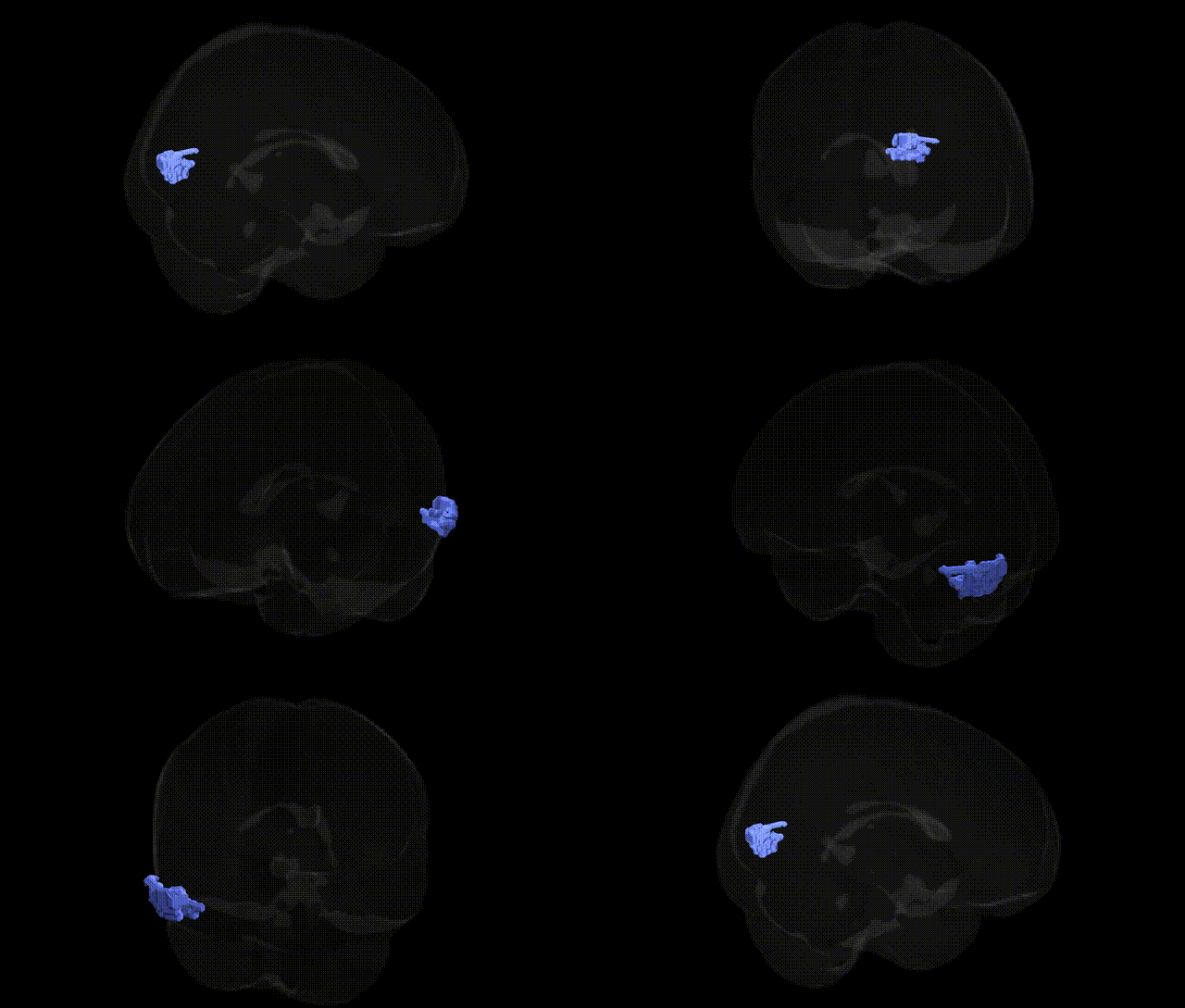
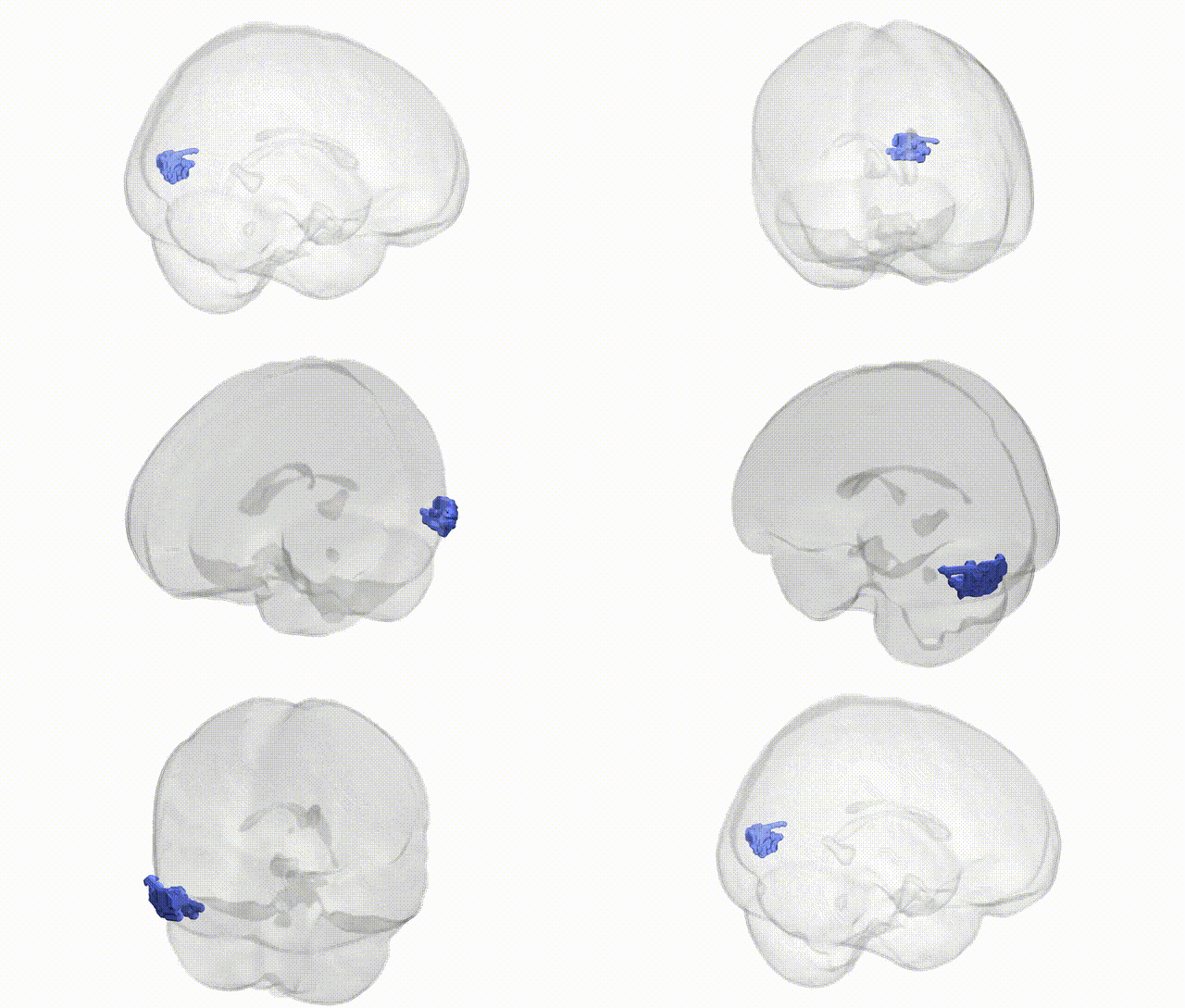
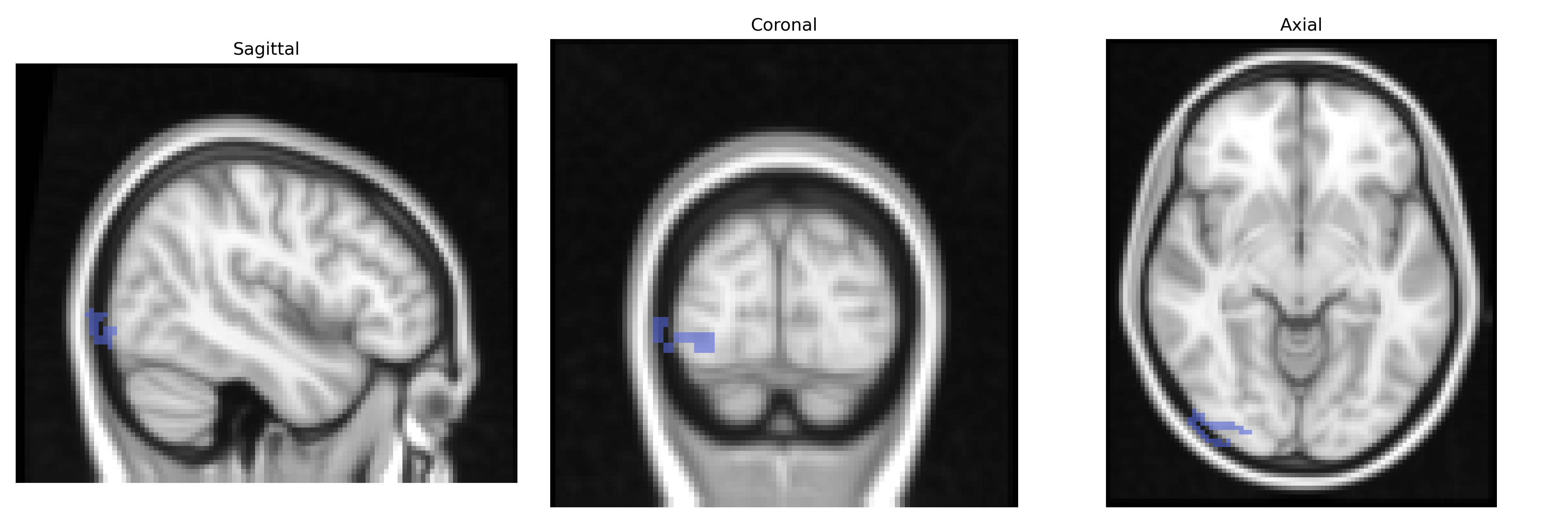
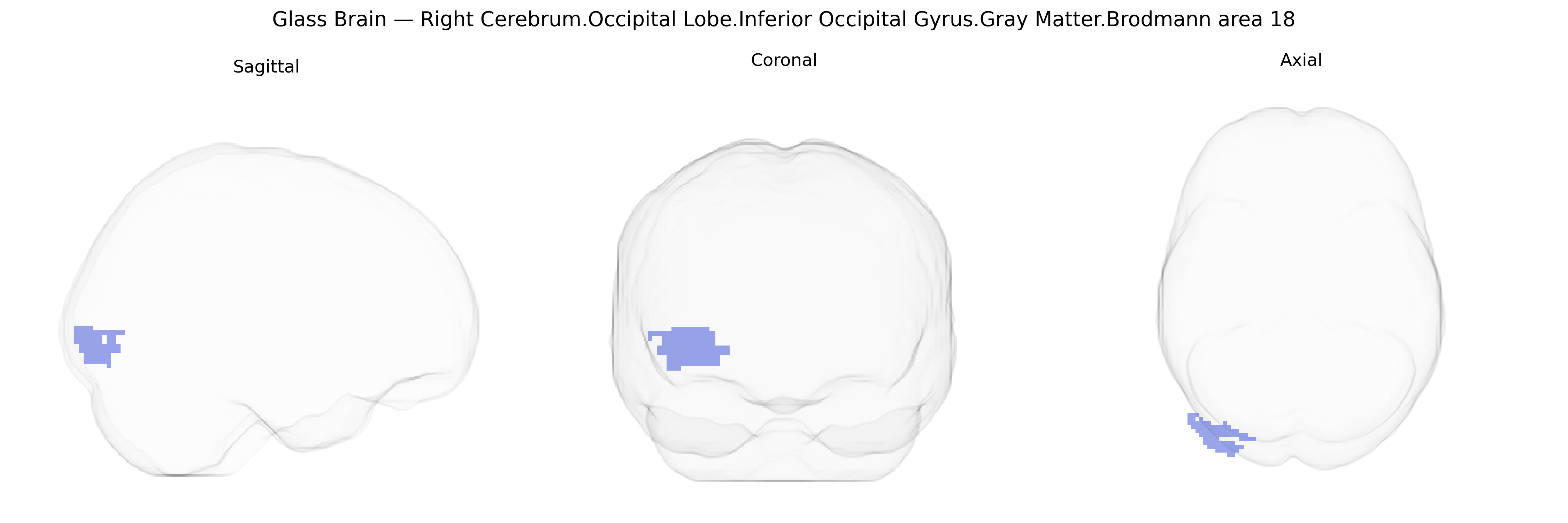
The bilateral Right Cerebrum.Occipital Lobe.Inferior Occipital Gyrus.Gray Matter.Brodmann area 18 corresponds to secondary visual cortex (V2) located in the occipital lobe, bordering the primary visual cortex (BA17). This region receives dense feed-forward input from BA17 and additional modulatory input from other visual association areas, integrating and refining visual information related to form, orientation, spatial frequency, and basic figure–ground segregation. Neurons in BA18 exhibit more complex receptive fields than those in BA17, supporting early stages of visual feature analysis and contributing to pathways that underlie object recognition and motion perception. Although there is no specific Wikipedia page for this exact Talairach-defined subdivision, the region is functionally encompassed within Brodmann area 18.
The bilateral Right Cerebrum Occipital Lobe Inferior Occipital Gyrus (gray matter, Brodmann area 18) lies within secondary visual cortex and has been implicated in genetic studies of visual processing, reading, and neuropsychiatric risk via both regional volume and functional activation. GWAS of cortical thickness and surface area (e.g., ENIGMA and UK Biobank cohorts) have linked variation in occipital and pericalcarine regions overlapping BA18 to common variants near genes involved in synaptic development and axon guidance (such as DLG2, CADM2, and PAX6-related pathways), though loci are typically reported at the level of “occipital cortex” rather than the specific inferior occipital gyrus. Structural and functional imaging–genetics work has associated polymorphisms in genes related to glutamatergic signaling (e.g., GRIN2B), neurotrophic factors (BDNF Val66Met), and dopamine regulation (COMT) with differences in visual cortical activation and occipital gray matter properties, including in BA17/18 complexes that encompass this region. Rare variant and copy number studies in developmental disorders affecting visual cognition and reading (such as dyslexia) and in neurodevelopmental syndromes with occipital structural anomalies have implicated genes like KIAA0319, DCDC2, and ROBO1, with downstream effects on occipital circuitry that include BA18, although regional specificity is coarse. Occipital BA18 has also emerged in imaging–genetic analyses of schizophrenia, bipolar disorder, and major depression, where risk variants in large GWAS (e.g., in CACNA1C, ZNF804A, and MIR137-containing loci) show associations with altered visual network connectivity and cortical thickness in secondary visual areas. Finally, GWAS of visual perceptual traits such as face recognition and motion perception have reported heritable variation in patterns of activation across lateral occipital regions that partially overlap the inferior occipital gyrus, suggesting that genetic influences on visual expertise and object recognition are mediated in part through BA18-related circuits, even though current evidence rarely isolates this Talairach-defined subregion as a primary locus.
Overview generated by GPT-4o (2026).
Region ID: 254
Hemisphere: bilateral
Atlas: Talairach labels 2mm
Full Quality Version: Download MP4
Full Quality Version: Download MP4
Wali Sidiqyar*, Gaurav Rudravaram*, Elyssa M. McMaster, Trent M. Schwartz, Adam M. Saunders, Kurt G. Schilling, Bennett A. Landman "Introducing SPINS: A Shared Public Visualization Library of Neuroanatomical Structures." Medical Imaging with Deep Learning- short paper
This resource is licensed under CC0 1.0 Universal (Public Domain).