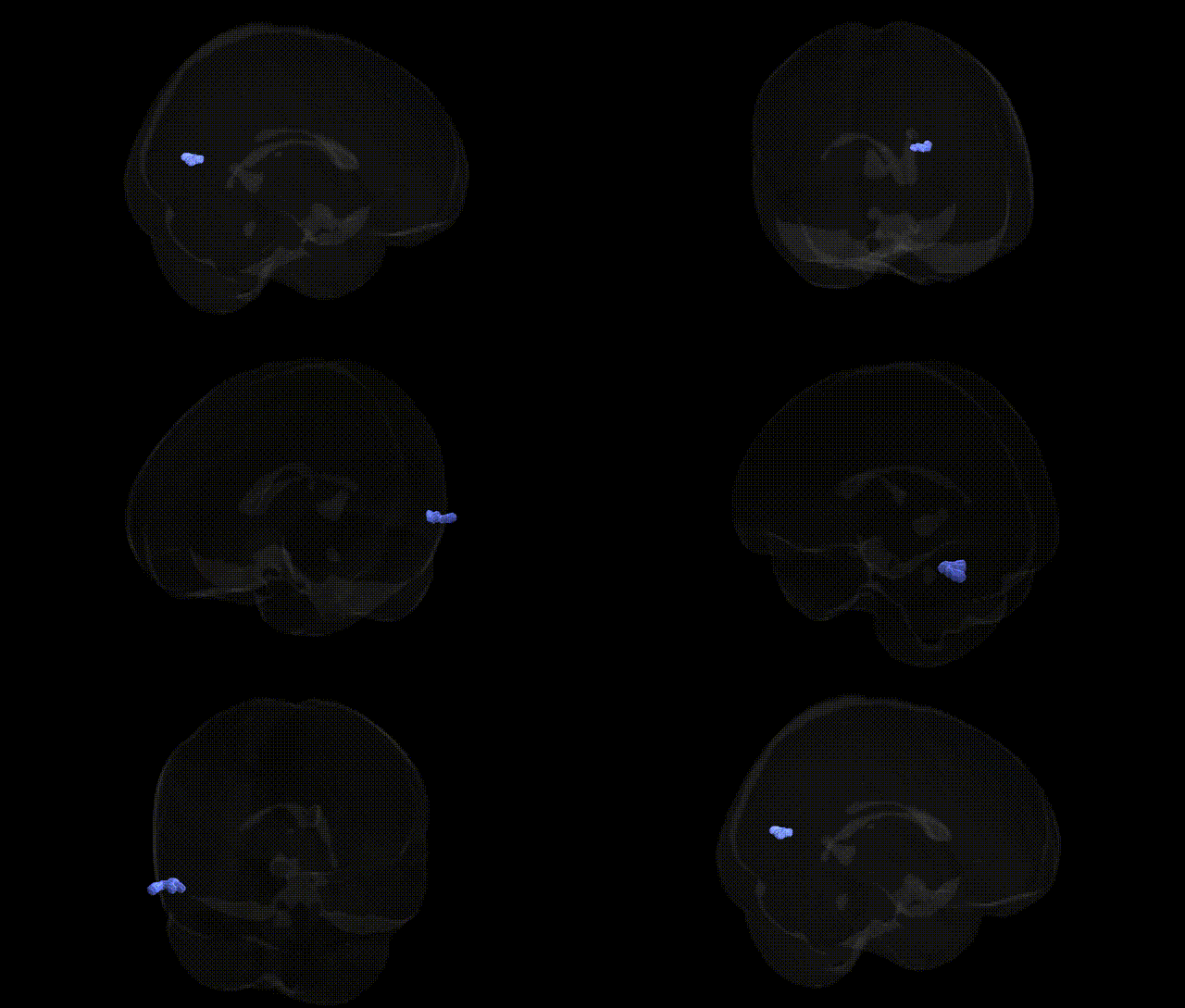
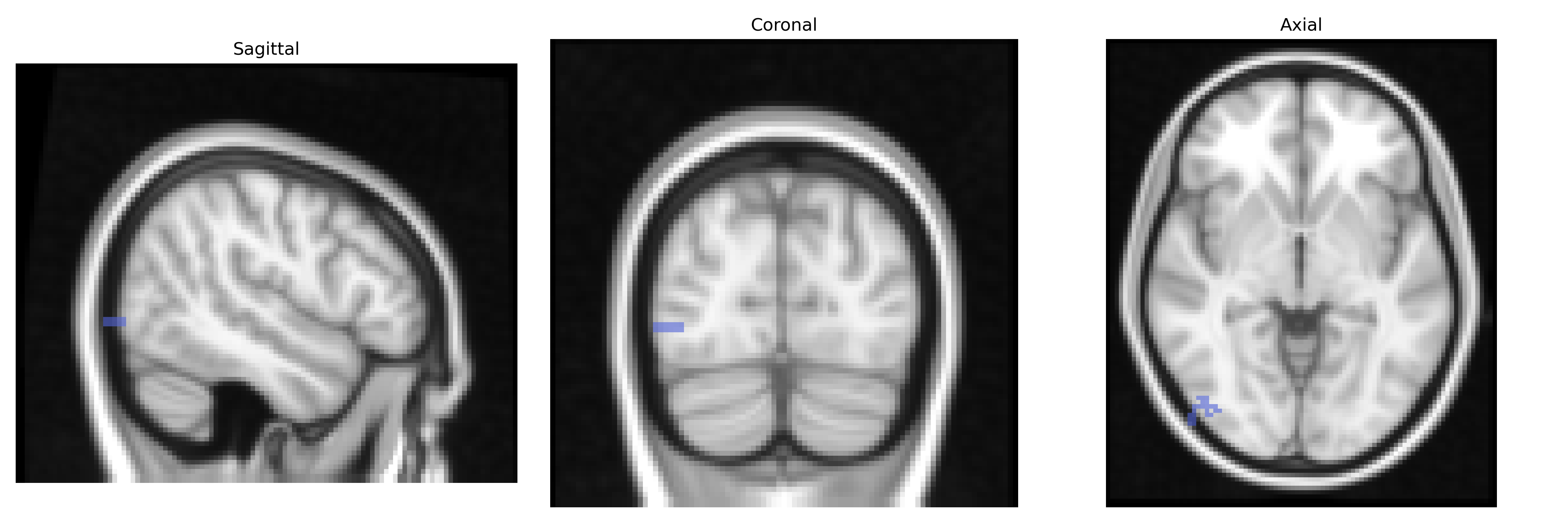
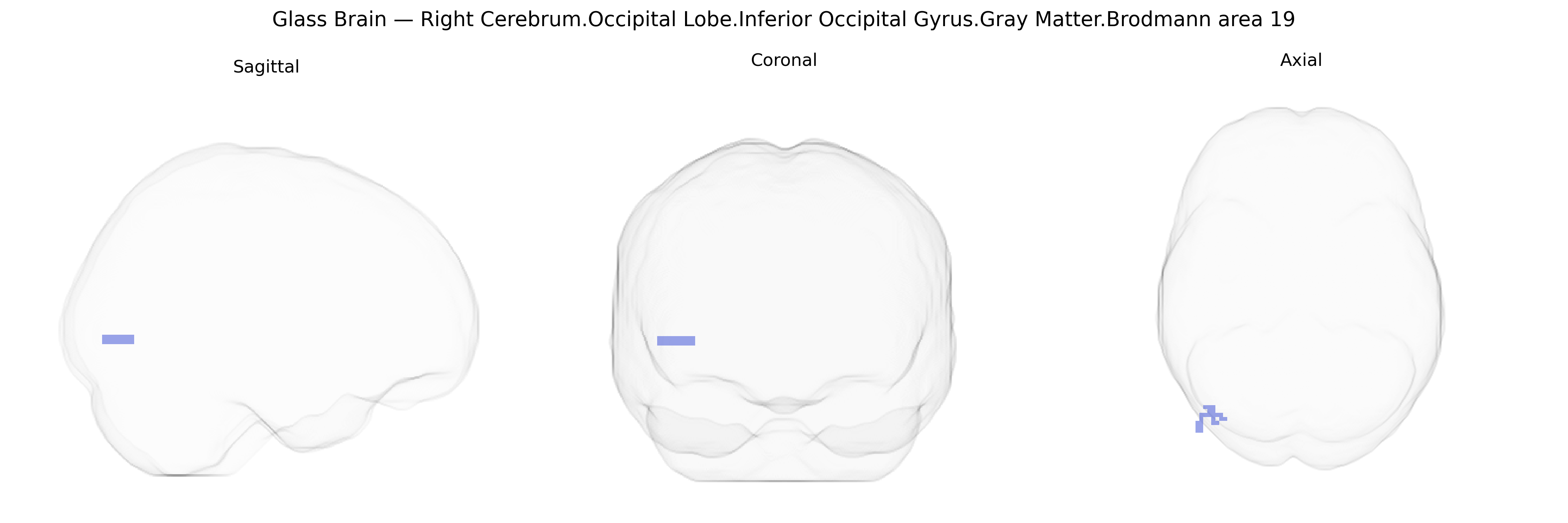
The bilateral Right Cerebrum.Occipital Lobe.Inferior Occipital Gyrus.Gray Matter.Brodmann area 19 corresponds to a portion of the extrastriate visual cortex involved in higher-order visual processing, including analysis of complex shapes, object features, and integration of visual information from primary and secondary visual areas. Situated in the lateral aspect of the occipital lobe, inferior to the middle occipital gyrus, this region receives input from V1 (BA17) and V2 (BA18) and contributes to pathways underlying object recognition and visual association functions, forming part of the ventral visual stream. Brodmann area 19 lacks a dedicated Wikipedia page; no direct link is available, but it is encompassed within the broader Visual cortex.
The bilateral Right Cerebrum.Occipital Lobe.Inferior Occipital Gyrus.Gray Matter.Brodmann area 19, a key part of the ventral visual stream implicated in higher-order visual processing, has been indirectly implicated in genetic studies through imaging genetics and GWAS of brain structure and visual cognition rather than through region-specific association studies. Large-scale GWAS of cortical thickness and surface area (e.g., ENIGMA, UK Biobank) have identified common variants in genes such as HMGA2, KIAA0586, PAX6, and others that influence occipital lobe morphology, with some clusters overlapping or bordering Brodmann area 19, although most studies report associations at the lobe or “visual cortex” level rather than at the inferior occipital gyrus specifically. Variants in genes involved in synaptic plasticity, neurodevelopment, and glutamatergic signaling (e.g., BDNF, GRIN2B) have been linked to individual differences in visual perception and learning, with functional imaging often showing engagement of area 19 during tasks involving object recognition, motion, and complex pattern processing. Disorders with strong visual processing components—such as schizophrenia, autism spectrum disorder, dyslexia, and certain forms of migraine and visual epilepsy—have genetic risk loci that, in imaging-genetics frameworks, are associated with altered activation or structure in extrastriate occipital regions including BA19, but these links are typically network-based and not confined to this single gyrus. Overall, genetic influences on BA19 are best characterized as part of broader polygenic effects on occipital and visual association cortex morphology and function, with current evidence coming mainly from GWAS of cortical measures, visual cognition, and neuropsychiatric disorders that show convergent involvement of this region rather than discrete, BA19-specific genetic risk factors.
Overview generated by GPT-4o (2026).
Region ID: 415
Hemisphere: bilateral
Atlas: Talairach labels 2mm
Full Quality Version: Download MP4
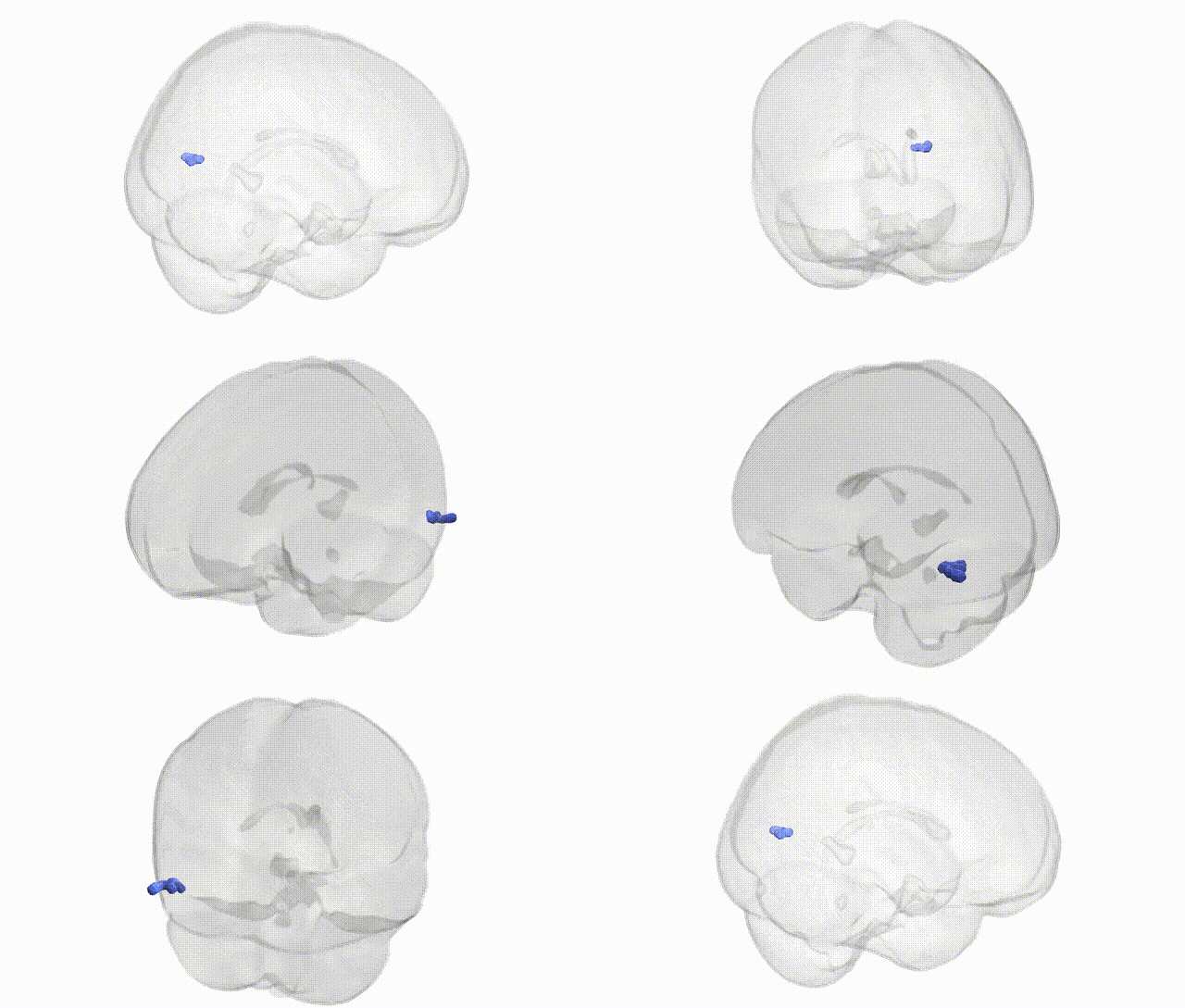
Full Quality Version: Download MP4
Wali Sidiqyar*, Gaurav Rudravaram*, Elyssa M. McMaster, Trent M. Schwartz, Adam M. Saunders, Kurt G. Schilling, Bennett A. Landman "Introducing SPINS: A Shared Public Visualization Library of Neuroanatomical Structures." Medical Imaging with Deep Learning- short paper
This resource is licensed under CC0 1.0 Universal (Public Domain).