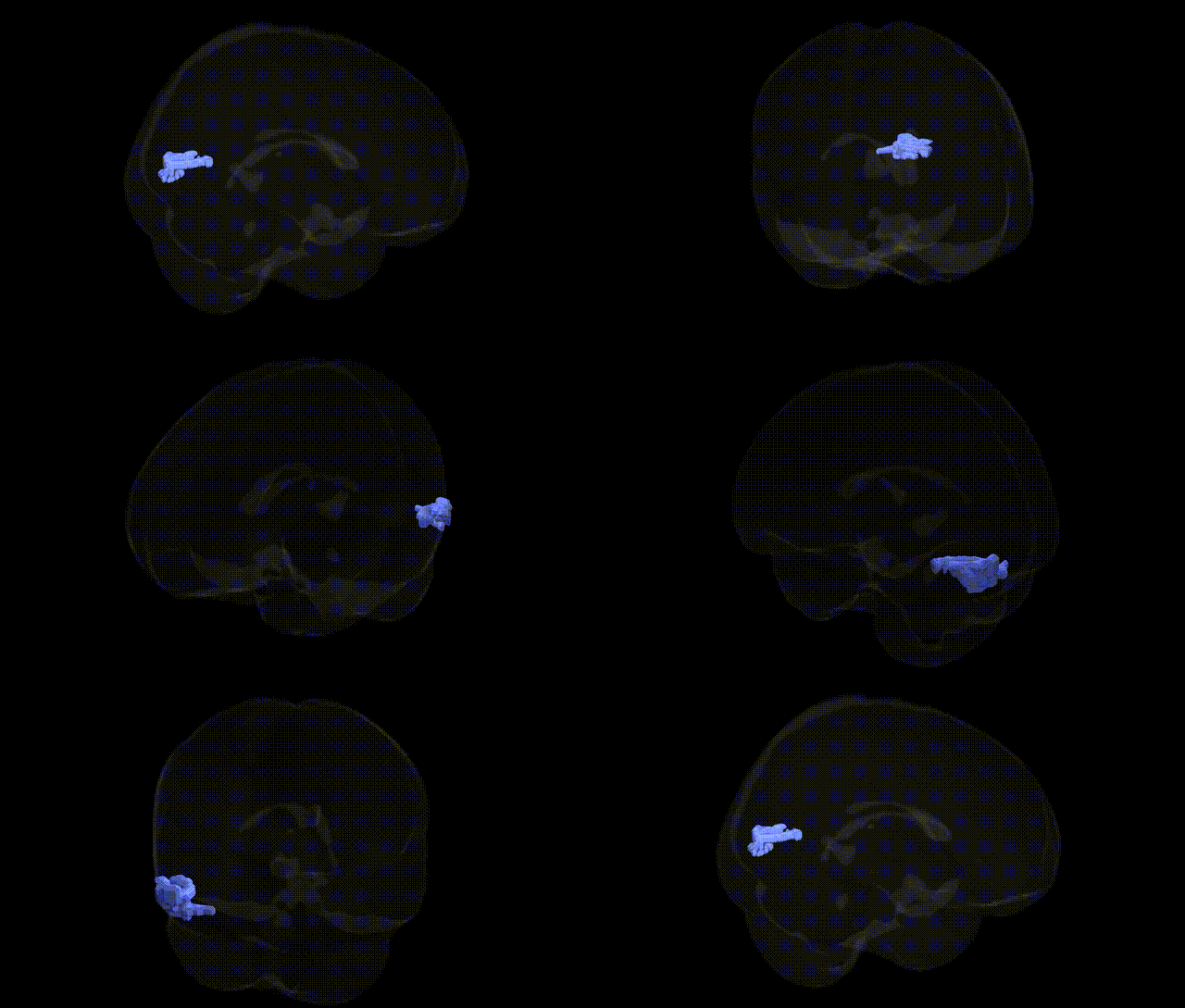
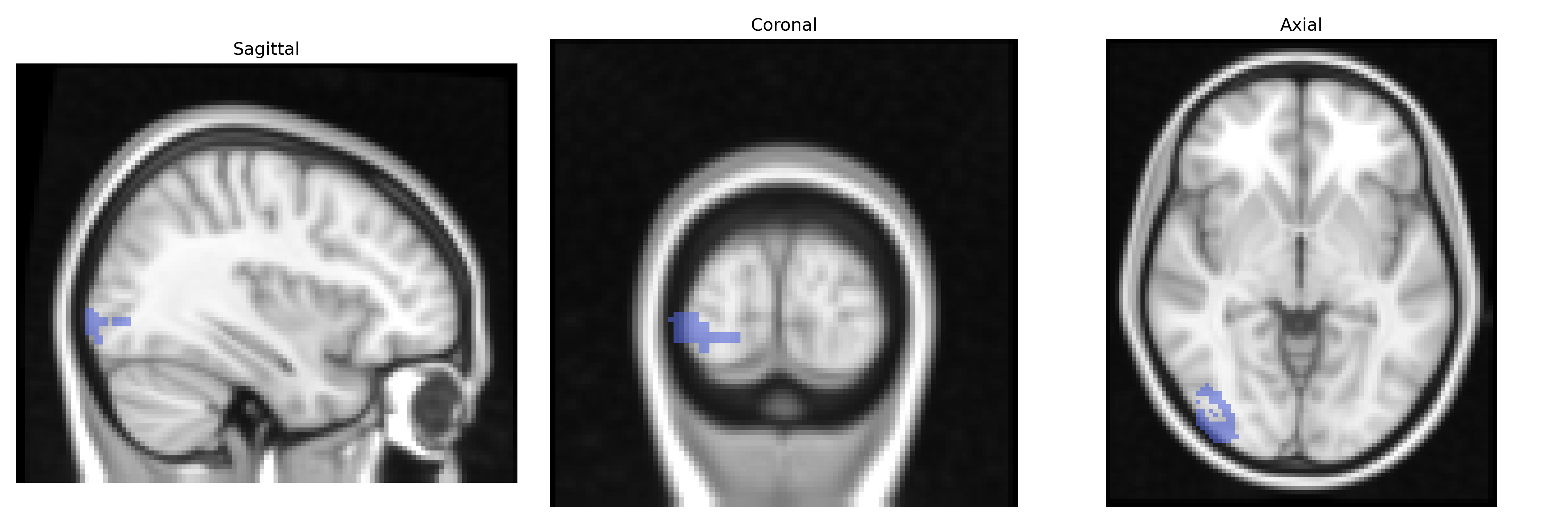
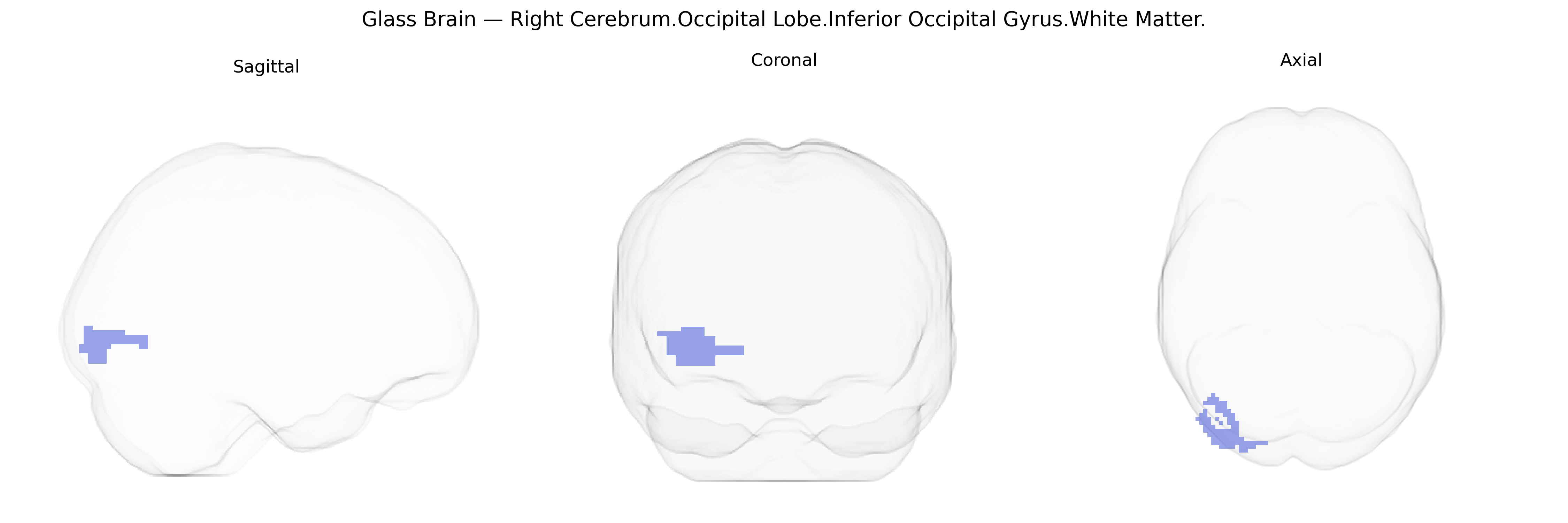
The bilateral Right Cerebrum.Occipital Lobe.Inferior Occipital Gyrus.White Matter corresponds to the subcortical fiber systems underlying the inferior occipital gyrus in the right occipital lobe. This white matter region contains association fibers that interconnect adjacent occipital gyri and contribute to longer-range tracts such as portions of the inferior longitudinal fasciculus, which links occipital visual areas with temporal regions involved in object recognition and visual memory. Functionally, these fibers participate in the transmission and integration of visual information from primary and secondary visual cortices toward ventral visual stream territories, supporting processes such as form and object perception. There is no direct link, see instead Occipital lobe.
The bilateral right cerebrum occipital lobe inferior occipital gyrus white matter, as defined in the Talairach 2 mm atlas, has not been a primary focus of region-specific genetic association studies, but GWAS and imaging-genetics work implicating nearby occipital and ventral visual white matter tracts provide indirect insight. Variants influencing white matter microstructure (e.g., in genes such as CNTN4, NRG1, and others involved in axon guidance and myelination) have been associated with global and occipital fractional anisotropy and mean diffusivity, which can encompass the inferior occipital white matter. Occipital lobe microstructure and volume have shown heritability and polygenic contributions in large imaging-GWAS consortia (e.g., ENIGMA), with some loci related to neurodevelopmental pathways, synaptic plasticity, and myelin formation. Genetic risk for disorders that affect visual processing and occipital connectivity—such as schizophrenia, bipolar disorder, autism spectrum disorder, and major depressive disorder—has been linked to alterations in occipital white matter tracts in imaging-genetics studies, though these links are typically network- and tract-based rather than specific to the inferior occipital gyrus white matter label. Additionally, genes associated with migraine, visual aura, and visual perceptual traits have been connected to occipital lobe structure and function, again at a macroscale rather than at the fine-grained Talairach parcel level. Overall, genetic associations relevant to this region reflect broader influences on occipital lobe and ventral visual pathway development, connectivity, and vulnerability to neuropsychiatric and neurological disorders, rather than robust, parcel-specific GWAS findings.
Overview generated by GPT-4o (2026).
Region ID: 256
Hemisphere: bilateral
Atlas: Talairach labels 2mm
Full Quality Version: Download MP4
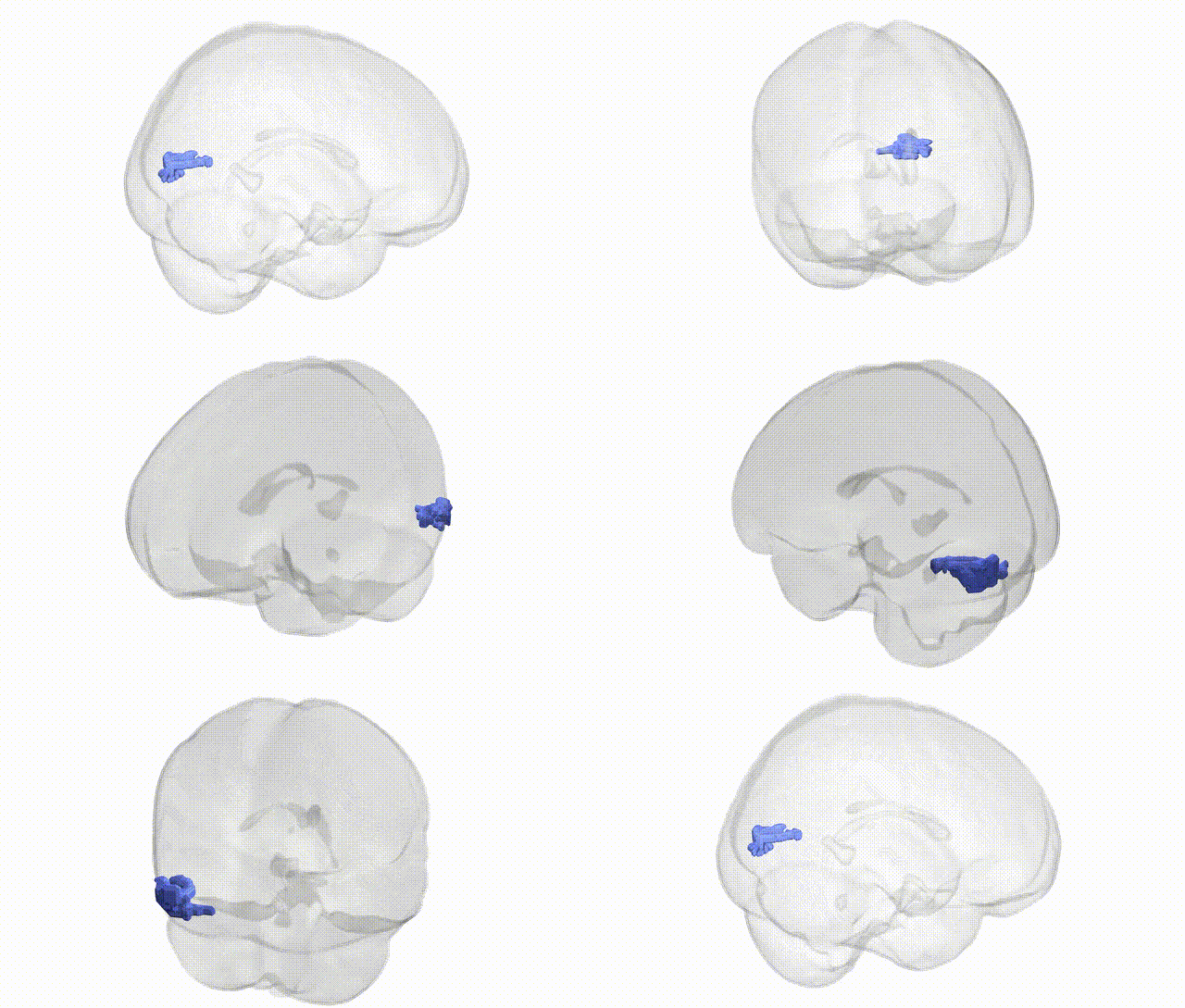
Full Quality Version: Download MP4
Wali Sidiqyar*, Gaurav Rudravaram*, Elyssa M. McMaster, Trent M. Schwartz, Adam M. Saunders, Kurt G. Schilling, Bennett A. Landman "Introducing SPINS: A Shared Public Visualization Library of Neuroanatomical Structures." Medical Imaging with Deep Learning- short paper
This resource is licensed under CC0 1.0 Universal (Public Domain).