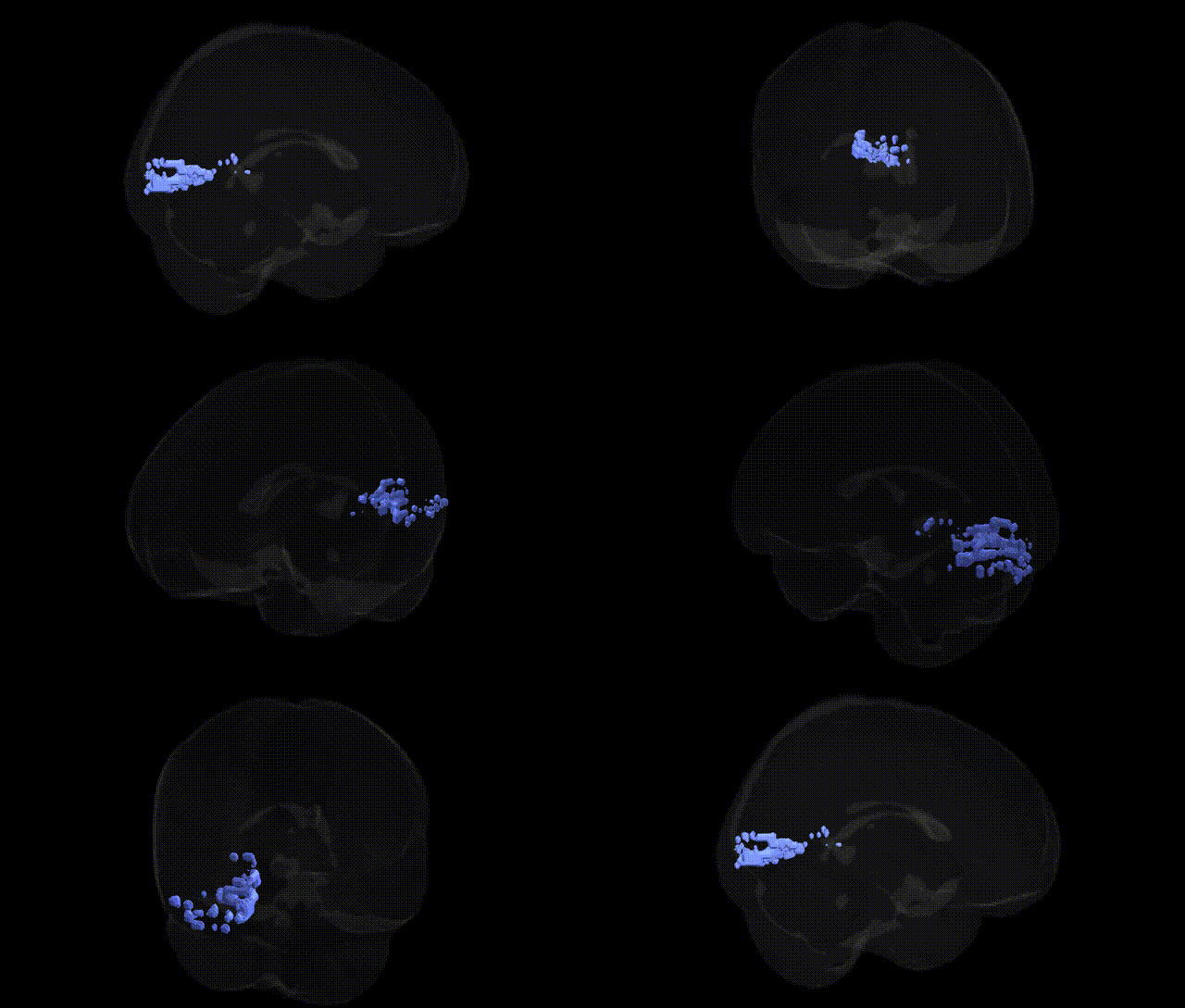
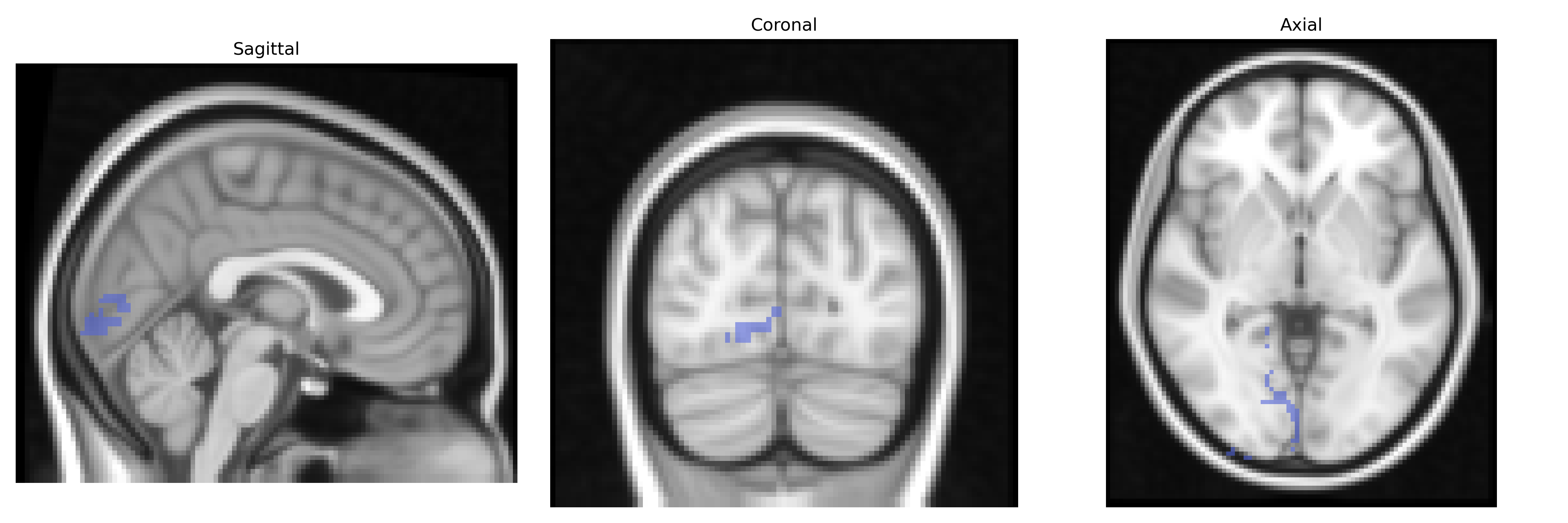
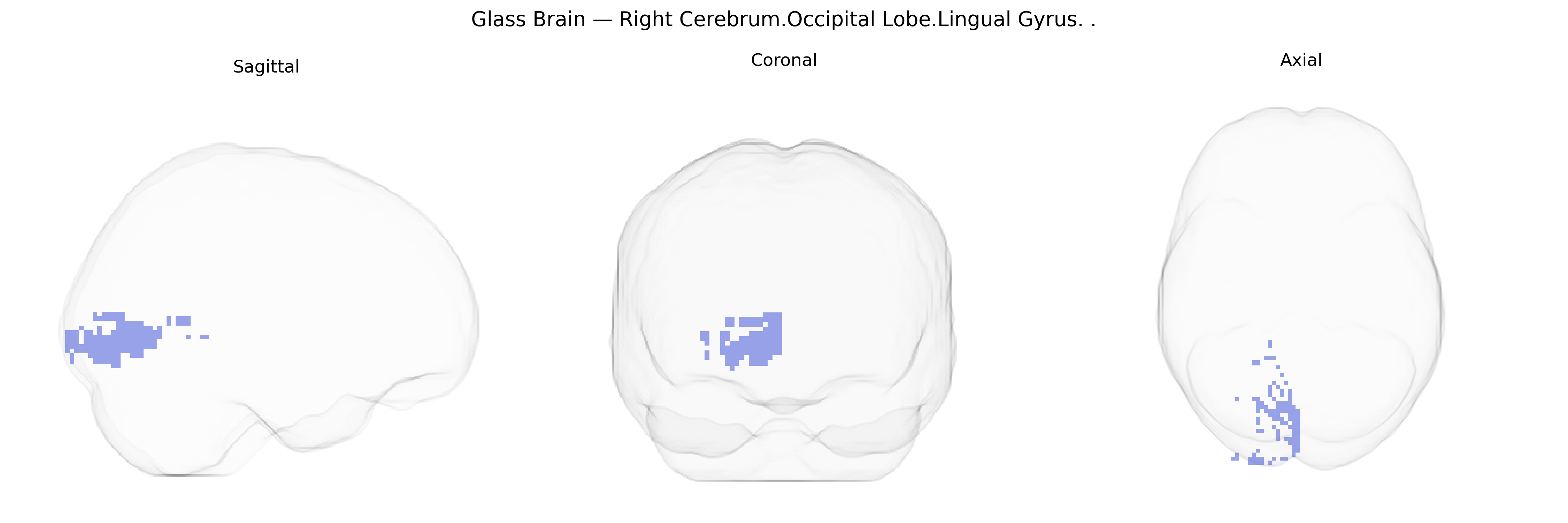
The bilateral Right Cerebrum.Occipital Lobe.Lingual Gyrus, as defined in the Talairach 2 mm atlas, refers to the portion of the lingual gyrus located in the right occipital lobe, extending medially along the ventral surface of the occipital cortex adjacent to the calcarine sulcus. This region forms part of the visual association cortex and plays a key role in processing complex visual information, including aspects of visual recognition, color, and form, and is involved in higher-order visual tasks such as word and letter recognition and scene analysis. It is closely interconnected with primary visual cortex (V1) and other extrastriate regions, contributing to the integration of visual input with memory and semantic processing. There is no direct Wikipedia article specifically for the “Right Cerebrum.Occipital Lobe.Lingual Gyrus” Talairach label; a related structure is the Lingual gyrus.
The bilateral Right Cerebrum Occipital Lobe Lingual Gyrus, a medial occipital region implicated in visual processing, has been highlighted in genetic and neuroimaging GWAS as a heritable structure whose volume, cortical thickness, and functional activation patterns show significant associations with common genetic variants. Large-scale brain imaging genetics consortia (e.g., ENIGMA, UK Biobank studies) have identified loci in and near genes involved in neurodevelopment, synaptic function, and axon guidance (such as variants near PAX6, CACNA1C, and NRGN in broader occipital and visual cortex measures) that contribute to inter-individual differences in occipital/lingual cortical morphology and activity. Functional neuroimaging genetics has linked polymorphisms affecting glutamatergic and GABAergic signaling to altered visual processing and object recognition in lingual and neighboring fusiform regions, sometimes in the context of schizophrenia, bipolar disorder, and major depression, where case-control GWAS-implicated risk genes (e.g., complement pathway genes like C4A, synaptic genes like GRIN2A) have been connected to structural or functional changes in visual association cortex. In autism spectrum disorder, genetic risk scores and specific variants in synaptic and neurodevelopmental genes have been associated with atypical activation and connectivity involving lingual gyrus during face and social perception tasks, while migraine and visual aura GWAS have pointed indirectly to vascular and ion-channel genes whose effects include altered excitability in occipital visual regions. Overall, the lingual gyrus emerges as part of a genetically influenced visual network in which polygenic risk for neuropsychiatric and neurodevelopmental disorders, as well as general cognitive and perceptual traits, is reflected in structural and functional variation captured in imaging-genetic studies, though few associations are specific to the Talairach-defined lingual gyrus rather than to broader occipital or visual cortex parcels.
Overview generated by GPT-4o (2026).
Region ID: 244
Hemisphere: bilateral
Atlas: Talairach labels 2mm
Full Quality Version: Download MP4
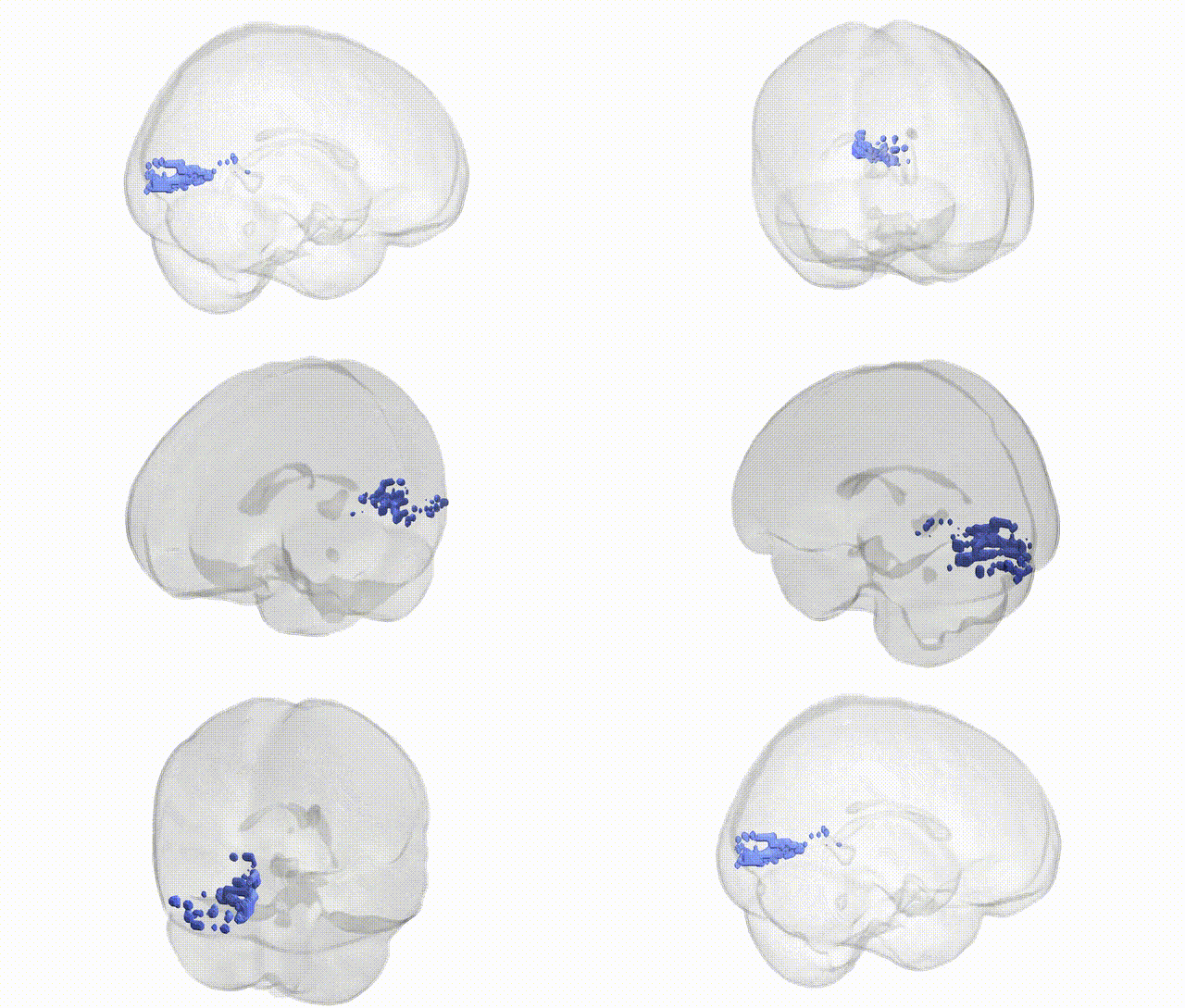
Full Quality Version: Download MP4
Wali Sidiqyar*, Gaurav Rudravaram*, Elyssa M. McMaster, Trent M. Schwartz, Adam M. Saunders, Kurt G. Schilling, Bennett A. Landman "Introducing SPINS: A Shared Public Visualization Library of Neuroanatomical Structures." Medical Imaging with Deep Learning- short paper
This resource is licensed under CC0 1.0 Universal (Public Domain).