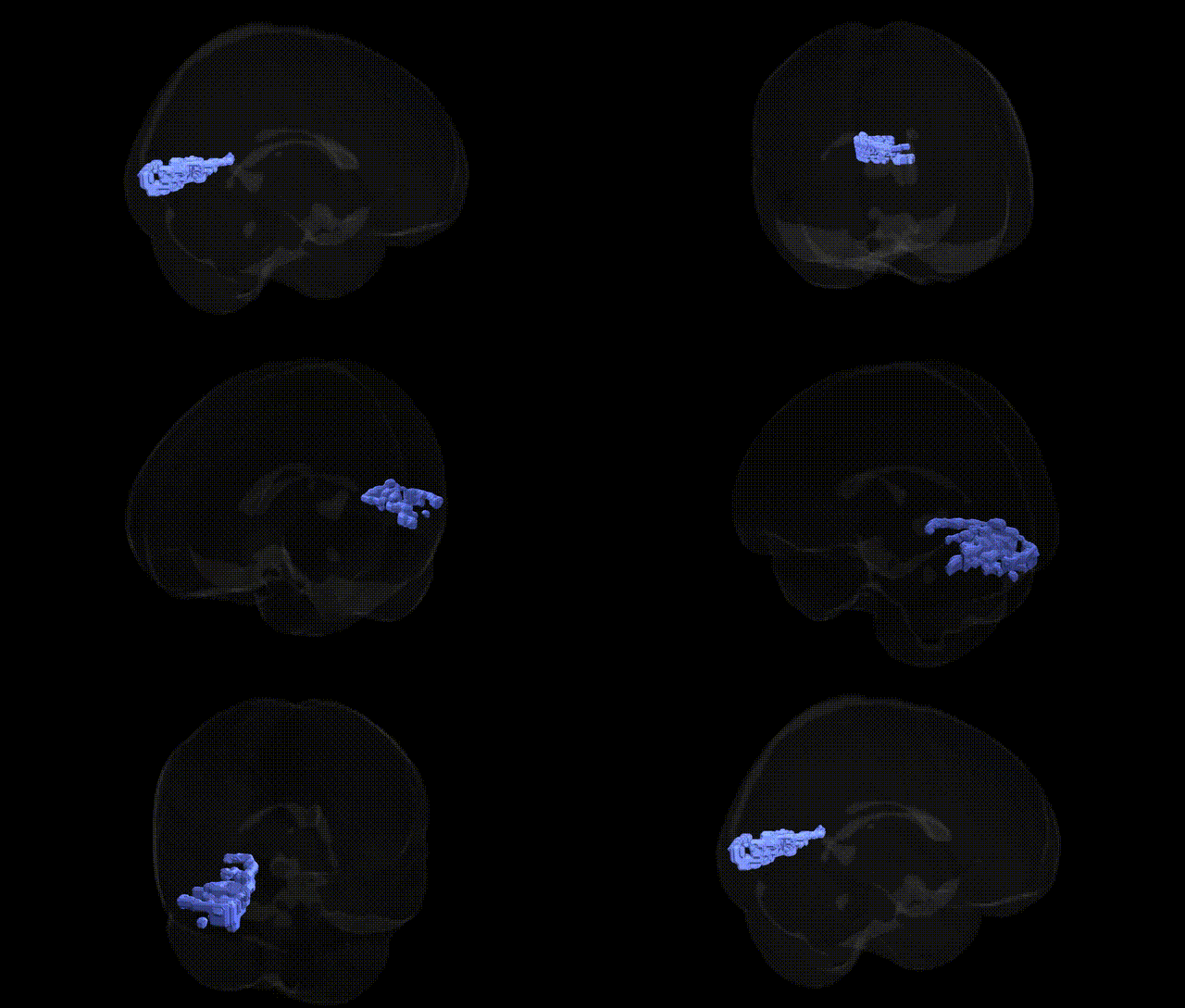
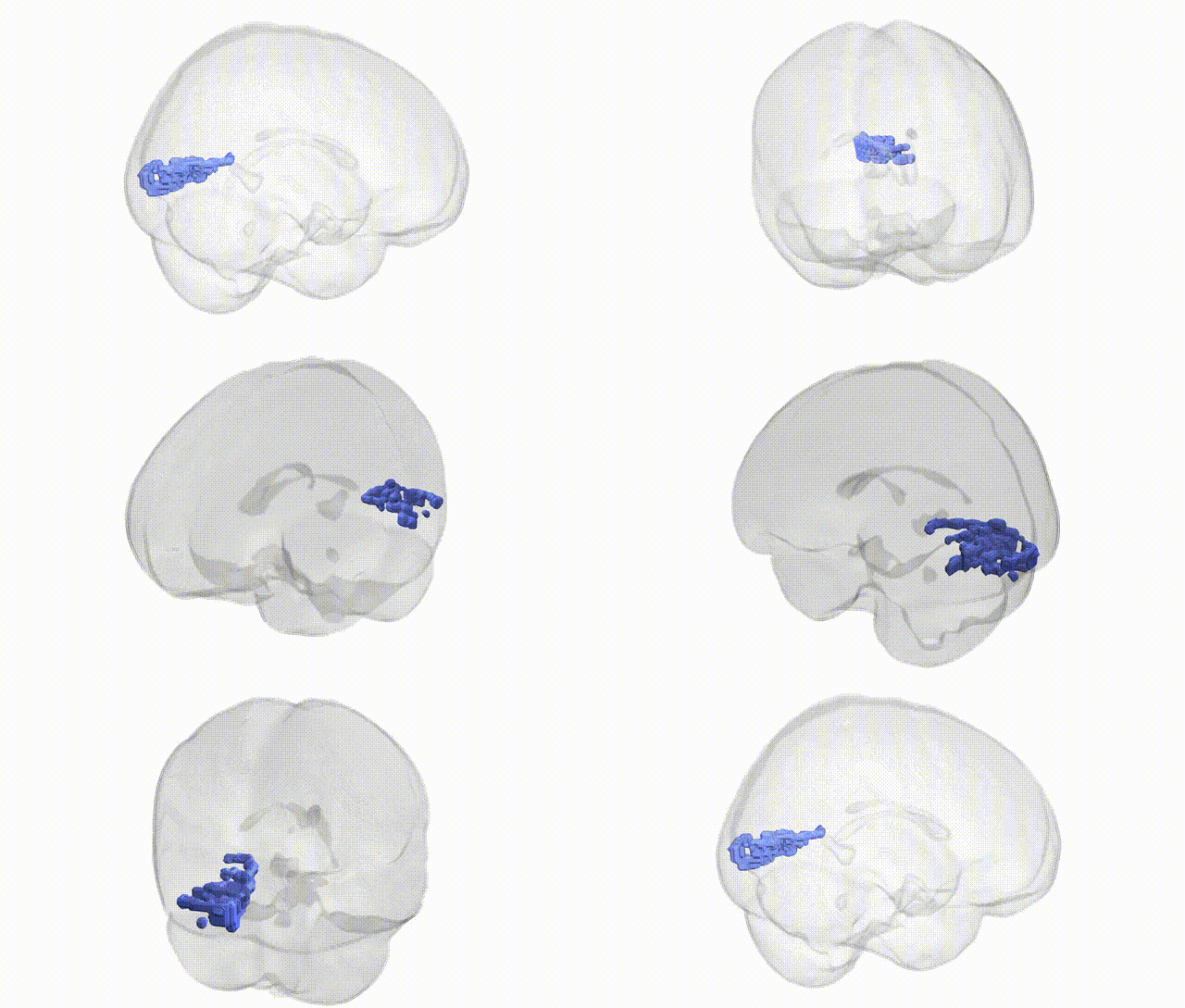
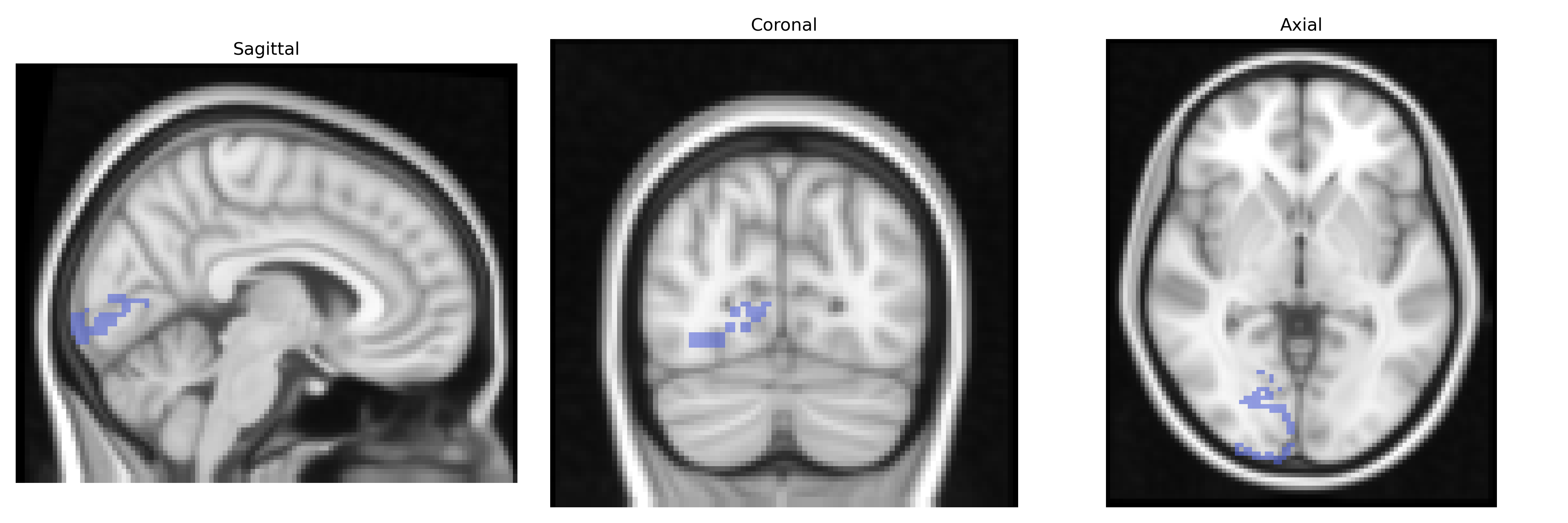
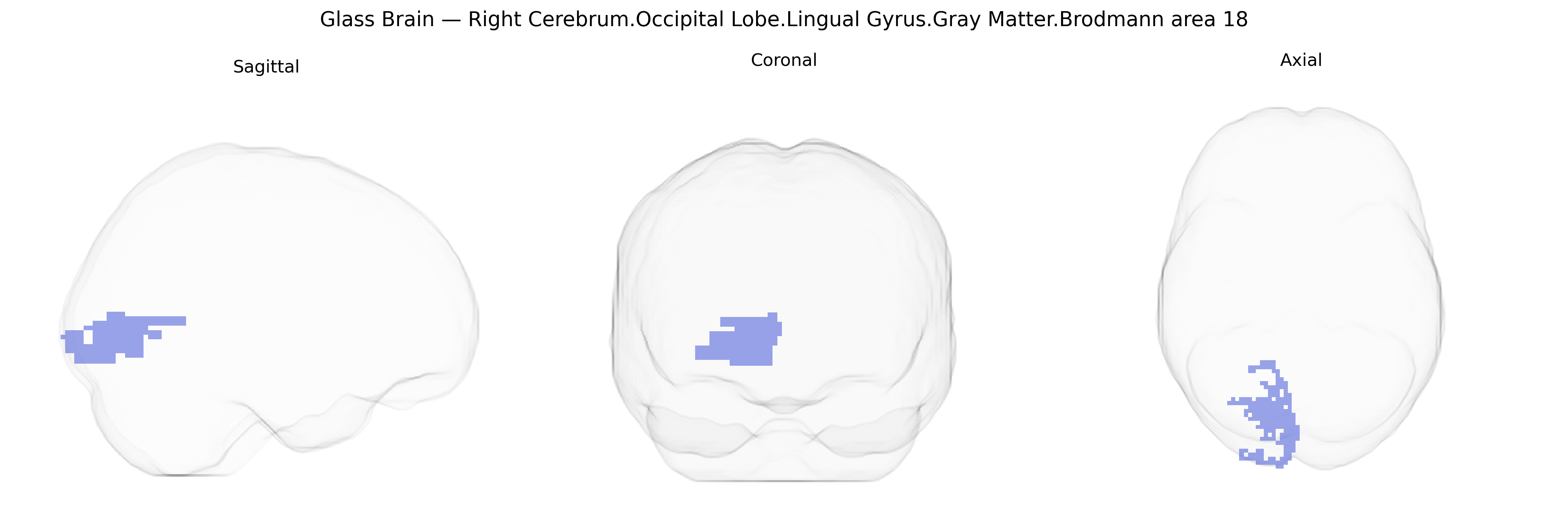
Bilateral Right Cerebrum.Occipital Lobe.Lingual Gyrus.Gray Matter.Brodmann area 18 corresponds to secondary visual cortex (V2) located in the medial occipital lobe within the lingual gyrus, adjacent to primary visual cortex (BA17). This region receives dense afferent input from BA17 and distributes processed visual information to higher-order extrastriate areas, contributing to analysis of visual features such as orientation, spatial frequency, contours, and figure–ground segregation. Neuronal populations here are organized retinotopically, preserving the spatial layout of the visual field, and participate in early stages of form and pattern recognition. Functionally, BA18 serves as an essential hub in the occipital visual processing hierarchy, integrating basic visual signals into more complex representations that support perception and visually guided behaviors. Brodmann area 18
The lingual gyrus (BA18) in the occipital lobe is a secondary visual cortex region whose genetic associations largely emerge indirectly from imaging genetics and GWAS of brain structure, visual processing, and neuropsychiatric disorders. Large-scale MRI-GWAS consortia (e.g., ENIGMA, UK Biobank studies) have identified heritable variation in occipital and visual cortical gray matter volumes and thickness, implicating common variants near genes involved in neurodevelopment (such as WNT signaling, axon guidance, and synaptic plasticity), although few loci are specific exclusively to BA18 and most findings aggregate across visual regions. Polygenic influences on visual cortex structure overlap with risk architectures for schizophrenia, bipolar disorder, and major depression, where case–control imaging genetics frequently reports altered occipital and lingual gyrus morphology and activation patterns. Lingual gyrus function is also implicated in dyslexia and other reading/visual word form deficits, with GWAS and candidate-gene studies linking reading ability and related traits to genes impacting cortical development (e.g., DCDC2, KIAA0319, ROBO1), though associations are typically at the network level rather than region-specific. Additionally, genetic variation affecting visual cortex excitability and plasticity has been associated with migraine, visual aura, and photosensitivity, and polygenic scores for ADHD and autism spectrum disorder show correlations with occipital and lingual gyrus structural measures. Overall, genetic studies support a substantial heritable component to structural and functional variability in BA18, but current evidence ties this region to broader visual and cognitive networks, with few robust GWAS findings that uniquely and specifically target the bilateral right lingual gyrus as defined in the Talairach 2 mm atlas.
Overview generated by GPT-4o (2026).
Region ID: 249
Hemisphere: bilateral
Atlas: Talairach labels 2mm
Full Quality Version: Download MP4
Full Quality Version: Download MP4
Wali Sidiqyar*, Gaurav Rudravaram*, Elyssa M. McMaster, Trent M. Schwartz, Adam M. Saunders, Kurt G. Schilling, Bennett A. Landman "Introducing SPINS: A Shared Public Visualization Library of Neuroanatomical Structures." Medical Imaging with Deep Learning- short paper
This resource is licensed under CC0 1.0 Universal (Public Domain).