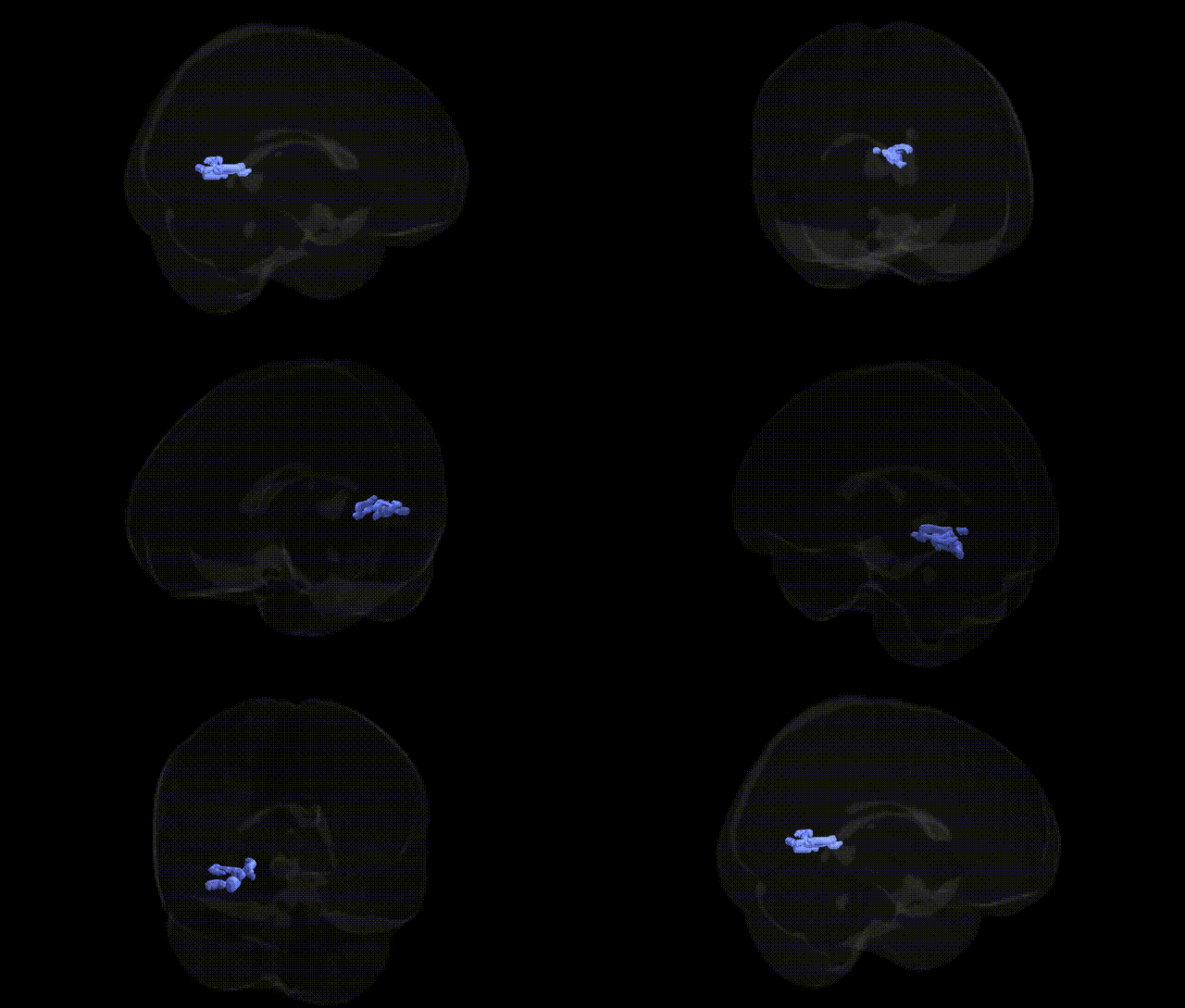
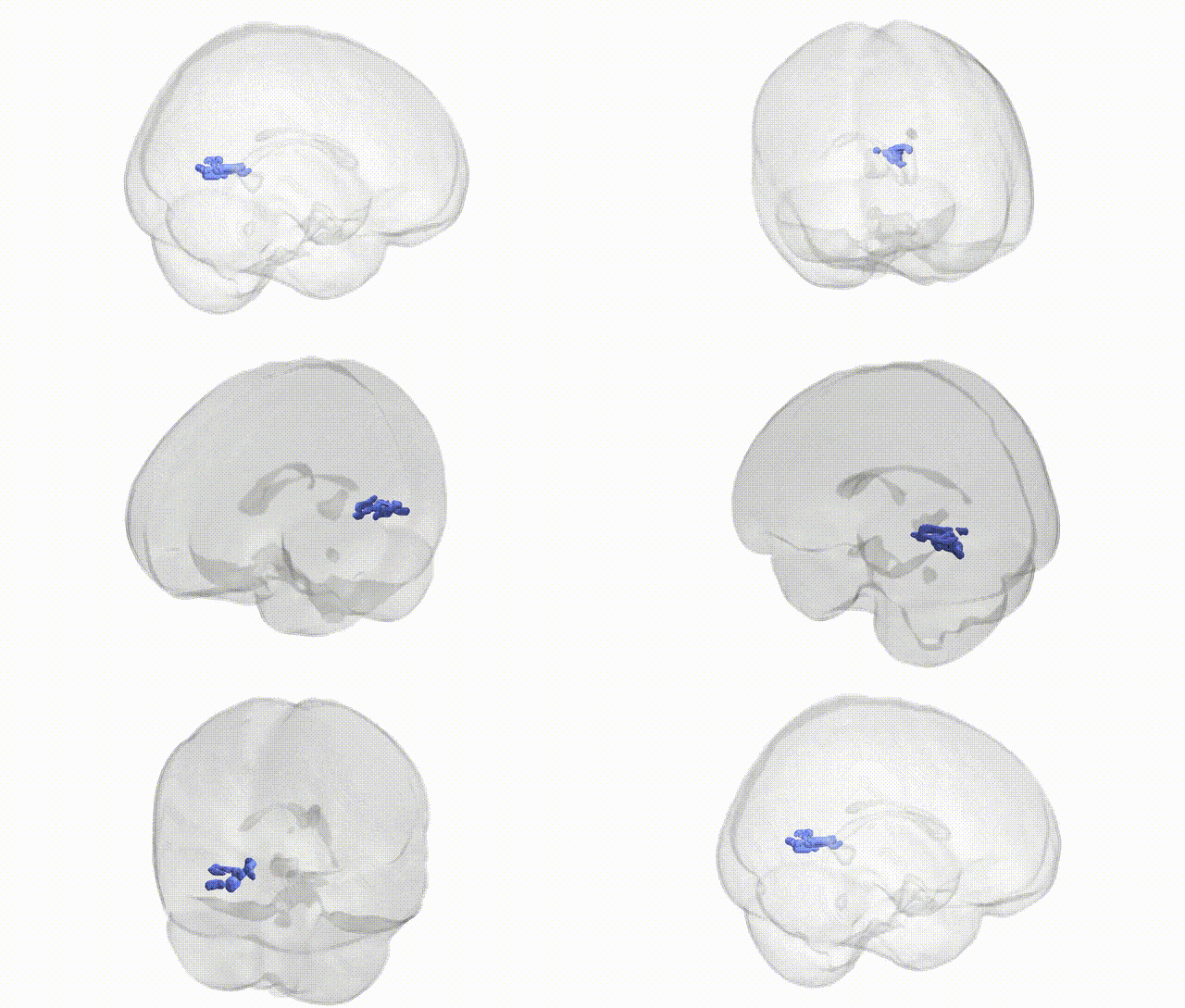
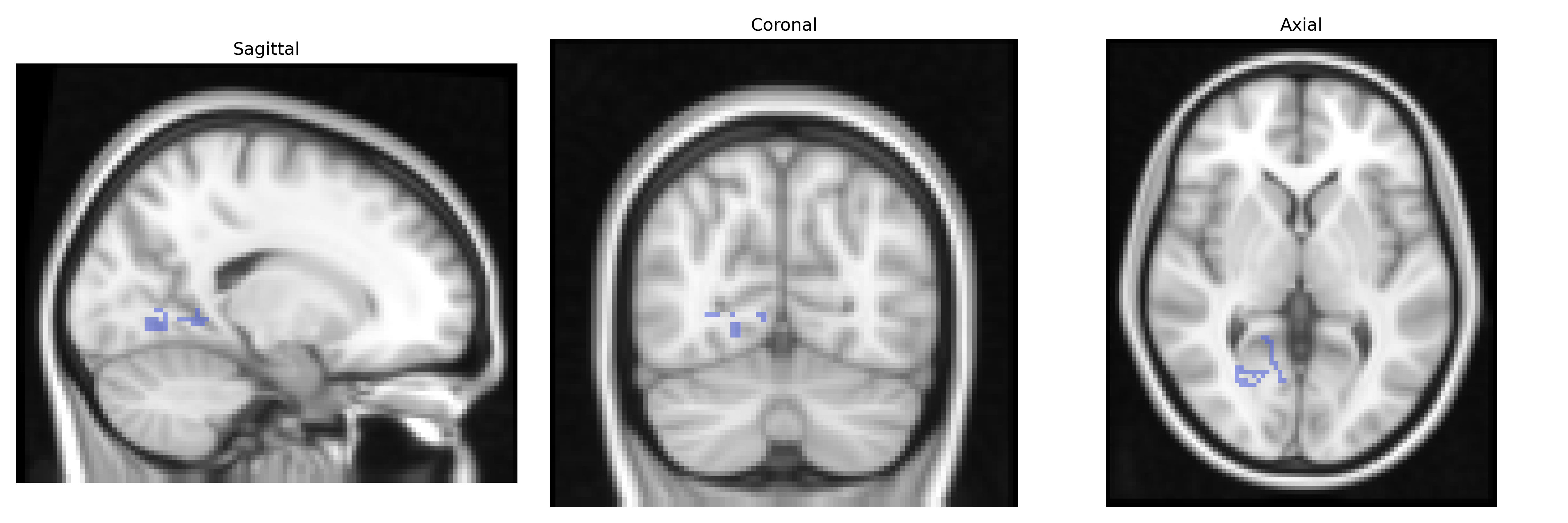
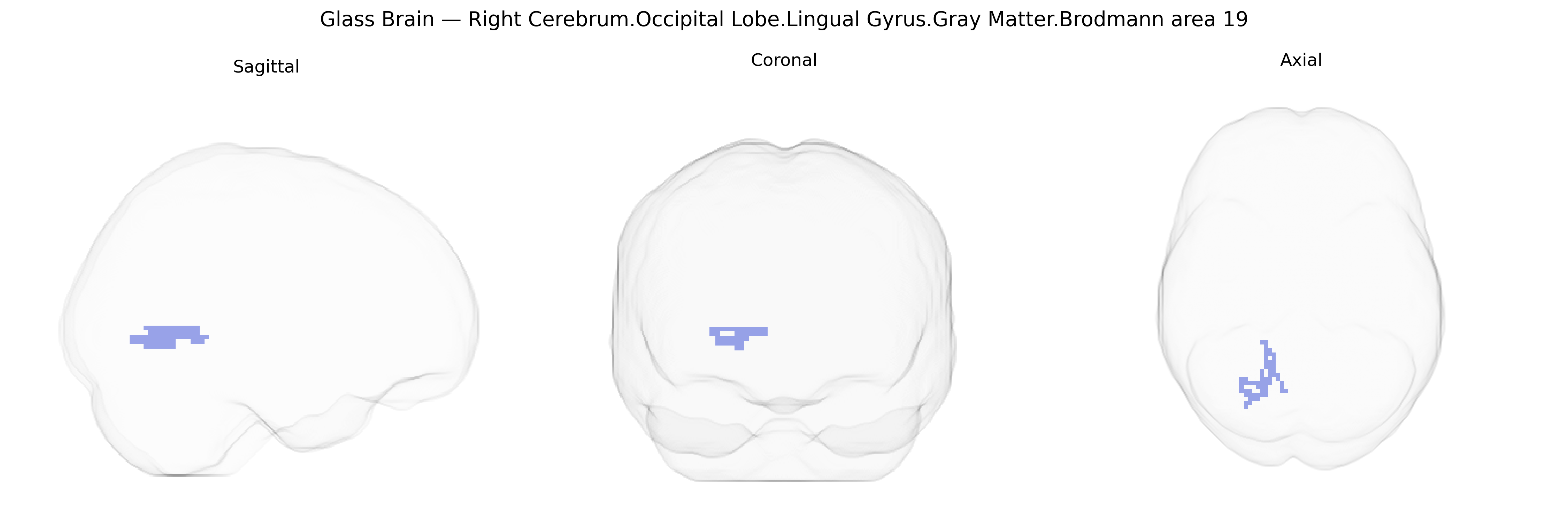
The bilateral Right Cerebrum.Occipital Lobe.Lingual Gyrus.Gray Matter.Brodmann area 19 corresponds to a higher-order visual association cortex located in the medial occipital lobe, within the gray matter of the lingual gyrus. As part of Brodmann area 19, it participates in the integration and interpretation of complex visual information, including object form, color processing, and aspects of visual memory, receiving inputs from primary and secondary visual areas and projecting to multimodal association regions. This region contributes to the construction of coherent visual perception and is implicated in functions such as visual scene analysis and recognition. There is no direct Wikipedia article for this exact Talairach-defined region; a closely related structure is Brodmann area 19.
The bilateral right lingual gyrus gray matter in Brodmann area 19 (occipital association cortex) has been implicated in genetic studies primarily through imaging genetics and GWAS of brain structure and visual–cognitive traits rather than region-specific single-gene effects. Large MRI-based GWAS have shown that common variants influence occipital and lingual gyrus cortical thickness and surface area, with notable contributions from loci near genes involved in neurodevelopment and synaptic function (e.g., variants in or near PAX6, FGFR genes, and general neurodevelopmental loci identified by ENIGMA and UK Biobank consortia), though effects are typically diffuse across visual association cortices rather than restricted to Brodmann area 19. Functional and structural imaging genetics studies link this region to GWAS-identified risk variants for schizophrenia, bipolar disorder, and major depression, which often show altered occipital and lingual gyrus volume or activation; polygenic risk scores for these disorders correlate with patterns of visual associative cortex structure and connectivity. Visual-processing traits—such as reading and dyslexia, face and object recognition, and visuospatial abilities—have also been associated with genetic variation that influences activation and morphology of BA19/lingual gyrus, including loci near KIAA0319 and DCDC2 in dyslexia and more distributed polygenic effects for general cognitive ability. Additionally, GWAS of migraine, especially visual aura migraine, and photosensitivity have indirectly implicated occipital visual association regions including BA19 through genotype-dependent differences in visual cortex excitability, although specific lingual gyrus–focused genetic associations remain limited and largely reflect the broader, polygenic architecture of visual cortex structure and function.
Overview generated by GPT-4o (2026).
Region ID: 418
Hemisphere: bilateral
Atlas: Talairach labels 2mm
Full Quality Version: Download MP4
Full Quality Version: Download MP4
Wali Sidiqyar*, Gaurav Rudravaram*, Elyssa M. McMaster, Trent M. Schwartz, Adam M. Saunders, Kurt G. Schilling, Bennett A. Landman "Introducing SPINS: A Shared Public Visualization Library of Neuroanatomical Structures." Medical Imaging with Deep Learning- short paper
This resource is licensed under CC0 1.0 Universal (Public Domain).