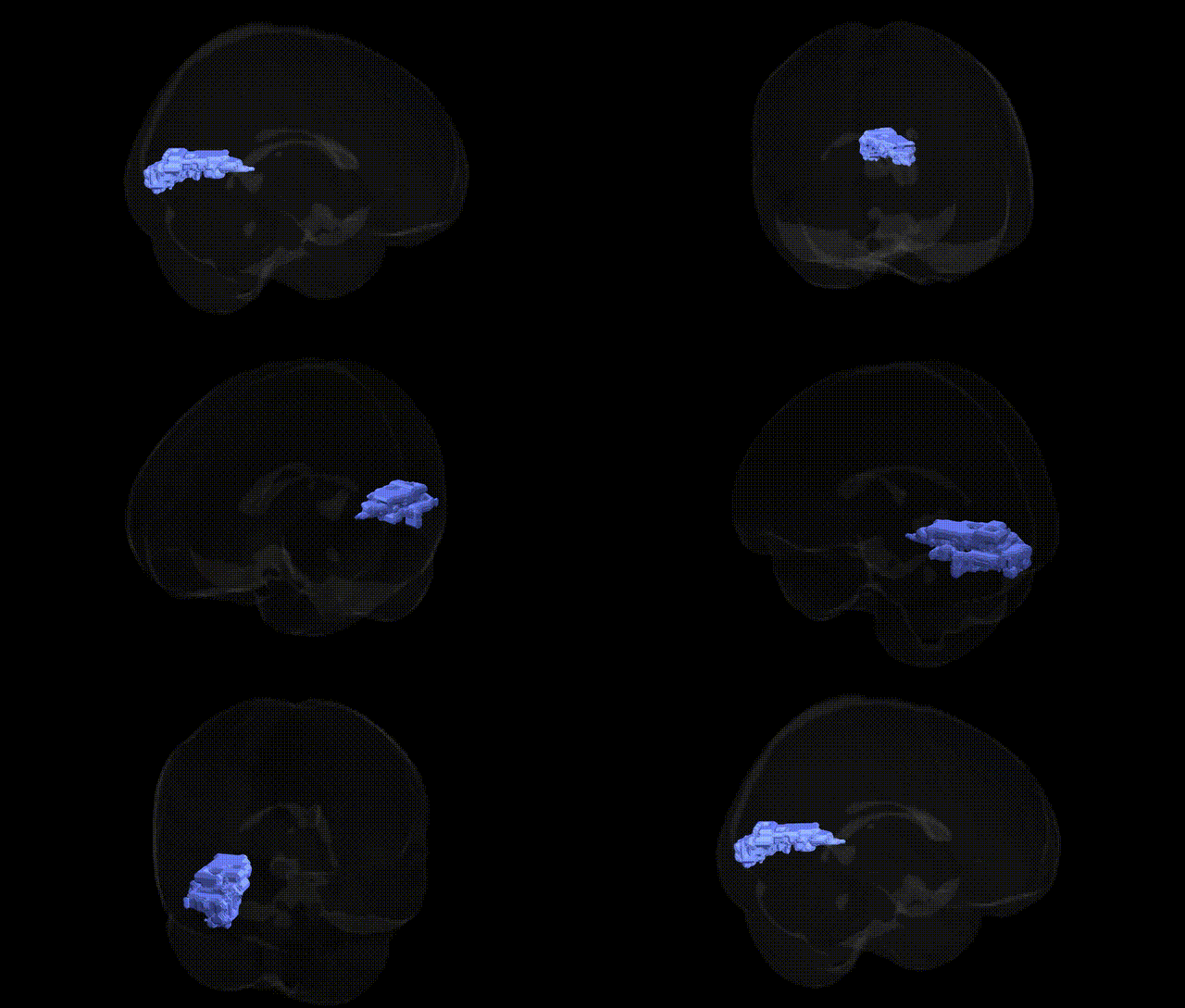
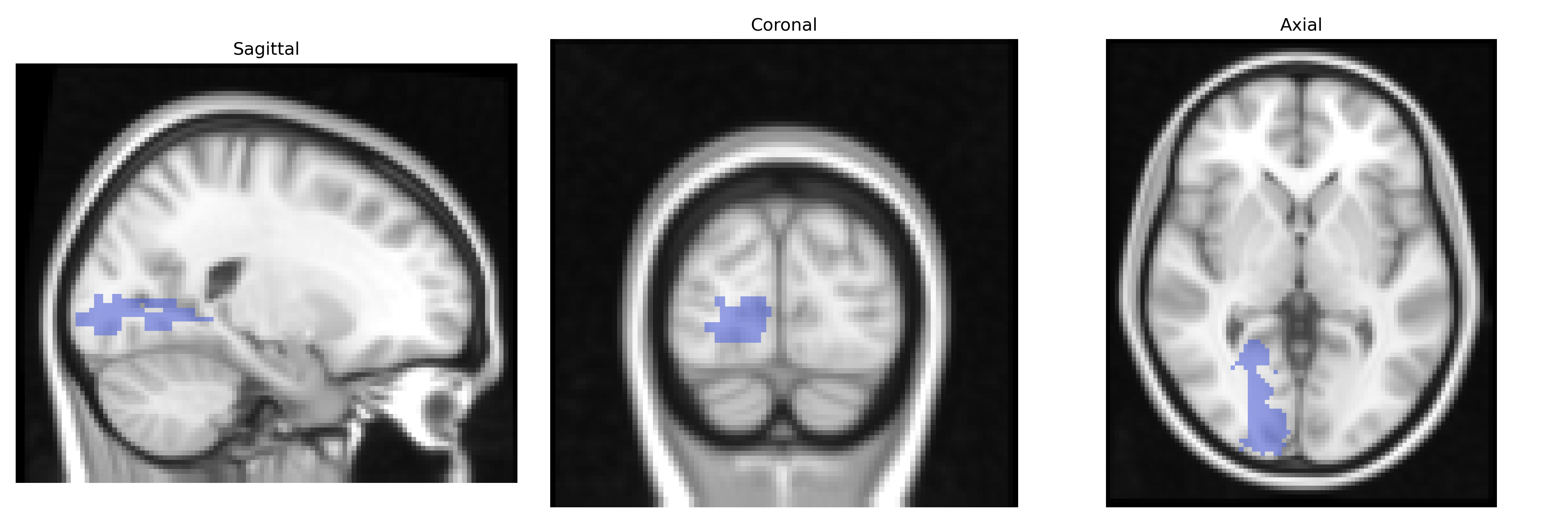
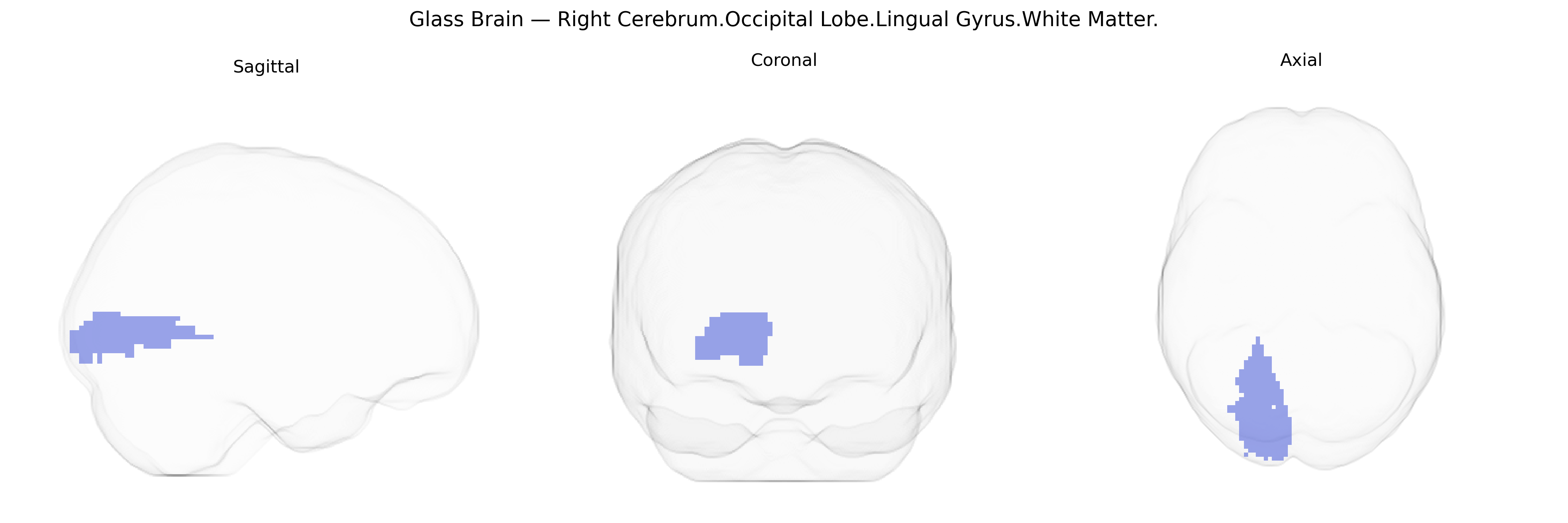
The bilateral Right Cerebrum.Occipital Lobe.Lingual Gyrus.White Matter corresponds to the subcortical myelinated fiber tracts underlying the lingual gyrus in the occipital lobe of the right cerebral hemisphere, involved primarily in visual processing networks. These white matter pathways include short association fibers that connect the lingual gyrus with adjacent occipital cortices and longer association fibers that contribute to ventral visual stream connections toward temporal regions, supporting functions such as complex visual pattern recognition and aspects of visual memory. While there is no direct Wikipedia article for this specific white matter subdivision, it is structurally and functionally related to the cortical Lingual gyrus.
The bilateral right cerebrum occipital lingual gyrus white matter (Talairach 2 mm Atlas) corresponds largely to occipital white-matter tracts supporting visual processing, especially aspects of visual recognition and integration. Genetic imaging studies and GWAS do not typically isolate this specific Talairach-defined region but have implicated overlapping occipital/lingual cortex and associated white matter in several traits and disorders. Polygenic influences on occipital white-matter microstructure are supported by large diffusion MRI GWAS, which identify variants near genes involved in axon guidance, myelination, and synaptic development (for example, loci near CNTN4, NRG1, MAG, and genes regulating oligodendrocyte function) as contributing to fractional anisotropy and mean diffusivity in occipital tracts. Lingual/occipital regions and their underlying white matter show heritable variation and have been linked to neurodevelopmental and psychiatric conditions, including schizophrenia, autism spectrum disorder, and major depression, primarily through case–control imaging–genetics studies where risk alleles (such as in CACNA1C, ZNF804A, and common complement system variants) associate with altered occipital activation or connectivity. Visual system white matter integrity in this territory is also associated with genetic risk for multiple sclerosis and other demyelinating conditions, with HLA region variants and genes affecting immune regulation contributing to lesion burden and microstructural damage seen in occipital pathways. In addition, genome-wide studies of cortical surface area and thickness have identified polygenic influences on occipital and lingual cortices (including variants near PAX6, TBR1, and other neurodevelopmental transcription factors), which indirectly reflect developmental constraints on their underlying white matter organization. Overall, genetic associations for this specific Talairach-defined white-matter region are inferred from broader occipital and visual pathway imaging–genetic findings rather than from studies targeting the bilateral right lingual gyrus white matter alone.
Overview generated by GPT-4o (2026).
Region ID: 253
Hemisphere: bilateral
Atlas: Talairach labels 2mm
Full Quality Version: Download MP4
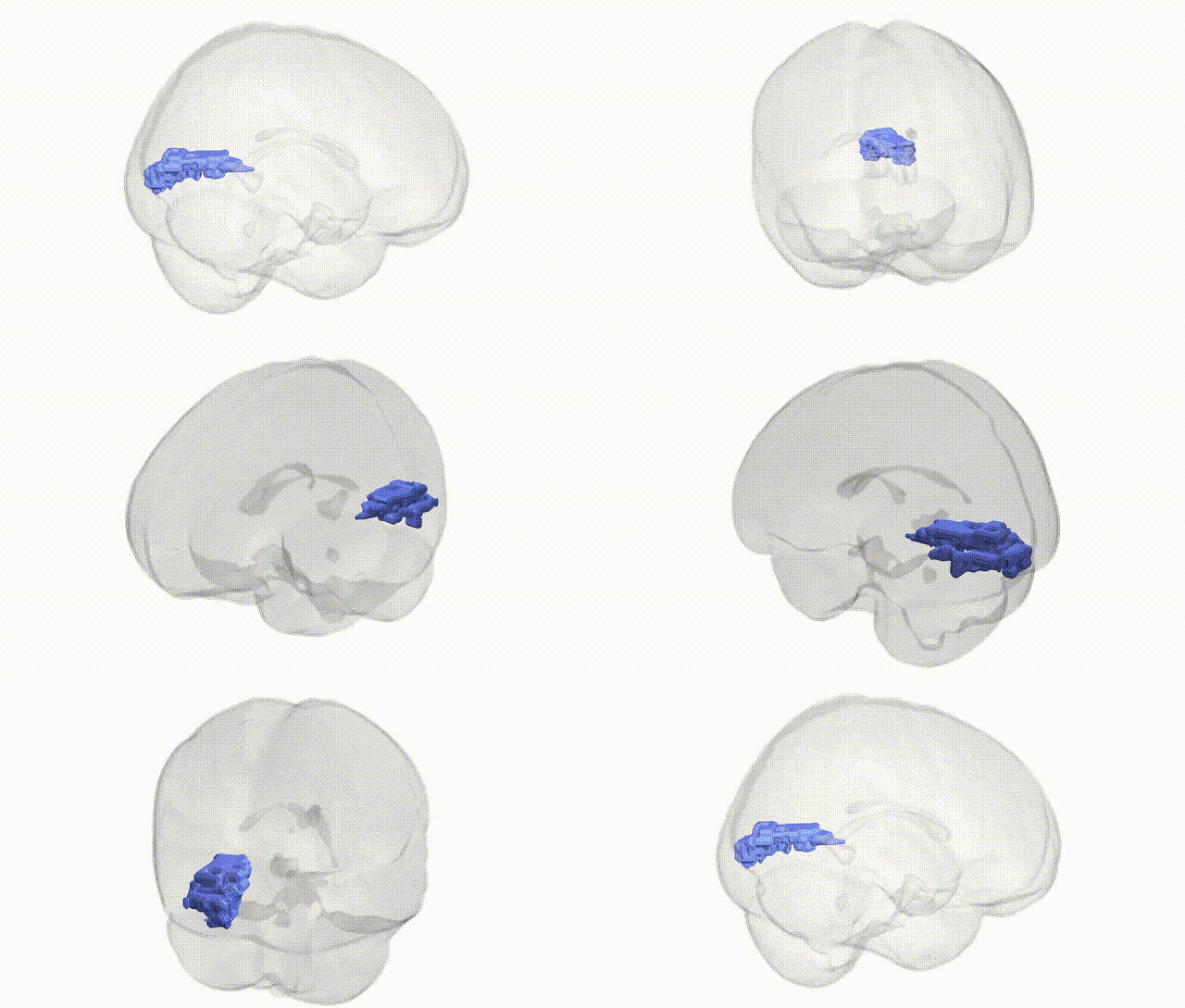
Full Quality Version: Download MP4
Wali Sidiqyar*, Gaurav Rudravaram*, Elyssa M. McMaster, Trent M. Schwartz, Adam M. Saunders, Kurt G. Schilling, Bennett A. Landman "Introducing SPINS: A Shared Public Visualization Library of Neuroanatomical Structures." Medical Imaging with Deep Learning- short paper
This resource is licensed under CC0 1.0 Universal (Public Domain).